CPT Code 69610: Tympanic membrane patch repair (myringoplasty)
CPT code 69610: official descriptor and procedure overview CPT code 69610 descri...

Last Updated: Oct 19, 2026
CCSD code B2983 is the UK private billing code for a mastectomy with immediate free TRAM flap reconstruction in one operation. The descriptor is precise. The catch is that many insurers have stopped using it. Bupa’s and The Exeter’s current schedules code free TRAM reconstruction as B2985, whether it’s immediate or delayed.
For a billing team, that means a clinically perfect claim can still bounce. Below, we’ll cover what the code means, how the claim moves from pre-authorization to payment, and what to check before you submit.

CCSD code B2983 covers a mastectomy with immediate breast reconstruction using a free TRAM flap, in a single operation.
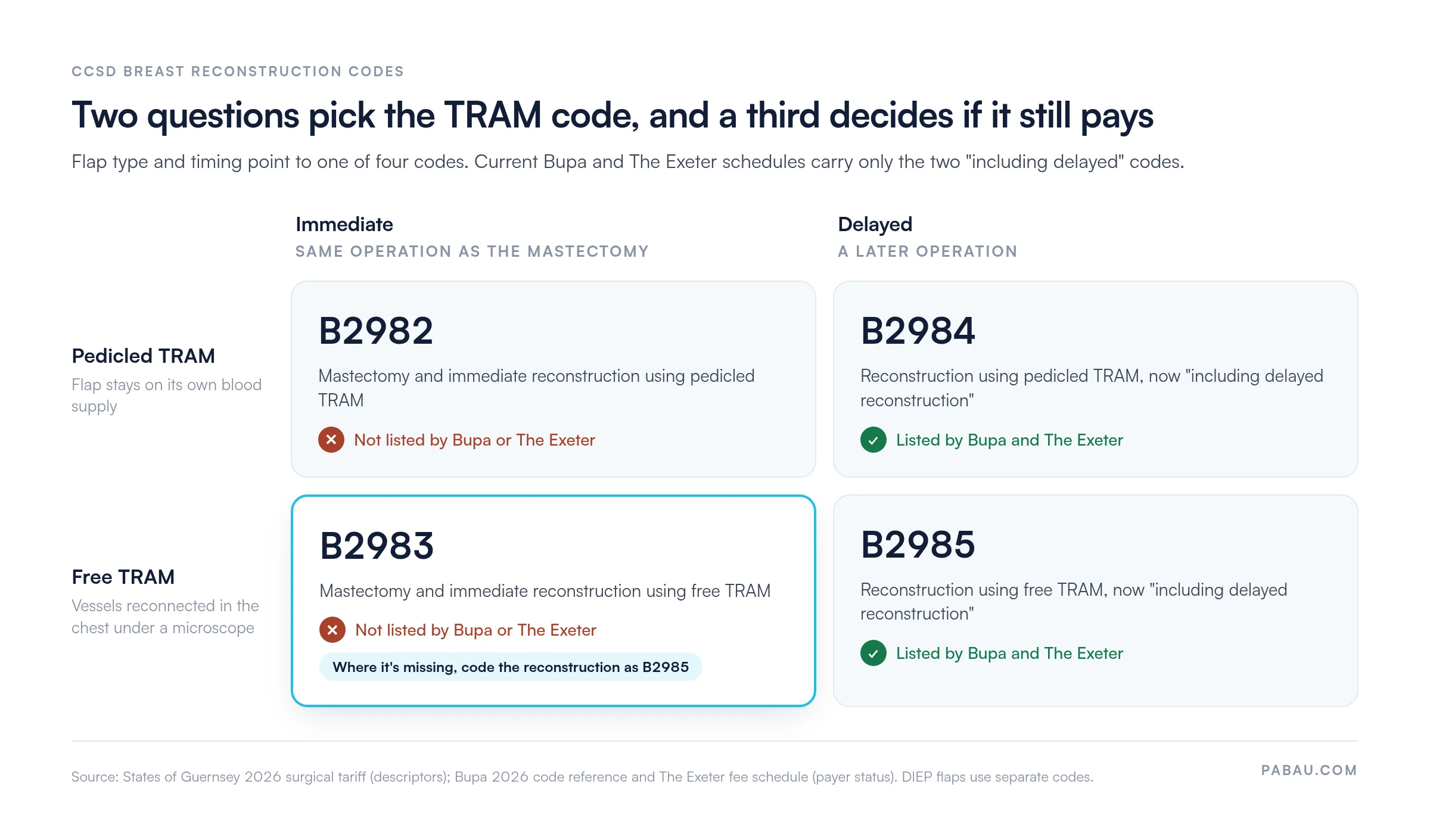
Its neighbors are B2982 (immediate pedicled TRAM), B2984 (delayed pedicled TRAM) and B2985 (delayed free TRAM).
Current Bupa and The Exeter schedules fold immediate and delayed free TRAM into B2985, so check B2983 is still accepted.
A stacked DIEP flap reconstruction is a different procedure with its own codes, so never bill it as B2983.
Claims need an operative note naming the free flap, the same-session mastectomy, laterality, the indication and a pre-authorization reference.
CCSD code B2983 is the code for “mastectomy and immediate reconstruction of breast using free TRAM.” That wording comes from the States of Guernsey 2026 surgical tariff, which still publishes the code with that descriptor.
CCSD stands for Clinical Coding & Schedule Development. It is the UK body that maintains procedure and diagnostic codes for private healthcare across every specialty. Its member insurers are Aviva, AXA Health, Bupa and Vitality. The group sets codes and descriptors, while each insurer sets its own fees.
Within the schedule, B2983 sits in the breast section, inside a run of reconstruction codes. That run separates the flap type (pedicled or free) from the timing (immediate or delayed). If you’re new to the schedule, our guide to CCSD codes explains how it’s organized.
Both of those choices change the code, so they’re worth unpacking before you touch the claim.
Two details decide the code: how the flap gets its blood supply, and when the reconstruction happens.
A TRAM flap uses skin, fat and part of the rectus abdominis muscle from the lower abdomen to rebuild the breast. In a free TRAM, the surgeon detaches the tissue completely. Its blood vessels are then reconnected to vessels in the chest under a microscope.
A pedicled TRAM skips that microvascular step. The flap stays attached to its original blood supply and is tunneled up to the chest. That’s why it has its own code, B2982. Delay that pedicled rebuild to a second operation and the claim moves to B2984.
Timing is the second split. B2983 is the immediate version, where the reconstructive surgeon builds the new breast under the same anesthetic as the mastectomy. A reconstruction at a later operation takes a delayed code instead. Which delayed code applies depends on the technique, so a later rebuild with an expandable prosthesis is coded B3014.
The grid below shows how the two answers combine, and which codes current payer schedules still carry.
With the clinical picture settled, here’s the reference data for B2983 in one place. Fees are set by each insurer, so check the payer’s own schedule at the time of the claim.
Many insurers no longer list B2983 at all. The older CCSD structure used four TRAM codes, one for each mix of flap type and timing. Newer insurer schedules have folded the immediate codes into the delayed ones, which now read “including delayed reconstruction.”
In practice, an insurer that no longer recognizes B2983 will usually expect the free TRAM reconstruction under CCSD code B2985. Ask the insurer how it wants the mastectomy itself coded, because that differs between payers.
Some online sources describe B2983 as a stacked DIEP reconstruction. That descriptor doesn’t match any published schedule we checked. In Bupa’s 2026 reference, stacked DIEP reconstructions sit under B2993 and B2999, and a single DIEP flap is B2986.
The difference is easy to spot on paper. A DIEP flap spares the rectus muscle, while a TRAM flap takes part of it. The operative note should make the flap type obvious, because that single detail decides the code.
Before you submit B2983, look it up in the insurer’s own code search. If the code is missing, code the reconstruction as B2985 and ask the insurer’s provider team how to code the mastectomy.
Pre-authorization comes first. Most UK private insurers expect it before a mastectomy with immediate flap reconstruction. Operating without it puts the whole claim at risk. From there, the claim follows the same path each time.
Here’s how the first checkpoint plays out. A Bupa patient is booked for a left mastectomy with an immediate free TRAM. The surgeon’s letter lists B2983, but Bupa’s code search doesn’t.
So the billing team requests approval for B2985 and asks the provider team how to code the mastectomy. The approval, the operation and the claim now carry the same code.
Each insurer keeps its own list, so bookmark these places to check.
Insurers review major reconstruction claims closely, and most ask for records before they pay. Tick off each item below before the claim leaves the practice.
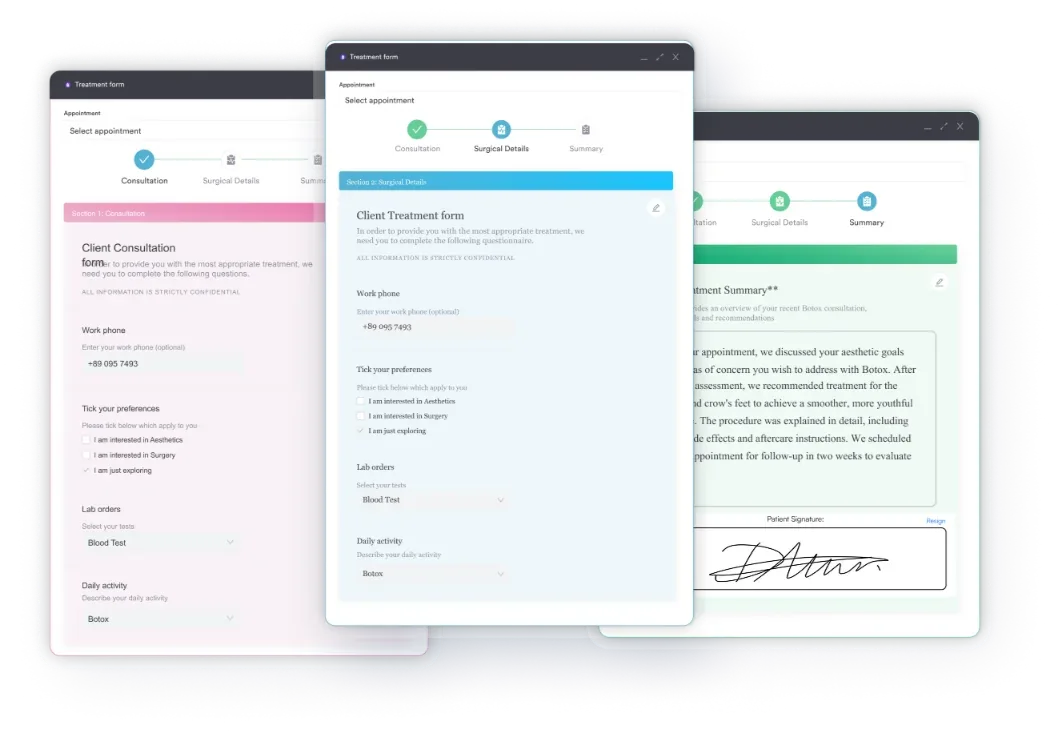
Practice management software like Pabau keeps these records in one patient file, so the claim is ready when the insurer asks. Digital consent and intake forms also remove the risk of an unsigned or missing page.
Even with a clean file, a few mistakes keep coming back on this code. Most of them start before the operation, which is also where they’re easiest to fix. The table pairs each pattern with the step that prevents it.
A reconstruction claim passes through several hands, from the surgeon’s operative note to the billing team’s submission. A missing reference or a retired code at any step sends it back.
Pabau’s claims management software pre-fills the claim from the patient record. It also checks required fields, such as membership numbers and authorization codes, before you can send it.
For UK private insurers, Pabau’s Healthcode integration submits CCSD-coded claims straight from the patient record. If an insurer rejects one, you correct the code in one place and resubmit.

Pabau pre-fills insurer claims from the patient record and checks required fields before sending. Book a demo to see CCSD claims submitted through Healthcode.

With B2983, the operative note usually settles the clinical side of coding. Free or pedicled, immediate or delayed, it’s all on the page. The harder question is whether this insurer still recognizes the code.
So make the insurer’s code search your first step, not your last. Confirm the code at pre-authorization, and the claim you send after surgery will match the approval you already hold.
Book a demo to see Pabau keep the operative note, approval reference and CCSD claim in one record, ready for Healthcode.

Billing a delayed free TRAM reconstruction? CCSD code B2985 covers free TRAM reconstruction, including delayed cases, on current insurer schedules.
Reconstructing with an expander instead of a flap? CCSD code B3012 explains mastectomy with immediate expandable prosthesis reconstruction.
Need the full list of breast reconstruction codes? Bupa CCSD codes guide sets out the surrounding codes and how Bupa uses them.
Checking how Bupa sets fees? Bupa procedure code fee schedule explains how fees apply across procedure codes.
No. CCSD codes are for private healthcare billing in the UK. NHS hospitals record procedures with OPCS-4 codes, so an NHS free TRAM reconstruction never carries B2983.
Usually, yes. UK private insurers typically pay anesthetists against the same CCSD procedure code as the surgeon. Keep both claims on one code, B2983 or B2985, so the insurer doesn’t query a mismatch.
No. B2983 covers the mastectomy and the free TRAM reconstruction in one operation. Later stages, such as nipple reconstruction or revision surgery, are separate procedures with their own CCSD codes.
It depends on the policy. Reconstruction after breast cancer surgery is often covered, but terms vary between insurers and plans. Confirm benefits at pre-authorization, before the operation is booked.
There’s no single fee. CCSD sets codes and descriptors, and each insurer publishes its own fee schedule. If the insurer has retired B2983, look up the fee listed against B2985 instead.