CPT code 21011: Excision of soft tissue tumor of the face
CPT code 21011: Official descriptor and procedure overview CPT code 21011, as pu...

Last Updated: Oct 8, 2026

CPT code 19367 covers breast reconstruction with a single-pedicle TRAM flap, including closure of the donor site.
Laterality modifiers RT and LT are required on every unilateral claim, and modifier -62 applies when two surgeons operate together.
Code 19368 adds a microvascular anastomosis to a single pedicle, while 19369 is the bipedicled TRAM flap.
Medicare covers 19367 as medically necessary after mastectomy, and the Women’s Health and Cancer Rights Act mandates group health plan coverage.
Practice management software like Pabau tracks prior authorizations and modifier rules, so fewer 19367 claims come back denied.
CPT code 19367 covers breast reconstruction with a transverse rectus abdominis myocutaneous (TRAM) flap, single pedicle, including closure of the donor site. It applies after mastectomy, when abdominal skin, fat, and one rectus abdominis muscle are moved to rebuild the breast mound.
This guide covers everything a biller needs for a clean 19367 claim. That means the descriptor, modifiers, Medicare reimbursement, and ICD-10 pairings. It also covers coverage rules, documentation standards, the anesthesia crosswalk, and the neighboring codes people confuse it with.
Reconstructive practices that keep charting and billing in one system catch most of these problems earlier. Purpose-built plastic surgery EMR software ties the operative note to the claim, so nobody re-keys clinical detail into a billing screen.
CPT code 19367 applies when a surgeon rebuilds the breast with a TRAM flap on a single pedicle. The American Medical Association maintains the CPT code set. It defines the procedure as the harvest and transfer of abdominal skin, fat, and rectus abdominis muscle.
That tissue travels on one vascular pedicle to form the breast mound. Donor site closure is included in the code and is never billed separately.
The single-pedicle designation drives code selection. CPT code 19367 requires one vascular pedicle connecting the flap to the abdominal blood supply. If the surgeon adds a microvascular anastomosis to improve perfusion of that single pedicle, the claim moves to 19368.
Coders and surgeons usually call this supercharging. When both rectus abdominis muscles carry the flap, the bipedicled procedure is coded 19369. Billing 19367 for either variant is a coding error that payers routinely catch on audit.
Modifier selection is one of the most common sources of denial on this claim. Most payers require a laterality modifier. Co-surgery and assistant surgeon modifiers have to match the operative arrangement described in the record.
Medicare requires laterality modifiers on all unilateral procedures. A 19367 claim submitted without RT or LT will be rejected by most Medicare Administrative Contractors (MACs). The AAPC’s CPT code reference carries further modifier guidance and the bundling edits for this code family.
Medicare pays for this procedure using the Resource-Based Relative Value Scale (RBRVS). The CMS Physician Fee Schedule publishes updated rates each January.
The figures below are national averages. Check them against the current-year schedule and your own locality adjustment before you quote a number.
CPT code 19367 is a major surgical procedure, so the 90-day global period applies. Anything rendered inside that window is bundled into the primary payment. An unrelated E&M visit is payable only when a separate diagnosis supports it.
Run the locality adjustment before you quote an expected payment. A practice in San Francisco sits well above the national geographic practice cost index, while rural practices often sit below it. The CMS Physician Fee Schedule lookup filters by MAC jurisdiction and state, which gives you the rate your contract will actually pay.
Medical necessity has to be supported by a paired ICD-10-CM diagnosis code. Most claims combine a reconstruction encounter code with an underlying history or active breast malignancy code. The table below lists the diagnoses paired most often.
Sequence Z42.3 as the principal diagnosis when the patient presents solely for reconstruction, and add Z85.3 to establish the underlying cancer history. When mastectomy and reconstruction happen in the same operative session, the malignancy code takes principal position.
The mastectomy itself is billed separately under a code such as CPT code 19305. Verify every diagnosis code against the current fiscal year tabular list, since CMS updates them annually.
Federal law mandates coverage of this procedure under most group health plans. The Women’s Health and Cancer Rights Act (WHCRA) of 1998 requires any plan that covers mastectomy to also cover the reconstruction. That includes reconstruction of the other breast for symmetry, prostheses, and treatment of physical complications. A clean claim carries the code, the modifiers and the diagnosis in agreement, and needs no rework before payment. A superbill form is not a claim form, but it carries the same data the patient insurer will ask for.
WHCRA reaches group health plans and group health insurance issuers. It does not reach every individual market plan, short-term plan, or grandfathered plan. Confirm the plan type before you assume the reconstruction is covered.
An expired authorization is the quietest way to lose payment on a case this size. Practices running plastic surgery practice management at scale attach authorization status to the booking. The surgery date and the authorization window then sit side by side.
Payer audits on this code focus almost entirely on the operative report. A claim with no laterality statement, no mention of pedicle type, or no donor site closure notes will not survive retrospective review. The report needs every element below.
Multi-surgeon cases need one more line: who performed which component. That sentence is what supports modifier -62 when the payer asks.
Reconstruction records rarely start in one place. The mastectomy date and pathology report often sit with the oncology or women’s health team.
Practices using OBGYN EMR software should share that history before the claim goes out. Oncology records are sensitive.
The anesthesia code that pairs with 19367 is 00402, which covers anesthesia for reconstructive procedures on the breast. Radical and modified radical breast procedures map to CPT code 00404 instead. The anesthesiologist bills this separately from the surgical claim.
Base units for 00402 are typically five, with time units added in 15-minute increments under the standard anesthesia formula.
Verify base units and modifier requirements against current ASA crosswalk data. Anesthesia modifiers such as QZ, AA, QK, and QX are payer-specific, so confirm the pairing with your anesthesia department before you submit split claims.
CPT code 19367 sits in a family of breast reconstruction codes, and picking the wrong member is a frequent, auditable error. The table below sets out what separates each one.
Two of these come up most often alongside 19367. Confirm which diagnosis codes support each one before submission, because LCD and NCD policies differ by payer.
Practices billing UK private medical insurers code from the CCSD schedule rather than CPT. On that schedule the free TRAM flap, which detaches completely and depends on microsurgical anastomosis, is CCSD code B2985.
Denials on this code cluster around a short list of causes. Every one of them is catchable with a review before the claim leaves the practice.
Most of these are pattern errors rather than one-off mistakes, which is why they respond well to automation.
Build a five-point pre-submission check for every 19367 claim. Confirm that RT or LT is present. Confirm the operative note says single pedicle. Confirm no separate donor site closure code is attached. Confirm the authorization number is on file. Confirm the ICD-10 sequence matches the encounter type. Running this before submission is the cheapest way to cut TRAM flap denials.
TRAM flap reconstruction is one of the most documentation-heavy procedures in surgical billing. A single claim ties together a high-value code, a mandatory modifier, and ICD-10 sequencing logic.
It also depends on a 90-day global period and an authorization that is still valid. Miss one layer and the practice absorbs a denial plus a resubmission cycle.
Practice management software like Pabau brings those layers into one workflow. You can attach 19367 to a procedure type and set the RT and LT prompts that have to be answered. The claim then links straight to the operative note in the clinical record.
Authorization status shows up in the scheduling and billing views, so staff confirm it before the surgery date instead of discovering a lapse at submission.
Pabau’s claims management software then handles transmission and tracking. Every claim carries the same checks, which is what turns a five-point manual review into something the system does on its own.
High-volume reconstructive schedules benefit most from the checks running automatically. That cuts the manual review your billing team does by hand.
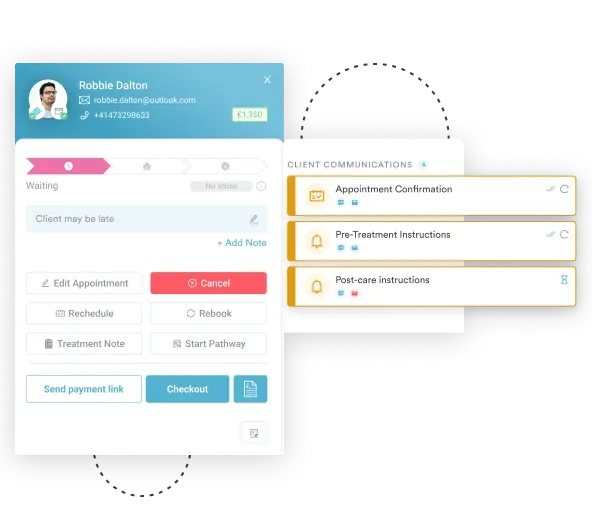

Pabau helps reconstructive practices track prior authorizations, prompt for the right modifiers, and link operative notes straight to the claim. See how it fits your billing workflow.

Getting 19367 right is a sequencing problem more than a coding one. Pedicle type, laterality, authorization, and ICD-10 order all have to be settled before the surgeon dictates. None of them can be fixed cleanly once the note is signed.
Practices that treat 19367 as a pre-operative checklist rather than a post-operative coding task field far fewer records requests. The shift costs nothing beyond the discipline of confirming five things before surgery day, and it protects a claim worth roughly 34 work RVUs.
Book a demo to see how Pabau connects operative notes, authorizations, and modifier rules for reconstructive surgery billing.

Monitoring flap perfusion after transfer? CPT code 15860 explains how to bill the dye injection used to test vascular flow in a flap.
Billing a free tissue transfer instead? CPT code 20970 covers the free osteocutaneous flap, including its own donor site rules.
Documenting a major donor site harvest? CPT code 20902 walks through the harvest detail payers expect on a large bone graft claim.
Coding a post-surgical tissue complication? ICD-10 code T86.828 covers the other complications of a skin graft and when to reach for it.
Billing breast brachytherapy alongside surgery? CPT code 19297 sets out the modifiers and documentation for device placement.
CPT code 19367 is the surgical code for single-pedicle TRAM flap breast reconstruction, including closure of the donor site. TRAM stands for transverse rectus abdominis myocutaneous. It applies to post-mastectomy reconstruction where abdominal tissue is harvested on one vascular pedicle to recreate the breast mound.
RT and LT are the modifiers required most often, because most payers including Medicare want laterality on the claim. Modifier -62 applies when two co-primary surgeons each perform distinct parts of the procedure. Modifier -80 covers an assistant surgeon. Modifier -22 fits an unusually complex reconstruction, supported by detailed operative documentation.
Payment is based on the current-year CMS Physician Fee Schedule and varies by geographic locality. The work RVU is approximately 34.0, which reflects the complexity of major flap reconstruction. Check the national and locality-adjusted rate in the CMS Physician Fee Schedule lookup, since rates are updated each January.
Yes, it is generally covered under the Women’s Health and Cancer Rights Act (WHCRA) for group health plans that cover mastectomy. Those plans must also cover reconstruction of the affected breast, reconstruction of the other breast for symmetry, and treatment of complications. WHCRA does not automatically extend to individual market plans, short-term plans, or grandfathered plans, so verify the plan type.
Both describe a single-pedicle TRAM flap. CPT 19368 is used when the surgeon adds a separate microvascular anastomosis to that single pedicle, a technique known as supercharging. Coders often assume 19368 covers the double pedicle. A bipedicled TRAM flap is coded 19369 instead, and it carries the highest work RVU of the three.
The operative report must record the indication for reconstruction, laterality, confirmation of single-pedicle technique, a description of flap harvest and transfer, and donor site closure. Most payers also want a prior authorization number and a letter of medical necessity. A missing element here is one of the most common reasons these claims are denied on records review.