CPT code 93503: Swan-Ganz catheter billing and modifiers
CPT code 93503: Official descriptor and procedure overview In the AMA CPT code s...

Last Updated: Oct 23, 2026
B2223 is the CCSD code for laparoscopic adrenalectomy – bilateral. It covers removal of both adrenal glands by keyhole surgery in one operative episode, through either the transperitoneal or the retroperitoneoscopic route.
B2223 sits in CCSD chapter 11 alongside five other adrenalectomy codes. Open bilateral removal is B2222, and robotic-assisted bilateral removal is B2224. Removing one gland takes B2232, B2233 or B2234 instead.
Let Pabau's smart automation suggest the right codes, reduce claim denials, and keep your practice compliant—effortlessly.
Automate repetitive tasks and focus on what matters most—your patients.
Reduce coding errors and ensure compliance with the latest regulations.
Clean claims, fewer denials, and faster reimbursements.
Powerful insights and reporting to help your practice thrive.
HIPAA compliant SOC 2 certified GDPR-compliant Trusted by 4,000+ clinics worldwide

CCSD Code B2223 applies only when both adrenal glands are removed laparoscopically in one operative episode. Open, robotic-assisted, and one-gland removals each take a different code.
The four most common indications are bilateral pheochromocytoma, MEN2, ACTH-independent bilateral macronodular adrenal hyperplasia, and Cushing disease refractory to pituitary surgery.
A unilateral ICD-10 diagnosis paired with B2223 is a common denial trigger, so the diagnosis must support bilateral disease.
Robotic-assisted bilateral adrenalectomy has its own code, B2224, so robotic cases should not be billed under B2223.
Pabau’s claims management software lets UK private practices put CCSD codes, ICD-10 diagnoses, and pre-authorization references on one claim, so fewer errors reach the insurer.
CCSD Code B2223 is the Clinical Coding and Schedule Development Group’s code for laparoscopic adrenalectomy performed bilaterally. It covers removal of both adrenal glands in one laparoscopic operative episode, by either the transperitoneal or the retroperitoneoscopic route. The code sits in chapter 11 of the CCSD schedule, which covers the abdomen, excluding urinary and reproductive organs.
B2223 belongs to a six-code adrenalectomy family. B2222, B2223 and B2224 cover bilateral removal by open, laparoscopic and robotic-assisted surgery. B2232, B2233 and B2234 cover the same three approaches when only one gland comes out.
Two conditions must both be true for B2223 to apply. First, both adrenal glands must be removed, not one gland with the other left in situ. Second, the whole procedure must be completed with conventional laparoscopic instruments. If either condition is not met, a different code from the family applies.
Bilateral laparoscopic adrenalectomy removes both adrenal glands with minimally invasive keyhole techniques. It usually happens in one continuous operating session and, less commonly, in staged episodes. The two main approaches are transperitoneal, through the abdominal cavity, and posterior retroperitoneoscopic adrenalectomy (PRA). PRA reaches each gland through the back without entering the peritoneum.
The approach matters for documentation rather than code selection. Both routes map to B2223, provided the procedure stays laparoscopic throughout. The operative note must still name the approach used on each side, because insurers use that wording to check the procedure against the submitted code.
Patients who have both adrenal glands removed become permanently adrenally insufficient, because they lose all their own cortisol and aldosterone production. Lifelong glucocorticoid and mineralocorticoid replacement starts straight after surgery. That permanence is why insurers treat the operation as irreversible and scrutinize the pre-authorization request so closely.
B2223 is reserved for conditions that require removal of both adrenal glands. The diagnosis must support bilateral disease, because a single-gland finding cannot justify a bilateral procedure code. The four main indications accepted by UK private medical insurers are listed below.
Adrenal cortical carcinoma that needs bilateral resection is a less common indication. When it applies, document pathological involvement of both sides in the pre-operative imaging and the MDT record.
The CCSD adrenalectomy family has six codes. Laterality sets the first split, one gland or both, and the approach sets the second: open, laparoscopic or robotic-assisted. Picking the wrong cell is the most preventable billing error in adrenal surgery, and the grid below shows where B2223 sits.
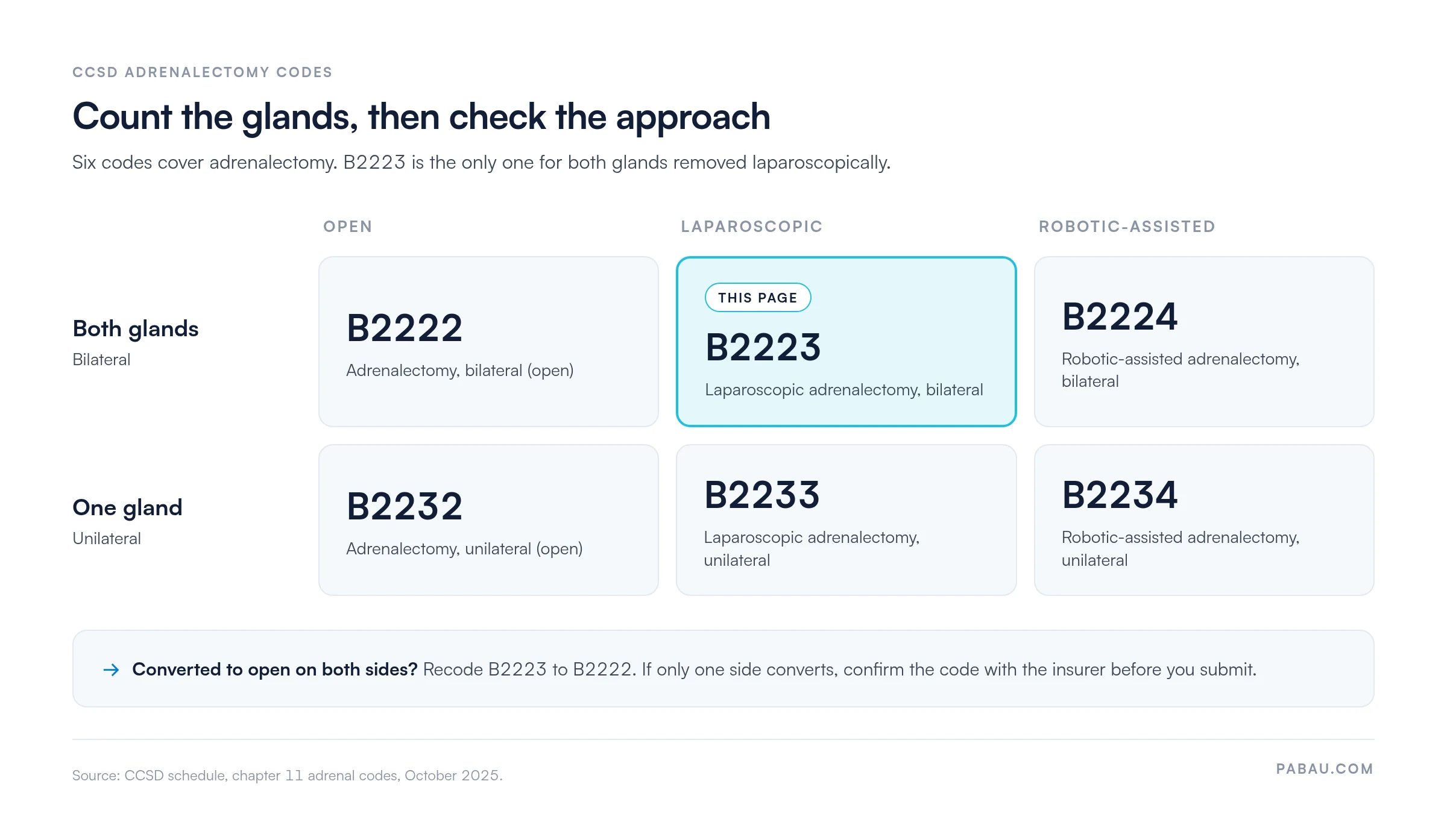
The table below maps each code, so coders can confirm the choice before submission.
If only one gland comes out, the claim moves to the unilateral codes: B2232 for open surgery, B2233 for laparoscopic and B2234 for robotic-assisted. Descriptors are revised from time to time, so check the live CCSD schedule before you submit.
For the wider coding framework, browse our CCSD billing guides or the Bupa CCSD codes walkthrough.
Every B2223 claim needs a matching ICD-10 diagnosis code that confirms the clinical reason for bilateral adrenal removal. The diagnosis must reflect bilateral or systemic disease. A single-gland tumor, such as D35.0 documented on one side only, paired with B2223 is likely to be denied by most insurers.
For UK ICD-10 lookups, the NHS Classifications Browser is the authoritative reference for the ICD-10 5th edition.
The operative note is the document insurers scrutinize most when they review a B2223 claim. An incomplete note is one of the most frequent reasons these claims are returned.
Private practice managers should build a structured operative note checklist into their pre-submission workflow. The wider principles of billing compliance set the documentation standards for every CCSD surgical claim.
Build a bilateral adrenalectomy operative note checklist and keep it in the operating room. Run through it before closing: bilateral removal confirmed in text, approach documented per side, specimen weights recorded, and no conversion event missed. The checklist takes under two minutes and heads off the most common B2223 denial triggers.
Bilateral laparoscopic adrenalectomy almost always needs pre-authorization from the patient’s insurer before surgery. Because the operation leaves the patient permanently adrenally insufficient, insurers treat it as a major, irreversible intervention and apply extra clinical scrutiny. Contact the insurer as soon as the decision to operate is made, ideally at least two weeks before the surgery date.
Each insurer has its own portal and timeline. Bupa uses its code search portal for procedure verification. AXA Health handles pre-authorization through its specialist forms portal. Aviva sets out its requirements in its practitioner fee schedule. Portals, required documents, and timelines differ, so never treat one insurer’s rule as universal.
B2223 claims draw close scrutiny because the code is procedure-specific, the clinical threshold is high, and the documentation is detailed. Effective denial management starts before the patient reaches the operating room, not after the claim comes back. The table below maps the most common denial triggers to the action that prevents each one.
When a laparoscopic bilateral adrenalectomy converts to open during the operative episode, the submitted code must change. B2223 covers laparoscopic bilateral removal only, so a change of approach means a change of code.
The recoding rule is less obvious in bilateral surgery, because conversion may affect one side or both. Apply these rules:
Robotic-assisted bilateral adrenalectomy has its own CCSD code, B2224, so robotic cases should be billed under B2224 rather than B2223. B2223 is for conventional laparoscopic removal of both glands. The unilateral family follows the same pattern, with B2234 for robotic-assisted removal of one gland.
Robotic systems such as da Vinci are increasingly used at specialist UK centers, and some insurers apply their own pre-authorization rules to robotic surgery. Name the planned approach in the request, for example “robotic-assisted bilateral adrenalectomy,” and quote B2224. That puts the insurer on notice before surgery and prevents a post-submission query that can add weeks to payment.
The operative note must then confirm that the robot was used on each side. A robotic note submitted under B2223, or a laparoscopic note under B2224, is a code mismatch the insurer will query.
Private practices submitting B2223 claims benefit from a standard pre-submission workflow. Each step below targets a common failure point in the medical billing process.
Submit B2223 claims within 30 days of the procedure date rather than waiting for the 90-day window. Early submission catches administrative errors while the operative note and pre-authorization details are fresh, and it keeps your practice’s cash flow predictable.
Many practices still assemble a B2223 claim by hand. Someone copies the code from the operative plan, looks up the diagnosis, and digs the pre-authorization reference out of an email. Each retyped field is another chance for a unilateral code or a missing reference to reach the insurer.
Pabau’s claims management software pulls the patient, treatment, and insurer details from the patient record into a pre-filled submission. You review it and send it to Healthcode without leaving Pabau. For insurers not on Healthcode, the claim goes out by email with the invoice attached.
Every claim then moves through clear stages: Pending, Submitted, Processing, and Paid or Error. A returned B2223 claim shows up straight away. Your team can then fix the code or attach the missing letter while the case is fresh.
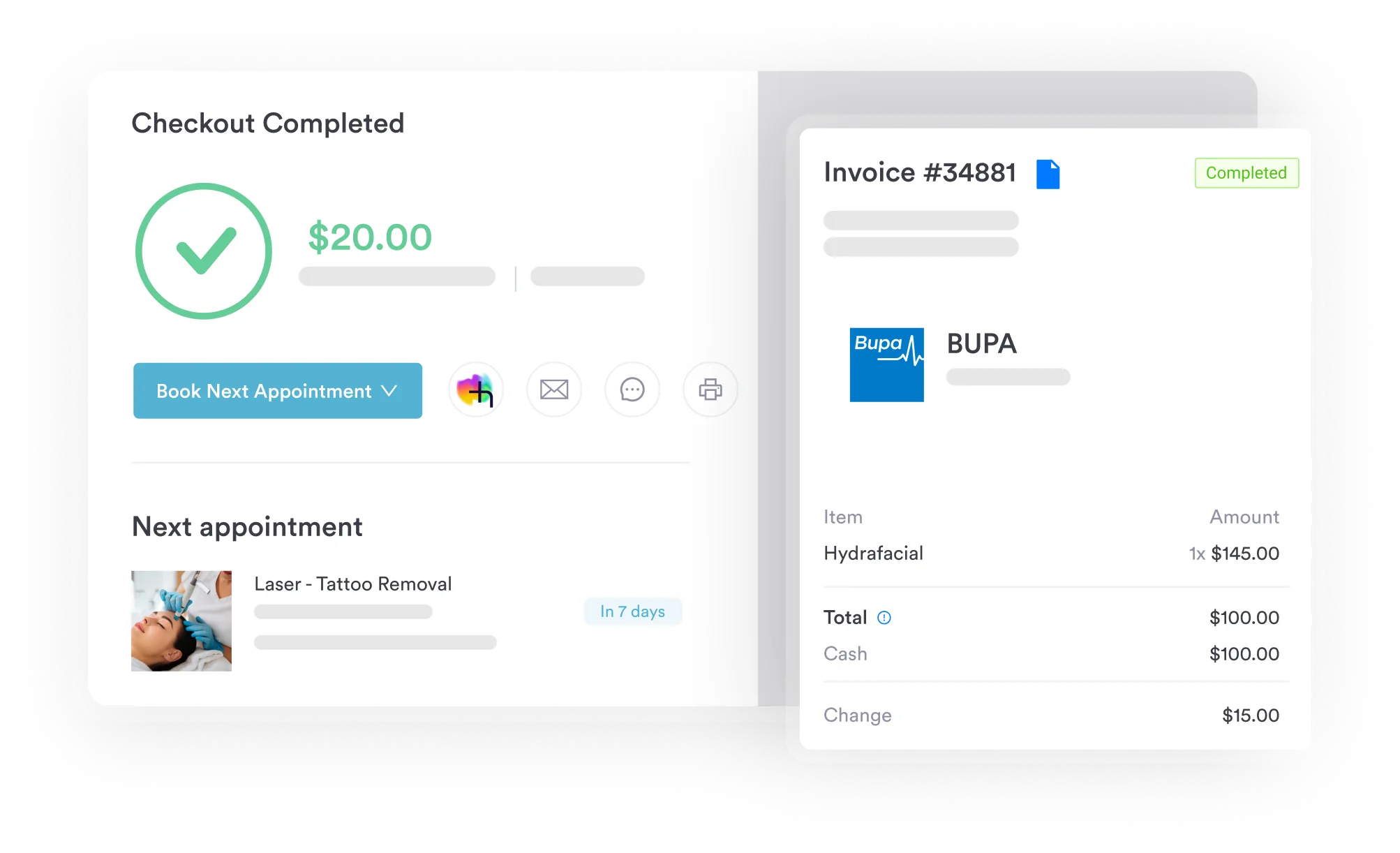

Pabau helps UK private practices attach CCSD procedure codes, ICD-10 diagnoses, and pre-authorization references to one digital claim record. That cuts the submission errors behind B2223 denials.

B2223 is only correct when the operative note proves two facts: both adrenal glands came out, and both sides stayed laparoscopic. If either fact is missing, the claim belongs to a sibling code, and the insurer will spot it before payment.
So settle the code before surgery rather than after a denial. Confirm laterality and approach with the surgeon, quote B2224 at pre-authorization if the robot is planned, and recheck the note for conversion before you submit. That routine takes minutes and protects a high-value claim that insurers check closely.
Book a demo to see how Pabau carries the code, diagnosis, and pre-authorization reference onto one clean B2223 claim.

Billing another bilateral endocrine operation? CCSD code B0820 is the billing guide for bilateral subtotal thyroidectomy in UK private practice.
Need the insurer fee before you quote a self-pay or insured patient? The Bupa procedure codes and fee schedule guide sets out how Bupa prices CCSD codes and where to look up each one.
Want to confirm a patient’s cover before you book surgery? Insurance eligibility verification walks through checking coverage before every visit, so a claim never starts on a lapsed policy.
Looking to cut the time spent writing operative notes? AI clinical documentation explains how AI drafts notes that still record the detail insurers check on a claim.
CCSD Code B2223 covers laparoscopic adrenalectomy performed bilaterally, meaning both adrenal glands are removed by keyhole surgery in one operative episode. It applies to both transperitoneal and posterior retroperitoneoscopic approaches, provided the procedure stays laparoscopic throughout.
B2233 covers laparoscopic removal of one adrenal gland, while B2223 covers laparoscopic removal of both glands in one episode. The approach is the same, so laterality decides the code. Billing B2233 when both glands were removed underpays the claim and can prompt an audit.
In practice, yes. Major UK private medical insurers expect pre-authorization for B2223 before surgery, because bilateral adrenalectomy is irreversible and complex. Contact the insurer at least two weeks before the surgery date with imaging, biochemistry, and the consultant’s clinical letter.
The ICD-10 diagnosis code must reflect bilateral or systemic disease. Common codes include E27.5 (pheochromocytoma), E24.0 (Cushing disease), E24.8 (other Cushing syndrome, including BMAH), and D35.0 (benign adrenal neoplasm, when both glands carry tumors). Never pair a unilateral tumor diagnosis with B2223.
No. Robotic-assisted bilateral adrenalectomy has its own CCSD code, B2224, so bill robotic cases under B2224 rather than B2223. Name the robotic approach in the pre-authorization request too, because some insurers apply separate approval rules to robotic surgery.
If both sides convert to open, recode as B2222 (open bilateral adrenalectomy). If only one side converts, document the hybrid approach and get written guidance from the insurer’s medical reviewer before submitting. No single CCSD code covers a mixed approach, and B2223 never stays on a fully converted case.