

CCSD code G5100: Bypass of duodenum billing guide
CCSD code G5100 bills a bypass that leaves the duodenum in place CCSD code G5100...

Last Updated: Oct 16, 2026
25012 is the CCSD code for a sacral root block performed under X-ray control. It covers an injection of local anaesthetic, a corticosteroid, or both at one or more sacral nerve roots, reached through the dorsal sacral foramen. The imaging is part of the code rather than an extra. A block performed without confirmed fluoroscopic guidance does not meet the descriptor.
The code sits in chapter 3 of the CCSD schedule, under section 3.3, paraspinal injections. Most refused claims trace back to a procedure note that never records the guidance used. The wording of that note decides whether the invoice is paid.
Let Pabau's smart automation suggest the right codes, reduce claim denials, and keep your practice compliant—effortlessly.
Automate repetitive tasks and focus on what matters most—your patients.
Reduce coding errors and ensure compliance with the latest regulations.
Clean claims, fewer denials, and faster reimbursements.
Powerful insights and reporting to help your practice thrive.
HIPAA compliant SOC 2 certified GDPR-compliant Trusted by 4,000+ clinics worldwide

CCSD code 25012 covers a sacral root block performed under X-ray control, and the imaging sits inside the descriptor.
The code belongs to chapter 3 of the CCSD schedule, under section 3.3, paraspinal injections.
A note that skips fluoroscopy and contrast confirmation gives the insurer grounds to refuse the claim.
Caudal epidural injection and the A5753 to A5756 nerve root block family are the codes billed by mistake most often.
Bupa, AXA Health, Aviva, Cigna and WPA all want pre-authorisation before the procedure date.
CCSD code 25012 covers a sacral root block performed under X-ray control. The published descriptor reads: Sacral root block (under X-ray control). Clinical Coding and Schedule Development (CCSD) publishes that wording, and the CCSD Group behind it represents Aviva, AXA Health, Bupa and VitalityHealth.
The words in brackets carry weight. Imaging is written into the descriptor, so it forms part of what the code describes. A sacral root block performed without confirmed fluoroscopic guidance does not meet that descriptor, and it cannot be billed as 25012.
Not every pain-block descriptor is written that way. CCSD code 25022 reads Stellate ganglion block (local anaesthetic) +/- Image Guidance, so imaging stays optional on that code. Reading the bracketed wording first tells you which descriptor demands imaging and which one leaves it to clinical judgment.
Position in the schedule matters too. The code sits in chapter 3, spine, spinal cord and peripheral nerves, under section 3.3, paraspinal injections. Its neighbours in that section are the codes it gets confused with. CCSD 25011 caps a paravertebral block at two levels, while 25012 carries no level limit.
CCSD codes are maintained by the Clinical Coding and Schedule Development group, and they form the procedure coding schedule used across UK private healthcare. Bupa, AXA Health, Aviva, Cigna, WPA and Vitality Health all reference them when they process claims and apply contracted fee schedules.
A sacral root block is a fluoroscopically guided injection at one or more sacral nerve roots. The needle reaches the root through the dorsal sacral foramen, usually at S1, S2, S3 or S4. What goes in is a local anaesthetic, a corticosteroid, or a combination of both.
The sequence below is where the documentation comes from. Each step leaves behind something the insurer expects to read later.
Steps two and four draw the most scrutiny on audit. A note that records needle insertion, with no word on fluoroscopy or contrast, will not satisfy the 25012 descriptor.
The block suits a patient whose pain or dysfunction traces to one or more sacral nerve roots, once conservative treatment has failed. These are the indications that come up most often in UK private practice.
Insurers query 25012 when the linked diagnosis does not justify a sacral-level injection. A lumbar diagnosis paired with a sacral root block is the classic mismatch. Where the primary diagnosis is broader, the note has to spell out the sacral involvement.
Miscoding is the second most common reason a 25012 claim fails, behind missing fluoroscopy documentation. Section 3.3 holds several codes for a needle going somewhere near the sacrum.
Only one of them describes this procedure, and the comparison below lines them up by target and by what each descriptor says about imaging.
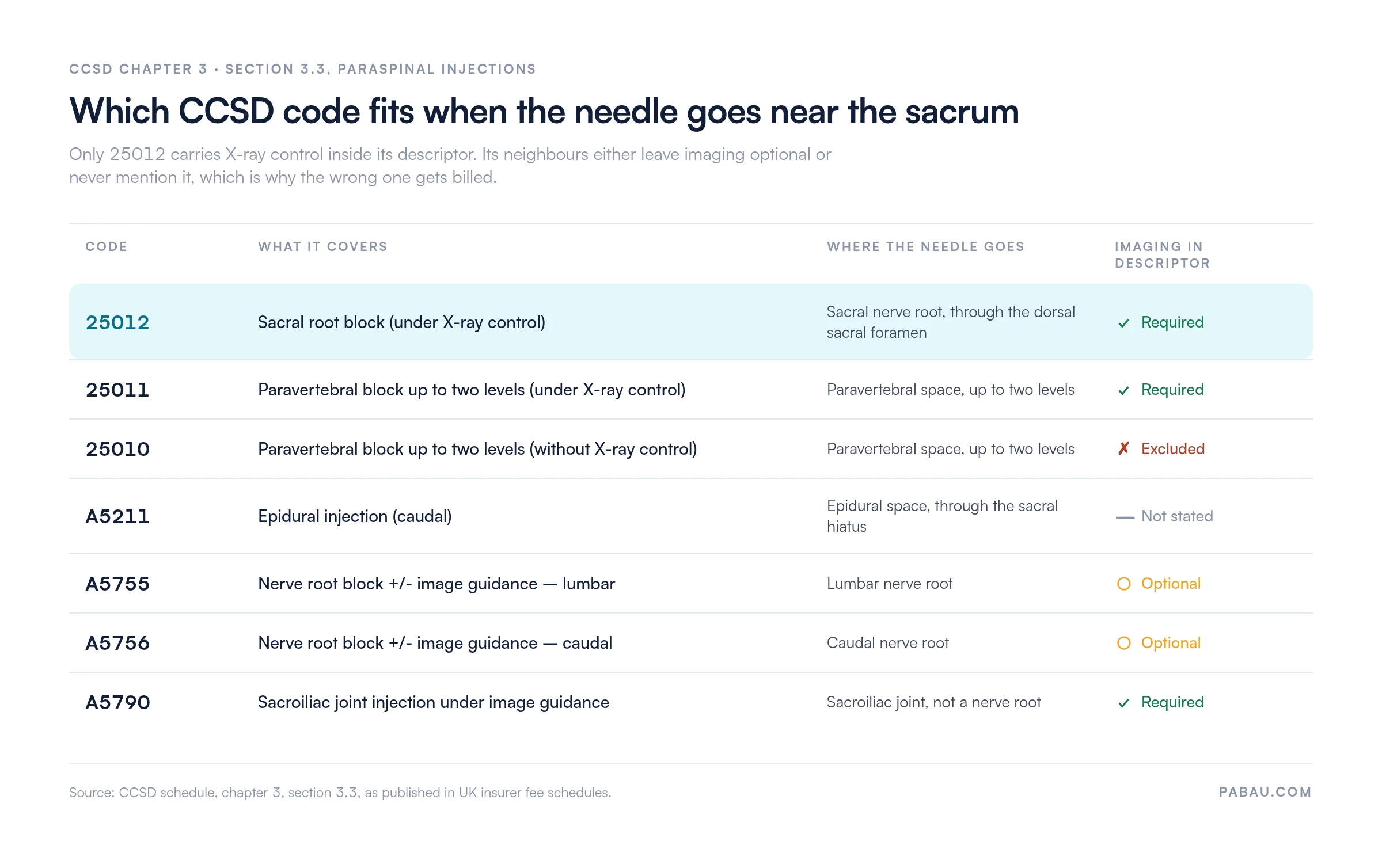
Two traps account for most of the miscoding.
Sacral nerve stimulation is a different job again. A7085 covers an implanted stimulator for incontinence or constipation, which is a device rather than a single injection. A dorsal root ganglion block is another neighbour worth knowing, coded CCSD 25120. Treat that same ganglion with radiofrequency rather than an injected agent, and the code becomes CCSD 25130.
That depends on who provided the guidance, and on the insurer processing the claim. Two scenarios cover almost all of it.
Ask each insurer before you split a claim. Some want a single combined invoice from the lead clinician, while others accept separate professional billing. Send a split claim to an insurer that wants one invoice, and you get a duplicate-billing rejection that takes weeks to unpick.
A complete procedure note is the main defence against a query or an audit. For 25012, six fields have to be in it. Miss one and the insurer has grounds to hold payment.
A structured template prompts for each field before the note can be finalised. Write it up from memory after the list instead, and one field usually goes missing. The denial letter then lands three weeks later.
Every major UK insurer treats a sacral root block as an interventional procedure that needs authorisation first. Go ahead without a valid pre-auth number and you risk partial or full non-payment. Retrospective approval is not something to count on.
Criteria and turnaround times move. Check each insurer’s provider portal before you submit, and keep a written record of what each one currently asks for.
Quote the CCSD code at pre-auth stage, not just the procedure name. An authorisation granted against a description rather than a code is the one most likely to be disputed later. The insurer can argue it approved a different procedure.
Rejections follow a short list. Practices that audit their own refusals usually find the same two or three causes coming back.
Patterns only show up when refusals are logged in one place. Claims management software that records each refusal against the code turns that review into a five-minute job. A spreadsheet rebuilt every quarter rarely gets it done.
Bilateral blocks in one session follow the insurer’s rules rather than a single CCSD convention. The schedule carries no bilateral modifier equivalent to the US modifier 50, so the three approaches below are all in use.
Agree the approach before the procedure where you can, or straight afterwards where the second side was unplanned. Submitting without that agreement gets the claim refused on technical grounds, even when the clinical record is complete.
The Clinical Coding and Schedule Development group sets the code and its narrative. It does not set what you get paid. Reimbursement comes from the contracted rate between your practice and each insurer, so two insurers can pay differently for the same code.
The schedule and its technical guide sit behind the official CCSD website. For codes already broken down in plain language, our CCSD codes index is the quicker route.
Get the agreed fee in writing before an elective 25012 on an insured patient. Where no contracted rate exists, tell the insurer in advance and keep their written acknowledgement. That one email settles most shortfall disputes before they start.
Two pressures sit on a practice billing 25012. The note has to satisfy each insurer’s documentation rules. Separately, the pre-auth and claim cycle runs across insurers that all work slightly differently.
Practice management software like Pabau keeps the clinical record and the billing trail in one place. Interventional pain teams build a procedure-note template that prompts for each of the six required fields. None of it is then left to memory at the end of a list.
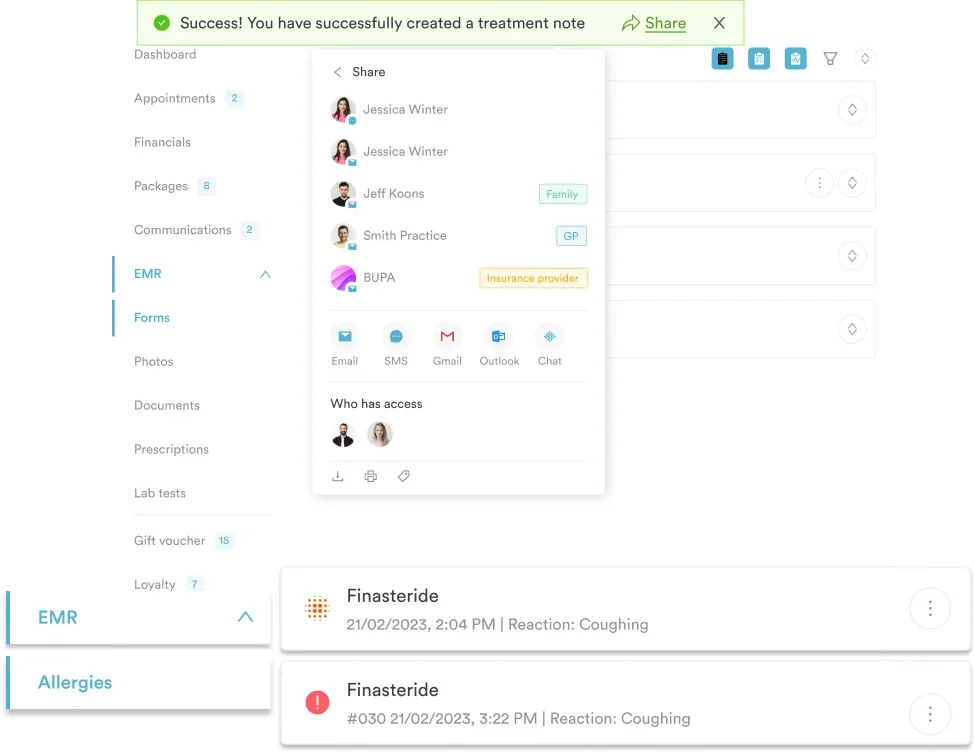
The same record holds the pre-authorisation number, the consent reference and the note itself. Audit trails show who wrote what and when, which is exactly what an insurer asks for when it queries a claim.

Pabau gives UK private practices structured procedure notes, pre-authorisation tracking and claim records in one system. The documentation behind a CCSD 25012 claim is then complete before it is submitted.

Two conditions decide whether a 25012 claim is paid: a valid pre-authorisation, and a note confirming the block was done under X-ray control. Most refusals trace back to how that note was worded.
So build the template once, make the six fields compulsory, and settle the bilateral rule with each insurer before the second side is injected. Refusal rates fall because the note stops omitting the fields an insurer reads first.
Pabau brings procedure notes, pre-auth tracking and claims into a single record. Book a demo to see how UK private practices keep their CCSD claims moving.

Need the wider Bupa code reference? Bupa CCSD codes sets out the schedule of codes used when billing Bupa for UK private procedures.
Coding a dorsal root ganglion block instead? CCSD code 25120 explains the descriptor, the documentation and the pre-auth position for that block.
Billing another procedure performed under X-ray control? CCSD code A7520 covers diagnostic thoracic sympathectomy, where the imaging requirement works the same way.
Want to cut refusals across every code you bill? Denial codes in medical billing walks through why claims are rejected and how practices stop the repeats.
The Clinical Coding and Schedule Development group maintains it. The CCSD Group represents Aviva, AXA Health, Bupa and VitalityHealth, and it sets code numbers and narratives rather than fees. What you are paid is set by your contract with each insurer.
The descriptor sets no level limit, unlike its neighbours 25010 and 25011, which are capped at two levels. It does not follow that multiple roots are paid as one claim. Record every level treated, then confirm the billing approach with the insurer.
The descriptor does not split the two. Other codes in section 3.3 do, such as 25100 and 25110 for diagnostic and therapeutic plexus blocks. So 25012 is billed the same way either way, and the clinical intent belongs in the note instead.
No. Sacral nerve stimulation implants a device for incontinence or constipation and is coded A7085. A sacral root block is a single injection at a named root under X-ray control. Billing one as the other is a straightforward refusal.



