CCSD code H4430: Examination of rectum under anaesthetic
CCSD code H4430 pays for the examination alone CCSD code H4430 is the UK private...

Last Updated: Oct 20, 2026
25011 is the CCSD code for a paravertebral block performed at up to two spinal levels under X-ray control. It covers an injection of local anesthetic into the paravertebral space, where the spinal nerves leave the spine. Fluoroscopic confirmation of the needle position is included in the code and is not billed separately.
The code sits in chapter 3 of the CCSD schedule, under section 3.3, paraspinal injections. The same block performed without X-ray control is billed as CCSD 25010. The procedure note has to record the imaging, because it decides which of the two codes a payer accepts.
Let Pabau's smart automation suggest the right codes, reduce claim denials, and keep your practice compliant—effortlessly.
Automate repetitive tasks and focus on what matters most—your patients.
Reduce coding errors and ensure compliance with the latest regulations.
Clean claims, fewer denials, and faster reimbursements.
Powerful insights and reporting to help your practice thrive.
HIPAA compliant SOC 2 certified GDPR-compliant Trusted by 4,000+ clinics worldwide

CCSD code 25011 covers a paravertebral block at up to two spinal levels, performed under X-ray or fluoroscopic control. Image guidance is part of the code itself.
CCSD code 25010 covers the same block at up to two levels without X-ray control, so the imaging record alone decides between 25010 and 25011.
Every claim must include a procedure note naming the block, the imaging modality used, the spinal level(s) treated, and the local anesthetic agent and volume.
Pabau, the practice management and billing platform we build, links CCSD codes to insurer fee schedules. It flags a missing pre-authorization number before the claim is submitted.
CCSD code 25011 covers a paravertebral block at one or two spinal levels, performed under X-ray control. Its official descriptor reads: Paravertebral block up to two levels (under X-ray control). The Clinical Coding and Schedule Development (CCSD) group publishes that wording, and each phrase in it sets a billing condition.
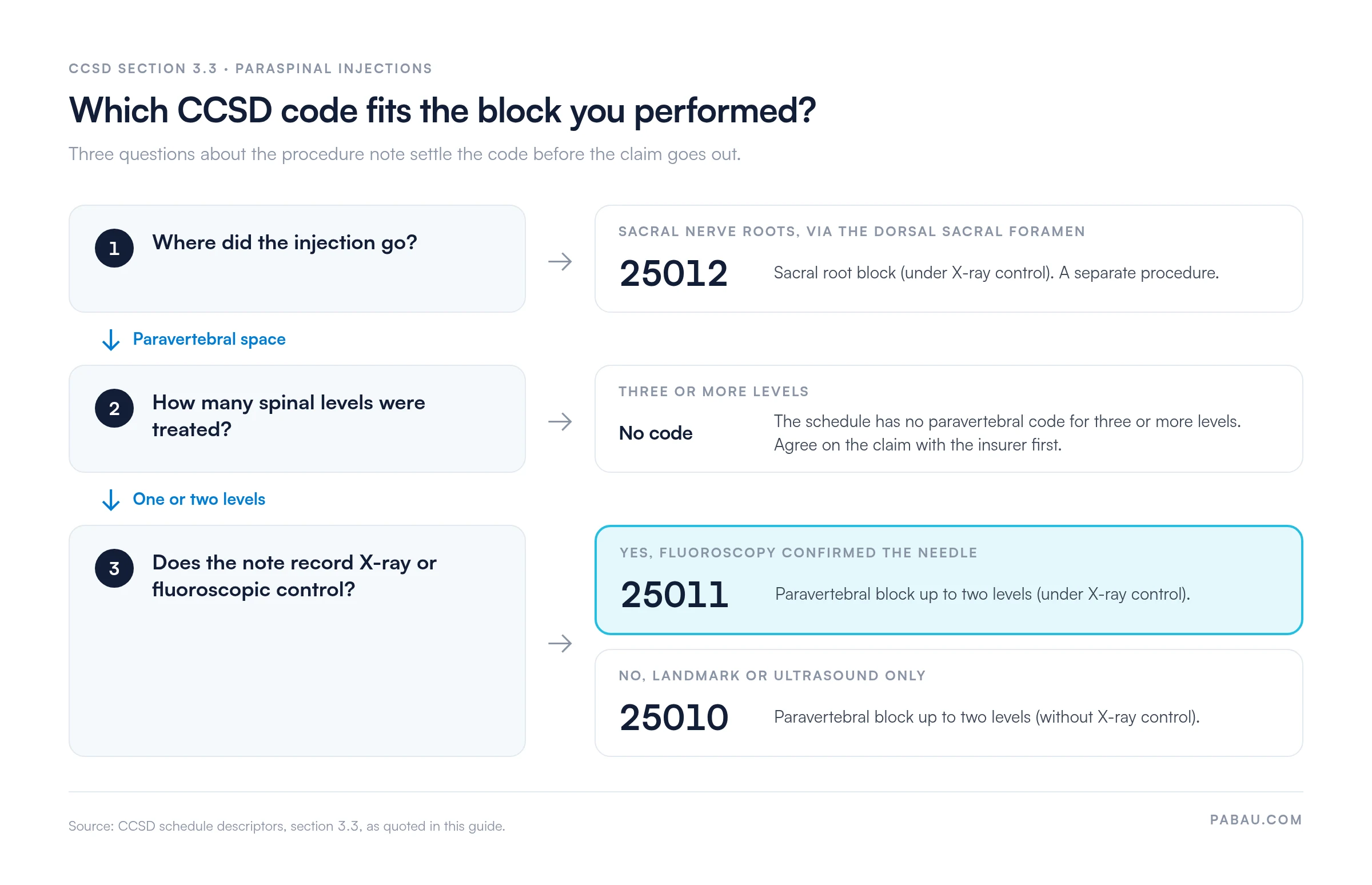
Two elements of the descriptor carry direct billing consequences. First, “under X-ray control” is a condition of the code, so the imaging has to happen and be recorded. The same block performed without X-ray control is billed as CCSD code 25010. Second, “up to two levels” sets the scope at one or two spinal levels. The schedule has no separate paravertebral code for three or more levels, so query the insurer before a wider block is claimed. For edge cases, check the CCSD technical guide before you bill.
A paravertebral block (PVB) targets the paravertebral space, a wedge-shaped compartment beside the vertebral body. In the thoracic region, it lies just behind the parietal pleura. Injecting local anesthetic here blocks the spinal nerve as it exits the intervertebral foramen. The result is one-sided somatic and sympathetic blockade over the dermatomes that level serves.
Under code 25011, X-ray or fluoroscopic imaging guides the procedure throughout. The typical steps for a two-level thoracic block are:
The requirement for image guidance exists because the paravertebral space sits immediately anterior to the pleura. Fluoroscopic confirmation of needle depth before injection reduces the risk of pneumothorax and inadvertent intrathecal or intravascular injection.
Paravertebral blocks are established as an opioid-sparing analgesic technique, supported by Cochrane review evidence for thoracic and breast surgical applications. In private anesthesia practice, the most common indications for billing CCSD code 25011 are:
The image-guidance requirement is most relevant for thoracic-level blocks, where pleural proximity makes fluoroscopic confirmation prudent. Lumbar paravertebral blocks are less common, but they can be performed under X-ray control for renal or flank procedures. Both fall within CCSD code 25011 provided no more than two levels are treated.
The CCSD schedule lists two paravertebral block codes under section 3.3, paraspinal injections. Both cover a block at up to two levels, and only the imaging guidance separates them. The table below shows what the note has to record for each one.
The billing boundary: If fluoroscopy confirmed needle position at one or two levels and the note records it, 25011 is correct. The same block without X-ray control belongs to 25010. Billing 25011 without an imaging record invites a query or a denial. Billing 25010 after using fluoroscopy understates the procedure you performed.
CCSD code 25012 sits in the same section of the schedule but is a different procedure. It covers a sacral root block under X-ray control, not a paravertebral block at three or more levels.
Three questions about the procedure note settle which section 3.3 code applies, if any.
Paravertebral blocks share anatomical territory with several other procedures. A medial branch block at one or two levels under X-ray control has its own entry, CCSD code A5750. The table below shows the most frequent coding errors and the clinical detail that resolves each one. For the other codes in the schedule, see our CCSD billing guides.
Some schedules name the intercostal nerve block inside the A7350 descriptor. When that block is image-guided, check whether the insurer expects A7352 instead.
A valid claim for CCSD code 25011 rests on what the procedure note contains. A missing element is the most avoidable reason for a denial. Back every claim with a note that confirms the following:
Procedure notes that use templated language without filling in specific levels or imaging confirmation are a consistent source of denials. If the note says “paravertebral block performed under image guidance” but the imaging modality is not specified, some insurers will query it. Name the modality, fluoroscopy or X-ray, explicitly.
Draft a procedure note template for CCSD 25011 with mandatory fields for the imaging modality and each spinal level treated. Add fields for the local anesthetic name, concentration, volume per level, and the clinical indication. When those fields must be completed before the note saves, the omissions that most often trigger denials never reach the claim.
CCSD code 25011 involves an elective interventional procedure, and most UK private medical insurance (PMI) providers require pre-authorization before treatment. Rules vary by payer and change over time. Always verify directly with the insurer before booking the procedure.
The table below summarizes the general approach of the main PMI payers. Treat it as a starting point, and check each insurer’s current portal guidance.
For Bupa claims specifically, the Bupa CCSD code guide and the Bupa fee schedule provide a starting reference for procedure recognition and fee levels. Healthcode is the primary electronic submission channel for most UK PMI claims, and the claim must include the pre-authorization number in the designated field.
Denials for CCSD code 25011 cluster around a predictable set of errors. Knowing them before submission cuts re-work and protects cash flow in UK private practice billing.
Submitting CCSD code 25011 correctly takes more than the right code number. Your billing workflow decides whether a missing level, modality, or authorization number is caught before the claim leaves the practice.
For consultants running a private practice without dedicated billing staff, software checks replace the manual review a billing team would otherwise do.
In Pabau, the workflow for a CCSD 25011 claim follows these steps:
A procedure note held in one system cannot be checked automatically against a claim built in another. Keep the clinical record and the claim in the same platform. Your team can then check the note against the claim before it goes to the insurer.

Pabau links CCSD codes to insurer fee schedules and flags missing pre-authorization numbers before submission. See how private anesthesia and pain management practices use Pabau to submit cleaner claims via Healthcode.

The procedure note settles CCSD code 25011 long before anyone fills in the claim form. The imaging record is the only detail that separates it from 25010, and an insurer can only pay what the note proves. A practice that captures the modality, the levels, and the authorization number at the point of care stops defending these claims after submission.
Pabau’s claims management workflow flags missing authorization numbers before the claim leaves the practice. It also links CCSD codes to each insurer’s fee schedule, which cuts the re-work that erodes revenue in private anesthesia and pain management practices.
Book a demo to see how Pabau keeps a 25011 claim from reaching the insurer without its authorization number.

Billing multiple CCSD nerve block codes in the same session? Bupa CCSD codes covers Bupa’s procedure code acceptance rules and how CCSD codes interact with Bupa’s fee schedule across specialties.
Submitting claims for the first time as a private consultant? Bupa procedure codes and fee schedule explains how Bupa fee schedules are structured and what consultants need to submit clean claims.
Performed the block without fluoroscopy? CCSD code 25010 covers the paravertebral block billed when no X-ray control is used, ultrasound-guided blocks included.
Treating the sacral roots instead? CCSD code 25012 covers the sacral root block under X-ray control, a separate procedure in the same section.
CCSD code 25011 covers a paravertebral block performed at up to two spinal levels under X-ray or fluoroscopic control. Anesthetists and pain management specialists use it in UK private healthcare billing. Typical indications include post-thoracotomy analgesia, mastectomy, rib fractures, and upper abdominal surgery.
Imaging guidance is the only difference. Both codes cover a paravertebral block at up to two levels. CCSD code 25011 applies when the block is performed under X-ray control, and 25010 applies when it is performed without it. The procedure note must record the modality, because it decides which code the insurer accepts.
No. CCSD code 25012 is a sacral root block under X-ray control, a separate procedure at the sacral nerve roots. The CCSD schedule has no code for a paravertebral block at three or more levels. Check with the insurer before a wider block is claimed.
Yes. Image guidance is mandatory for CCSD code 25011. The descriptor explicitly states “under X-ray control,” meaning X-ray or fluoroscopic guidance must be used and documented in the procedure note. A paravertebral block performed without X-ray control is billed as CCSD code 25010. A block guided by ultrasound alone matches that wording rather than 25011’s, so confirm with the insurer if the modality is in question.
Generally yes. Both Bupa and AXA Health typically require pre-authorization for elective interventional procedures. The authorization number must appear on the claim form. Rules vary and change over time, so verify directly with each insurer’s provider portal before booking the procedure.
The most common reason is a missing or incorrect pre-authorization number. Others include a procedure note that never confirms image guidance, and claims submitted outside the insurer’s time limit. Policy exclusions for pre-existing conditions are also a significant source of non-payment.
The consultant anesthetist who performs the block typically bills it, since it falls within anesthesia and regional nerve block practice. A pain management specialist may also bill the code when performing the procedure in a pain management practice. The billing clinician must be the one who performed the procedure and is named in the procedure note.