

CCSD code G5100: Bypass of duodenum billing guide
CCSD code G5100 bills a bypass that leaves the duodenum in place CCSD code G5100...

Last Updated: Oct 16, 2026
25010 is the CCSD code for a paravertebral block performed at up to two vertebral levels without X-ray control. It covers an injection of local anesthetic into the paravertebral space, where the spinal nerve roots emerge. The qualifier refers to fluoroscopy alone. A block guided by ultrasound still meets this descriptor, because ultrasound is not X-ray control under the schedule.
The code sits in chapter 3 of the CCSD schedule, under section 3.3, paraspinal injections. Where fluoroscopy confirmed needle position, the claim belongs to CCSD 25011 instead. The operative note is what decides which of the two a payer accepts.
Let Pabau's smart automation suggest the right codes, reduce claim denials, and keep your practice compliant—effortlessly.
Automate repetitive tasks and focus on what matters most—your patients.
Reduce coding errors and ensure compliance with the latest regulations.
Clean claims, fewer denials, and faster reimbursements.
Powerful insights and reporting to help your practice thrive.
HIPAA compliant SOC 2 certified GDPR-compliant Trusted by 4,000+ clinics worldwide

CCSD Code 25010 covers a paravertebral block at up to two vertebral levels, performed without fluoroscopic guidance.
Ultrasound-guided blocks still bill as 25010. Only fluoroscopic confirmation of needle position moves the claim to CCSD Code 25011.
The operative note must record the levels injected, the local anesthetic and volume, the guidance technique, and laterality.
Three or more levels puts the procedure outside the descriptor, so check the current schedule before invoicing.
Pabau ties CCSD code selection to the structured operative note behind it, so invoice and record agree.
CCSD Code 25010 covers a paravertebral block performed at up to two vertebral levels without X-ray control. The anesthetist injects a local anesthetic into the paravertebral space, the wedge-shaped area beside the vertebral body where the spinal nerve roots emerge.
Bupivacaine, ropivacaine, and levobupivacaine are the agents used most often. The anesthetic spreads ipsilaterally, producing unilateral dermatomal anesthesia across the target segments.
The code’s “up to two levels” scope is the defining clinical parameter. A single-level block and a two-level block both fall under 25010. Blocks performed at three or more levels need checking against the current CCSD schedule, which says whether a separate or additional code applies.
Common clinical indications for a paravertebral block in private practice include:
The procedure is performed by a recognized consultant anesthetist in a UK private hospital or day-surgery facility. Knowing the code’s scope lets clinicians and billing administrators route a claim correctly before it is submitted, which is where most denials are avoided.
The “without X-ray control” qualifier in the 25010 descriptor refers to fluoroscopic guidance, not to imaging in general. A clinician who uses ultrasound to visualize needle placement still bills CCSD Code 25010. Ultrasound does not count as X-ray control under the CCSD schedule.
Anesthetists who adopt ultrasound guidance sometimes assume the change of technique requires a different code, and that assumption is a common source of miscoded claims.
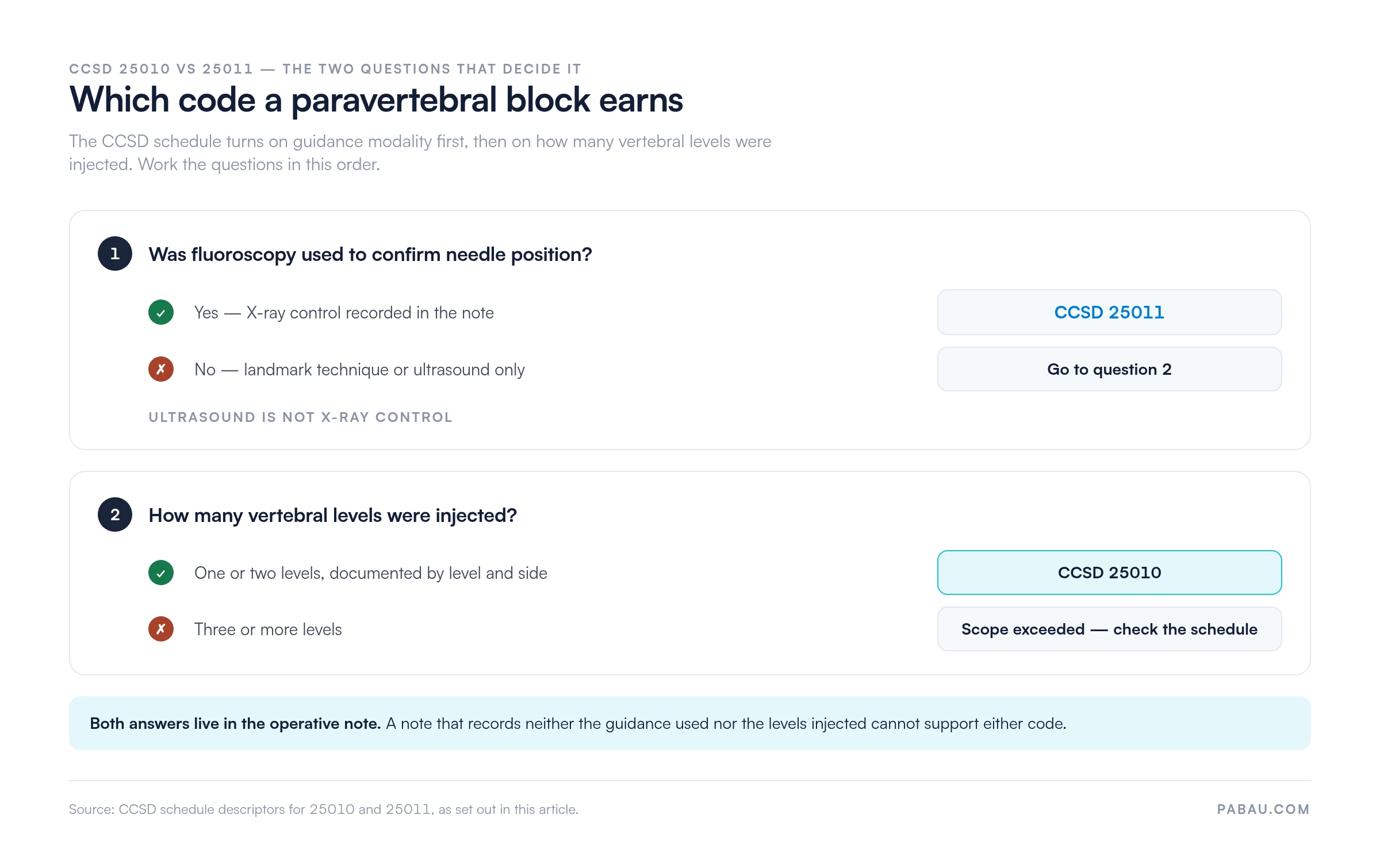
The rule reduces to one question. If fluoroscopy confirmed the needle tip position in the paravertebral space, use CCSD Code 25011. If the block was performed on anatomical landmarks alone, or with real-time ultrasound, use CCSD Code 25010. Check the current schedule before you invoice, because the Clinical Coding and Schedule Development Group revises code definitions periodically.
CCSD Code 25010 and CCSD Code 25011 are paired codes that differ on a single clinical variable: whether fluoroscopic guidance confirmed needle placement. Both codes cover paravertebral blocks at up to two levels, so the guidance modality alone decides which applies.
Where there is any ambiguity about which modality was used, the operative note is the deciding document. An anesthetic record stating “ultrasound-guided paravertebral block at T4 and T5” clearly supports 25010. One reading “fluoroscopic confirmation of needle tip in paravertebral space at L1-L2” supports 25011.
Taken together with the level count, the whole decision comes down to two questions asked in order.
Several adjacent procedures sit near CCSD Code 25010 in the schedule. Choosing the wrong one is a common cause of claim rejection, particularly where a technique shares anatomical proximity but is procedurally distinct.
A stellate ganglion block is a sympathetic procedure, not a paravertebral one, and it bills under CCSD Code 25022. That descriptor covers the injection with or without image guidance. A landmark technique with no fluoroscopy therefore stays on the sympathetic code, rather than falling back to 25010 or 25011.
Consultants new to private work should read the schedule’s regional anesthesia chapter directly, rather than working from CPT crosswalks or NHS tariff equivalents. The structures differ. The archive of CCSD codes sets out how the chapters and sections are organized. That is the fastest way to find the neighboring code a procedure needs.
CCSD Code 25010 claims are subject to clinical record requests from insurers, particularly on audit. The operative or anesthetic note must carry every element the payer needs to validate the code without contacting the clinician for clarification.
A digital anesthetic record that captures these six fields as discrete data points is far easier to audit than free text. Practices working on paper often find out what a note left unrecorded only when an insurer requests it. That can be weeks after the procedure, and by then the note can no longer be completed.

Audit your anesthetic note template against the six documentation requirements above before your next private list. If any field is missing from your standard form, add it now. Insurers can request records years after submission, and a note cannot be completed retrospectively.
Bupa, AXA Health, Vitality Health, Cigna, and Aviva all accept CCSD Code 25010 claims. Each operates its own fee schedule and pre-authorization requirements. Reimbursement rates vary by insurer and are updated periodically, so historical figures are not a safe guide. Verify the current fee at the time of billing with the insurer or through its provider portal.
Key payer requirements that apply across most UK private insurers:
Bupa’s provider portal at codes.bupa.co.uk handles code verification and fee lookup directly. The Vitality fee finder and the Cigna UK fee schedule do the same for their own schedules. The Bupa CCSD code guide walks through the schedule’s chapters and its main billing rules. Read it before you start looking individual codes up.
Denials for CCSD Code 25010 follow recognizable patterns. Knowing them lets a practice fix the cause rather than resubmit the same claim repeatedly.
Five of those six causes are documentation problems rather than clinical ones. A note template is therefore the cheapest denial control a private list has.
A consistent billing workflow catches errors before they turn into denials. The steps below apply to elective and semi-elective paravertebral block procedures in UK private practice.
Paravertebral blocks and intercostal nerve blocks are anatomically related but carry separate CCSD codes. Coding one as the other is a recognized denial trigger for CCSD Code 25010 claims.
The injection site is the whole difference. A paravertebral block targets the paravertebral space medially, where the nerve roots leave the intervertebral foramina. An intercostal nerve block targets the intercostal groove lateral to the posterior angle of the rib, after the nerve has already branched.
The two share dermatomal territory but are distinct in anatomy, technique, and code. Billing the intercostal code for a paravertebral procedure ends in denial, because the insurer’s coding team reads the anatomy off the operative note.
The intercostal code itself is worth confirming against the current schedule. Some schedules name intercostal blocks inside the A7350 descriptor, so an image-guided one may fall under CCSD Code A7352 instead.
Review how your anesthetic note template describes the needle entry point and the anatomical target. “Paravertebral space at T3-T4 medially” and “intercostal groove at the posterior angle of the 3rd rib” are the two phrasings that decide the code. Vague wording leaves the insurer’s coder no option but to call you.
Two errors account for most rejected 25010 claims. The first is picking the wrong half of the 25010/25011 pair. The second is submitting against an operative note that never recorded the levels or the guidance. Both happen at the seam between the clinical record and the invoice. A paper note and a separate billing spreadsheet never speak to each other.
Practice management software like Pabau closes that seam. The anesthetic note becomes a structured form, with named fields for level, agent, volume, technique, and laterality. The invoice is raised from the same patient record. Our claims management software then carries the CCSD code and its supporting note through to submission together. The code on the invoice matches what the anesthetist documented.
For a practice billing Bupa, AXA Health, Vitality, and Cigna from the same list, that means one process instead of four payer-specific paper workflows. When an insurer asks for records months later, the note is already attached to the claim it supports.
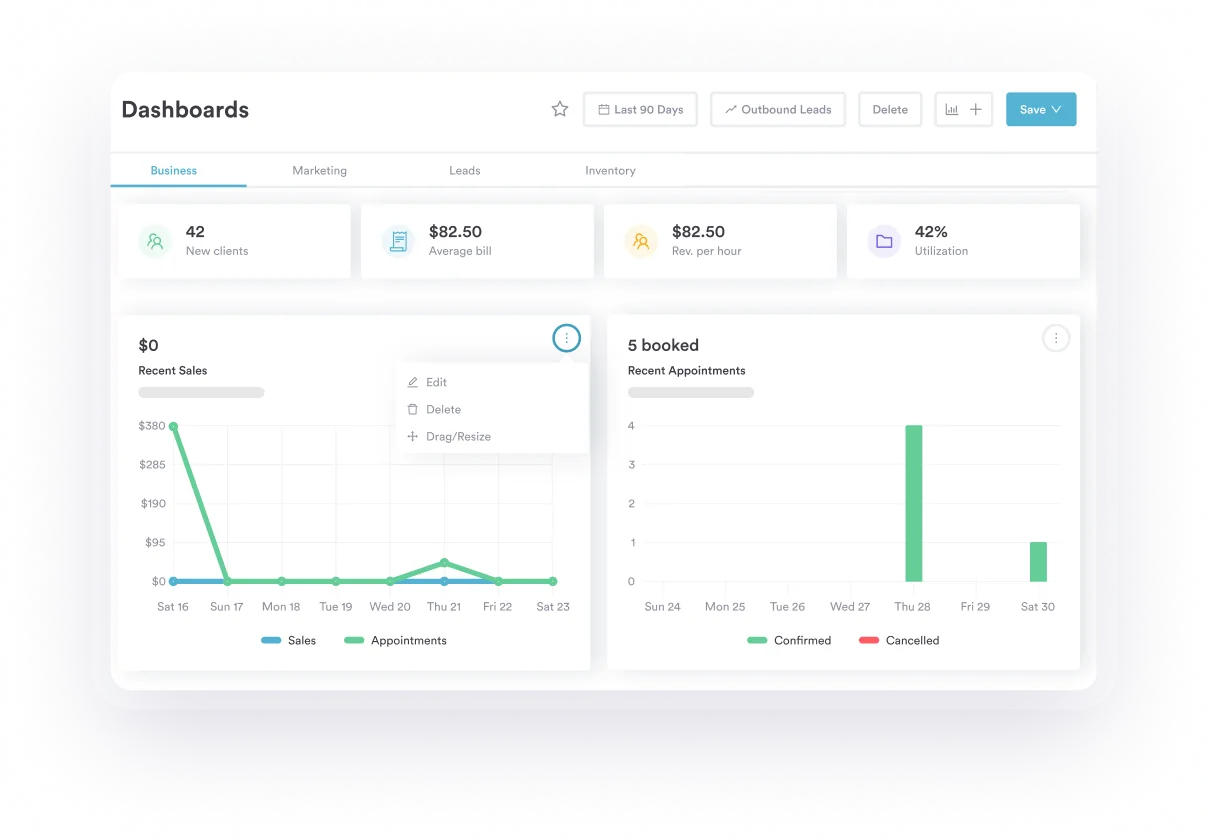
Reporting closes the loop. Once claims and notes sit in one system, a practice can see which insurer is slowest to settle a block claim. It can also see which denial reason keeps recurring. That turns denial handling into a fixable pattern rather than a monthly surprise.

Pabau links CCSD code selection to a structured operative note and carries both through to insurer submission. See how it handles a private anesthesia list from booking to settled claim.

CCSD Code 25010 is not a hard code to get right. It has one scope limit and one qualifier, and both are settled by what the anesthetist writes down at the time of the block. The work is in the note, not in the schedule.
So the useful change is a template, not a lookup habit. Put the six elements on the standard anesthetic record, and the 25010 versus 25011 question answers itself at billing. That holds for every consultant on the list, not just the one who remembers. The trade-off is a few seconds per case against a records request months later that nobody can now satisfy.
Book a demo to see how Pabau keeps the CCSD code, the operative note, and the insurer claim on one record.

Billing a sacral root block from the same section of the schedule? CCSD code 25012 covers the paraspinal injection performed under X-ray control, and the documentation that supports it.
Seeing the same denial reason come back every month? Denial management in healthcare sets out how to work denials by cause instead of resubmitting claims one at a time.
Comparing systems to run private billing on? Best medical billing software in the UK compares the platforms UK private practices use to submit and track insurer claims.
CCSD Code 25010 is the UK private medical insurance billing code for a paravertebral block performed at up to two vertebral levels without X-ray control. It covers single-level and two-level blocks alike, whether performed by anatomical landmark technique or with ultrasound guidance. Bupa, AXA Health, Vitality, Cigna, and Aviva all accept it for claims from recognized consultant anesthetists.
CCSD 25010 applies where the paravertebral block was performed without fluoroscopic guidance. CCSD 25011 applies where fluoroscopy confirmed the needle position. Ultrasound-guided blocks still bill as 25010, because ultrasound does not count as X-ray control under the CCSD schedule. Check the current schedule before billing either code, since definitions are revised periodically.
No. The 25010 descriptor explicitly covers the block “without X-ray control.” Adding a separate imaging guidance code where no fluoroscopy was used is not supported by the procedure performed. Where fluoroscopy was used, the correct code is 25011. Check the current CCSD schedule rules on additional modifiers with your insurer.
CCSD 25010 covers up to two vertebral levels. A single-level block and a two-level block both sit inside the code’s scope. Where three or more levels are treated, the scope is exceeded. Check the current CCSD schedule to see whether a separate or additional code applies.
No. The two are anatomically distinct procedures with separate CCSD codes. A paravertebral block targets the paravertebral space medially at the vertebral level. An intercostal nerve block targets the intercostal groove laterally. Billing one code for the other ends in denial once the insurer’s clinical coder reads the operative note against the descriptor.
The common causes are a fluoroscopy-guided block billed as 25010 instead of 25011, and more than two levels treated without a supporting code. An operative note that does not name the vertebral levels injected is the third. Missing pre-authorization, lapsed consultant recognition, and coding the block as an intercostal nerve block account for the rest.



