HCPCS code Q4154: Biovance billing, Medicare rate and denial guide
HCPCS code Q4154: definition and code details HCPCS code Q4154 is a Level II cod...

Last Updated: Oct 6, 2026
Billable Code
25022 is the CCSD code for stellate ganglion block (local anaesthetic) +/– Image Guidance. It covers a percutaneous local anesthetic injection at the stellate ganglion, with or without fluoroscopic or ultrasound guidance, billed by UK private consultants and facilities.
The code sits in section 3.5.0 Sympathetic Nerves of the CCSD schedule's spine, spinal cord and peripheral nerves chapter. Most UK private insurers require prior authorization, and the insurer contract decides whether image guidance is billed separately.
Let Pabau's smart automation suggest the right codes, reduce claim denials, and keep your practice compliant—effortlessly.
Automate repetitive tasks and focus on what matters most—your patients.
Reduce coding errors and ensure compliance with the latest regulations.
Clean claims, fewer denials, and faster reimbursements.
Powerful insights and reporting to help your practice thrive.
HIPAA compliant SOC 2 certified GDPR-compliant Trusted by 4,000+ clinics worldwide

CCSD code 25022 covers a stellate ganglion block with local anesthetic, with or without image guidance, in UK private healthcare.
Established indications include CRPS, hyperhidrosis, Raynaud’s phenomenon and upper limb vascular insufficiency. Menopausal vasomotor symptoms and PTSD get variable insurer acceptance.
The +/- image guidance notation means the insurer contract decides whether guidance is bundled into the fee or billed separately.
UK claims pair 25022 with a WHO ICD-10 code, such as M89.0 for CRPS type I, rather than a US ICD-10-CM code.
Pabau, the practice management platform we build, gives UK private practices digital forms for recording the agent, guidance modality and consent behind each claim.
CCSD code 25022 is the billing code for “Stellate ganglion block (local anaesthetic) +/- Image Guidance.” The Clinical Coding and Schedule Development Group defines it in the CCSD schedule. The code sits within the Sympathetic Nerves section (3.5.0) of the CCSD schedule’s Spine, spinal cord and peripheral nerves chapter.
The schedule governs billing for UK private healthcare consultants and facilities, and our library of CCSD codes for consultants covers the neighboring entries.
The “+/-” notation in the descriptor is a CCSD convention indicating that image guidance is optional. The base code covers the block procedure itself. The insurer’s contract and the guidance modality decide whether image guidance gets a separate billing code or sits within the 25022 fee.
A stellate ganglion block involves injecting local anesthetic onto the stellate ganglion. This is the fused inferior cervical and first thoracic sympathetic ganglion, sitting at the C7/T1 vertebral level, anterolateral to the vertebral body. Interrupting sympathetic signaling at this ganglion reduces vasomotor tone and pain transmission in the upper limb, head and neck.
The procedure note must document each of the five steps above. That includes the agent used, the volume and concentration injected, the image guidance modality and the post-procedure observation findings. A note missing any of these is a common reason insurers query or deny CCSD 25022 claims.
The indications UK private insurers accept under CCSD code 25022 fall into two groups. Established indications get consistent insurer acceptance. Emerging indications get variable funding, and prior authorization is almost always required.
Document the specific indication and pair it with the matching ICD-10 diagnosis code. An operative note that lists CRPS as the indication, submitted with a non-specific musculoskeletal code, predictably draws an adjudication query.
The “+/-” notation in the CCSD code 25022 descriptor means image guidance is performed at the clinician’s discretion and may or may not be separately reimbursable. In practice, three scenarios arise:
Those three scenarios come down to two questions, and the diagram below walks through them in order.
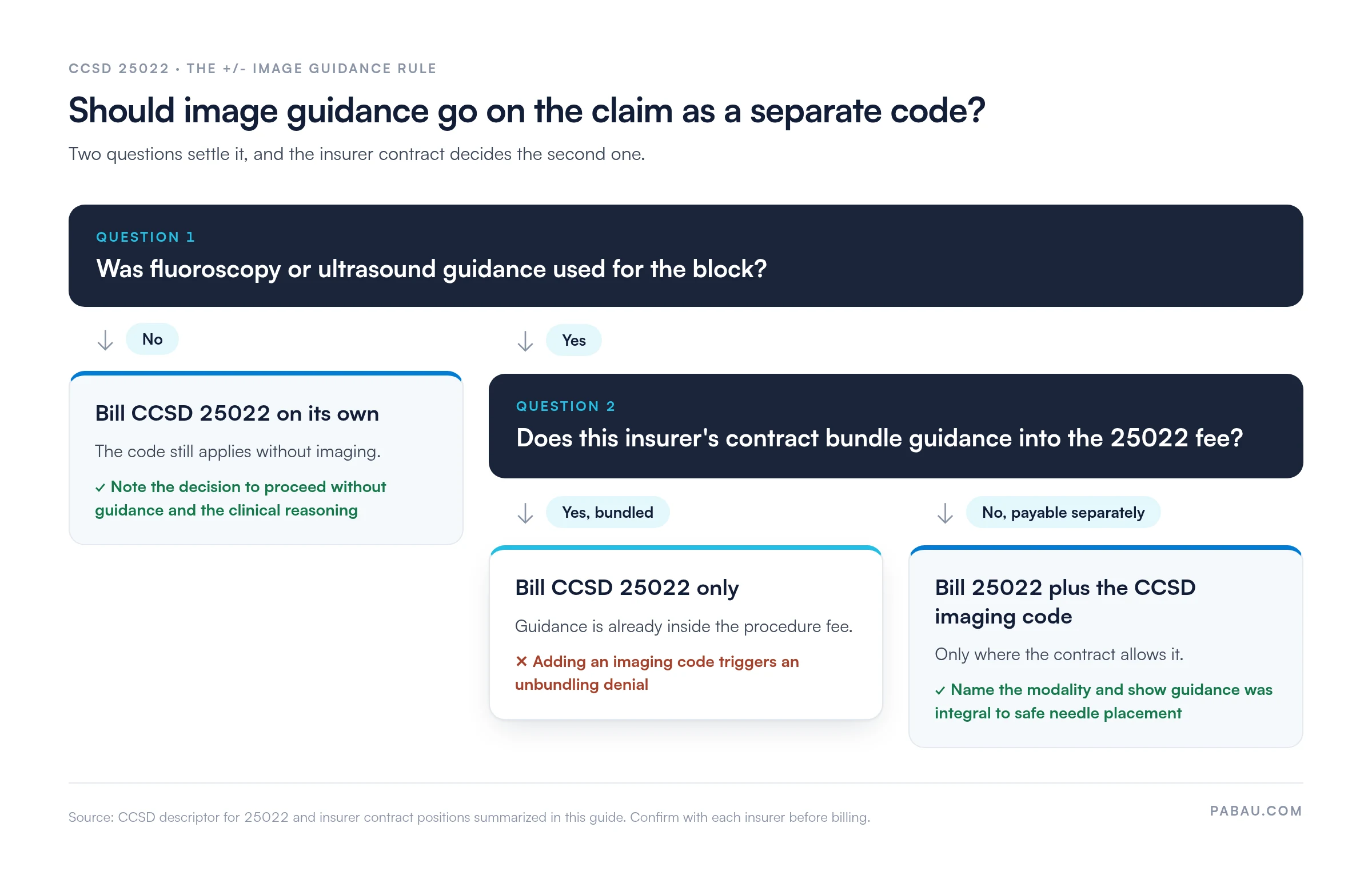
Fluoroscopy remains the most widely used modality for stellate ganglion blocks in UK private practice. Ultrasound guidance has become increasingly common for real-time soft-tissue visualization. CT guidance is used in complex cases but is rarely reimbursed as a separate code without specific insurer pre-approval. Always verify the image guidance billing position with the relevant insurer before submitting.
Before billing image guidance separately alongside CCSD code 25022, call the insurer’s provider line. Ask whether their contract bundles guidance into the procedure fee or allows a separate imaging code. Note the agent’s name, the date and the reference number in the patient file. That one call heads off an unbundling denial before the claim is sent.
Billing CCSD code 25022 correctly means completing five steps in order. A claim submitted without prior authorization, or with an incomplete operative note, will almost always be queried or rejected, however appropriate the treatment was.
Pabau’s private healthcare claims management tools let UK consultants record CCSD codes against appointment records, link them to procedure notes and track authorization numbers. That cuts the manual steps that generate submission errors.
Every element listed below must appear in the operative or procedure note before a CCSD 25022 claim is submitted. An insurer’s clinical reviewer checks these elements if the claim is queried, and a missing one gives grounds for denial.
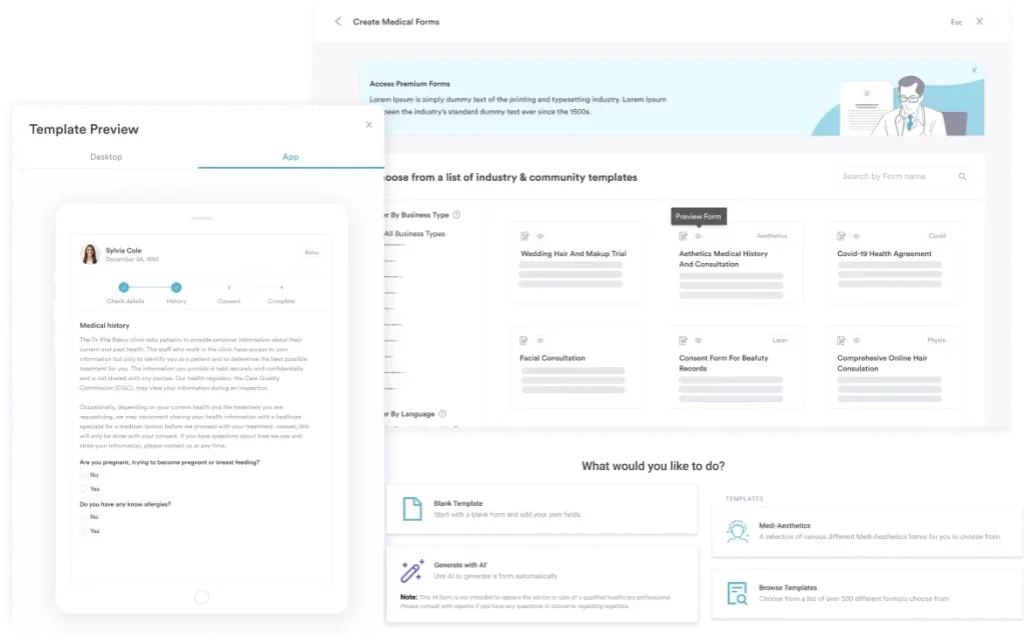
Pabau’s digital procedure documentation lets UK private practices build a standardized stellate ganglion block note template that prompts for each required field. Fewer omissions means fewer insurer queries.
CCSD 25022 is often confused with other regional block codes and with surgical sympathectomy codes. Paravertebral blocks, for example, bill under CCSD 25011, not 25022. Selecting the wrong code is an upcoding risk, and splitting a single procedure across two codes is an unbundling risk. Both carry audit consequences.
Precise clinical records are the foundation of correct code selection. The operative note should state that the injection targeted the stellate ganglion specifically, not the broader cervical sympathetic chain, and that the procedure was percutaneous. A block of a named major nerve under image guidance falls under CCSD A7352 instead.
UK private insurers generally recognize CCSD code 25022 for established indications. Their policies on prior authorization, funded indications and image guidance billing vary. The table below shows typical positions, but positions change, so verify current requirements with each insurer before proceeding.
For Bupa, the Bupa CCSD procedure codes page explains how Bupa applies the CCSD schedule, including the prior authorization process for interventional pain codes.
Most CCSD 25022 denials fall into five categories, and each one can be prevented before the claim goes out.
Build a denial prevention checklist into your CCSD 25022 claim workflow. Before each submission, confirm the authorization number, the ICD-10 code, the agent and modality in the operative note, and the insurer’s image guidance position. The check takes a couple of minutes and covers each of the five denial causes above.
Electronic claim rejections usually start at data entry. Healthcode requires the CCSD code in the designated procedure code field. Enter it in a free-text or notes field and the claim goes out without a valid code. Healthcode then returns an error before the insurer sees it.
The most common data-entry errors on CCSD 25022 claims are:
Each one triggers an electronic rejection that delays payment by at least one billing cycle. Pabau’s claims workflows let practices record CCSD codes, ICD-10 codes and authorization numbers against the episode of care. Your billing team stops retyping codes from the operative note, which removes the transcription step where most of these errors start.

Pabau keeps CCSD codes, ICD-10 codes and authorization numbers on the episode of care, next to the operative note. Your team submits stellate ganglion block claims with fewer rejections and fewer insurer queries.

A CCSD 25022 claim is won or lost before the needle goes in. Confirm prior authorization, agree the funded indication and settle the image guidance position with the insurer first. If you skip that call, a clinically sound block can still go unpaid.
After the procedure, the operative note carries the claim. Name the agent, volume, modality and post-procedure finding, and adjudication becomes routine. Book a demo to see how Pabau keeps CCSD codes and procedure notes together for UK pain practices.

Want to reduce claim errors across all CCSD procedures? Private healthcare claims management shows how Pabau lets practices record CCSD codes, ICD-10 codes and authorization numbers against each episode of care.
Billing other nerve blocks too? CCSD code A7350: Peripheral nerve block procedures covers local anesthetic blockade of major nerve trunks.
Need a standard prior authorization request? Medical prior authorization form gives you a template for requesting approval before an interventional procedure.
Still getting claims bounced? Denial codes in medical billing explains what each denial reason means and how to fix it.
CCSD code 25022 covers a stellate ganglion block performed with local anesthetic, with or without image guidance, in UK private healthcare. It covers the percutaneous injection at the stellate (cervicothoracic) ganglion at the C7/T1 level. It does not cover surgical sympathectomy.
It depends on the individual insurer contract. The “+/-” notation means guidance is optional and may be bundled into the procedure fee or separately reimbursable. Check with each insurer before adding a separate imaging code, because billing bundled guidance separately triggers an unbundling denial.
Established indications include complex regional pain syndrome (CRPS), hyperhidrosis, Raynaud’s phenomenon and upper limb vascular insufficiency. Menopausal vasomotor symptoms and PTSD are emerging indications with published evidence but inconsistent UK private insurer funding. Confirm the funded indication with the insurer before proceeding.
Yes. Bupa requires prior authorization for stellate ganglion blocks under CCSD code 25022. Get the authorization number before the procedure date, and confirm the indication (such as CRPS or hyperhidrosis) is a funded benefit under the patient’s policy.
The operative note must include the anatomical target and the local anesthetic agent’s name, volume and concentration. It also needs the image guidance modality if used, negative aspiration, the post-procedure Horner’s syndrome assessment and the prior authorization number. A missing element gives grounds for an insurer query or denial.
CCSD code 25022 covers a percutaneous local anesthetic block of the stellate ganglion. A cervical sympathectomy code covers surgical ablation or resection of cervical sympathetic ganglia, a separate and more invasive procedure. Never use CCSD 25022 for open or endoscopic sympathectomy.
The code can be applied to any stellate ganglion block procedure. However, UK private insurers do not routinely fund PTSD as an indication and have inconsistent policies on menopausal vasomotor symptoms. Get written insurer confirmation that the indication is a covered benefit before performing and billing the procedure.