









HCPCS code J2860: Injection, siltuximab, 10 mg billing guide
HCPCS code J2860 is the billing code for Injection, siltuximab, 10 mg. It is a L...

Last Updated: Sep 4, 2026


HCPCS Code E0265 describes a hospital bed, total electric (head, foot, and height adjustments), with any type side rails, with mattress – billed as a capped rental item under the DMEPOS fee schedule.
Under LCD L33820, the motorized height adjustment is a non-covered convenience feature. Medicare denies E0265/E0266 as not reasonable and necessary regardless of diagnosis (CHF, COPD, arthritis, spinal cord injury, and so on) and pays no more than the semi-electric E0260 equivalent rate.
The correct billing path for a total electric upgrade is the covered semi-electric bed (E0260/E0261) billed with GK, plus a signed ABN and the GA modifier on the non-covered height upgrade. KX does not legitimately apply to E0265, since the item itself is never covered.
Practice management software like Pabau centralizes the clinical documentation and audit trail that supports DME medical necessity determinations, without submitting or tracking the Medicare claim itself.
HCPCS Code E0265 describes a hospital bed, total electric (head, foot, and height adjustments), with any type side rails, with mattress. It’s billed as a capped rental item under the DMEPOS fee schedule, and its medical necessity requirements differ sharply from the more commonly covered semi-electric bed codes.
This reference covers the full descriptor, the 2026 fee schedule, LCD L33820 coverage criteria, required modifiers, and the related codes coders most often confuse with E0265.
Managing the documentation behind DME claims is far easier when practice management software features connect clinical notes directly to the billing record. We’ll return to that workflow connection at the end.
The official descriptor for HCPCS Code E0265, as maintained by the Centers for Medicare and Medicaid Services (CMS), is:
Hospital bed, total electric (head, foot and height adjustments), with any type side rails, with mattress.
“Total electric” refers to the height adjustment, not the head and foot movement. Semi-electric beds (E0260, E0261) already have motorized head and foot sections – the only manual part is the height crank that raises or lowers the entire bed frame. E0265 simply adds a motorized height adjustment on top of that.
The code includes any type of side rails and a mattress as part of the base equipment. Suppliers billing for a total electric bed without a mattress use E0266 instead.
E0265 is classified as a capped rental item under the DMEPOS fee schedule. Medicare pays a monthly rental amount for the first 13 months, after which ownership transfers to the beneficiary. Reimbursement rates vary by MAC jurisdiction and are updated annually by CMS.
The DMEPOS Competitive Bidding Program has had no active contracts since January 1, 2024, and hospital beds are excluded from the next competitive bidding round. Until CMS awards new contracts covering hospital beds, suppliers everywhere bill at the standard DMEPOS fee schedule rate for their MAC jurisdiction rather than a competitively bid rate.
For current jurisdiction-specific payment amounts, suppliers should consult the CMS DMEPOS fee schedule directly. Rates change each January 1 and are subject to mid-year adjustments under the Consolidated Appropriations Act provisions.
E0265 is a capped-rental DMEPOS item, so it has no Medicare Physician Fee Schedule (MPFS) or RVU-based pricing – use the DMEPOS fee schedule or the DME MAC lookup instead of the physician fee schedule tool.
With software for managing patients, DME prescriptions stay linked to the assessments that justified them.
Medicare coverage for hospital beds is governed by LCD L33820. The core coverage standard: the patient must have a medical condition that requires positioning of the body in ways not feasible with an ordinary bed. That standard determines whether an electric hospital bed (E0260/E0261, semi-electric) is covered at all – on its own, it does not support HCPCS Code E0265. Tracking which plans carry an authorization requirement for a service saves the appeal later.
Under LCD L33820, the motorized height adjustment that distinguishes a total electric bed (E0265/E0266) from a semi-electric bed (E0260/E0261) is classified as a non-covered convenience feature.
Medicare denies E0265/E0266 as not reasonable and necessary regardless of the patient’s diagnosis – severe CHF, COPD, arthritis, spinal cord injury, and similar conditions can justify a semi-electric bed, but none of them make the total electric height upgrade itself covered.
When a total electric bed is furnished, Medicare pays no more than the equivalent semi-electric (E0260) rate. Maintaining complete client records documenting the functional limitations that support the semi-electric bed is essential to keep that distinction clear at the claims level.
Qualifying conditions under LCD L33820 that support a semi-electric bed (E0260/E0261) include:
Patients meeting the arthritis-based positioning criteria often also have documented joint procedures such as CPT 20605 in their history, though that code is billed separately from the hospital bed claim itself.
The treating physician must document why the patient needs motorized head and foot positioning at all – a general diagnosis of COPD or CHF alone is not sufficient. Chart notes must reflect the functional limitation that makes electric head/foot control medically necessary.
None of that documentation extends to the height feature: no diagnosis, however severe, establishes medical necessity for the total electric upgrade under LCD L33820.
The following ICD-10-CM codes are among those recognized under LCD L33820 as supporting medical necessity for an electric hospital bed – that is, the covered semi-electric bed, E0260/E0261. None of these diagnoses extend coverage to the total electric height feature (E0265/E0266), which LCD L33820 treats as a non-covered convenience item regardless of diagnosis.
This is not an exhaustive list. Verify current coverage codes against the active LCD version at CMS before submitting claims, as the code list is updated periodically. Proper EHR integration between clinical notes and the billing system helps ensure the correct diagnosis codes flow through to the claim.
Always confirm ICD-10-CM codes against the current version of LCD L33820 before claim submission. Remember these codes support the covered semi-electric bed – the LCD also lists codes that do NOT support medical necessity even for E0260/E0261, and submitting those is a common denial trigger. No ICD-10-CM code converts the E0265 height feature into a covered item.
Coders should also keep similar-looking arthritis codes straight: M06.9 and M12.9 describe related but distinct joint conditions, and billing the wrong one against LCD L33820 risks a denial even when a bed is otherwise medically justified.
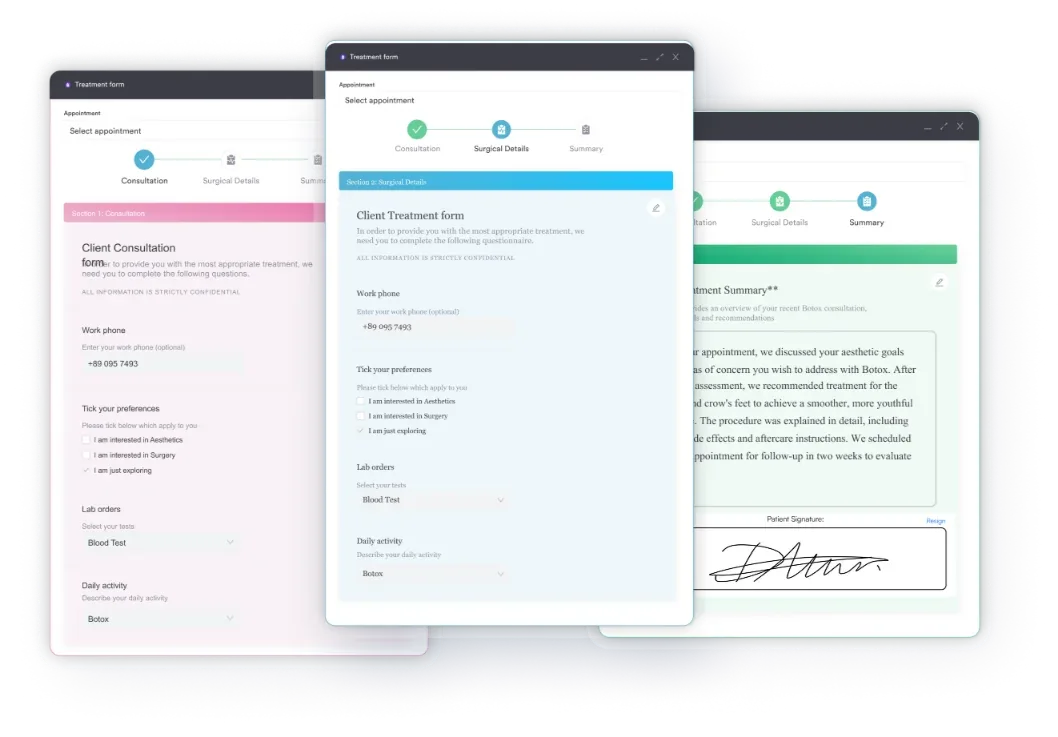
Incomplete documentation is the leading cause of HCPCS Code E0265 claim denials. Before submitting a claim, DME suppliers need a complete documentation package on file. Using digital intake forms to capture the required clinical information at the point of care reduces the back-and-forth that delays claim submission.
Required documentation includes:
Our guide to HIPAA compliance for medical offices covers good documentation practices in more depth. Suppliers should also review our medical forms guide for structuring intake workflows that capture the information payers require. Keeping records well-organized also supports the audit trail needed for any OIG compliance review.
Flag each E0265 claim file for a pre-submission documentation review. Confirm the SWO and supporting medical-record documentation address the need for motorized head/foot positioning (E0260/E0261), and confirm a signed ABN is on file if a total electric bed is being furnished. The height feature itself is a non-covered convenience item under LCD L33820 regardless of diagnosis.
Modifier selection directly affects both claim payment and compliance risk for HCPCS Code E0265.
KX is never the right modifier for E0265/E0266 themselves – it attests that medical necessity criteria for the billed item have been met, and no diagnosis satisfies that standard for the total electric height feature.
The compliant path is billing the covered semi-electric item with GK, and the non-covered height upgrade with GA backed by a signed ABN. Billing staff should build GA/GK/ABN handling as a required check in any DMEPOS billing template for E0265 upgrade claims.
Selecting the correct hospital bed HCPCS code requires understanding how each code maps to the specific equipment features. The most common coding error in this category is billing E0265 when E0261 (semi-electric with mattress) is all that is medically necessary.
Payers cross-reference the code against the documentation and deny claims where the code level exceeds the documented need. For an overview of HCPCS Level II code structures, the AAPC Codify HCPCS lookup provides descriptor details and crosswalk references.
The distinction between E0261 and E0265 is the height crank, not the foot section – both already have motorized head and foot control. Height motorization is never itself medically necessary under LCD L33820, regardless of diagnosis, so code selection isn’t a clinical judgment call the way head/foot positioning is.
If the physician’s documentation supports a semi-electric bed, bill E0261 (or E0260 without a mattress). If the patient specifically wants the motorized height feature, that’s an upgrade billed as E0265 with a signed ABN and the GA/GK modifier pair – not a code chosen based on medical necessity.
Because LCD L33820 excludes the total electric height feature as a convenience item regardless of diagnosis, any time a patient wants HCPCS Code E0265 rather than the covered semi-electric bed, the supplier is in an upgrade billing scenario.
Mishandling an upgrade request exposes the supplier to improper billing liability.
The process for handling an upgrade request correctly:
Billing E0265 with the KX modifier is a compliance violation, because KX attests that medical necessity criteria for the billed item have been met – and no diagnosis meets that standard for the total electric height feature under LCD L33820. Using KX on E0265 instead of the correct GA/GK-plus-ABN pattern constitutes a false claim.
Solid patient data security tools and well-organized medical practice management software help maintain the audit trail needed to distinguish standard claims from upgrade scenarios.

Pabau centralizes clinical notes, patient records, and the audit trail your practice needs to support DME medical necessity documentation – all without switching between systems.

DME suppliers nearly always bill additional codes alongside HCPCS Code E0265, not the base bed on its own. Bundling the right accessories into each claim, with proper documentation for each item, reduces the number of follow-up orders and incomplete claim submissions.
Important bundling note: Because E0265’s descriptor includes “any type of side rails,” separately billing E0305 or E0310 for side rails provided with the same bed is typically not permitted.
Review your MAC’s billing guidance and LCD L33820 bundling provisions before billing side rail codes alongside E0265. The PGM Billing lookup tool and the NLM HCPCS API are useful references for checking current code descriptors and bundling indicators.
Run a pre-claim audit on every E0265 submission. Confirm that: (1) the SWO and medical-record documentation support the underlying semi-electric bed (E0260/E0261), (2) a signed ABN is on file and the correct modifiers (GK on the covered item, GA on the non-covered height upgrade) are applied – never KX on E0265/E0266, (3) no bundled accessories are billed separately in violation of your MAC’s bundling rules, and (4) the ICD-10-CM codes on the claim appear in the current LCD L33820 supported code list.
Incomplete or disconnected documentation causes more HCPCS Code E0265 claim denials than wrong code selection. When clinical notes live in one system and billing data lives in another, information gets lost between the physician’s order and the claim.
Practice management software like Pabau connects the clinical encounter record directly to the patient’s chart, so the documentation that establishes medical necessity for HCPCS Code E0265 upgrade decisions is centralized rather than scattered across systems.
Pabau doesn’t submit or track Medicare or DMEPOS claims – its medical records management features centralize the clinical notes, signed ABNs, and audit trail a DME supplier’s billing team needs to support the claim.
For practices building a running a paperless practice workflow, Pabau’s integrated records also keep signed ABNs in the patient record alongside the clinical notes. See how it works with a book a demo session.

Want to see a similarly documentation-heavy DME code in action? A4425 covers billing for a drainable ostomy pouch, another DME item where the paperwork decides the claim.
Coding an unspecified primary malignancy? Unspecified primary malignancy code covers when this audit-sensitive code applies, since the primary site must be genuinely unidentifiable, not just undocumented.
Coding a hereditary bleeding disorder? Hemophilia B coding guide covers this code for a genetic clotting disorder caused by insufficient factor IX activity in the blood.
HCPCS Code E0265 claims most often fail because the documentation trail doesn’t clearly show that the total electric height feature is a non-covered upgrade over the covered semi-electric bed. That distinction has to live in the physician’s notes, the SWO, the signed ABN, and the claim modifiers, all telling the same story.
Pabau’s integrated digital intake forms and patient record system keep clinical documentation, signed forms, and billing data in one place, so nothing gets lost between the physician’s order and the claim submission. To see how Pabau supports DME billing workflows, get in touch with our team for a walkthrough.
HCPCS Code E0265 bills for a total electric hospital bed with powered head, foot, and height adjustment, plus side rails and a mattress, furnished to a Medicare beneficiary at home. Under LCD L33820 the motorized height feature is a non-covered convenience item, so E0265 is usually billed as an ABN-backed upgrade over the covered semi-electric bed. It is a capped-rental DMEPOS item for the first 13 months.
E0265 is a capped-rental DMEPOS item with no Physician Fee Schedule pricing. Rates come from the CMS DMEPOS Fee Schedule or the applicable DME MAC lookup (Noridian for JA/JD, CGS for JB/JC) and vary by jurisdiction. No Competitive Bidding contracts currently apply to hospital beds, so suppliers bill the standard rate. Because the height feature is non-covered, Medicare pays no more than the semi-electric (E0260) rate.
There are none. Under LCD L33820 the motorized height adjustment that makes a bed total electric is a non-covered convenience feature regardless of diagnosis. Conditions such as severe CHF, COPD, severe arthritis, spinal cord injury, and some neuromuscular diseases can justify a semi-electric bed (E0260/E0261), but none extend coverage to the height feature. A supplier furnishing E0265 needs a signed ABN and bills it as an upgrade.
KX does not apply to E0265/E0266, since the total electric height feature is not covered under any diagnosis. The correct pattern is billing the covered semi-electric bed (E0260/E0261) with GK and the non-covered height upgrade (E0265/E0266) with GA to reflect a signed ABN. RR indicates rental months 1 through 13, NU applies to new equipment, and UE to used equipment.