

CCSD code G5100: Bypass of duodenum billing guide
CCSD code G5100 bills a bypass that leaves the duodenum in place CCSD code G5100...

Last Updated: Oct 16, 2026
S0142 is the HCPCS Level II code for colistimethate sodium, inhalation solution administered through dme, concentrated form, per mg.
The code remains current for the 2026 coding year. Each element of the descriptor changes how the claim is built:
Let Pabau's smart automation suggest the right codes, reduce claim denials, and keep your practice compliant—effortlessly.
Automate repetitive tasks and focus on what matters most—your patients.
Reduce coding errors and ensure compliance with the latest regulations.
Clean claims, fewer denials, and faster reimbursements.
Powerful insights and reporting to help your practice thrive.
HIPAA compliant SOC 2 certified GDPR-compliant Trusted by 4,000+ clinics worldwide

HCPCS code S0142 describes colistimethate sodium inhalation solution administered through durable medical equipment (DME), concentrated form, billed per milligram.
S0142 is a temporary national S-code: Medicaid and private payers accept it, but Medicare Part B does not typically reimburse HCPCS S-codes.
Billing errors most often come from unit reporting: Each unit billed must equal exactly one milligram of colistimethate sodium administered.
Practice management software like Pabau helps DME suppliers track per-unit drug billing, payer rules, and HCPCS documentation in one place.
S0142 is billable only when the inhalation solution reaches the patient through a qualifying nebulizer system. A small-volume, large-volume, or ultrasonic nebulizer can all qualify. The equipment itself has to be separately enrolled and billed through the DME benefit.
Billing S0142 for oral or parenteral colistimethate sodium is incorrect, and the claim will be rejected.
DME suppliers must hold active Medicare DMEPOS accreditation even for Medicaid and private payer claims. Most state Medicaid programs and commercial payers mirror the CMS supplier standards. The supplier’s National Provider Identifier (NPI) has to appear on the claim form.
The treating physician’s order must specify the inhalation route, the drug concentration, and the prescribed dose in milligrams. Incomplete physician orders are the most common upstream cause of S0142 denials.
State Medicaid programs and commercial insurers pay S0142. Traditional Medicare Part B does not, because CMS created the S-series for non-Medicare payers only. Part B will not process an S0142 claim under standard fee-for-service rules.
For a patient who is dually eligible, Medicaid acts as the secondary payer. Route the claim through the Medicaid billing system rather than Medicare’s.
Not every S-code resolves a Part B denial through Medicaid. S0114, the S-code for injectable treprostinil, rebills to J3285 with the unit count halved.
State Medicaid programs are the primary payer for S0142. Coverage policies and reimbursement rates vary by state. Verify the current fee schedule rate directly with the state Medicaid agency before submitting.
Many commercial and private insurers also accept S-codes, though prior authorization requirements differ by plan. Checking the patient’s eligibility and benefits before dispensing through DME heads off after-the-fact denials.
The per-milligram billing unit is where S0142 claims most often go wrong. Each unit reported must represent exactly one milligram of colistimethate sodium administered to the patient. If the physician prescribes 150 mg per dose, bill 150 units.
Rounding up or estimating units without supporting documentation creates fraud risk under False Claims Act standards. The quantity billed has to reconcile against the physician’s order, the dispensing record, and the administration record.
Understanding what makes a clean claim is the starting point for S0142 submissions. A complete claim carries the following elements on the CMS-1450 (UB-04) or CMS-1500 form, depending on the billing entity:
Verify the administered milligram count against the dispensing record before billing. Colistimethate sodium is often supplied in concentrated vials that are diluted before nebulization. The billed quantity should reflect the milligrams in the final administered solution, not the undiluted vial concentration. Discrepancies between vial documentation and billed units are a common audit trigger.
Documentation requirements extend beyond the claim form. During post-payment review, a payer may ask for:
A consistent documentation routine for every S0142 dispensing episode cuts the rework a billing team absorbs later.
Under the Outpatient Prospective Payment System (OPPS), CMS assigns status indicators that decide how an outpatient facility claim is processed and paid. Hospital outpatient billers should read S0142’s indicator in the current OPPS addendum rather than trust a stored value. Those designations can change with each annual OPPS final rule.
The Integrated Outpatient Code Editor (IOCE) applies edit logic to outpatient facility claims. It checks the coding, the diagnosis pairing, and the modifiers. A claim that fails an IOCE edit returns with Claim Adjustment Reason Codes (CARCs) naming the specific failure.
Reviewing those edits before submission prevents rework. The AAPC HCPCS code reference publishes current code attribute data, including OPPS indicators.
Every S0142 claim needs a diagnosis code that establishes medical necessity for inhaled colistimethate sodium. The treating physician documents the underlying condition in the medical record. The code on the claim must reflect that documentation.
Two clinical scenarios drive most S0142 use. The first is cystic fibrosis with pulmonary involvement. The second is gram-negative respiratory infection in patients with chronic lung disease or structural airway abnormalities.
The table below lists the ICD-10-CM codes most frequently paired with S0142. Each one reflects a condition for which inhaled colistimethate sodium is commonly prescribed. The treating provider still has to document medical necessity separately. Coders should not assign a diagnosis code without supporting clinical documentation.
Cystic fibrosis (E84.0) is the dominant indication. Inhaled colistimethate sodium suppresses chronic Pseudomonas aeruginosa colonization in CF patients, which reduces exacerbation frequency. For non-CF patients, the indication usually involves multidrug-resistant gram-negative organisms.
Inhaled delivery reaches the respiratory tract directly and limits systemic toxicity. Coders should name the specific organism when the record documents it, since that strengthens medical necessity at review. Confirm the exact subcategory in the ICD-10-CM code library before assigning it.
Colistimethate sodium is the prodrug form of colistin, a polymyxin-class antibiotic. It works against aerobic gram-negative bacteria, including Pseudomonas aeruginosa, Acinetobacter baumannii, and Klebsiella pneumoniae. Clinicians reach for it as a last-resort agent once multidrug-resistant organisms have exhausted first-line options.
The inhaled route reaches the pulmonary epithelial surface directly. That achieves high local drug concentrations while reducing the systemic exposure that drives nephrotoxicity with intravenous colistin.
Knowing the patient population helps coders tell when S0142 applies and when a different code does. Three groups account for most use:
Coders do not prescribe or recommend treatment. This clinical context exists so the code lands on the right claims, with a diagnosis pairing the treating physician documented. Every code on a claim has to be supported by the medical record.
Several adjacent HCPCS codes appear alongside S0142 in DME and respiratory drug billing. Knowing which code covers which drug and formulation prevents miscoding across the inhaled antibiotic category. It also keeps the claim set complete when several inhaled medications go out in the same episode.
J7682 and J7685 deserve particular attention from CF billing teams. Tobramycin and colistimethate are sometimes alternated on a monthly rotation. Both codes then appear in the same patient record across different dates of service.
Verify the dispensing record against the code submitted for each date. Billing J7682 on a date when colistimethate went out is a coding error, and payers flag it during retrospective audits.
When billing S0142 alongside nebulizer equipment codes (E0570, E0585), submit the drug code and equipment code on separate claim lines. Some payers bundle the equipment into a single payment if they are combined, which underpays the drug component. Separate line submission preserves the distinct reimbursement pathways for drug and equipment.
S0142 claims deny for predictable reasons. Catching the pattern before submission costs far less than appealing after the fact. The three most frequent triggers are missing prior authorization, unit count discrepancies, and wrong payer routing.
Each of those denials has a step in the dispensing workflow that prevents it. The checkpoints below map one to the other.
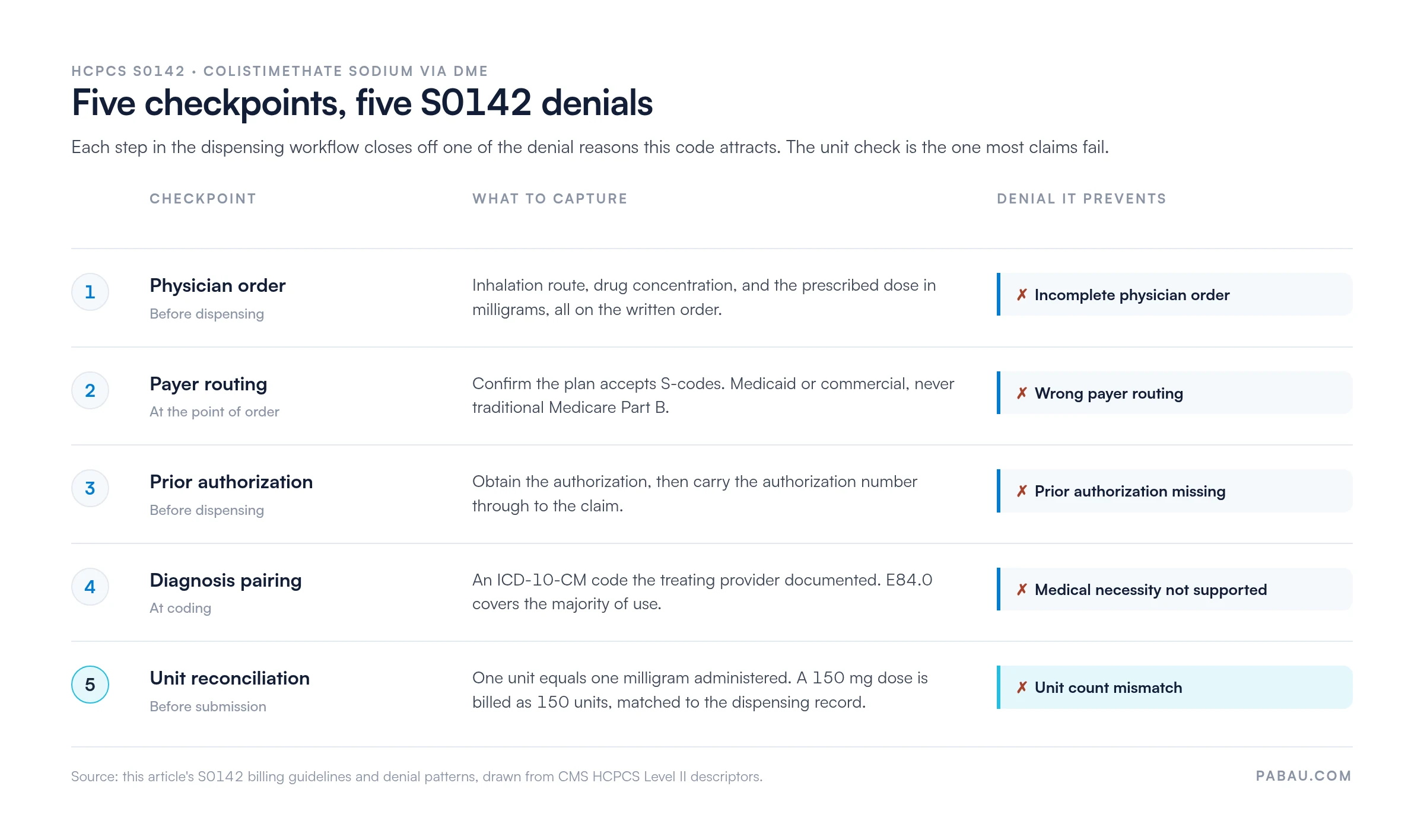
Billing teams handling per-unit drug codes lean on claims management software to hold those checkpoints in one place. That keeps the order, the authorization, and the unit count together when a payer asks for them.
Most DME suppliers and specialty practices track an S0142 episode across three disconnected places. The physician order sits in a fax folder. The authorization number lives in a spreadsheet, and the administered dose is written on a treatment note.
Reconciling units at billing time then means opening all three. Pabau, our practice management software, keeps those records against the patient instead. Structured treatment forms capture the inhalation route, the concentration, and the milligrams given at each visit.
Insurance details and authorization references sit on the same patient record, so the biller reads one screen rather than three. The outcome is a shorter reconciliation step and fewer claims returned over a unit count nobody can trace.
When a payer requests records during post-payment review, the documentation is already attached to the episode it belongs to.

Pabau’s claims management tools help DME suppliers and specialty practices track per-unit drug billing. Payer-ready documentation stays on the patient record, which reduces rejections on codes like S0142.

Two checks decide whether an S0142 claim survives. The first is the payer, since a claim sent to traditional Medicare Part B is dead on arrival. The second is the milligram count, which turns into an audit finding months later if it cannot be traced.
The rest is routine. Build the documentation habit once, at the point of dispensing, and the claim assembles itself from records that already exist. Book a demo to see how Pabau keeps physician orders, authorizations, and administered doses on one patient record.

Want to reduce claim rejections across your HCPCS billing? What is medical billing explains the full lifecycle from documentation through reimbursement.
Seeing denials on drug claims? Denial management in healthcare covers systematic approaches to reducing and recovering rejected claims.
Need a billing compliance checklist? Medical billing compliance outlines documentation and audit requirements for specialty drug billing.
HCPCS code S0142 is a temporary national HCPCS Level II S-code. It describes colistimethate sodium inhalation solution administered through durable medical equipment (DME), concentrated form, billed per milligram. It is used by Medicaid programs and commercial payers to reimburse inhaled colistimethate sodium dispensed through a qualifying nebulizer system.
No. Medicare Part B does not typically reimburse HCPCS S-codes, including S0142. S-codes are temporary national codes designated for non-Medicare payers. Claims submitted to traditional Medicare Part B for S0142 will be denied. Dual-eligible patients should have these claims routed through Medicaid rather than Medicare.
State Medicaid programs are the primary payers for S0142, and most commercial and private insurers also accept the code. Coverage policies, prior authorization requirements, and reimbursement rates vary by state and plan. Some Medicare Advantage plans may accept S-codes under commercial rules. Always verify eligibility and prior authorization requirements with the specific payer before dispensing.
The “per mg” billing unit means one unit on the claim equals one milligram of colistimethate sodium administered to the patient. If a patient receives a 150 mg dose, bill 150 units of S0142. The quantity billed must match the administered milligrams documented in the treatment record and dispensing log. Do not bill the vial size, or the prescribed dose if it was diluted before administration.
E84.0 (cystic fibrosis with pulmonary manifestations) is the most common diagnosis paired with S0142, reflecting its primary use in suppressing Pseudomonas aeruginosa in CF patients. Other commonly paired codes include J18.9 (pneumonia, unspecified organism) and J96.0 (acute respiratory failure) for non-CF gram-negative respiratory infections. Medical necessity must be documented by the treating physician regardless of which diagnosis code is used.
Submit S0142 on the appropriate claim form (CMS-1450 for facilities, CMS-1500 for professionals/suppliers) to the state Medicaid program. Include the exact milligrams administered as the unit count. Add the treating and ordering physician NPIs, a supporting ICD-10 diagnosis code, and the supplier’s accreditation information. Obtain prior authorization before dispensing if required by the state plan, as many Medicaid programs require PA for inhaled specialty antibiotics.
Yes. S0142 belongs to the HCPCS Level II S-code series, which CMS classifies as temporary national codes. These codes exist for Medicaid and private payers. They apply when no permanent J-code or other HCPCS Level II code covers a specific drug or service. CMS maintains the S-code list annually and may add, revise, or delete codes with each update cycle.



