CCSD code H4430: Examination of rectum under anaesthetic
CCSD code H4430 pays for the examination alone CCSD code H4430 is the UK private...

Last Updated: Oct 20, 2026
J3245 is the HCPCS Level II code for injection, tildrakizumab, 1 mg.
Tildrakizumab is marketed as Ilumya by Sun Pharmaceutical Industries. It carries the USAN suffix tildrakizumab-asmn, the biologic qualifier assigned by the FDA.
Ilumya is an interleukin-23 (IL-23) inhibitor approved by the FDA for moderate-to-severe plaque psoriasis in adults. The code is billable under Medicare Part B as a physician-administered drug. Per the CMS HCPCS overview, J-series codes apply to drugs that cannot be self-administered and are furnished incident to a physician's professional service.
Let Pabau's smart automation suggest the right codes, reduce claim denials, and keep your practice compliant—effortlessly.
Automate repetitive tasks and focus on what matters most—your patients.
Reduce coding errors and ensure compliance with the latest regulations.
Clean claims, fewer denials, and faster reimbursements.
Powerful insights and reporting to help your practice thrive.
HIPAA compliant SOC 2 certified GDPR-compliant Trusted by 4,000+ clinics worldwide

HCPCS code J3245 describes an injection of tildrakizumab (Ilumya), 1 mg per unit, for moderate-to-severe plaque psoriasis in adults
A standard 100 mg Ilumya dose bills as 100 units of J3245. Wrong unit counts are the leading cause of denials for this code.
Medicare Part B pays J3245 at ASP+6% in non-facility settings. Rates change quarterly, so check the current CMS ASP pricing file before each new quarter.
Most payers also want the NDC on the claim, reported with the N4 qualifier and an ML unit of measure
Practice management software like Pabau ties each J3245 claim line to the treatment record, so units and diagnosis codes match the documentation
The unit convention for J3245 is 1 mg per unit. Ilumya is supplied and given as a 100 mg subcutaneous injection, so a single dose is 100 units on the claim. Billing fewer than 100 units for a standard dose is a common cause of underpayment or denial.
FDA labeling sets the following dosing schedule for moderate-to-severe plaque psoriasis in adults.
Mapped onto a calendar, that schedule produces six administrations in the first year rather than the three rows above. Every one of them carries the same 100 units.
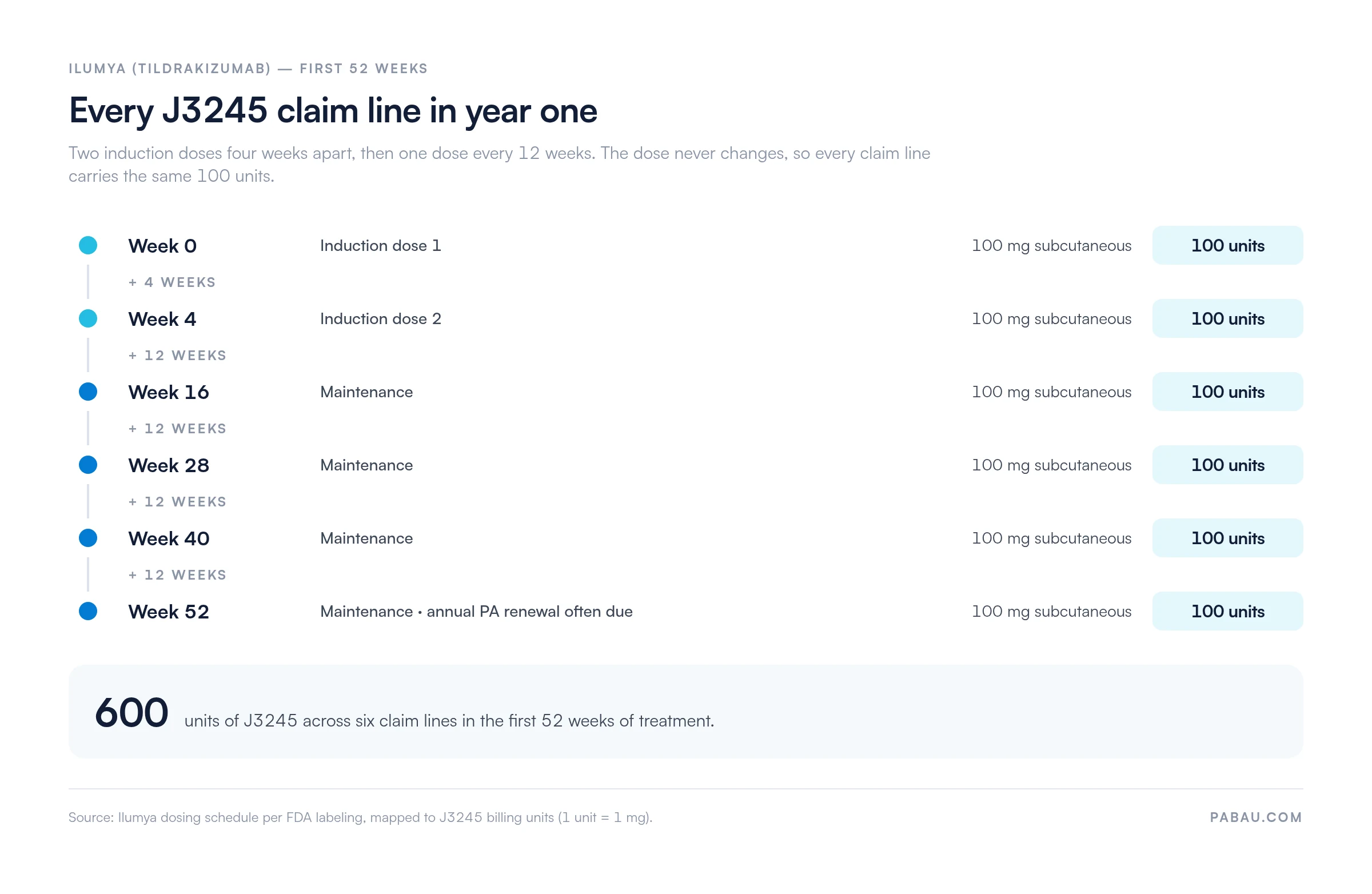
Each claim for a standard Ilumya administration shows J3245 with units = 100. Practices using claims management software that links injection billing to the treatment record can pull the unit count straight from the documented dose. That removes the manual entry step behind most unit errors on high-cost biologics.
Medicare Part B covers J3245 as a physician-administered drug under the average sales price (ASP) payment methodology. CMS pays Part B drugs at ASP+6% in non-facility settings such as a physician office. In hospital outpatient settings the facility payment follows OPPS rules, and the provider portion is subject to cost-sharing.
CMS updates ASP pricing quarterly, so published third-party figures go stale fast. Verify the current ASP file at the CMS Physician Fee Schedule lookup before billing a new quarter’s claims.
Commercial and managed Medicaid payers set their own contracted rates for J3245, which may differ substantially from Medicare ASP. Tracking per-payer reimbursement against the documented dose and units surfaces underpayment patterns early. That record also supports payer audits and internal contract reviews.
Verify your MAC’s (Medicare Administrative Contractor) local coverage article for J3245 before the start of each new quarter. Noridian and other MACs occasionally publish coding alerts for high-cost biologic J-codes. Those alerts can change documentation requirements or coverage limits that the national ASP file does not show.
Many payers, including Medicare, require the National Drug Code (NDC) on claims alongside HCPCS code J3245. The NDC identifies the specific drug product, package size, and labeler. It crosswalks the pharmacy dispensing record to the HCPCS billing code. Tildrakizumab products come from Sun Pharmaceutical Industries and carry NDCs that must be mapped to J3245 on the CMS-1500 or 837P claim.
Report the NDC as qualifier N4, then the 11-digit NDC with no dashes, then the unit of measure and the quantity. Ilumya is supplied as a 100 mg/mL single-dose prefilled syringe, so the unit of measure is ML rather than UN. A standard dose is reported as 1 mL.
NDCs for tildrakizumab-asmn change when new lot configurations are released. Confirm current NDCs against your wholesaler invoice or the AAPC HCPCS code reference rather than a static list.
Practices that submit claims electronically can carry the NDC from the dispensed drug record onto the J3245 claim line. That removes the transcription step behind most NDC rejections. Practice management software like Pabau integrates with Claim.MD, which supports 837P submission and NDC reporting across thousands of US payers.
Medical necessity for J3245 claims depends on pairing the HCPCS code with an appropriate ICD-10-CM diagnosis code. Payers use local coverage determinations (LCDs) and national coverage determinations (NCDs) to define which diagnoses support coverage for tildrakizumab. The codes below are the ones payer LCDs most often cite for Ilumya. Covered diagnoses vary by payer, so verify against your MAC’s LCD before submitting.
For dermatology practices billing J3245 often, the diagnosis in the treatment record has to match the diagnosis on the claim. A mismatch between the clinical note and the submitted ICD-10 code is a common trigger for payer audits on high-cost biologics. The CMS ICD-10 codes page publishes the official annual code updates and guidelines for Medicare claims.
Commercial payers and managed Medicaid plans almost universally require prior authorization (PA) before they reimburse J3245. Medicare does not require PA for most Part B drugs given in a physician’s office. Medicare Advantage plans may impose their own PA requirements, so confirm with the specific payer before the first administration.
Common PA requirements across major payers for tildrakizumab include the following.
Missing or expired PA is the single largest denial driver for biologic injection codes. Practices managing several biologic patients should track PA expiration dates alongside treatment schedules. A documented trail of PA status at each administration date supports an appeal when a payer disputes coverage later.
Correct place of service (POS) coding matters for J3245 because the payer’s rate varies by setting. An office administration billed with POS 22 will trigger a rate reduction or a denial. In that setting the facility fee is expected to cover the drug cost.
When you submit electronically, route the claim through a clearinghouse that validates HCPCS codes, unit counts, and NDC fields before the payer sees it. J3245 covers the drug only. The injection service bills on its own line, and the CPT codes for drug administration start with 96372 for a subcutaneous injection.
J3245 generates a predictable set of claim denials, and most are preventable with the right pre-submission checks. The errors below are the failure points that show up most often in biologic injection billing. They follow published payer denial patterns for J-series drug codes.
Practices managing recurring biologic patients benefit from a PA tracking log tied to each patient’s treatment schedule. Denied J3245 claims then get flagged for appeal with the right supporting documents instead of being written off. For a structured approach to submission, the clean claim checklist covers what payers expect on physician-administered drug billing.
Run a monthly audit of all J3245 claims submitted in the prior 90 days. Filter by denial reason code and sort the denials into four buckets, covering units, PA, NDC, and ICD-10 mismatches. This four-bucket breakdown shows where your workflow needs a fix before the next quarter’s biologic claims go out.
Dermatology and rheumatology billing teams often code several IL-23 and IL-12/23 inhibitors within the same patient panel. Knowing how J3245 relates to the other biologic injection codes cuts miscoding risk when a patient switches therapy.
Each of those codes carries its own unit convention, so never copy a unit count from one biologic to another. For a broader reference on HCPCS Level II code structure, the PGM Billing HCPCS lookup tool offers a free searchable database built on CMS data.
The unit-count caution reaches beyond the IL-23 class too, since intravenous tocilizumab bills per milligram under its own code, J3262.
In most practices the injection is documented in one system and billed in another. A staff member reads the dose from the note, types the units into the billing screen, and checks the PA date on a separate spreadsheet. Each of those handoffs is a chance for a 100 to become a 1.
Pabau keeps the treatment note, the patient record, and the invoice in one place. The dose recorded at the visit is the dose the billing team works from, and the claim is raised from that same record. Reporting then shows which J3245 claims were paid, short-paid, or denied.
For a dermatology practice running a panel of biologic patients, that means fewer unit-count corrections and a documented trail behind every appeal. The Claim.MD integration handles 837P submission, so claims leave the same system that holds the clinical evidence.

Pabau connects injection billing records, treatment documentation, and claims workflows so your team spends less time chasing denials and more time on patient care.

The most preventable J3245 denials come from a mismatch between what the clinical record documents and what the claim says. Wrong units, a mismatched ICD-10 code, a lapsed PA, and a missing NDC are all fixable before the claim leaves the practice.
Set those checks up once and they hold for every maintenance dose that follows. A patient on Ilumya generates six claim lines in year one, so one workflow fix pays for itself quickly. Book a demo to see how Pabau ties biologic billing to the treatment record.

Need to understand how clearinghouse submission works for J-codes? Medical claims clearinghouse guide explains how 837P electronic claims are validated and routed to payers before payment.
Want to reduce denials across all your HCPCS codes? Denial management in healthcare covers the end-to-end process for identifying, appealing, and preventing claim denials.
Looking for the billing compliance checklist for your practice? Medical billing compliance outlines the documentation and submission standards that protect practices during payer audits.
J3245 is the HCPCS Level II code for an injection of tildrakizumab (Ilumya), billed at 1 mg per unit. Clinicians use it for moderate-to-severe plaque psoriasis in adults. It is a J-series injectable drug code covered under Medicare Part B as a physician-administered biologic.
A standard 100 mg Ilumya dose requires 100 units of J3245, because the code is defined as 1 mg per unit. Billing 1 unit for a 100 mg dose is the most frequent unit-count error on J3245 claims and typically results in an underpayment or denial.
Yes, Medicare Part B covers J3245 as a physician-administered drug, reimbursed at ASP+6% under the Average Sales Price methodology. Rates update quarterly, so always check the current CMS ASP file before billing. Medicare Advantage plans may impose additional prior authorization requirements.
L40.0 (psoriasis vulgaris/plaque psoriasis) is the primary diagnosis code used with J3245. Some payer LCDs also accept L40.8 or L40.9 for related psoriasis presentations. The covered codes vary by payer, so verify against your MAC’s local coverage determination before submitting.
Traditional Medicare Part B generally does not require prior authorization for J3245 in an office setting. Commercial payers and Medicare Advantage plans almost universally do. PA requirements typically include documented moderate-to-severe severity and step therapy failure with conventional systemic agents.
The NDC codes for tildrakizumab-asmn (Ilumya) products manufactured by Sun Pharmaceutical Industries crosswalk to J3245. Report the NDC with the N4 qualifier, the 11-digit number without dashes, and an ML unit of measure. Confirm current NDCs against your wholesaler invoice, as lot configurations can change.
Medicare Part B reimburses J3245 at ASP+6% per unit billed, updated quarterly by CMS. The rate changes every quarter, so check the current CMS ASP pricing file or the Physician Fee Schedule lookup rather than a published static rate.
The CMS HCPCS overview and Physician Fee Schedule lookup are the authoritative sources for J3245 code status and Medicare payment rates. Free commercial lookup tools such as the PGM Billing HCPCS lookup also provide CMS-sourced code data for quick reference.