

CCSD code G5100: Bypass of duodenum billing guide
CCSD code G5100 bills a bypass that leaves the duodenum in place CCSD code G5100...

Last Updated: Oct 16, 2026
Q4140 is the HCPCS Level II code for biodfence, per square centimeter (add-on, list separately in addition to primary procedure).
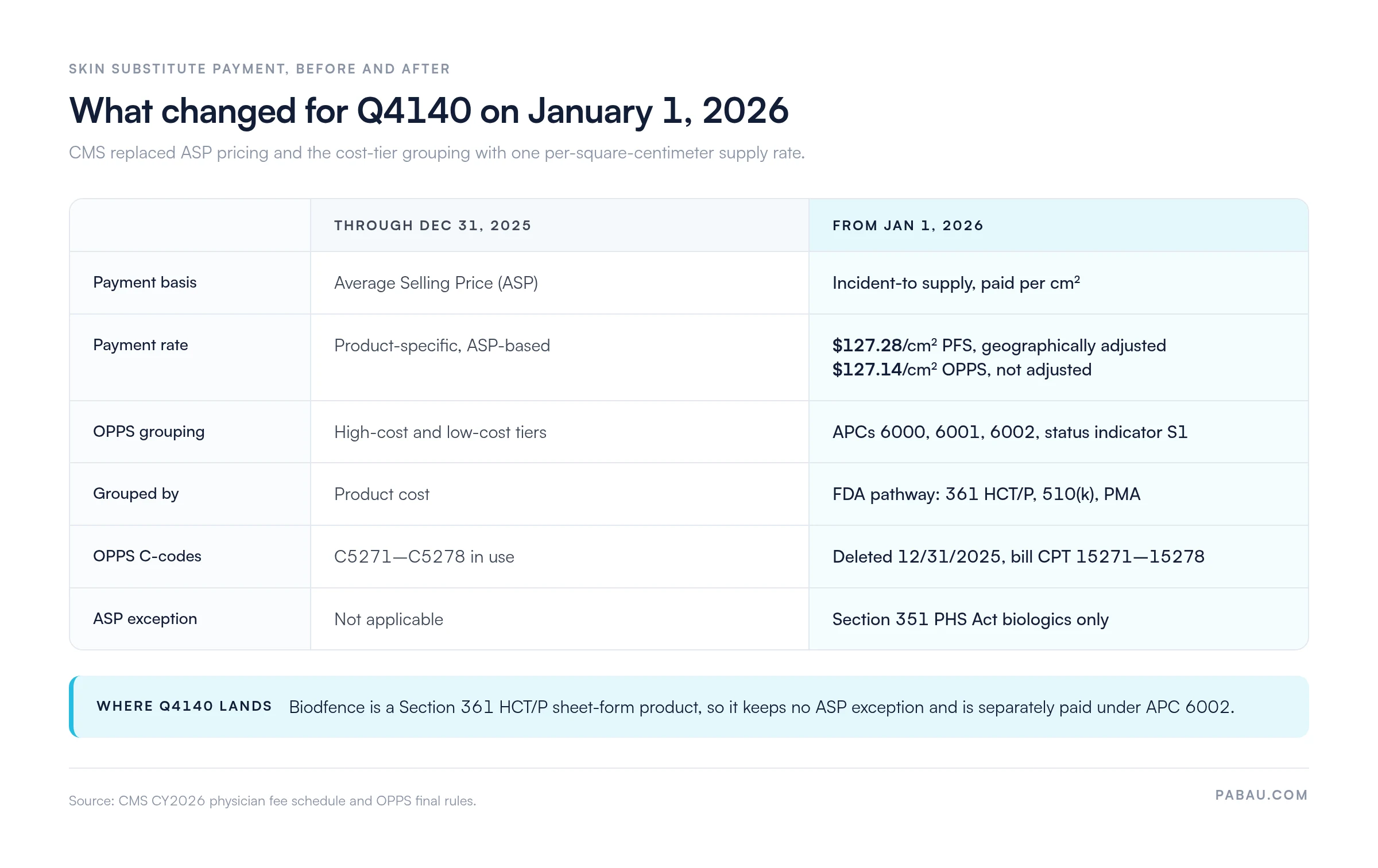
The billing rules changed on January 1, 2026. CMS now pays skin substitute products as incident-to supplies at one site-neutral rate per square centimeter. The high-cost and low-cost APC split that governed these products through 2025 no longer applies.
Let Pabau's smart automation suggest the right codes, reduce claim denials, and keep your practice compliant—effortlessly.
Automate repetitive tasks and focus on what matters most—your patients.
Reduce coding errors and ensure compliance with the latest regulations.
Clean claims, fewer denials, and faster reimbursements.
Powerful insights and reporting to help your practice thrive.
HIPAA compliant SOC 2 certified GDPR-compliant Trusted by 4,000+ clinics worldwide

HCPCS code Q4140 describes Biodfence, per square centimeter, a Level II Q-series code for a dehydrated amniotic membrane skin substitute billed by wound area
From January 1, 2026, CMS pays Q4140 as an incident-to supply at a single site-neutral rate rather than on ASP
The 2026 rate is roughly $127.28 per cm² under the physician fee schedule and $127.14 per cm² under the OPPS. Q4140 sits in APC 6002
No national LCD covers skin substitutes. Novitas, First Coast and CGS apply L35041 with article A54117, while other MACs decide case by case
Always pair Q4140 with a CPT application code from 15271 to 15278, and Pabau’s claims management software flags a missing one before submission
Biodfence is a dehydrated amniotic membrane skin substitute designed for chronic wounds where the body’s own tissue repair is insufficient. It is regulated as a Section 361 human cell and tissue product. Confirm the current FDA pathway against the manufacturer label before billing. Applied as a sheet, it provides a temporary structural matrix to support wound closure.
Medicare coverage for these products centers on chronic venous leg ulcers and diabetic foot ulcers that have failed standard wound care. Wound care programs and dermatology practices both bill the product per square centimeter applied. Wound measurement at the time of application is both a clinical and a billing requirement.
Medicare no longer pays Q4140 on Average Selling Price. Since January 1, 2026, CMS treats skin substitute products as incident-to supplies when they are applied during a covered procedure. Payment runs through the physician fee schedule in the non-facility setting and through the OPPS in hospital outpatient departments.
The rate is site-neutral. CMS set roughly $127.28 per square centimeter under the physician fee schedule, which is geographically adjusted. The OPPS rate is $127.14 per square centimeter and is not geographically adjusted.
Payment now turns on wound measurement, because the units billed carry it in full. Confirm the current figures in the CY2026 fee schedule files before you bill, since CMS issues technical corrections.
Place of service still decides which system pays. A physician office bills Q4140 under the physician fee schedule. A hospital outpatient department bills under the OPPS. The two rates are close but not identical, and the wrong place-of-service code remains a frequent audit trigger.
Use the CMS Physician Fee Schedule lookup to verify current payment rates for Q4140 by MAC jurisdiction and place-of-service indicator before billing.
The high-cost and low-cost grouping is gone. CMS eliminated it in the CY2026 OPPS final rule and deleted codes C5271 through C5278 on December 31, 2025. Skin substitute products moved into three new APCs, 6000, 6001 and 6002, under the new status indicator S1.
Products are now grouped by FDA pathway rather than by cost, across the 361 HCT/P, 510(k) and PMA categories. Only biologics licensed under Section 351 of the PHS Act kept ASP methodology. Q4140 is a Section 361 HCT/P, so it does not qualify for that exception.
Sheet-form products such as Biodfence are unpackaged and separately paid under the OPPS. Q4140 therefore sits in APC 6002 rather than being swept into the payment for the application procedure. The comparison below sets the 2025 rules against the 2026 rules line by line.
Place of service (POS) determines which fee schedule governs Q4140 reimbursement and which bill type codes apply. Getting it wrong invites an audit as well as a delayed payment.
Confirm bill type codes and revenue codes with your specific Medicare Administrative Contractor (MAC) before billing. Noridian, Novitas, CGS, and Palmetto GBA may have jurisdiction-specific guidance that supersedes general CMS tables.
Q4140 is a product code. It cannot stand alone on a claim. According to CMS billing article 54117, the application of bioengineered skin substitutes requires a companion CPT application code from the 15271-15278 series. Submitting Q4140 without the correct application code is the single most common denial for this product.
Codes 15273, 15274, 15277 and 15278 are not pediatric codes. They apply to any patient whose total wound surface area reaches 100 sq cm or more. The 1% of body area wording in the descriptor is an alternate measure for infants and children, not an age restriction on the code.
The 15271-15278 series applies to sheet-form products only. Non-sheet skin substitutes, such as the injectable EpiFix billed under Q4145, report application with the G0681-G0684 series instead.
Covered diagnosis lists sit in the MAC’s local coverage policy, not in a single national list. Where LCD L35041 applies, its billing article A54117 carries the ICD-10-CM codes that support a skin substitute application. Billing Q4140 against a diagnosis outside that list creates an automatic denial. Check the patient’s diagnosis against the applicable covered list before the product is opened.
Always select the most specific ICD-10-CM code available. An unspecified code increases denial risk, because it does not clearly demonstrate the wound characteristics the coverage policy requires. Coverage under L35041 centers on lower extremity chronic non-healing wounds, so burn and pressure injury indications depend on the payer.
There is no national Local Coverage Determination for skin substitutes. The policy that carries the Q-code and covered diagnosis lists is LCD L35041, Application of Bioengineered Skin Substitutes to Lower Extremity Chronic Non-Healing Wounds. Its billing article is A54117. The same article frames coverage for related products, including Q4111 for Gammagraft.
L35041 and A54117 are active in the Novitas, First Coast and CGS jurisdictions only. Palmetto GBA, NGS, WPS and Noridian carry no skin substitute LCD and adjudicate these claims case by case. Check your own MAC’s position on skin substitutes before the product goes on the wound.
A harmonized set of DFU and VLU skin substitute LCDs was withdrawn on December 24, 2025, before it ever took effect. No single national coverage number replaced the jurisdictional patchwork, so document criteria against the policy that applies to you.
Where L35041 applies, covered indications generally include:
Commercial payers such as BCBS and Aetna follow their own medical policies for bioengineered skin substitutes. Those policies may differ from L35041 on covered diagnoses, applications permitted per year, and prior authorization. Prior authorization for Q4140 is payer-specific. Some MACs and commercial plans require it and others do not. Check the payer’s current policy and your MAC’s jurisdiction guidance before each application episode.
Documentation is what carries a Q4140 claim through review. CMS, and L35041 where it applies, require specific elements in the medical record before and at the time of application.
Assemble the charge detail before the claim goes out. A complete package carries Q4140, the companion application code, and every supporting ICD-10-CM code.
Under the 2026 rule the wound measurement is the payment. Q4140 units are multiplied by a fixed per-square-centimeter rate, so a loosely recorded measurement moves the money directly. Photograph the wound and record length by width at every application, then make the units on the claim match the note exactly.
The CY2026 rules rewrote skin substitute payment rather than adjusting it. Wound care practices need to reset expected reimbursement, and to recheck every fee estimate built on a 2025 assumption.
Q4140 sits within a large family of skin substitute Q-codes. Coders often confuse adjacent codes when products share similar descriptions. Use the AAPC HCPCS code lookup to verify the current code assigned to the specific product applied.
Q4158 covers Kerecis Omega3, an acellular fish-skin graft that also bills per square centimeter under the 2026 site-neutral rate. It pairs with the same CPT 15271-15278 application series, so the companion-code rule you follow for Q4140 applies there too.
Never substitute one Q-code for another to achieve a higher reimbursement rate. Each code is product-specific; billing Q4140 for a different product constitutes upcoding and creates false claims liability. Biodfence Dryflex is a separate product with its own code, so a Dryflex application bills as Q4138 and never as Q4140.
These are the patterns that generate the most denials and the most rework for wound care billing teams. Effective denial management in healthcare starts with preventing them before submission, rather than chasing them afterward.
Build a Q4140 pre-submission checklist into your billing workflow. Confirm the product code, the application code, and a place of service that matches the setting. Then confirm the diagnosis is on your MAC covered list, the wound area in cm² matches the units, and prior treatment failure is documented. Running the checklist takes under two minutes and removes the most common denial categories before the claim leaves the practice.
Practices that apply skin substitutes regularly need a system that keeps wound measurements, companion codes, and documentation requirements connected. Under the 2026 per-square-centimeter rate, the measurement in the chart is the number that gets paid.
Practice management software like Pabau holds those elements in one patient record. Pabau’s claims management software tracks what a Q4140 claim needs, from the wound measurement through to submission. Tying the treatment note to the claim means companion codes stop getting missed.
The measurement, the signed order, and the product lot number all sit beside the charge, so nobody reconciles two systems at month end. See how Pabau’s billing tools fit your wound care workflow by booking a demo.

Pabau’s claims management software tracks wound measurements, flags missing companion codes, and helps wound care practices submit cleaner claims with fewer denials.

The 2026 rules moved the risk on a Q4140 claim from pricing to measurement. When every square centimeter pays the same fixed amount, the figure in the wound note becomes the figure on the remittance. Tightening measurement discipline pays back faster than any appeal you write.
Coverage deserves the same caution. Until CMS replaces the withdrawn DFU and VLU policies, your own MAC decides whether the application is covered at all. Confirm that position before the product is opened, not after the denial lands.
Get those two right and most of the rework this code generates disappears. Book a demo to see how Pabau keeps wound measurements, companion codes, and claim submission in one workflow.

Need to understand the full claims process before submitting Q4140? What is medical billing explains the end-to-end process from charge capture through remittance.
Getting denials on skin substitute claims? Denial management in healthcare covers root-cause analysis and appeal strategies for common remittance codes.
Want to understand how clearinghouses process wound care claims? Medical claims clearinghouse explains how electronic claims are validated, scrubbed, and routed to payers.
HCPCS code Q4140 is used to bill for Biodfence, a dehydrated amniotic membrane skin substitute, applied per square centimeter of wound area. It is used for chronic lower extremity ulcers, including diabetic foot ulcers and venous leg ulcers that have not closed with standard care. A companion CPT application code from 15271 to 15278 must be billed on the same claim.
Medicare pays Q4140 at a single site-neutral rate per square centimeter, effective January 1, 2026. That rate is roughly $127.28 per cm² under the physician fee schedule, which is geographically adjusted. Under the OPPS it is $127.14 per cm², with no geographic adjustment. ASP-based pricing no longer applies to Q4140, so confirm the current figure in the CY2026 fee schedule files before billing.
No. CMS eliminated the high-cost and low-cost skin substitute grouping in the CY2026 OPPS final rule. Codes C5271 through C5278 were deleted on December 31, 2025. Products are now grouped by FDA pathway across 361 HCT/P, 510(k) and PMA. Q4140 is a 361 HCT/P sheet-form product and is separately paid under APC 6002 with status indicator S1.
No national LCD covers skin substitutes, so the answer depends on your MAC. Novitas, First Coast and CGS apply LCD L35041 with billing article A54117. Palmetto GBA, NGS, WPS and Noridian carry no skin substitute LCD and review these claims case by case. Check your own jurisdiction policy before the product is applied.
Common ICD-10-CM codes paired with Q4140 include E11.621 for type 2 diabetes with foot ulcer and the L97 series for chronic lower extremity ulcers. Coders also use I83.009 for varicose veins with ulceration and the T31 series for burn wounds. Covered diagnosis lists are jurisdictional rather than national. Where LCD L35041 applies, its billing article A54117 carries the covered codes. Always use the most specific code available, since an unspecified code increases denial risk.
CPT codes 15271 through 15278 are the required application codes billed alongside Q4140. The correct code depends on body region and total wound surface area. Codes 15271, 15272, 15275 and 15276 work in 25 sq cm increments. Codes 15273, 15274, 15277 and 15278 apply once total wound surface area reaches 100 sq cm, at any age. Omitting the application code is the most common reason Q4140 claims are denied.
Required documentation includes wound measurements in cm² that match the units billed, plus the wound type and its duration. The record also needs at least 30 days of prior standard wound care with documented failure to respond. Add a signed physician order, a medical necessity narrative, and the product label with its lot number. Where LCD L35041 applies, it specifies these requirements. Incomplete documentation makes the claim non-covered rather than merely deficient.
Payment changed completely. From January 1, 2026, CMS pays skin substitute products as incident-to supplies at one site-neutral rate per square centimeter. The high-cost and low-cost APC grouping was eliminated and C5271 through C5278 were deleted. Q4140 remains an active code for Biodfence and is paid under APC 6002. Only Section 351 licensed biologics kept ASP methodology, and Q4140 is not one of them.



