CPT code 93503: Swan-Ganz catheter billing and modifiers
CPT code 93503: Official descriptor and procedure overview In the AMA CPT code s...

Last Updated: Oct 23, 2026
E0275 is the HCPCS Level II code for bed pan, standard, metal or plastic.
CMS runs that code set under the Durable Medical Equipment, Prosthetics, Orthotics and Supplies (DMEPOS) program. The code is active and billable for the 2026 fiscal year.
The full official descriptor is "Bed pan, standard, metal or plastic." Both material types, metal and plastic, sit under this single code. A fracture bed pan is a different device with its own code, E0276.
Let Pabau's smart automation suggest the right codes, reduce claim denials, and keep your practice compliant—effortlessly.
Automate repetitive tasks and focus on what matters most—your patients.
Reduce coding errors and ensure compliance with the latest regulations.
Clean claims, fewer denials, and faster reimbursements.
Powerful insights and reporting to help your practice thrive.
HIPAA compliant SOC 2 certified GDPR-compliant Trusted by 4,000+ clinics worldwide

HCPCS code E0275 covers a standard bed pan, metal or plastic, billed as Medicare Part B durable medical equipment.
Coverage runs through CMS LCD L36267, so medical necessity has to be documented before you bill.
KX, GA, GY, GZ, NU, RR, and UE are the modifiers that apply to E0275.
Leaving KX off a claim that meets the necessity criteria is the most common denial trigger.
Practice management software like Pabau tracks modifier rules, documentation, and claim status in one place.
Medicare Part B covers E0275 under the DME benefit when a patient cannot use a standard toilet because of a qualifying condition. Coverage is not automatic. It is governed by Local Coverage Determination (LCD) L36267, “Bowel Management Devices,” published by CMS. Check the claim against that LCD before you bill it.
CMS Policy Article A54516 accompanies LCD L36267 and turns coverage policy into claim-level requirements. Keep both documents on file if you bill E0275 regularly.
Medicare covers E0275 when the patient meets the necessity standard in LCD L36267. The treating physician has to document a condition that prevents the patient from reaching a toilet. The record also has to show that a standard bed pan is part of the plan of care. Conditions that commonly support medical necessity include:
Coverage is denied when the record does not name the condition or the functional limitation preventing toilet use. Naming it precisely matters most on rare diagnoses, where an inherited autonomic disorder belongs at ICD-10 code G90.1 rather than an unspecified neurologic entry. A physician order on its own is not enough. Clinical notes have to explain why a bed pan is needed instead of a commode. That explanation often comes from an occupational therapy assessment rather than the ordering physician.
Before submitting any E0275 claim, pull the patient’s most recent progress notes and confirm the physician has documented the functional limitation preventing toilet access. A signed order with no supporting clinical notes is a frequent audit finding.
Medicare reimburses E0275 under the DMEPOS fee schedule, not the Physician Fee Schedule. CMS updates DMEPOS rates every year. Check the 2026 national allowed amount against the current CMS DMEPOS fee schedule file, because rates vary by region. CMS can also adjust them mid-year.
Pull the current file from the CMS website, or from the fee schedule tables inside your billing system. Relying on prior-year rates without checking the current file is a compliance risk.
Billing E0275 takes more than dropping the code on a CMS-1500 or an electronic claim. Confirm DMEPOS enrollment, verify Part B benefits, obtain a compliant physician order, and append the right modifier.
Modifier selection decides whether an E0275 claim pays. The table below covers the modifiers that apply to standard bed pan billing. Check each one against CMS Policy Article A54516, since your MAC may add requirements.
With built-in stock tracking, every brace or device billed under these codes is deducted from inventory automatically.
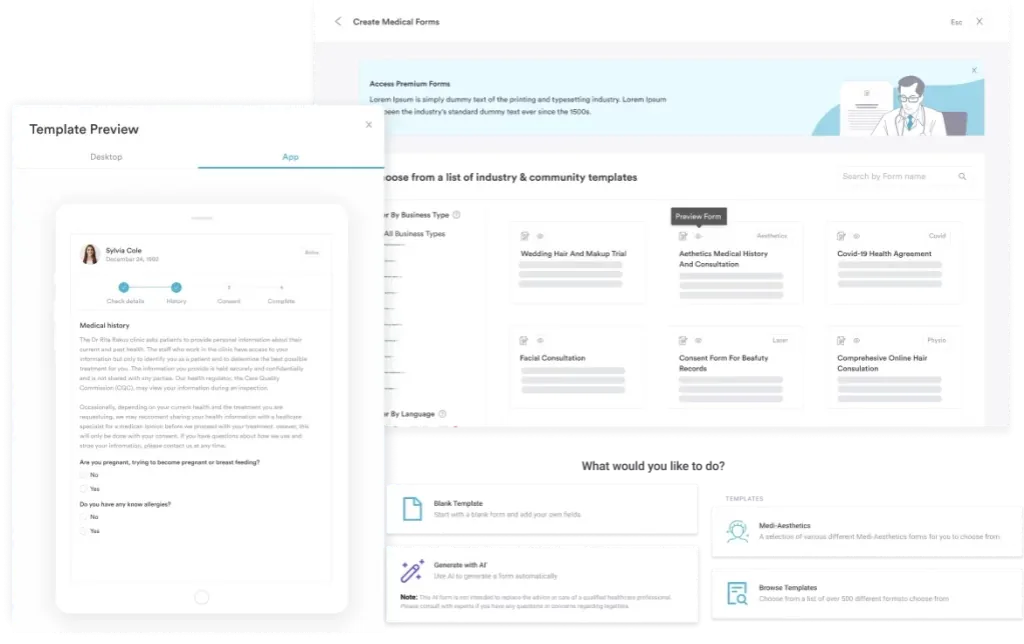
Documentation errors are a frequent reason E0275 claims are denied or recouped on audit. Assemble the file before submission, not after a denial lands. Standardized medical forms give every claim the same documentation package.
Progress notes from physical therapy often carry the clearest description of what the patient cannot do unaided. A digital forms system that timestamps each document against the patient record makes those notes easy to produce at audit. Paper packets are harder to retrieve and easier to lose across multiple locations.
The errors below come up again and again on E0275 claims. Building prevention into the workflow costs less than reworking denials one at a time. Tightening up revenue cycle management pays off across every DMEPOS line you bill, not only bed pans.
E0275 sits in a group of bowel management and patient mobility codes. Picking the wrong one from that group is a common coding error, especially when the item delivered is a fracture pan or a commode. The AAPC HCPCS reference lists the full descriptors for the E-series.
E0275 and E0276 are the pair most often confused. Confirm with the clinician whether the patient has a hip fracture or another orthopedic condition needing a fracture pan. Coding the wrong one of the two means a denial and a corrected claim. If the same patient also needs the covers kept off their legs and feet, a bed cradle bills separately as HCPCS code E0280.
The NLM Clinical Table Search API gives you a free lookup if you want to verify descriptors programmatically.
E0275 belongs to a US code set that CMS maintains for Medicare and Medicaid billing. Outside Medicare, the rules change with the payer.
Medicaid: State programs vary widely in how they cover DME supplies. Some follow Medicare’s LCD framework closely, while others apply their own coverage policies, prior authorization rules, and fee schedules. Verify the state Medicaid DME policy separately from LCD L36267. Many states also expect HIPAA-compliant records to support the prior authorization. Every payer sets its own timely filing window, and a correctly coded claim still fails once that window closes. The CARC denial code list is short enough to learn, and most rework traces to a handful of entries.
Commercial payers: Many commercial insurers accept HCPCS Level II codes for DME, but coverage, prior authorization, and fee schedules are plan-specific. Call provider relations or read the provider manual before billing E0275 to a commercial plan. Prior authorization for DME is more common here than with Medicare.
Self-pay: E0275 is not billed to any payer for a self-pay patient. You invoice the patient directly at your established price. No modifier applies, and LCD criteria do not come into it.
When billing E0275 to Medicaid, never assume the Medicare LCD L36267 criteria apply. Request the state Medicaid DME coverage policy for bed pans directly from your state’s Medicaid agency or MAC and keep it on file. State policies can differ substantially from Medicare in both covered diagnoses and quantity limits.
Most DME billing teams keep the E0275 rules in their heads or in a shared spreadsheet. The order sits in one folder, the clinical notes in the patient’s chart, and the delivery slip in a scanning queue. Nobody sees the whole file until a denial arrives.
Practice management software like Pabau keeps all of it against one patient record. Digital forms capture the order, the ABN, and the delivery confirmation, each timestamped as it is signed. Your billing team can see what is missing before the claim goes out.
Pabau’s claims management tools track which modifier each DMEPOS code needs, so KX never gets left off a covered E0275 line. When an audit letter arrives, the whole documentation package is already in one place. That is the difference between answering a request in an afternoon and rebuilding a file from scratch.

Pabau’s claims management tools help DME suppliers and clinic billing teams track modifier requirements, maintain documentation checklists, and submit cleaner claims. Book a demo to see how it works in practice.

E0275 is a cheap item with an expensive failure mode. The device costs a few dollars. The documentation behind it is what a MAC reviews three years later. Decide now whether your team assembles that file at delivery or rebuilds it under pressure.
The trade-off worth remembering is small and one-sided. Two minutes of modifier and note checking at delivery beats a corrected claim, an appeal, and a recoupment letter. Build that check into the delivery step and E0275 stops being a denial line on your aging report.
Want the documentation and modifier checks built into the workflow rather than bolted on? Book a demo to see how Pabau handles DME claims end to end.

Billing other DMEPOS supplies to Part B? A4234 covers the order and proof-of-delivery rules that apply to a high-volume supply code.
Working through an LCD-driven implant claim? C1755 sets out the coverage documentation a MAC expects to see.
Billing a service where payer rules diverge from Medicare? S0265 shows how commercial and state policies treat the same code differently.
Coding an unspecified corneal scar? Corneal scar coding guide describes this billable code used when a corneal scar can’t be classified more specifically.
HCPCS code E0275 bills Medicare Part B and other payers for a standard metal or plastic bed pan. It applies when a patient cannot use a standard toilet because of a qualifying medical condition. The code is durable medical equipment under DMEPOS, governed by CMS LCD L36267.
Yes. Medicare Part B covers E0275 when the necessity criteria in LCD L36267 are met. The treating physician has to document the functional limitation preventing toilet use. An enrolled DMEPOS supplier must supply the item, and the claim needs the KX modifier when necessity is established. The patient pays 20% coinsurance after the Part B deductible.
Seven modifiers apply to E0275. KX confirms the LCD necessity criteria are documented, and GA shows an ABN is on file. GY marks a non-covered item, and GZ an expected denial with no ABN. NU, RR, and UE identify new, rented, and used equipment. KX is the one that decides whether a covered claim pays.
E0275 needs a written physician order carrying the diagnosis and the prescriber’s NPI. It also needs clinical notes supporting the functional limitation, plus a signed delivery confirmation. Records must link the patient’s ICD-10 diagnosis to the covered list in LCD L36267. Check whether a Certificate of Medical Necessity applies against CMS Policy Article A54516 and your MAC’s rules.
E0275 is for a standard bed pan, metal or plastic, used in general patient care. E0276 covers a fracture bed pan, a lower-profile design for patients with hip fractures. It also fits orthopedic conditions that require immobilization. Using the wrong code for the delivered item is a common billing error. Always confirm with the clinician which design was supplied.
LCD L36267, titled “Bowel Management Devices,” governs Medicare coverage of E0275. It defines the covered diagnoses, medical necessity criteria, and documentation requirements. CMS Policy Article A54516 accompanies this LCD and carries the billing-level instructions for clean claim submission. Both documents are available through the CMS Medicare Coverage Database.