CCSD code H4430: Examination of rectum under anaesthetic
CCSD code H4430 pays for the examination alone CCSD code H4430 is the UK private...

Last Updated: Oct 20, 2026
J2860 is the HCPCS Level II code for injection, siltuximab, 10 mg.
The CMS HCPCS Level II coding system maintains J2860 as the billing code for this drug across every Medicare payer type and most commercial plans.
Let Pabau's smart automation suggest the right codes, reduce claim denials, and keep your practice compliant—effortlessly.
Automate repetitive tasks and focus on what matters most—your patients.
Reduce coding errors and ensure compliance with the latest regulations.
Clean claims, fewer denials, and faster reimbursements.
Powerful insights and reporting to help your practice thrive.
HIPAA compliant SOC 2 certified GDPR-compliant Trusted by 4,000+ clinics worldwide

HCPCS code J2860 covers Injection, siltuximab, 10 mg, sold under the brand name Sylvant.
One billing unit equals 10 mg, and the dose is 11 mg/kg every three weeks, so unit counts move with patient weight.
Medicare Part B pays J2860 at ASP+6% per unit, and most commercial payers require prior authorization first.
Claims management software like Pabau’s tracks J-code units and NDC fields, so fewer biologic claims come back denied.
Siltuximab is a chimeric monoclonal antibody that binds and neutralizes IL-6, a pro-inflammatory cytokine. That cytokine sits at the center of multicentric Castleman disease (MCD). The FDA approved Sylvant for MCD in patients who test negative for human immunodeficiency virus (HIV) and human herpesvirus-8 (HHV-8). Claims for any other indication are unlikely to be covered.
For billing staff, the clinical picture shapes every claim. MCD is a rare lymph node disorder that drives overproduction of IL-6. A confirmed diagnosis, negative HIV and HHV-8 results, and documented disease progression are what support medical necessity on a J2860 claim.
Units for J2860 are counted per 10 mg of siltuximab actually administered. The dose is weight-based at 11 mg/kg, so every patient weight produces a different unit count. Three mistakes account for most incorrect unit counts.
The calculation formula: Dose (mg) = patient weight (kg) x 11 mg/kg. Units billed = dose administered (mg) divided by 10, rounded to the nearest whole unit under your payer’s waste policy.
Every row above opens more drug than the patient receives, and that leftover is what waste billing covers. Medicare generally allows billing the full vial when the remaining drug cannot be reused, which is the case with single-dose vials.
Document the administered dose, the vials opened, and the amount discarded in the infusion record. Waste policies for commercial plans vary, so check the payer’s rule before you submit.
Base units on the dose administered, not the dose ordered. If a patient’s weight changes between cycles, recalculate and update the units billed. Auditors treat a run of identical round-number unit counts as a documentation problem.
Most payers require the National Drug Code (NDC) on the claim line for physician-administered drugs billed under J-codes. Submitting J2860 without a valid NDC is a common reason for technical rejection. The NDC must reflect the vial that was dispensed and administered.
Sylvant comes in two vial sizes, and NDC numbers change when a manufacturer updates labeling or packaging. Verify current NDCs against the FDA drug label or the NCI SEER CanMED HCPCS database before each billing cycle. Treat the table below as a format reference rather than a current list.
On the CMS-1500 claim form, report the NDC in field 24A using the N4 qualifier in the shaded area. Follow it with the 11-digit NDC, the quantity dispensed, and the unit of measure qualifier. Claims that miss this format often fail front-end edits before an adjudicator ever sees them.
Medicare Part B pays for physician-administered drugs like siltuximab using the Average Sales Price (ASP) methodology. The rate for J2860 is ASP+6% per unit, meaning per 10 mg. CMS updates ASP quarterly, so the dollar amount per unit changes four times a year.
Pull the current quarter’s figure from the CMS Physician Fee Schedule lookup before you set a patient estimate. Practices running claims management software can flag J-code line items for that quarterly check automatically.
Place of service (POS) affects the rate too. A J2860 claim billed from a physician office reimburses differently than the same drug given in a hospital outpatient department.
Physician offices generally receive the standard ASP+6% rate. Hospital outpatient departments are paid under the Outpatient Prospective Payment System (OPPS), which assigns siltuximab to an Ambulatory Payment Classification rather than the ASP formula. Confirm your enrollment status and the POS code you are authorized to bill before submitting.
Read the remittance advice after each J2860 claim adjudicates. It is the fastest way to catch a systematic underpayment before it compounds across a quarter of infusion visits.
Siltuximab is usually administered under the buy-and-bill model. The practice acquires Sylvant directly, gives it to the patient, and bills the payer for both the drug and the infusion service. The drug goes on the claim as J2860 and the service as CPT 96413 or 96415.
Only part of that sequence repeats. Acquisition and storage are set up once. The weight, the dose, the unit count, and the claim are rebuilt at every infusion, as the cycle below shows.
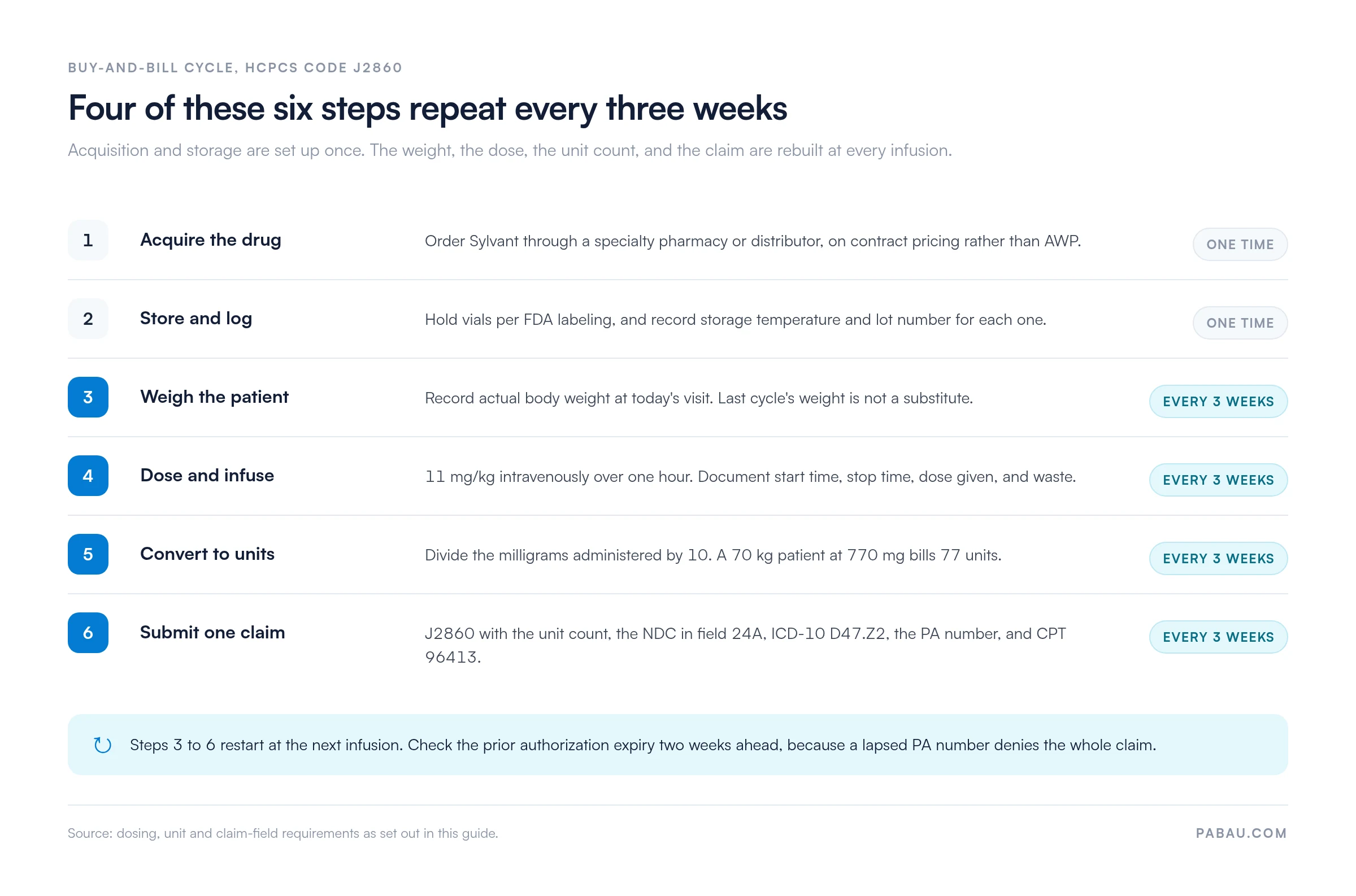
Documentation for each infusion visit should capture the dose ordered, the dose administered, the vials used, and any waste amount. That one record supports the J-code unit count and the wastage line on the same claim.
Prior authorization (PA) is required for siltuximab by most commercial payers, and it is increasingly common on Medicare Advantage plans. The PA burden reflects both the drug’s cost and the rarity of its approved indication.
Verify eligibility before every infusion cycle, not just the first one. Patients switch plans mid-treatment, and a lapsed PA number is a leading cause of J2860 denials.
When a PA is denied, the appeal needs the pathology report confirming MCD and serology ruling out HIV and HHV-8. Add the prescribing oncologist’s clinical rationale to it.
PA rules and their documentation lists change regularly, so verify with the payer instead of relying on a historical approval. Tracking policy updates from your MAC and your commercial payers is the most reliable way to avoid PA-related claim holds.
D47.Z2 (Castleman disease) is the diagnosis code that carries a J2860 claim. Without a supported diagnosis on the claim, the drug line denies for lack of medical necessity even when a PA was approved. Verify the code against the current fiscal year’s tabular list rather than working from memory.
D47.Z2 is the most widely accepted code for MCD, but a MAC-specific LCD can attach extra documentation requirements to it. Some plans want the pathology report to name the histologic subtype, whether hyaline vascular, plasma cell, or mixed variant. Review the current LCD for your MAC jurisdiction before the first claim for a new patient.
J2860 covers only the siltuximab drug cost. The infusion administration service needs its own CPT code on the same claim. Submitting the drug code alone, or pairing it with the wrong administration code, cuts or denies the administration payment.
The AAPC Codify HCPCS lookup carries coding guidance and crosswalks for J2860. It is a useful second check when you are confirming which administration code your payer contract expects.
Most J2860 claim errors are preventable. Weight-based dosing, NDC reporting, PA rules, and dual-code submission create several checkpoints, and one missed element at any of them causes a denial. The denial codes attached to J-code claims fall into three buckets: technical rejections, medical necessity denials, and unit errors.
Pull a monthly report of J2860 denials sorted by CARC and RARC reason code. It takes minutes in most billing systems, and it separates a systemic problem from scattered one-off errors. A run of NDC omissions is a workflow fix; two unrelated denials are not.
Meeting the standards for a clean claim on the first pass is the single most effective way to shorten J2860 payment cycles.
Build a J2860 checklist into your infusion billing workflow. Check the weight recorded today, recalculate the units, and confirm the NDC from the vial label. Then copy the PA number from the approval letter and add CPT 96413. Five checks, applied consistently, remove most preventable denials.
In most practices, a J2860 claim is assembled by hand. Someone reads today’s weight off the infusion note, works out the milligrams, and divides by 10. Then they copy the NDC off the vial label and hunt down the PA number. Every one of those steps is a place to mistype a figure.
Practice management software like Pabau holds the infusion record and the claim in the same place. The weight and the administered dose recorded at the visit feed the charge, so the unit count comes off what the patient actually received. Required fields such as the NDC and the authorization number are flagged before submission rather than after a rejection.
Remittance data then comes back into the same record, so you can see which J-code lines underpaid and why. Your billing team spends its time on the handful of claims that need an appeal, instead of re-keying the ones that were correct all along.

Pabau’s claims management software tracks J-code units, flags missing NDC fields, and reconciles remittance automatically. Your billing team spends less time chasing denials on high-cost drugs like siltuximab.

J2860 rewards a boring, repeatable process more than it rewards coding expertise. The math is simple, and the fields are always the same. What breaks a claim is a figure carried over from three weeks ago.
So treat every cycle as a new claim. Weigh the patient, recalculate the units, and read the NDC off the vial in front of you. Then check the authorization still has cycles left on it. Do that and the drug line pays on the first pass, which matters on a drug that costs thousands per infusion.
Book a demo to see how Pabau keeps J-code units, NDC fields, and remittance data in one place for your infusion billing.

Need a framework for cleaner biologic claims? Medical billing workflow guide covers the claim lifecycle from charge capture through remittance reconciliation.
Getting hit with unexplained remittance adjustments? Understanding electronic remittance advice explains how to read ERA files and match adjustment reason codes to the right action.
Want to reduce J-code denial rates systematically? Denial management in healthcare outlines how to track, appeal, and prevent recurring claim denials.
Worried about cash flow on buy-and-bill drugs? Revenue cycle management maps the chain from patient registration through to final payment posting.
Want the infusion visit documented once, properly? What a superbill includes sets out the charge detail a payer expects behind a drug line.
HCPCS code J2860 bills for siltuximab, sold as Sylvant, a monoclonal antibody approved by the FDA for multicentric Castleman disease (MCD). It is a Level II J-code billed per 10 mg administered by intravenous infusion. It covers physician office, infusion center, and hospital outpatient settings under Medicare Part B and most commercial plans.
Multiply the patient’s current body weight in kilograms by 11 mg/kg to get the dose in milligrams. Divide that dose by 10 to get the number of units to bill. A 70 kg patient receives 770 mg, which equals 77 units. Recalculate at every cycle using the weight recorded that day.
Medicare Part B reimburses J2860 at ASP+6% per 10 mg unit. The dollar amount per unit changes quarterly when CMS updates the ASP pricing file. Verify the current quarter’s rate through the CMS Physician Fee Schedule lookup before you calculate patient estimates or expected revenue.
Traditional Medicare Part B generally does not require prior authorization for J2860, though LCD criteria from your Medicare Administrative Contractor still apply. Most commercial payers and Medicare Advantage plans do require PA for siltuximab. UnitedHealthcare updated its oncology prior authorization policy in 2026, which affects J-code biologics including siltuximab. Verify J2860 requirements on the UHC provider portal before submitting.
The primary ICD-10-CM code is D47.Z2 (Castleman disease), which matches the FDA-approved indication for siltuximab. Submit D47.Z2 as the principal diagnosis on J2860 claims. Secondary codes such as D89.1 (cryoglobulinemia) can be added when clinically documented. Confirm that your MAC’s LCD accepts D47.Z2 before the first claim for a new patient.
Sylvant comes in 100 mg and 400 mg single-dose vials, each with its own NDC. Those numbers change when a manufacturer updates packaging or labeling. Verify the current NDC from the vial label or the FDA prescribing information before each billing cycle. Report it in field 24A with the N4 qualifier, the 11-digit NDC, the quantity administered, and the unit of measure.