ICD-10 code T43.604S: Psychostimulant poisoning sequela
What does ICD-10 code T43.604S cover? ICD-10 code T43.604S covers the late effec...

Last Updated: Oct 22, 2026
Billable Code Specific Code
X05.XXXD is the billable ICD-10-CM code for exposure to ignition or melting of nightwear, subsequent encounter. It is reported after a T20-T32 burn code once active treatment has ended and the patient returns for aftercare.
X05.XXXD is never the principal diagnosis. Claims on it are denied when a follow-up visit carries X05.XXXA, when the three placeholder Xs are dropped, or when the code is sequenced first.
Let Pabau's smart automation suggest the right codes, reduce claim denials, and keep your practice compliant—effortlessly.
Automate repetitive tasks and focus on what matters most—your patients.
Reduce coding errors and ensure compliance with the latest regulations.
Clean claims, fewer denials, and faster reimbursements.
Powerful insights and reporting to help your practice thrive.
HIPAA compliant SOC 2 certified GDPR-compliant Trusted by 4,000+ clinics worldwide

X05.XXXD is an external cause code from chapter V00-Y99, so it can never be the principal diagnosis.
The 7th character D means active treatment has ended. Use X05.XXXA for visits that deliver active treatment.
Always pair X05.XXXD with a burn code from the T20-T32 range, sequenced first as the principal diagnosis.
Pabau’s claims management software flags external cause sequencing errors before submission to reduce denials.
ICD-10 code X05.XXXD is a billable external cause code classifying exposure to ignition or melting of nightwear during a subsequent encounter. It sits in chapter V00-Y99 (external causes of morbidity), within block X00-X08 (exposure to smoke, fire, and flames). The code is valid for FY2025 and FY2026, according to the CMS ICD-10-CM tabular releases.
Because X05.XXXD is an external cause code, it records how the burn happened. The T-code records the burn itself, so X05.XXXD never stands alone on a claim.
Every character in X05.XXXD carries a defined meaning under the ICD-10-CM Official Guidelines for Coding and Reporting. Misreading any segment leads to an invalid code submission.
The three placeholder Xs are part of the code. Per ICD-10-CM Official Guidelines Section I.A.4, placeholder characters must be present whenever a code requires a 7th character but has no content in intermediate positions. Submitting “X05.D” or “X05XD” instead of “X05.XXXD” will produce a claim edit error at the clearinghouse level.
Subsequent encounter means the patient has completed active treatment for the nightwear burn. The visit is now routine care: Wound checks, dressing changes, scar management, physical therapy for burn contracture, or a scheduled follow-up. The 7th character D records the phase of care. It tells the payer that treatment has moved from acute care to aftercare, whatever the pace of healing.
Per ICD-10-CM Official Guidelines Section I.C.19.a, the 7th character applies to both the injury code (from T20-T32) and the external cause code. Both must carry the same encounter qualifier, so a subsequent encounter burn code pairs with X05.XXXD. The diagram below maps each phase of care to its character and shows how the pair sits on a claim.
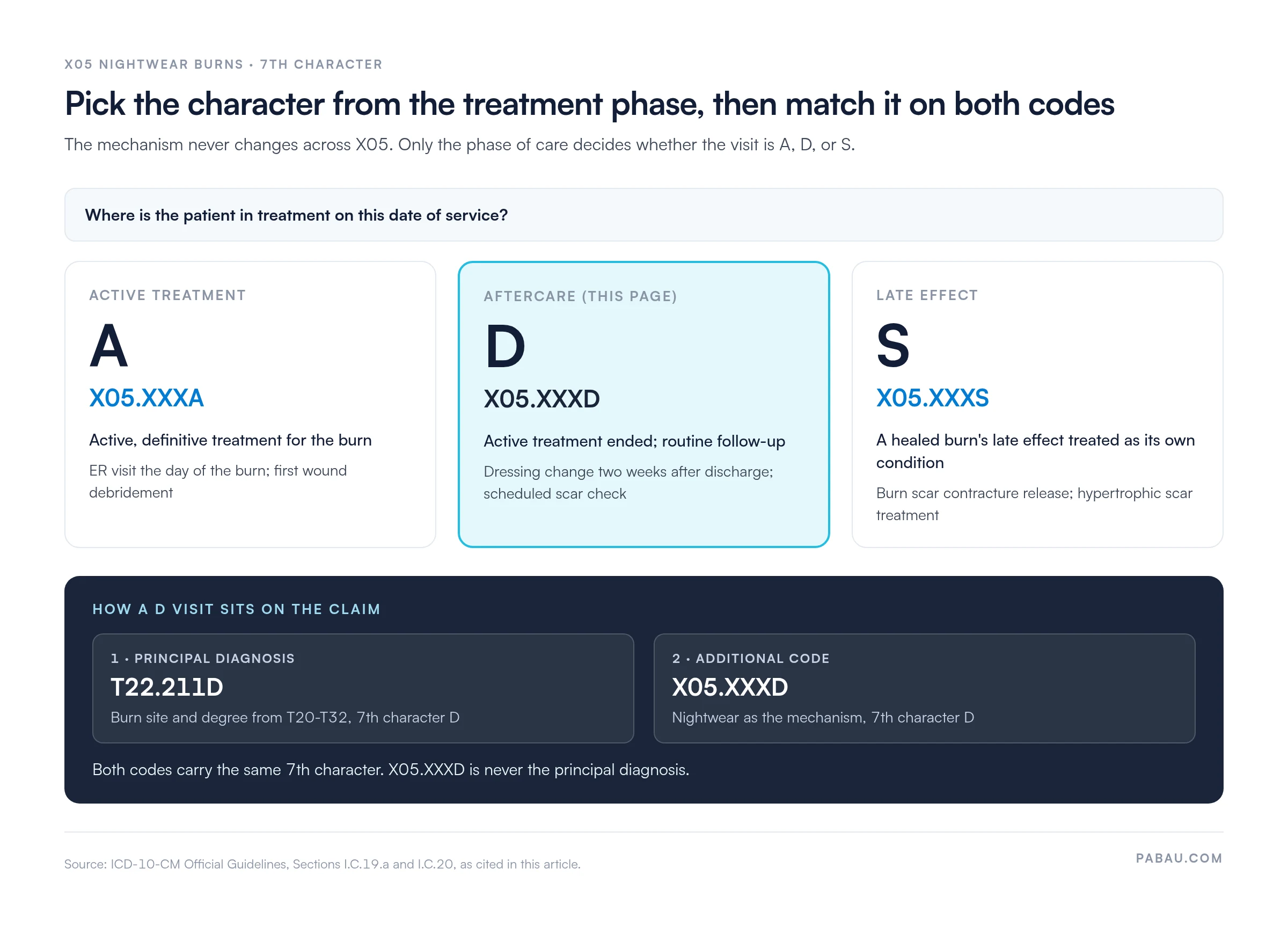
The most common coding error in this category is using X05.XXXA for every nightwear burn visit, whatever stage of treatment the patient has reached. A follow-up or aftercare visit takes X05.XXXD instead.
The 7th character works the same way across the rest of the external cause chapter. A powered lawn mower injury seen at a follow-up visit takes W28.XXXD, which also sits after the injury diagnosis on the claim.
Use the AAPC Codify ICD-10-CM lookup to verify code descriptors and encounter flags against the current FY tabular when in doubt.
X05 applies specifically to nightwear: Pajamas, nightgowns, robes, and similar sleep garments that ignite or melt. According to the CDC/NCHS ICD-10-CM web tool, the category includes situations where synthetic fabric melts onto the skin, causing a combination contact-and-flame injury.
Several related scenarios fall outside X05 and require different external cause codes.
The distinction between X05 and X06 matters at the claim level because payers can audit external cause code assignments for medical necessity consistency. A burn patient whose notes reference “work uniform” should never carry X05.XXXD. A burn that began with a boat fire moves out of the X00-X08 block entirely. A fishing boat fire seen at follow-up takes V91.02XD instead.
X05.XXXD never appears alone on a claim. Per ICD-10-CM Official Guidelines Section I.C.20, external cause codes are always supplementary codes sequenced after the principal diagnosis. For a nightwear burn follow-up, the principal diagnosis is always a T20-T32 burn code with the same 7th character as the external cause code. Pabau, the practice management platform we build, checks that sequencing in its claims management software before submission.
Leave the other external cause codes off a D visit. Per Section I.C.20, place of occurrence (Y92), activity (Y93), and status codes such as Y99.8 are reported once, at the initial encounter.
Always confirm the 7th character on the T-code and X05 code match before submitting. A T-code with ‘D’ paired with X05.XXXA (initial) creates a sequencing conflict that triggers an automated edit denial. Build a claim template that locks both codes to the same encounter type.
Payers audit X05 claims against the chart, so medical billing documentation decides whether the code survives review. For X05.XXXD, the clinical note must establish three facts clearly.
Recording these three points in every note supports medical billing compliance if a payer audits the claim. A note that says only “burn injury” is a common trigger for audit queries on X05 claims.
Most X05.XXXD denials are preventable. They fall into five patterns, and each one has a fix your denial management workflows can apply at the source.
Use this denial codes reference to match the CARC/RARC reason codes on your remittance advice to the root causes above. Payers return those explanations as electronic remittance advice (835 ERAs), so each denial maps back to a specific coding error.
Clearinghouse edits catch placeholder and sequencing errors before submission. Fixing a claim at that stage takes minutes, while a denial means rework, resubmission, and a longer wait for payment.
ICD-9-CM did not use encounter-type qualifiers (no 7th character system), so the crosswalk from ICD-9 to X05.XXXD is approximate rather than exact. According to WHO’s ICD-10 classification reference, the predecessor category for accidental clothing ignition in ICD-9-CM falls under E893.x (accidental ignition of clothing). The 7th character D representing subsequent encounter is a concept introduced with ICD-10-CM; it has no ICD-9 equivalent.
For practices converting legacy records, ICD-9-CM offers no encounter-type detail. The ICD-10 assignment therefore depends entirely on the clinical note, not the old code. Verify all crosswalk mappings against the CMS General Equivalence Mappings (GEMs) file before applying them to billing.
When reviewing historical records for value-based care reporting or quality measure audits, do not assume an ICD-9 E893 code maps cleanly to X05.XXXD. The encounter-type distinction (A vs D vs S) is entirely ICD-10-CM logic. Re-code from the original clinical documentation, not from the old code.
Without a claim edit in place, a coder reads the note, picks the T-code, and adds the X05 code. Matching both 7th characters is left to memory. The payer’s edit is then the first check the pair gets, and a mismatch comes back as a denial.
Pabau checks the claim before it leaves the practice. Its claims workflow validates code sequencing, placeholder characters, and encounter-type consistency at the point of submission. Claims then pass through the Claim.MD clearinghouse integration, which runs its own edits before the payer sees them.
The result is fewer burn aftercare claims coming back for rework. Your coders spend that time on the next chart instead of on an appeal.

Pabau’s claims management workflow flags external cause sequencing errors before they reach the payer. See how practices handling burn aftercare reduce rework with automated claim edits.

Coding X05.XXXD correctly comes down to two disciplines: Confirming the visit is a follow-up (not an acute encounter), and sequencing the paired T-code first. A documentation checklist and a claim edit that runs before submission prevent both errors.
Start with the note. If it does not name the garment and the phase of care, fix the documentation template before you touch the codes. No claim edit can supply what the chart never recorded, and clean claim submission depends on both.
Book a demo to see how Pabau flags mismatched 7th characters on burn aftercare claims before they reach the payer.

Need guidance on burn claim denial codes? Denial codes in medical billing maps common CARC/RARC codes to their root causes for faster appeals.
Want to understand how clearinghouse validation works? Medical claims clearinghouse guide explains the edit and validation process before claims reach payers.
Looking for the full revenue cycle picture? What is revenue cycle management walks through each stage from charge capture to payment posting.
ICD-10 code X05.XXXD is an external cause code identifying exposure to ignition or melting of nightwear during a subsequent (follow-up) encounter. It confirms the mechanism of a burn injury is nightwear and that the visit is post-acute aftercare, not the initial treatment episode. It must always accompany a primary burn diagnosis code from T20-T32.
Use X05.XXXD when active treatment has ended and the visit is a follow-up, wound check, dressing change, or aftercare appointment. Use X05.XXXA when the patient is receiving active, definitive treatment for the burn injury, including the initial ER visit or first surgical debridement. Both codes refer to the same nightwear mechanism; only the encounter phase differs.
The 7th character D indicates the original injury is still being managed through routine aftercare. S indicates the injury has healed and a late effect is now being treated as a new condition. Use D for wound checks and dressing changes after the acute phase. Use S when treating burn scar contracture or hypertrophic scarring as a distinct diagnosis months or years after the burn.
Yes, X05.XXXD is an active, billable code for both FY2025 and FY2026 per the CMS ICD-10-CM tabular releases. No code changes affecting X05 have been announced for FY2026. Verify against the official CMS release file each October for any updates.
No. External cause codes (V00-Y99) are always additional codes and can never be the principal diagnosis. Per ICD-10-CM Official Guidelines Section I.C.20, the burn diagnosis T-code is always sequenced first. Submitting X05.XXXD as the principal will result in a claim rejection at the clearinghouse or payer edit level.
The ICD-9-CM predecessor is the E893.x category (accidental ignition of clothing). ICD-9-CM had no encounter-type distinction, so the D (subsequent) qualifier is an ICD-10-CM addition with no direct ICD-9 equivalent. When converting legacy records, determine the correct 7th character from the original clinical documentation rather than mapping directly from the ICD-9 code.