ICD-10 Code T63.591D: Toxic effect of other venomous fish
ICD-10 Code T63.591D: Quick reference ICD-10 Code T63.591D reports the toxic eff...

Last Updated: Oct 23, 2026
Billable Code Specific Code
V57.9XXD is the billable ICD-10-CM code for an unspecified pick-up truck or van occupant injured in collision with a fixed or stationary object. The crash was a traffic accident, and the D marks a subsequent encounter. It records how the injury happened at follow-up visits after active treatment ends, and it never stands alone on a claim.
It fits when the patient was in a pick-up truck, van, minivan or SUV that hit a pole, tree or wall in traffic. The note must also leave the seat unstated. Once the record names the driver or passenger, V57.5 or V57.6 replaces it.
Let Pabau's smart automation suggest the right codes, reduce claim denials, and keep your practice compliant—effortlessly.
Automate repetitive tasks and focus on what matters most—your patients.
Reduce coding errors and ensure compliance with the latest regulations.
Clean claims, fewer denials, and faster reimbursements.
Powerful insights and reporting to help your practice thrive.
HIPAA compliant SOC 2 certified GDPR-compliant Trusted by 4,000+ clinics worldwide

V57.9XXD is a billable ICD-10-CM code, valid for FY2026, for a pick-up truck or van occupant whose vehicle hit a fixed object in traffic.
The fourth character 9 means the record names no occupant role. A documented driver or passenger moves the code to V57.5XXD or V57.6XXD.
The 7th character D marks a subsequent encounter after active treatment ends. Use A during active treatment and S for a late effect.
The XX placeholders are mandatory, so a code submitted as V57.9D is invalid and rejected automatically.
V57.9XXD never goes first on a claim. The injury code, with its own D character, leads and V57.9XXD follows it.
Claims software such as Pabau validates claim details before submission and holds back a claim with missing information until it is fixed.
V57.9XXD is the ICD-10-CM external cause code for a pick-up truck or van occupant, role unknown, hurt when the vehicle hit a fixed object. The crash was a traffic accident. It applies at follow-up visits once active treatment is complete. The table covers the facts coders check most often before billing it.
Each of the seven characters in V57.9XXD has a fixed job, and misreading one produces an invalid code. Here is what each position encodes.
ICD-10-CM defines a pick-up truck or van as a four- or six-wheeled vehicle built to carry passengers and cargo. It weighs less than the limit for a heavy goods vehicle and needs no special driver’s license. The definition includes minivans and sport-utility vehicles (SUVs), so an SUV that hits a tree codes to V57.
The 7th character is the most frequently miscoded part of V57.9XXD. The ICD-10-CM Official Guidelines assign it by treatment status, not by visit number.
Critical distinction: Subsequent encounter does not mean the second visit. A patient can have 15 follow-up appointments coded D if every one of them follows active treatment. A patient readmitted for surgical revision of a complication goes back to A, because that is active treatment again.
Sequela (S) covers residual conditions. If a patient treated months ago now presents with neuropathy from the crash, the residual condition is coded first. The injury code with S follows, and V57.9XXS identifies the external cause.
The same A, D and S choice runs through other external cause blocks. ICD-10-CM code W44.B0XA carries the initial-encounter A for a plastic object in a natural orifice.
ICD-10-CM codes must reach the 7th character position when a 7th character is required. V57.9 has only four characters, so two placeholder Xs fill positions 5 and 6 to carry the encounter character into position 7.
Omitting either X produces a structurally invalid code. Claims processors and clearinghouses reject these automatically, because the code does not exist in the ICD-10-CM tabular list.
Billing systems that allow free-text code entry are the most common source of this error. Systems that validate against the full ICD-10-CM tabular list catch it before submission. According to the CMS ICD-10 codes page, placeholder X characters are a formal part of ICD-10-CM code structure.
Category V57 splits by two facts from the record: The occupant’s role and whether the crash was a traffic accident. Use the most specific subcode the documentation supports.
Two ICD-10-CM defaults steer a sparse note toward V57.9. A vehicle accident is assumed to have happened on a public highway unless the record names another place. Accidents involving only off-road vehicles are the exception. And when no seat is named, the occupant is unspecified. The grid below shows where each answer leads.
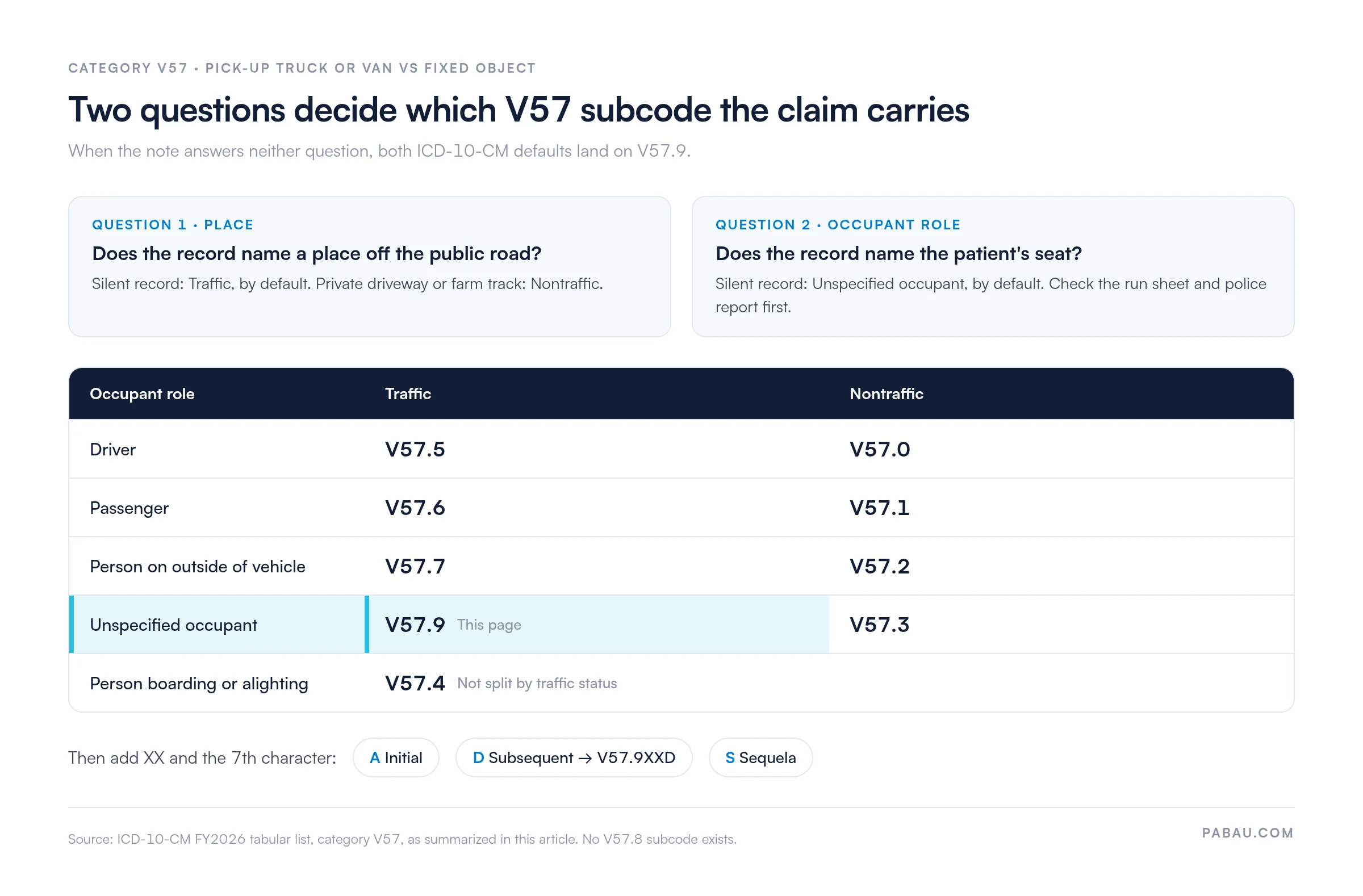
A triage note reading “restrained occupant, van vs utility pole” therefore codes to V57.9 by default. Before settling on it, check the ambulance run sheet and the police report for the patient’s role. A named driver earns V57.5XXD, and a named passenger earns V57.6XXD.
The nontraffic subcodes (V57.0 to V57.3) need a documented place off the public road, such as a private driveway or farm track. There is no V57.8 subcode.
V57 covers people in or on a pick-up truck or van that hit something fixed. A different vehicle, a different collision partner or a pedestrian moves the code to another category. A car passenger injured in the same kind of fixed-object traffic crash takes V47.6XXD at a subsequent encounter.
A heavy transport vehicle or bus as the collision partner moves a pick-up truck or van occupant to V54. Someone boarding or alighting at the time takes V54.4XXD on the follow-up claim.
Do not confuse V57 with V04. A pedestrian struck by a truck is never a V57 case, because V57 describes the people inside the pick-up truck or van. When the record points to one of these other categories, look up its subcode and encounter character in our ICD-10-CM code library.
V57.9XXD is an external cause code. It records how the injury happened, while a separate code from the injury chapters describes the injury. The ICD-10-CM guidelines state that an external cause code can never be a principal or first-listed diagnosis.
The required order is as follows.
A crash during a leisure drive, for example, carries Y99.8 on the initial claim with V57.9XXA. The follow-up claim with V57.9XXD leaves it off.
Report V57.9XXD at every follow-up visit where the injury is still being treated, with a 7th character that matches the injury code. Placing it in the first diagnosis field triggers a denial on most payer systems. The CDC’s ICD-10-CM web tool shows the chapter notes for V57 during code lookup.
Run a sequencing check on every external cause claim before it leaves the practice. If V57.9XXD sits in the first diagnosis field, the payer will deny it. Your billing system should block this automatically. If it does not, add a manual review step to your workflow.
Solid documentation prevents denials on both the clinical and the payer side. Two sets of requirements apply: What the medical record must show, and what payers add for accident-related claims.
The ICD-10-CM guidelines set no national requirement to report external cause codes. State reporting mandates and payer policies decide whether V57.9XXD is required, and voluntary reporting is encouraged. Auto liability and personal injury protection (PIP) payers often expect it, because the code establishes the accident mechanism.
External cause codes generate a predictable set of denials, and most are avoidable with a pre-submission check. The denial management process for these rejections follows the same pattern. Identify the root cause, correct the code or sequencing, and resubmit with supporting documentation.
A clean claim submission for V57.9XXD needs three elements to agree. The injury code sits first, V57.9XXD follows with all seven characters, and the note supports a subsequent encounter. A claim that passes the format edits can still fail an audit when those three disagree.
These three scenarios show how V57.9XXD applies in practice and where coders most often go wrong.
A patient returns six weeks after the van they were riding in hit a utility pole on a city street. The ED record never states whether they were driving. Today’s visit is a routine fracture check with repeat imaging, and healing is on track.
Correct coding: The fracture code with 7th character D goes first. V57.9XXD follows, because the record confirms a traffic accident but names no occupant role. If the ambulance report shows the patient was driving, V57.5XXD replaces it.
A patient attends outpatient physical therapy after open reduction internal fixation (ORIF) of a tibial fracture. The injury happened when their pick-up truck struck a tree beside a county road. The surgical note gives no seat position.
Correct coding: The tibial fracture code with 7th character D goes first, then V57.9XXD. The surgery completed active treatment, so the therapy visits are subsequent care. Aftercare Z codes do not apply to injuries, because the D character already records the aftercare.
Nine months after an SUV hit a highway guardrail, a patient presents with persistent nerve pain in the injured arm. The original injury has healed. Today’s visit treats the pain as a late effect of the crash.
Correct coding: The residual condition goes first, followed by the original injury code with 7th character S. V57.9XXS then identifies the external cause. Coding this visit with D misstates the encounter type. Use the AAPC ICD-10-CM lookup to find the residual condition code that best fits the note.
Errors on V57.9XXD tend to start at claim entry. A coder types the code by hand, drops a placeholder, or lists the external cause ahead of the injury.
Pabau, the practice management platform we build, runs validation checks on claim details in its claims management software every time you send a claim. If a required detail is missing, the claim stays unsent until it is fixed, so your team spends less time on resubmissions.
Pabau’s Claim.MD clearinghouse integration supports electronic claims submission across thousands of US payers. Real-time eligibility checks confirm coverage before the patient arrives for a subsequent encounter.
Claim status tracking then shows each V57.9XXD follow-up claim as pending, submitted, processing, paid or error. A rejected claim surfaces in one dashboard instead of waiting for a payer letter.

Pabau’s built-in claims management checks claim details before submission and tracks every claim to payment. See how it keeps your follow-up injury claims moving.

V57.9XXD is a default code, and defaults deserve a second look. It lands on the claim when the note is silent about the seat and the road. Before billing it, check the ambulance run sheet and the triage note for the occupant role. A documented driver or passenger earns a more specific code.
Where the record gives no role, V57.9XXD is the correct choice. Bill it second, with all seven characters and a D that matches the injury code. Book a demo to see how Pabau checks and tracks your follow-up injury claims from submission to payment.

Need a full picture of the claims submission process? What is medical billing covers the end-to-end workflow from code assignment through payment posting.
Seeing repeated external cause code denials? Denial codes in medical billing explains the most common CARC denial reason codes and how to resolve them.
Want to verify eligibility before the patient arrives for a follow-up? Insurance eligibility verification walks through coverage checks that prevent post-visit denials.
Was the patient in a car rather than a van? ICD-10 code V47.1XXA covers a car passenger in a nontraffic collision with a fixed object.
ICD-10 code V57.9XXD records a pick-up truck or van occupant, role unknown, injured when the vehicle hit a fixed or stationary object in traffic. The D marks a subsequent encounter, after active treatment ends. The code sits in Chapter 20 (V00-Y99) and supplements the injury code on the claim.
Yes. V57.9XXD is a billable ICD-10-CM code, valid for FY2026. It needs all seven characters, including the placeholder Xs in positions 5 and 6. A code submitted as V57.9D is invalid and rejected automatically.
V57.9XXA is the initial encounter code, used while the patient receives active treatment for injuries from the crash. V57.9XXD is the subsequent encounter code, used once active treatment is complete. The distinction is based on treatment status, not visit number.
Use V57.5 when the record says the patient was driving, and V57.6 when they were a passenger. Both cover traffic accidents. V57.9 applies only when the note places the patient in the vehicle but names no role.
No. V57 covers people in or on a pick-up truck or van that hit a fixed or stationary object. A pedestrian struck by a heavy transport vehicle or bus codes to category V04.
ICD-10-CM defines it as a four- or six-wheeled vehicle built to carry passengers and cargo, below the weight limit for a heavy goods vehicle. It needs no special driver’s license. The definition includes minivans and sport-utility vehicles (SUVs).
The two X characters in positions 5 and 6 are mandatory placeholders. ICD-10-CM requires them to move the encounter character (A, D or S) into the 7th position. They carry no clinical meaning, and omitting either one produces an invalid code that payers reject.
No. The ICD-10-CM guidelines state that an external cause code can never be a principal or first-listed diagnosis. The injury code, such as a fracture or laceration, is always sequenced first. V57.9XXD goes in a secondary field to show how the injury happened.
No. Place (Y92), activity (Y93) and external cause status (Y99) codes are reported once, at the initial encounter. A subsequent encounter claim with V57.9XXD does not repeat them.
D changes to S when the original injury has healed and the patient presents for a residual condition it caused. Chronic pain, neuropathy and scarring are common examples. The residual condition goes first, then the injury code with S, then V57.9XXS. If aftercare for the original injury continues, D stays correct.
The most common reasons are missing placeholder Xs, the wrong 7th character, and V57.9XXD in the principal position. A claim with no injury code alongside it is also denied. Each needs a specific correction before you resubmit.