ICD-10 Code Y76.0: Diagnostic obstetric and gynecological devices
ICD-10 Code Y76.0: Definition and billable status ICD-10 Code Y76.0 is a valid, ...

Last Updated: Oct 23, 2026
Billable Code Specific Code
N75.9 is the billable ICD-10-CM code for disease of Bartholin's gland, unspecified. It covers a documented Bartholin gland condition that the record doesn't identify as a cyst (N75.0), an abscess (N75.1), or another specified disease (N75.8).
The code sits in category N75 (Diseases of Bartholin's gland) in Chapter 14, which covers the genitourinary system. Obstetric complications and confirmed malignancies code outside N75, so rule those out first.
Let Pabau's smart automation suggest the right codes, reduce claim denials, and keep your practice compliant—effortlessly.
Automate repetitive tasks and focus on what matters most—your patients.
Reduce coding errors and ensure compliance with the latest regulations.
Clean claims, fewer denials, and faster reimbursements.
Powerful insights and reporting to help your practice thrive.
HIPAA compliant SOC 2 certified GDPR-compliant Trusted by 4,000+ clinics worldwide

N75.9 is a valid, billable ICD-10-CM code for Bartholin gland disease when documentation can’t support a more specific N75 code.
Check N75.0 (cyst), N75.1 (abscess), and N75.8 (other) before assigning N75.9, which is a last-resort residual code.
Payers often deny N75.9 when the chart clearly supports a cyst or abscess, so a specificity review is the first denial-prevention step.
Clearinghouse edit checks in claims management software like Pabau catch CMS edit errors before submission, but choosing the specific N75 code stays with the coder.
ICD-10 Code N75.9 is the billable diagnosis code for disease of Bartholin’s gland, unspecified. Use it only when the record documents a Bartholin gland condition but doesn’t identify a cyst, an abscess, or another named disease.
The code sits in category N75 (Diseases of Bartholin’s gland) in Chapter 14 of ICD-10-CM, which covers the genitourinary system (N00-N99). The table below captures the reference data coders need before billing.
The CDC/NCHS ICD-10-CM web tool confirms N75.9 as a valid billable code for FY2026, with no descriptor change from the prior year.
The Bartholin’s glands (also called the greater vestibular glands) are two small mucus-secreting glands located at the posterior introitus of the vagina. A blocked duct leads to a cyst, and infection turns a cyst or the gland itself into an abscess. Less often, the gland is inflamed without an abscess, or a tumor develops, and those conditions code outside N75.0 and N75.1.
N75.9 applies when the clinical record documents a Bartholin gland condition but lacks the detail to assign a more specific code in category N75. Common clinical presentations coded to N75.9 include:
“Unspecified” in N75.9 describes what the note records about the condition. Once examined, most Bartholin gland conditions turn out to be a cyst or an abscess. Defaulting to N75.9 without querying the provider is a coding error under the ICD-10-CM Official Guidelines.
Category N75 contains four codes, and N75.9 is always the last option. The table maps each code to its clinical trigger and explains when N75.9 is and is not appropriate.
The AAPC ICD-10-CM code lookup provides the full N75 category with its coding notes. Review all four codes before defaulting to N75.9. N75.8 catches named conditions, such as bartholinitis and Bartholin gland adenitis, that providers often describe without a cyst or abscess label.
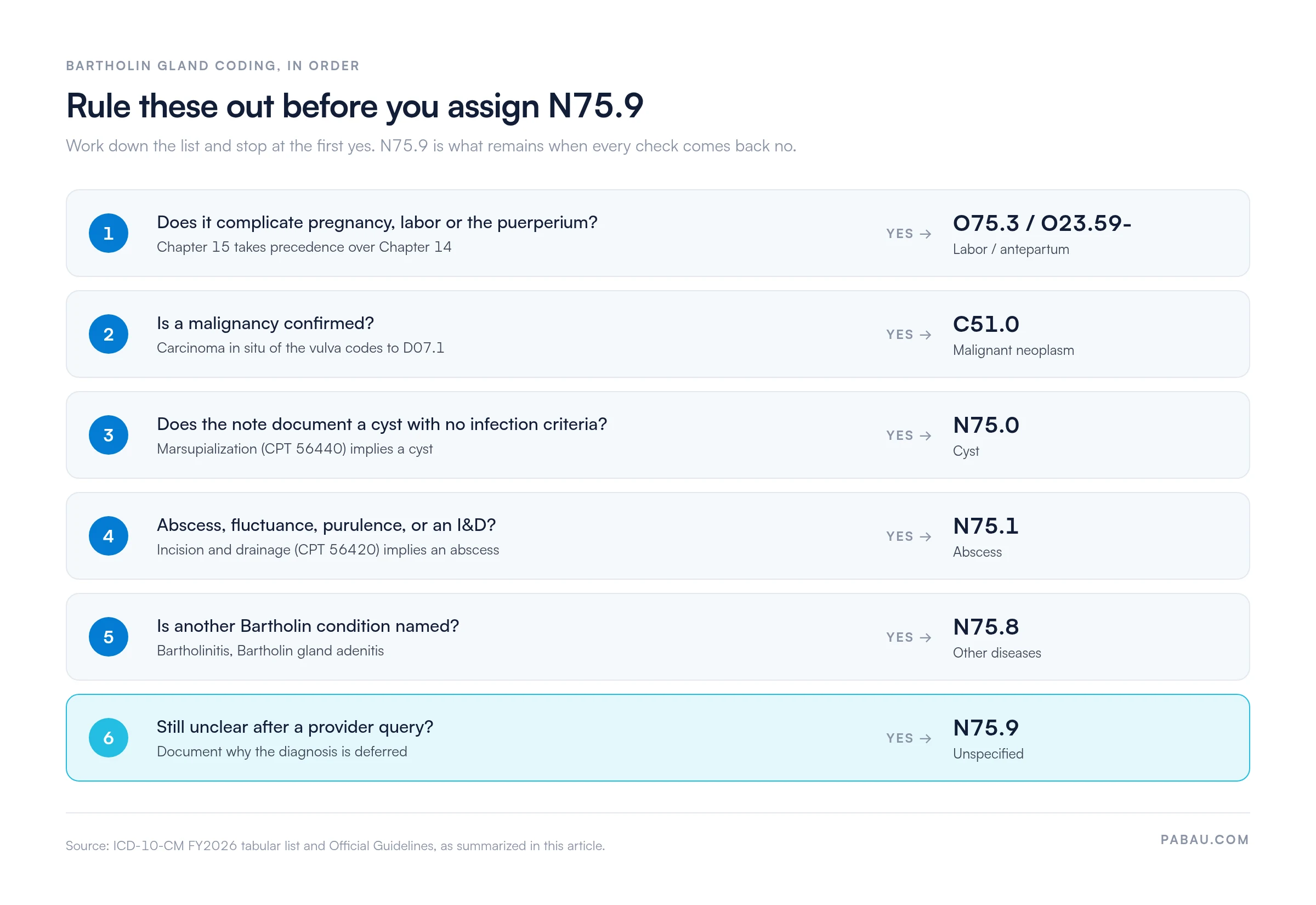
Several of the codes that outrank N75.9 sit outside category N75 entirely. The decision order below pulls them into one sequence, so you can stop at the first code the record supports.
Section I.B.5 of the ICD-10-CM Official Guidelines for Coding and Reporting allows an unspecified code only when the record can’t support a more specific one. This standard applies directly to N75.9.
Before assigning N75.9, work through this sequence:
An unspecified code backed by a documented provider query holds up at audit. An unexamined default is the pattern payers and auditors flag.
Bartholin gland conditions are managed through several distinct procedures, each paired with a specific CPT code. The ICD-10 code used on the claim should match the confirmed diagnosis, not simply the procedure performed. Running every claim through claims management software with clearinghouse edit checks catches formatting and edit errors before they reach the payer.
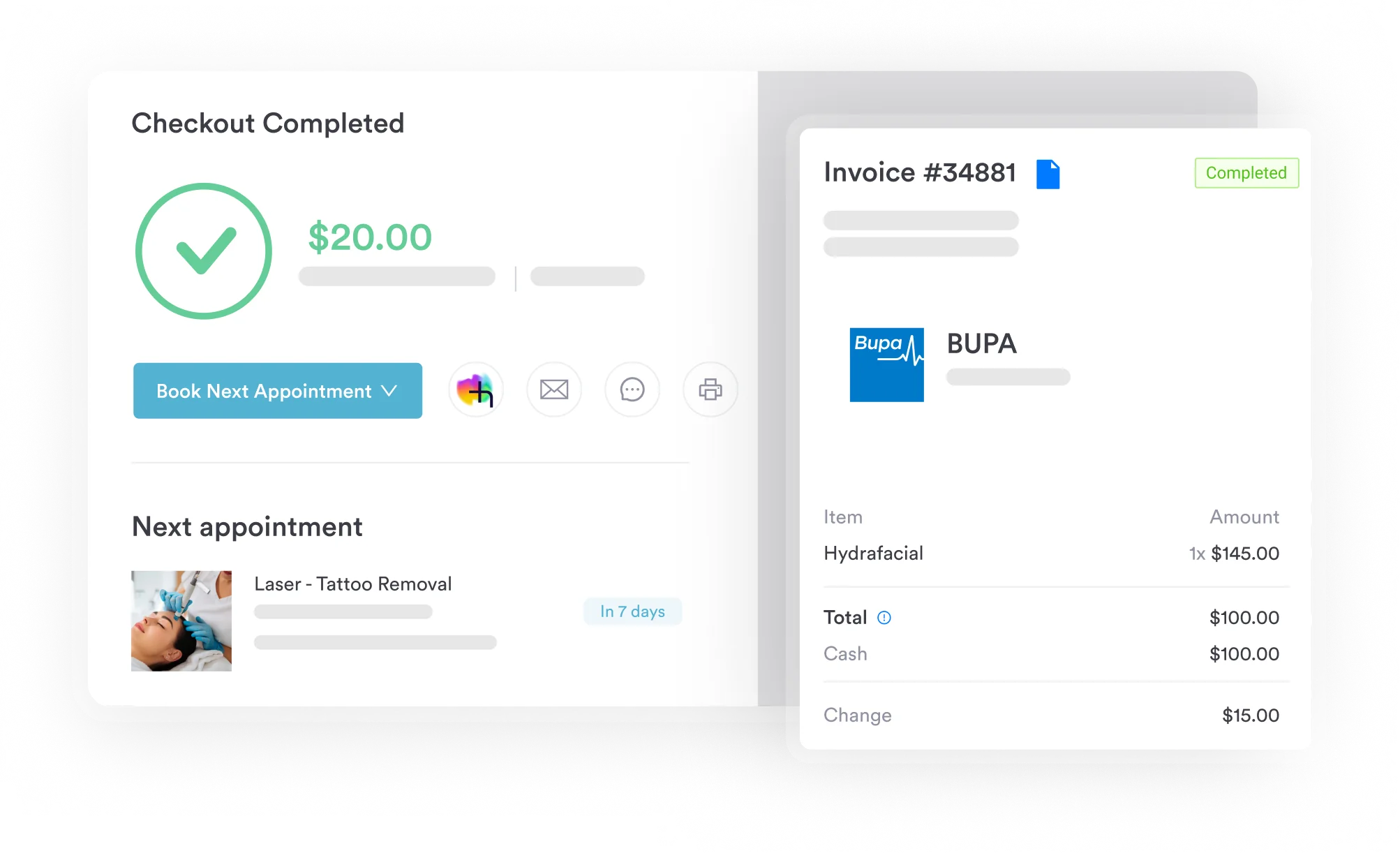
Pabau sends claims electronically through the Claim.MD clearinghouse, which runs standard CMS edit checks before transmission. That catches formatting and edit errors early and shortens the rework cycle for OB-GYN and women’s health practices. The clearinghouse won’t choose N75.0 over N75.9 for you, so the specificity check stays with the coder.
Before submitting a claim with CPT 56440 (marsupialization) paired with N75.9, check whether the operative note or pathology report confirms a cyst. If it does, upgrading to N75.0 takes 30 seconds and eliminates the most common denial pattern for this CPT code.
When N75.9 is the most specific code the record supports, the documentation must affirmatively demonstrate that specificity could not be determined. A note that simply says “Bartholin gland problem” without ruling out cyst or abscess will not survive payer review.
To support N75.9, the record should include all five of these elements:
A clean claim with N75.9 requires that all five documentation elements are present in the record before the claim leaves the practice. Missing any one of them creates an audit vulnerability even if the payer pays initially.
Payers use automated edits to flag claims where an unspecified code appears when the procedure or clinical context implies specificity was achievable. For ICD-10 Code N75.9, the denial patterns are predictable and largely preventable. Each rejection comes back with a reason code, which you can look up in our guide to medical billing denial codes before you resubmit.
Effective denial management in healthcare for gynecologic practices requires tracking which CPT-to-ICD-10 pairings generate the most rejections. N75.9 paired with procedure codes that inherently imply a specific pathology is one of the highest-frequency correctable denial patterns in women’s health billing.
Most N75.9 specificity errors enter the revenue cycle at charge entry. A generic ICD-10 code is accepted there without a documentation review, and the error travels with the claim to adjudication.
N75.9 has no Excludes notes of its own. The N70-N77 block that contains it carries an Excludes1 note for current obstetric complications (O00-O9A), and several neighboring codes are often confused with it:
The WHO ICD-10 browser lets coders browse the N70-N77 block to confirm its boundaries. That helps keep inflammation-type diagnoses out of the wrong category.
N75.9 is not used when a Bartholin gland condition complicates pregnancy, delivery, or the puerperium. AHA Coding Clinic guidance sends a Bartholin’s abscess during labor to O75.3 (Other infection during labor), not N75.1 or N75.9. If the abscess is found antepartum, it codes to O23.59- (O23.593 in the third trimester).
Practices providing maternity care need a clear code-routing rule. If the encounter is pregnancy-related and the Bartholin condition affects the obstetric episode, assign from Chapter 15. If the patient returns postpartum in a separate encounter for a Bartholin gland issue unrelated to the delivery, Chapter 14 codes (N75.x) apply.
The distinction matters at audit. An N75.9 claim for a labor-related infection instead of O75.3 signals a chapter-routing error that can affect medical necessity determinations and trigger retrospective review.
Yes, ICD-10 Code N75.9 is valid and billable for both FY2025 and FY2026. The FY2026 tabular list made no change to the N75.9 descriptor and added no new Excludes notes.
Coders should verify FY code validity annually using the CMS ICD-10 codes page, which publishes updated tabular lists and addenda each October. N75.9 has been a stable code since ICD-10-CM implementation and has not been subject to revision in recent years.
Set a calendar reminder for October each year when CMS releases the new ICD-10-CM tabular. Cross-check any frequently used unspecified codes, including N75.9, against the addenda. Codes rarely change without notice, but the 30-second verification protects against billing an invalidated code.
In many OB-GYN practices, the coder reads the chart in one system and bills from another. A vague note gets keyed as N75.9, and the denial lands weeks later with the chart out of view.
Practice management software like Pabau keeps the clinical note, the diagnosis and procedure codes, and the claim in the same patient record. Claims go out electronically through the Claim.MD clearinghouse, and their status is tracked in one place.
When a Bartholin gland claim comes back, your coder can reread the note, query the provider, and resubmit with N75.0 or N75.1 without switching systems. That turns a multi-week denial cycle into a same-day correction.

Pabau keeps the clinical note, codes, and claim in one patient record, and sends claims through Claim.MD edit checks before they reach the payer. See how OB-GYN practices cut rework on Bartholin gland claims.

Treat N75.9 as the code you reach after a provider query, when the record still can’t name the condition. When the note, procedure log, or pathology report points to a cyst, an abscess, or bartholinitis, the specific code gets paid.
The trade-off is a few minutes of pre-bill review on each Bartholin gland claim, weighed against repeat denials on every drainage and marsupialization. Book a demo to see how Pabau keeps notes, codes, and claims together for your OB-GYN billing team.

Want to understand how clearinghouse validation works? Medical claims clearinghouse guide explains how clearinghouses catch errors before claims reach payers and how to choose one.
Looking to reduce denial rates across all codes? Denial management in healthcare outlines how billing teams track, appeal, and prevent claim rejections.
Need a checklist for first-pass acceptance? What makes a clean claim walks through the data every claim needs before it leaves the practice.
Checking your coding against payer rules? Medical billing compliance covers the documentation and audit standards that keep unspecified codes defensible.
ICD-10 Code N75.9 is the billable diagnosis code for disease of Bartholin’s gland, unspecified. It applies when the record confirms a Bartholin gland condition but can’t classify it as a cyst (N75.0), abscess (N75.1), or other specified disorder (N75.8). It sits in Chapter 14 of ICD-10-CM and is valid for FY2025 and FY2026.
N75.9 applies only when the clinical record genuinely cannot support a more specific code after documentation review and, if needed, a provider query. If palpation findings, imaging, or the operative note confirms a cyst, use N75.0. If infection criteria, I&D, or abscess language is present, use N75.1. N75.9 is a last resort, not a default.
CPT 56740 (excision of Bartholin’s gland or cyst) can pair with N75.9 when the pre-operative diagnosis is genuinely unspecified. CPT 56420 (I&D abscess) and CPT 56440 (marsupialization of cyst) should almost always pair with N75.1 and N75.0 respectively. The procedures themselves imply a confirmed diagnosis. Pairing either of those CPT codes with N75.9 is a common denial trigger.
Most payers accept N75.9 when documentation supports its use, but acceptance varies by Medicare Administrative Contractor (MAC) and individual payer LCD policy. Some MACs restrict coverage for certain procedure codes when paired with unspecified diagnosis codes. Verify the applicable LCD before submitting and obtain an Advance Beneficiary Notice when coverage is uncertain.
Yes. N75.9 is a valid billable ICD-10-CM code for FY2026 with no descriptor changes, no new excludes notes, and no addenda modifications. Verify currency each October when CMS releases the updated tabular list.
N75.8 (Other diseases of Bartholin’s gland) captures named conditions beyond cyst and abscess, including bartholinitis (inflammation) and Bartholin gland adenitis. N75.9 is used when no specific condition can be identified at all. If the provider’s note names the condition but it does not fit N75.0 or N75.1, check N75.8 before assigning N75.9.