ICD-10 Code V28.01XD: E-bike driver noncollision accident, nontraffic, subsequent encounter
ICD-10 Code V28.01XD: Definition and billable status ICD-10 Code V28.01XD is the...

Last Updated: Oct 20, 2026
Billable Code Specific Code
Y99.8 is the billable ICD-10-CM code for other external cause status. It records that an injury happened during leisure, recreation, sport, student activity, a hobby, or a service member's off-duty time.
Y99.8 is always a secondary code, reported last in the external cause sequence after the injury, mechanism, place, and activity codes. It applies only when the record rules out paid work (Y99.0), military duty (Y99.1), and volunteering (Y99.2).
Let Pabau's smart automation suggest the right codes, reduce claim denials, and keep your practice compliant—effortlessly.
Automate repetitive tasks and focus on what matters most—your patients.
Reduce coding errors and ensure compliance with the latest regulations.
Clean claims, fewer denials, and faster reimbursements.
Powerful insights and reporting to help your practice thrive.
HIPAA compliant SOC 2 certified GDPR-compliant Trusted by 4,000+ clinics worldwide

Y99.8 covers leisure, recreational, student, hobby, and off-duty military activities that don’t fit Y99.0, Y99.1, or Y99.2.
It’s always a secondary code, and reporting it as the principal diagnosis gets the claim rejected.
Report the Y92 place code and the Y93 activity code alongside it whenever the record documents them.
Claims management software like Pabau runs validation checks before each claim goes out, so missing details get fixed before submission.
ICD-10 Code Y99.8, “Other external cause status,” records an injury that happened outside paid work, military duty, or volunteering. That covers leisure, sport, student activities, hobbies, and a service member’s off-duty time. It’s always a secondary code, reported last in the external cause sequence.
The code sits under category Y99 in the Y90-Y99 block of Chapter 20, External causes of morbidity (V00-Y99). That block is titled “Supplementary factors related to causes of morbidity classified elsewhere.” Y99.8 has been billable since ICD-10-CM took effect in the US, and it remains valid this fiscal year.
Coders looking up Y99.8 in the CDC/NCHS ICD-10-CM web tool will find it listed under Y99 alongside three sibling codes. Mixing up those siblings is the main source of Y99 errors, so the next two sections set out what each code covers.
Y99.8 covers any activity-status scenario that does not fit civilian paid work (Y99.0), active military duty (Y99.1), or volunteer activity (Y99.2). The ICD-10-CM tabular list’s inclusion notes confirm four activity categories fall under Y99.8.
The code also functions as the default when the activity status is unknown or cannot be classified under any other Y99 subcode. That default-to-Y99.8 rule appears in the ICD-10-CM Official Guidelines for Coding and Reporting, Chapter 20 section on external cause status.
When the record confirms a non-work, non-military, non-volunteer context, don’t leave the status field blank. Y99.8 is the correct assignment.
Y99.8 carries Excludes1 relationships with its Y99 siblings, meaning those sibling codes may not be reported in addition to Y99.8 for the same encounter. The entire Y99 block captures one status per encounter. The table below shows all four Y99 subcodes so coders can select the correct one at a glance.
The AAPC Codify ICD-10-CM lookup displays these Excludes1 notes directly on the Y99.8 code page. Reviewing them before coding prevents the most common Y99 selection error. That error is assigning Y99.8 when the record clearly documents paid employment or a recognized volunteer role.
External cause coding follows a mandatory sequence under CMS ICD-10-CM guidelines. Y99.8 occupies the final position in that sequence, never the first. The five-step order below applies whenever the record documents the circumstances of an injury or external health event.
Y99.8 is reported as an additional code only. The ICD-10-CM tabular instruction reads “Code first…” for external cause codes, reinforcing that the injury drives the sequence. Reporting Y99.8 without a companion external cause code (step 2) leaves the claim incomplete. When the activity and place are both documented, Y92 and Y93 codes are also required.
The correct Y99 subcode depends on the patient’s employment or duty status at the exact time of the incident, not their general occupation. A surgeon who is injured while playing weekend tennis is Y99.8, not Y99.0.
An off-duty soldier injured during a personal run is Y99.8, not Y99.1. Three questions about that moment settle the choice, as the decision path below shows.
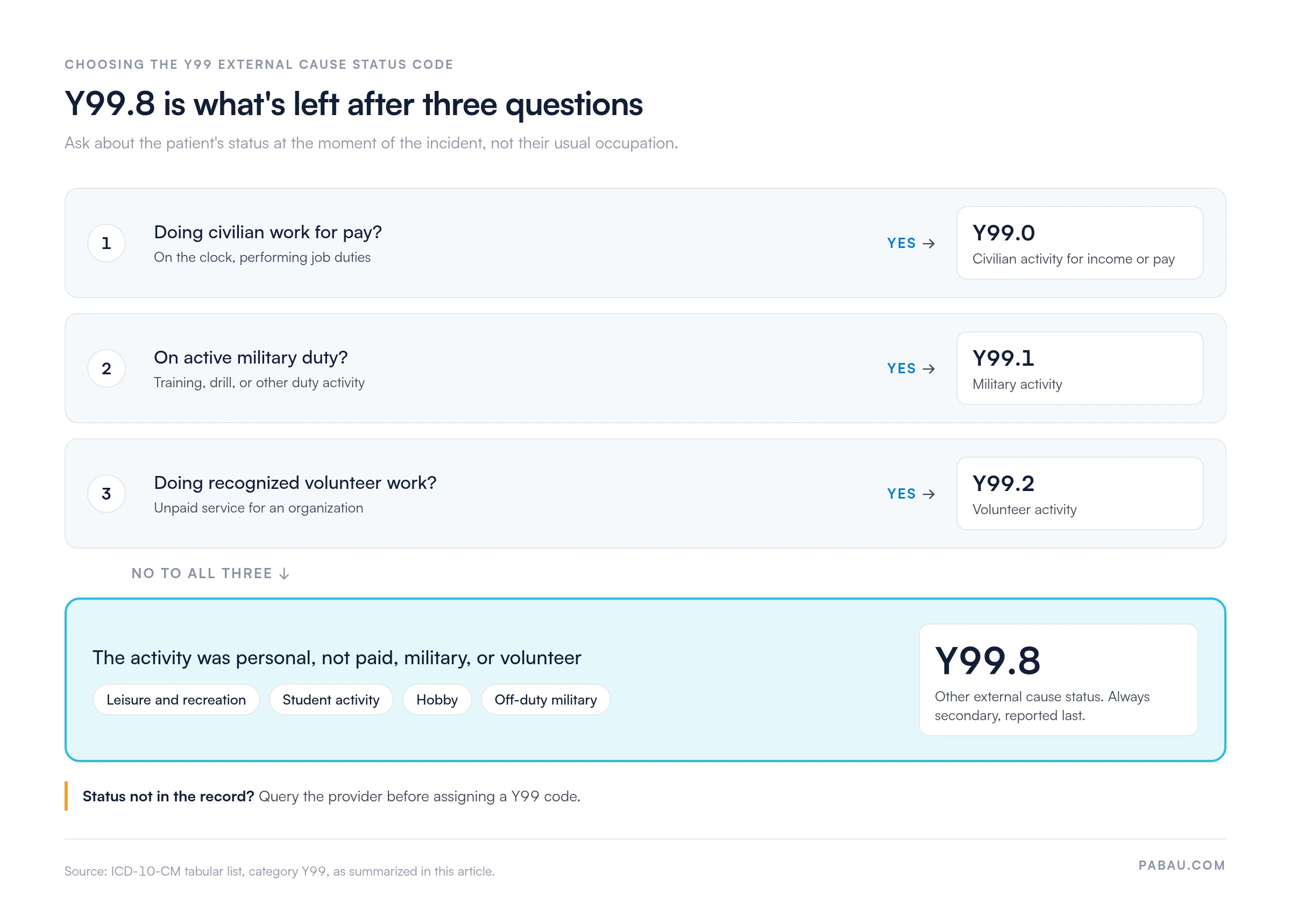
The decision table below maps seven common scenarios to the correct code.
When the record is silent on employment status, Y99.8 is the appropriate default. Query the physician when the documentation could support Y99.0 but is ambiguous. A patient who works as a personal trainer but was exercising on their own time is a typical example.
Concrete code string examples help coders build templates for the most common Y99.8 presentations. The five scenarios below show the full sequence for each encounter.
These code strings assume initial encounter. Subsequent encounters and sequela encounters replace the 7th character accordingly (D or S).
Build EHR charge templates for your five most common Y99.8 presentations. Pre-loading the Y92 and Y93 companion codes alongside Y99.8 in each template cuts per-claim coding time and heads off the ‘missing companion code’ denial.
The ICD-10-CM Official Guidelines for Coding and Reporting (Chapter 20) require that the medical record support every external cause code assigned. For Y99.8 specifically, the record must address three elements before the code can be reported.
When the intake form or physician note does not capture activity status, the coder should query the provider before assigning Y99.8. Assuming recreational status without documentation exposes the practice to audit risk.
Front-desk intake workflows that ask “What were you doing when this happened?” at registration resolve most ambiguity before the chart reaches the coding queue. Training staff to collect this information during intake is discussed further in the coding tips section below.
Under the ICD-10-CM Official Guidelines, external cause status codes including Y99.8 are generally optional on outpatient claims. Most commercial payers treat them as supplemental information rather than mandatory billing fields. That said, the picture varies significantly by claim type and payer.
Medicare does not publish a universal LCD requiring Y99.8 on outpatient claims. Check the current policy of your Medicare Administrative Contractor (MAC) before treating Y99.8 as mandatory on professional claims.
When a Y99.8 claim does come back, the electronic remittance advice (the 835 transaction) carries the denial reason code. Reading those codes across a payer’s claims shows which adjudication edits keep catching you.
Most Y99.8-related claim issues trace to five error types. Each denial pattern is correctable before the next submission cycle if the root cause is identified from the ERA or explanation of benefits.
Sorting rejections by their medical billing denial codes shows whether Y99.8 errors are systemic or a one-off coder slip. A systemic pattern points at the intake form or the charge template. When sequencing denials repeat, each one should produce a corrected claim plus a fix to the step that caused it.
The five practices below target the intake and coding steps where Y99.8 errors start, so fewer of them reach a payer.
For practices with a billing compliance program, external cause completeness belongs on the standing coding-audit checklist. The superbill design is another lever. Adding an “activity status at time of injury” field moves documentation capture to the point of service rather than the billing queue.
Checking claims against payer edits before they reach the clearinghouse is the fastest way to cut Y99.8 denials. That check catches the missing fields a payer would otherwise find at adjudication.
Run a quarterly report filtering claims that contain a W-, X-, or Y-series mechanism code but no Y99 status code. This single filter finds every external cause encounter with an incomplete coding sequence. It’s usually the quickest way to a measurable drop in denials.
Without a claims system, a Y99.8 error usually surfaces weeks later on a remittance. The coder keyed five codes by hand, and no one checked the claim against payer requirements before it went out.
Practice management software like Pabau pulls the patient, treatment, and insurer details from the patient record into a pre-filled claim. Validation checks run every time you go to send, and the Send button stays disabled until required details are in place. In the US, Pabau connects to Claim.MD for electronic submission, real-time eligibility checks, and claim status tracking.
Pabau’s claims management software also posts ERA remittances to the same dashboard. A Y99.8 denial reason then sits next to the claim that caused it. Your team can correct the claim and fix the intake step in one sitting.

Pabau pre-fills claims from the patient record and runs validation checks before each one goes out, so fewer Y99.8 claims come back rejected. See how the full claim workflow runs from one dashboard.

Y99.8 rarely goes wrong on its own. The denials come from where it lands in the sequence, and from records that never say what the patient was doing. Fix the intake question first, because a coder can’t report a status that no one documented.
Then lock the sequence into charge templates and let software hold incomplete claims back. The trade-off is a few extra seconds at registration against a full resubmission cycle later. Book a demo to see how Pabau’s claim validation and Claim.MD connection help your Y99.8 claims go out complete the first time.

Need a framework for managing coding denials? Denial management in healthcare covers the end-to-end process for tracking, appealing, and resolving claim rejections across code categories.
Want to understand how external cause claims move through the clearinghouse? Claim.MD clearinghouse guide explains how 837P files are validated, edited, and submitted to payers for adjudication.
Looking for a revenue cycle overview that puts external cause coding in context? Revenue cycle management explained maps every stage from encounter through payment posting.
ICD-10 Code Y99.8 is a supplementary code for “other external cause status.” It applies when an injury or health event happens during recreation, student activity, a hobby, or off-duty military time. It doesn’t apply to civilian paid work (Y99.0), military duty (Y99.1), or volunteer service (Y99.2). It’s always reported as a secondary or additional code, never as the principal diagnosis.
Y99.8 is always a secondary or additional code. Payer edits flag supplementary factor codes in the principal position, so reporting it first-listed gets the claim rejected. The injury or condition code must appear first in the code sequence.
Use Y99.8 when the patient was doing a recreational, student, or hobby activity at the time of the incident, not their paid civilian job. Use Y99.0 when the patient was on the clock and performing work duties. A nurse who slips while gardening on a day off is Y99.8. The same nurse slipping while moving a patient on shift is Y99.0. When the status is unknown, Y99.8 is the default.
Any Y93 code that matches the documented activity pairs with Y99.8. Examples include Y93.02 (running) for a jogging injury, Y93.11 (swimming) for a pool incident, and Y93.55 (cycling) for a cycling injury. The Y93 code and Y99.8 hold separate positions in the external cause sequence. Both are required when the activity is documented.
Medicare doesn’t publish a universal local coverage determination (LCD) requiring Y99.8 on outpatient professional claims. CMS guidelines generally treat external cause status codes as optional for outpatient billing. Facility inpatient claims fall under UHDDS requirements, which typically mandate external cause coding when the activity is known. Check the applicable MAC’s current LCD before treating Y99.8 as mandatory.
The most common cause is Y99.8 submitted as the principal diagnosis. Selecting the wrong Y99 subcode, such as Y99.8 when Y99.0 applies, is another. A missing W, X, or Y mechanism code also triggers denials, and so does a record with no note of the recreational or student activity. Each denial type has its own correction path, covered in the denial reasons section above.