ICD-10 Code Y76.0: Diagnostic obstetric and gynecological devices
ICD-10 Code Y76.0: Definition and billable status ICD-10 Code Y76.0 is a valid, ...

Last Updated: Oct 23, 2026
Billable Code Specific Code
T86.12 is the billable ICD-10-CM code for kidney transplant failure. It applies when the physician documents that the transplanted kidney has lost function, which is a separate finding from rejection (T86.11).
The distinction matters because rejection, graft infection and stable post-transplant CKD each code differently, so the physician's wording decides the claim. Z94.0, kidney transplant status, is commonly added, but no tabular note makes it mandatory. Code any documented chronic kidney disease with N18.- by stage. A rising creatinine on its own does not support T86.12.
Let Pabau's smart automation suggest the right codes, reduce claim denials, and keep your practice compliant—effortlessly.
Automate repetitive tasks and focus on what matters most—your patients.
Reduce coding errors and ensure compliance with the latest regulations.
Clean claims, fewer denials, and faster reimbursements.
Powerful insights and reporting to help your practice thrive.
HIPAA compliant SOC 2 certified GDPR-compliant Trusted by 4,000+ clinics worldwide

T86.12 is the billable code for kidney transplant failure, meaning the graft has lost function.
Rejection alone goes to T86.11, and infection of the transplanted kidney goes to T86.13.
Post-transplant CKD alone is not a complication, so it takes N18.- plus Z94.0, not T86.12.
Z94.0 is commonly added as a status code, but no tabular note makes it mandatory with T86.12.
Most T86.12 problems start in the note, so query the provider when failure is not stated plainly.
ICD-10 code T86.12 is the billable ICD-10-CM code for kidney transplant failure. You use it when the physician documents that the transplanted kidney has lost function. That is a different finding from rejection, which has its own code, T86.11.
The code has been valid since October 1, 2015, and it is still active for FY2026. It has no child codes, so T86.12 is the complete code on the claim. It sits in Chapter 19, under category T86 for complications of transplanted organs and tissue.
The T86.1 subcategory holds five codes. Each one answers a different question about the graft. So the first job is matching the physician’s exact word to the right sibling.
The mix-up is easy to understand. A rejected kidney can go on to fail, and both words can appear in the same chart. Still, the codes record different findings. Rejection describes an immune attack on the graft. Failure describes the result, a kidney that no longer does its job.
The chart below maps each documented finding to its code, including the CKD-only and unclear-wording cases.
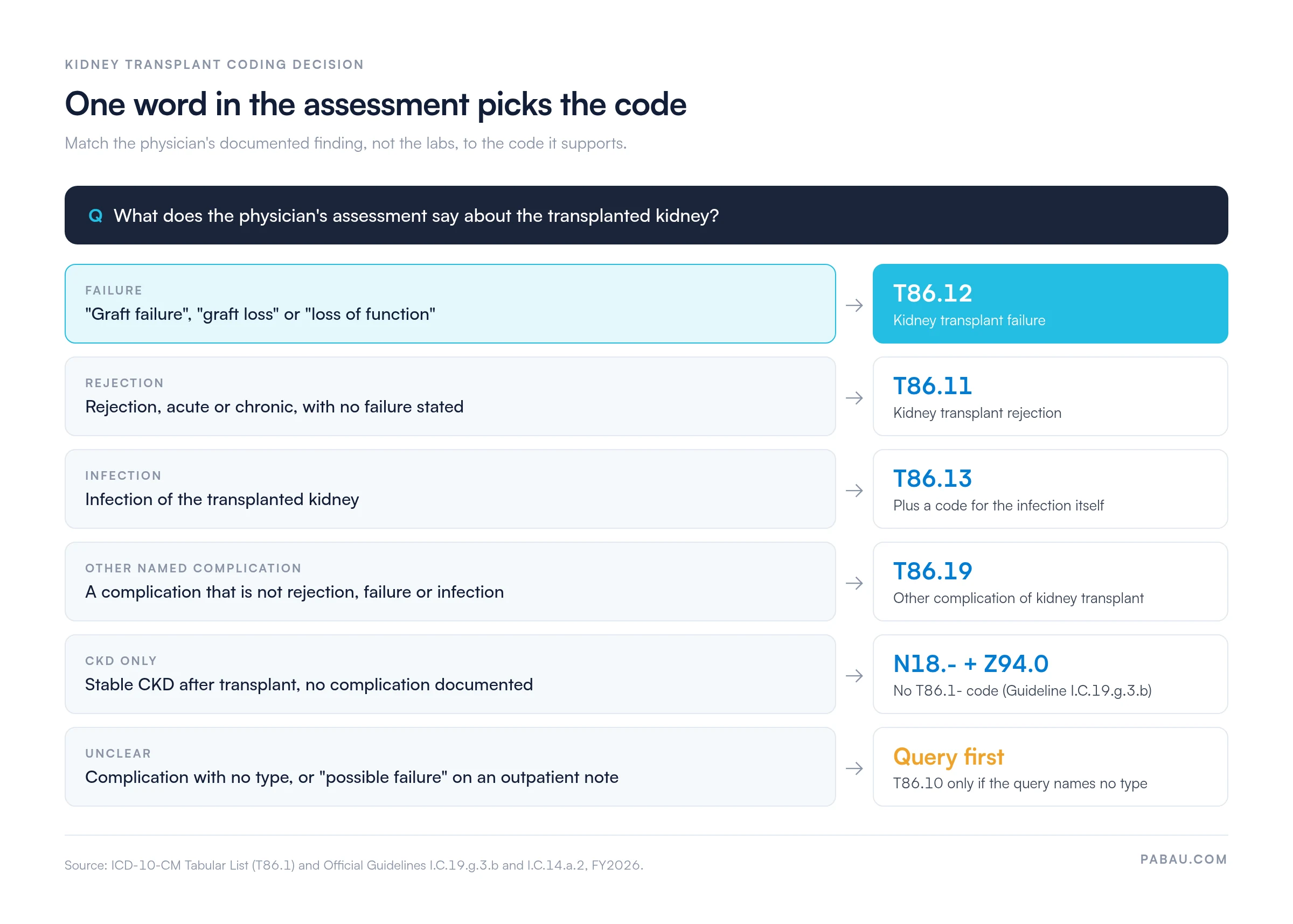
T86.12 covers a transplanted kidney that has stopped working, as the physician documents it. Terms such as “graft failure”, “allograft failure” and “loss of graft function” all point here. The code stays the same whether the failure is described as acute or chronic.
T86.12 does not cover these situations:
Labs and imaging alone never support the code. A rising creatinine or a falling GFR helps the physician reach a diagnosis. The coder, however, needs the diagnosis itself written in the record.
The coder’s job is to translate the physician’s words, not to infer a diagnosis. For T86.12, the chart needs a clear statement that the graft has failed or lost function.
Work through the note in this order:
Here is a quick example. A patient six years after transplant returns with poor graft function. The nephrologist writes “chronic allograft failure, restarting hemodialysis.” That supports T86.12, with N18.6 and Z99.2 when ESRD and dialysis dependence are documented.
Now compare a second patient. The note says “stable CKD stage 3a after kidney transplant” and names no complication. That chart supports N18.31 and Z94.0. It does not support T86.12.
If the biopsy report describes rejection but the physician has not documented failure, do not upgrade the code yourself. Send a query that asks whether the graft has lost function. The physician’s answer, not the pathology report, decides between T86.11 and T86.12.
T86.12 rarely goes out alone. The table below lists the secondary codes you will see most, and when each one belongs on the claim.
Sequence T86.12 first when the graft failure is the reason for the encounter. When another condition drives the visit, that condition goes first and T86.12 follows. Before you submit, check current notes in AAPC’s ICD-10-CM lookup and the CDC/NCHS ICD-10-CM browser tool.
The Official Guidelines for Coding and Reporting handle this in two places. Section I.C.19.g.3.b covers kidney transplant complications. It says T86.1- is assigned for documented complications, such as transplant failure or rejection.
The same section adds a limit that matters for T86.12. A kidney transplant may not fully restore kidney function, so CKD after a transplant is expected. T86.1- is not assigned for that CKD unless a complication such as failure is documented.
Section I.C.14.a.2 says the same thing from the CKD side. It directs you to code the CKD stage with N18 and add Z94.0. Both sections end the same way: when it is unclear whether a complication exists, query the provider.
Two more rules apply to uncertain wording. Inpatient coding may report a diagnosis documented as “probable” or “suspected” at discharge. Outpatient coding may not, so “possible graft failure” on a clinic note does not support T86.12. Read the current-year CMS ICD-10-CM guidelines for the full text, since sound medical billing compliance depends on applying them every time.
A T86.12 claim passes through the same stages as any other diagnosis claim. Each stage has its own failure point.
These are the mistakes that show up most often at those stages. A steady denial management workflow catches them before they repeat.
Run through these checks before the claim leaves your system. Each one takes seconds and removes a common cause of rework.
A clean claim passes all eight checks and still carries the right CPT codes for the services billed.
Graft failure encounters bring a familiar set of procedure codes. The exact mix depends on the setting and on whether a biopsy or dialysis is involved. Logging each service with its diagnosis in your claims management software makes every pairing easy to check.
Check every CPT and ICD-10 pairing against current National Correct Coding Initiative edits before submission. Payer edits can also differ from the national set.
Most T86.12 errors start with a coder reading a note in one system and building a claim in another. The wording that separates failure from rejection gets lost between the two.
Pabau, the practice management and billing platform we build, keeps the clinical note, the diagnosis codes and the claim on the same patient record. Your coder can check the physician’s exact wording before the claim is built. Claims then go out electronically through our Claim.MD integration, and remittance data comes back to the same record.

The result is fewer claims that go out with the wrong T86.1 sibling, and faster fixes when a payer does push back.

Pabau keeps the physician note, the codes and the claim in one place. Your team can check the diagnosis wording before billing and send claims electronically via Claim.MD.

T86.12 turns on one word in the chart. When the physician documents failure or loss of graft function, the code fits. When the note says rejection, infection or stable CKD, a different code tells the story better.
So build the habit of reading the assessment before you open the code set. Query early when the wording is unclear, because a two-minute query costs less than a denied claim. Book a demo to see how Pabau keeps notes and claims together for your transplant patients.

Need to understand the clearinghouse that routes your T86.12 claims? Claim.MD clearinghouse guide explains how electronic claim submission and ERA processing work for US medical practices.
Want a structured framework for managing transplant claim denials? Denial codes in medical billing covers the remittance advice codes that appear when payers deny T86.12 and related transplant claims.
Building a clean-claim checklist for nephrology? Superbill guide for medical practices walks through the coding fields, including secondary diagnoses, that an encounter should capture before billing.
Does the note say rejection rather than failure? ICD-10 code T86.11 covers kidney transplant rejection and the wording that supports it.
No complication type named in the chart? ICD-10 code T86.10 explains when the unspecified kidney transplant code applies.
No. Many Chapter 19 codes need a seventh character for the encounter type, but category T86 does not. T86.12 is complete and billable at five characters.
The GEM crosswalk maps T86.12 to ICD-9-CM 996.81, complications of transplanted kidney. That older code was broader, since it grouped rejection and failure together.
No. T86.12 has no acuity axis, so acute and chronic kidney transplant failure share the same code. Record the acuity in the note for clinical context.
Not for coding. ESRD takes its own code, N18.6, when the physician documents it. A patient with a failed graft may have both codes, plus Z99.2 for dialysis dependence.
At the removal encounter, code the complication that required it, such as T86.12. At later encounters, Z98.85, transplanted organ removal status, records that the graft is gone.