ICD-10 Code S42.444P: Medial epicondyle fracture, right humerus
ICD-10 Code S42.444P: full descriptor and code validity ICD-10 Code S42.444P car...

Last Updated: Oct 13, 2026
Billable Code Specific Code
T86.812 is the billable ICD-10-CM code for lung transplant infection.
Let Pabau's smart automation suggest the right codes, reduce claim denials, and keep your practice compliant—effortlessly.
Automate repetitive tasks and focus on what matters most—your patients.
Reduce coding errors and ensure compliance with the latest regulations.
Clean claims, fewer denials, and faster reimbursements.
Powerful insights and reporting to help your practice thrive.
HIPAA compliant SOC 2 certified GDPR-compliant Trusted by 4,000+ clinics worldwide

T86.812 is a billable ICD-10-CM code for lung transplant infection, effective October 1, 2025 for FY2026.
It sits under T86.81, the subcategory for lung transplant complications, inside the T86 category for transplanted organs.
A Use additional code note requires a second code naming the infectious organism, such as B25.0 for CMV.
Heart-lung transplant complications belong in the T86.3- subcategory, not under T86.81.
Practice management software like Pabau keeps the note, the lab result, and the transplant history in one chart.
ICD-10 Code T86.812, as published in the CDC/NCHS ICD-10-CM web tool, is a billable and specific diagnosis code for lung transplant infection. It is valid for all HIPAA-covered transactions in the FY2026 code year, effective October 1, 2025. Billable and specific means the code carries enough detail to go on a claim without a more granular child code.
It captures one clinical scenario. A patient with a prior lung transplant develops an active infection in the transplanted organ. The infection may be bacterial, viral, or fungal. T86.812 does not name the causative organism on its own, so ICD-10-CM requires a secondary code that does.
Knowing where T86.812 sits in the ICD-10-CM tabular list helps coders apply it correctly and find related codes quickly. Each level of the structure below adds a further degree of clinical specificity.
T86.81 is not billable on its own. It is the parent subcategory for all lung transplant complications, and one of its five child codes carries the claim. T86.812 is the only child code under T86.81 that captures infection specifically.
T86.81 also carries an Excludes1 note for complication of heart-lung transplant (T86.3-). Excludes1 means the two are never coded together. When the graft is a combined heart-lung transplant, code from the T86.3- subcategory instead.
Within the T86.3- subcategory, the documented complication type decides the fifth character. When the documentation names a heart-lung complication outside rejection, failure, and infection, assign T86.39.
Four sibling codes share the T86.81 subcategory with T86.812, and the documented complication type decides which one applies. Rejection is an immune response, and T86.810 is its code. Failure is loss of graft function. Infection is a separate pathologic process driven by a pathogen. Consult CMS ICD-10 codes guidance for annual updates to descriptions and effective dates.
The same five-way split repeats across the category. Treat the unspecified code as a last resort. When the documentation describes infection, assign T86.812 rather than T86.819.
Three documentation elements must be present before T86.812 can be assigned, and missing any one of them creates an audit vulnerability.

Maintaining HIPAA-compliant documentation across post-transplant encounters supports both coding accuracy and audit defense. That matters most when a record travels between the transplant center, the infectious disease team, and the billing department.
Tip for CDI specialists: when reviewing a lung transplant record, look for the phrases graft infection, pulmonary infection in transplant, or post-transplant pneumonia. Each one maps to the code description and supports T86.812 without the physician naming a code number.
Tracking a complication from presentation to recall is far easier inside a patient management system than on paper.
The ICD-10-CM tabular list carries a Use additional code note under T86.812, directing the coder to specify the infection. That pairing is mandatory. Submitting T86.812 alone leaves the claim incomplete by ICD-10-CM standards and can trigger medical necessity queries. The AAPC ICD-10-CM lookup shows the note alongside the code entry.
T86.812 is the principal diagnosis when the transplant infection is the reason for the encounter. The organism code follows as the additional code. In claims management software, both codes belong in the diagnosis field, with T86.812 in first position.

Lung transplant recipients are immunosuppressed by design, which leaves them open to a particular range of opportunistic and bacterial pathogens. The table below lists the organisms seen most often in post-lung-transplant infection, with their ICD-10-CM codes.
Verify each organism code against the current FY2026 ICD-10-CM tabular list before submission. Descriptions and available specificity change between annual editions, so this table supports a lookup rather than replacing one.
Z94.2 identifies a patient who has undergone a lung transplant. It records transplant history and carries no complication of its own. On a T86.812 encounter, add Z94.2 as an additional code so the record shows that the affected lung is a graft. CMS ICD code lists cover how status codes sequence alongside complication codes on Medicare claims.
Sequencing for a T86.812 encounter follows the pattern below. It mirrors the order a physical therapy EMR uses for post-operative records, with the active condition first and the status code behind it.
If the patient is admitted for a separate reason and the transplant infection is discovered incidentally, sequencing may change. ICD-10-CM Official Guidelines for Coding and Reporting govern sequencing in those scenarios.
Coders working the ICD-10-CM alphabetic index will meet several alternate descriptions, and every term below maps to T86.812. Accurate patient record management captures the physician’s own wording, so coding staff can find the right code faster.
When you query a physician for clarification, mirror the terminology they already use. A query asking whether a pulmonary graft infection is present usually lands better than one asking for T86.812 by number.
The T86 category covers complications of every transplanted organ and tissue. ICD-10-CM groups them by organ type, with parallel subcategories for rejection, failure, infection, other specified, and unspecified. Cell and tissue grafts sit here too. The liver equivalent of T86.810 is T86.41, and the heart-lung equivalents live in T86.3-.
Infection in a heart-only graft belongs to T86.23, inside the T86.2 subcategory. A Use additional code note sits under T86.23 as well, so the organism still needs a second code.
T86.9- carries the same complication types for a graft the record does not name. A transplant infection with no documented organ or tissue site falls under T86.93.
Three key distinctions for coding transplant complications correctly:
Review coding tip: a post-lung-transplant patient admitted with both an active infection and declining graft function may need T86.812 and T86.811. Assign both where the documentation supports each condition independently, and query the physician when the record is ambiguous.
Most practices build a transplant complication claim from three separate places. The physician’s note names the infected site, the lab report names the organism, and the history supplies the transplant status. Coders reconcile all three by hand, and the organism code is the one that slips.
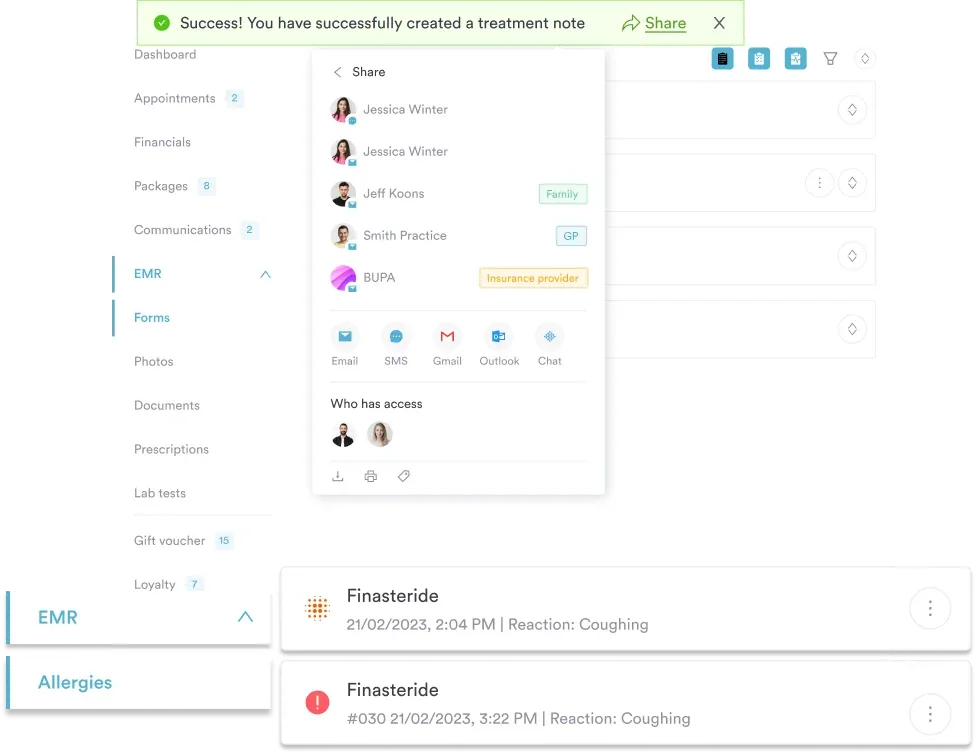
Practice management software like Pabau holds those three sources against one patient record. Lab results, clinical notes, and past procedures sit on the same chart, so a coder reads the culture result and the graft description together. Custom forms can prompt the clinician to state the site and the organism while the patient is still in the room.
The outcome is a shorter path from documentation to a clean claim. When the note, the lab result, and the transplant history sit together, the coder assigns T86.812 and its organism code in one pass.

Pabau keeps clinical notes, lab results, and transplant history in one patient record, so coders can see every fact a T86.812 claim needs. That cuts the back-and-forth before submission.

Two facts in the record decide whether T86.812 holds up. The note has to name the graft as the infected site, and the lab has to name the organism. Chase both before the claim goes out, because a retrospective query after a denial costs far more time.
Defaulting to T86.819 throws away specificity the documentation already supports. Submitting T86.812 on its own invites a payer query for the organism. Both outcomes are settled at the point of documentation rather than at the point of billing.
Pabau keeps the note, the lab result, and the transplant history in one chart. The second code stays visible while the first is being assigned. Book a demo to see how it supports post-transplant coding and documentation.

Coding a graft that came from the patient’s own body? CPT code 20955 walks through billing a bone graft with microvascular anastomosis.
Need the skin equivalent of a graft complication workflow? CPT code 15201 covers full thickness skin graft billing from documentation to submission.
Billing a home visit with no matching code? Unlisted home visit billing guide CPT code 99600 covers unlisted home visit services and the documentation that keeps claims from denial.
Coding a complication in a different transplanted organ? T86.298 covers the heart transplant equivalent, including its documentation and sequencing rules.
ICD-10 Code T86.812 is a billable ICD-10-CM diagnosis code for lung transplant infection. It sits under subcategory T86.81 within the T86 category for complications of transplanted organs and tissues. It became effective October 1, 2025 for the FY2026 code year.
Yes, T86.812 is a billable and specific ICD-10-CM code, valid for use in all HIPAA-covered transactions. It does not require a more granular child code for submission.
The ICD-10-CM tabular list carries a mandatory Use additional code note directing you to a second code for the infection. Common organism codes include B25.0 for CMV pneumonitis, B44.1 for pulmonary aspergillosis, and B59 for pneumocystosis. Verify organism codes against the current FY2026 tabular list before submission.
T86.810 covers lung transplant rejection, an immune-mediated process. T86.811 covers lung transplant failure, meaning loss of graft function. T86.812 covers infection. These are distinct conditions and may all be assigned when the documentation supports each one.
Z94.2 (Lung transplant status) should be coded as an additional diagnosis when the transplant status is relevant to the encounter. In most T86.812 encounters, Z94.2 applies because the transplant history is central to the clinical context. Sequence T86.812 first when the infection is the reason for the encounter.
Cytomegalovirus (CMV) is the most common viral opportunistic infection in lung transplant recipients. Fungal pathogens include Aspergillus (B44.1) and Pneumocystis jirovecii (B59). Bacterial causes include Pseudomonas aeruginosa (B96.5) and other gram-negative organisms. The treating clinician’s documentation of culture or serology results should guide organism code selection.