ICD-10 Code Y76.0: Diagnostic obstetric and gynecological devices
ICD-10 Code Y76.0: Definition and billable status ICD-10 Code Y76.0 is a valid, ...

Last Updated: Oct 23, 2026
Billable Code Specific Code
Z94.2 is the billable ICD-10-CM code for lung transplant status. It records that a patient has a transplanted lung, single or double, currently in place.
Z94.2 sits in category Z94, Transplanted organ and tissue status, and is usually reported as an additional code. A documented rejection, failure, or infection of the graft moves the claim to T86.81-, and a heart-lung graft takes Z94.3.
Let Pabau's smart automation suggest the right codes, reduce claim denials, and keep your practice compliant—effortlessly.
Automate repetitive tasks and focus on what matters most—your patients.
Reduce coding errors and ensure compliance with the latest regulations.
Clean claims, fewer denials, and faster reimbursements.
Powerful insights and reporting to help your practice thrive.
HIPAA compliant SOC 2 certified GDPR-compliant Trusted by 4,000+ clinics worldwide

Z94.2 is the billable ICD-10-CM code for lung transplant status, covering a single, double, or lobar lung graft that is still in place.
Report Z94.2 as an additional code, since it describes the patient’s history rather than the reason for today’s visit.
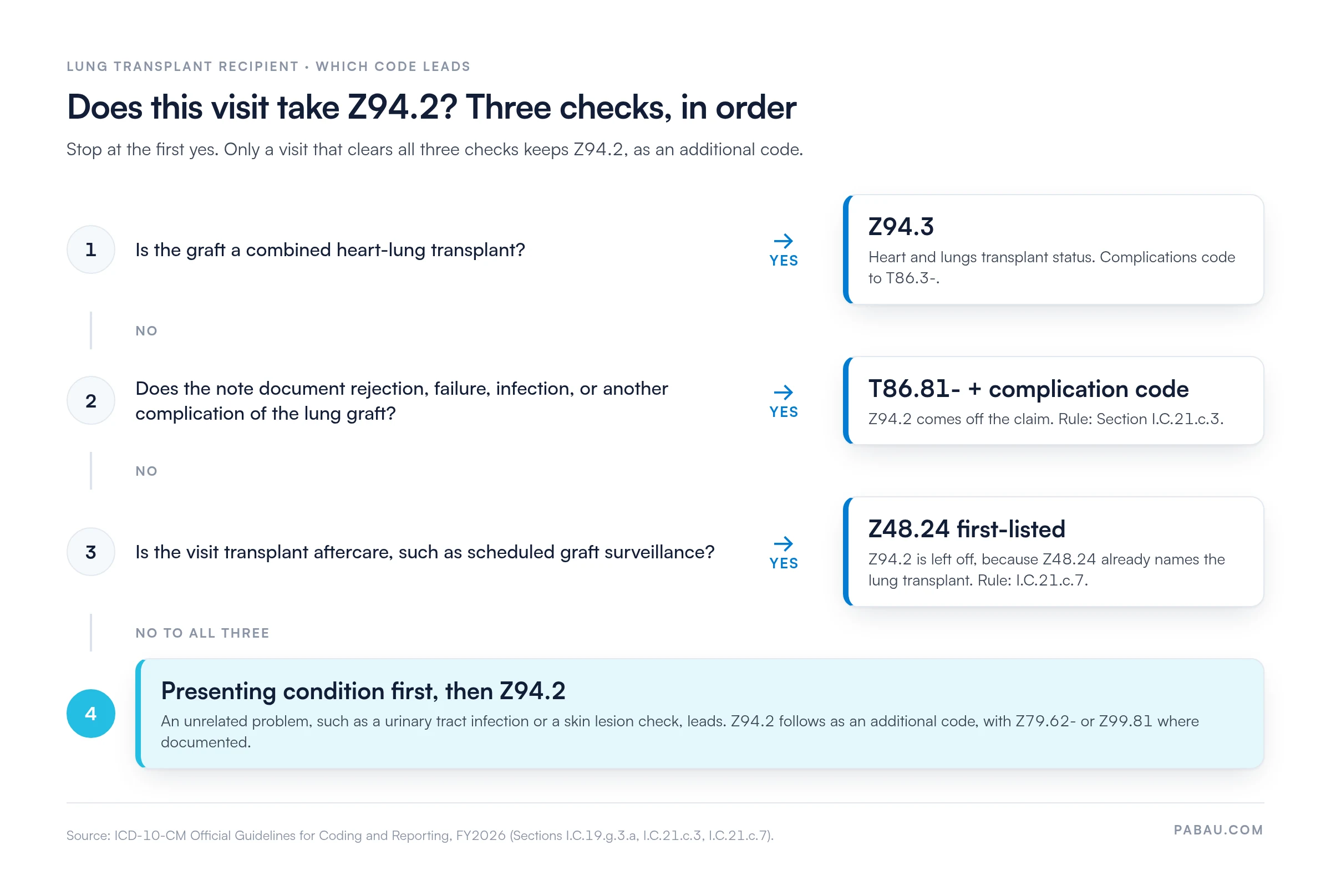
When the provider documents rejection, failure, or infection of the graft, replace Z94.2 with a T86.81- code plus a code for the complication.
A heart-lung recipient takes Z94.3, and a post-transplant aftercare visit leads with Z48.24 rather than Z94.2.
ICD-10 code Z94.2 is the billable code for lung transplant status. It tells the payer that the patient lives with a transplanted lung. Z94.2 belongs to category Z94, Transplanted organ and tissue status, in Chapter 21 of ICD-10-CM (Z00-Z99). The CDC/NCHS ICD-10-CM code tool lists it as billable, with the same descriptor in the FY2026 code set.
Z94.2 applies to any patient who has received a lung transplant and still has the graft in place. The code does not split by technique, so each scenario below takes Z94.2 once the transplant admission is over.
The ICD-10-CM index sends “lung(s)” under Transplant status to Z94.2. Laterality and the number of lungs never change the code.
Transplant pulmonology teams report Z94.2 most often, but any provider treating the patient can add it. The Official Guidelines call a status code informative, because the status may affect the course of treatment and its outcome. Lifelong immunosuppression changes how a primary care, dermatology, or infectious disease visit is managed, so the status belongs on those claims too.
Z94.2 records status only. It stops applying once the chart documents a problem with the graft, and it never stands in for another organ.
The Official Guidelines (Section I.C.21.c.3) state the rule directly. A status code is not used with a body-system code that already carries the same information. Their example pairs Z94.1 with T86.2-, and the same logic keeps Z94.2 off a claim that carries T86.81-.
Category Z94 runs from Z94.0 to Z94.9, and a chart that says “transplant” without naming the organ invites the wrong code. Two other codes are easy to confuse with Z94.2. Corneal transplant status is Z94.7, and the presence of a prosthetic heart valve is Z95.2.
Z94.2 is almost always an additional code. The Official Guidelines allow a Z code to be first-listed or secondary, depending on the encounter. A status code describes the patient rather than the reason for the visit, so it rarely belongs first.
For a lung transplant recipient seen for an unrelated problem, the sequencing works like this:
Two sequencing errors cause avoidable rework. One is sending Z94.2 as the only code on the claim. The other is listing it first when an unrelated condition drove the visit. If the new problem affects the lung graft itself, it is a transplant complication, and the T86.81- rules below apply instead.
Three checks decide whether Z94.2 belongs on the claim at all, and the order you run them in matters.
A claim with Z94.2 needs documentation showing that the transplant happened and that the graft is still in place. Auditors look for three elements:
Documentation prompts for post-transplant visits help providers record the status language under time pressure. They are a practical part of medical billing compliance for any practice that follows transplant recipients.
Add lung transplant status to the patient’s problem list with the transplant type and date. Every later visit then opens with the history the claim needs, and the provider only confirms current graft function.
When the visit exists because of the transplant, Z48.24 is the first-listed code. Its full title is “Encounter for aftercare following lung transplant.” Scheduled graft surveillance and immunosuppressant management during recovery are typical examples.
Adding Z94.2 to that claim looks natural, but the aftercare guideline (Section I.C.21.c.7) points the other way. It says a status code should not be used when the aftercare code already indicates the type of status. Z48.24 already names the lung transplant, so Z94.2 adds no information next to it.
The aftercare code has limits of its own. The guideline bars an aftercare Z code when treatment is directed at a current, acute disease. A patient treated for acute rejection gets T86.810, not Z48.24.
Heart-lung recipients take Z48.280, Encounter for aftercare following heart-lung transplant. Z48.288, Encounter for aftercare following multiple organ transplant, covers other combinations of transplanted organs.
In Pabau’s claims management software, you can set up code pairing templates by visit reason. A surveillance visit then starts from Z48.24, while an unrelated visit adds Z94.2 as an additional code.
When the provider documents a complication that affects the lung graft, a T86.81- code replaces Z94.2. The two are not reported together for the same graft. An infected graft, for example, codes to T86.812 with a second code that names the infection.
Section I.C.19.g.3.a sets two conditions for these codes. A T86 code applies only when the complication affects the function of the transplanted organ. It also needs a second code that identifies the complication.
Chronic lung allograft dysfunction shows how the pairing works. The tabular list says to code T86.810 or T86.818 first, then add a J4A.- code for the dysfunction. J44.81 is added where bronchiolitis obliterans syndrome is documented.
Documentation that confirms a complication but never names its type lands on T86.819. Assign it only after rejection, failure, and infection have been ruled out, and query the provider when the note looks unfinished.
A condition that develops after the transplant without affecting the graft is not a complication. Code it on its own, with Z94.2 as an additional code. Once a rejection episode resolves and the graft is stable, Z94.2 returns at later visits. Heart-lung grafts use T86.3- instead, because T86.81 excludes them.
Z94.2 is a diagnosis code, so it does not trigger prior authorization by itself. Payers focus on the services billed alongside it. For post-transplant pulmonary visits, that usually means:
Authorization rules vary by payer and plan year, so confirm them before each encounter. Running insurance eligibility verification at every post-transplant visit catches plan changes before they reach the claim.
Pabau connects to Claim.MD, a clearinghouse, for real-time eligibility checks and electronic claim submission on post-transplant encounters.
Z94.2 denials cluster around a small set of repeat mistakes. Your remittance data shows which of them is active in your practice.
Tracking CARC codes on Z94.2 remittances is part of systematic denial management in healthcare. A clean claim submission for these visits rests on three points: correct sequencing, documented graft status, and the right companion code.
Once a month, pull the claims where Z94.2 is the first-listed diagnosis and check their CARC denial codes. One afternoon’s audit usually shows which sequencing habit is driving the denials.
A lung transplant recipient comes back for years of follow-up. Each visit needs the right choice between Z94.2, Z48.24, and a T86.81- code. When the transplant history lives in scanned letters, coders rebuild it at every visit, and sequencing errors slip through.
Pabau keeps the transplant type and date on the patient record, where every provider sees it before the consultation. Code pairing templates load the right combination for each visit type. Claims then go out through the Claim.MD integration, and denials come back to one worklist.
The outcome is fewer claims returned for sequencing, and less time spent chasing transplant history before each claim goes out.

Pabau brings ICD-10 documentation, claim submission, and eligibility checks into one place for pulmonary and specialty practices. Your team spends less time on rework and more on patient care.

Z94.2 earns its place only when the lung graft is stable and something else brought the patient in. Every other post-transplant visit belongs to a different code, whether that is Z94.3, Z48.24, or a T86.81- code.
Build that decision into your visit templates once, and coders stop re-deciding it at every follow-up. The trade-off is upkeep, because the templates need a check against each October code set update.
Book a demo to see how Pabau keeps post-transplant claims sequenced correctly from the first follow-up.

Dealing with claim denials across your practice? Denial codes in medical billing maps CARC and RARC denial codes to corrective actions so your billing team can resolve remittances faster.
Want to understand how the claims submission process works end to end? Medical claims clearinghouse explains how claims move from practice to payer and where ICD-10 code accuracy affects adjudication outcomes.
ICD-10 code Z94.2 means lung transplant status. It records that a patient has received a lung transplant and that the graft is still in place. It sits in category Z94 and is usually reported as an additional code.
Yes. Z94.2 is a billable ICD-10-CM code in the FY2026 code set. It needs a first-listed diagnosis beside it, because a claim with Z94.2 alone rarely shows why the visit happened.
Z94.2 records a lung graft that is in place, while T86.810 records lung transplant rejection. Use Z94.2 when the graft is stable. Switch to T86.810, or another T86.81- code, when the provider documents a complication that affects the graft.
Z94.2 covers a lung transplant alone. Z94.3 covers a combined heart and lungs transplant, and its complications code to T86.3- rather than T86.81-.
Usually not. The aftercare guideline says a status code should not be used when the aftercare code already indicates the type of status. Z48.24, Encounter for aftercare following lung transplant, already names the transplant.
No. Corneal transplant status is Z94.7, and the presence of a prosthetic heart valve is Z95.2. Z95.3 and Z95.4 cover xenogenic and other heart-valve replacements.
T86.811 is lung transplant failure. Related codes are T86.810 for rejection, T86.812 for infection, T86.818 for other complications, and T86.819 for an unspecified complication. Each needs a second code for the complication, and Z94.2 comes off the claim.