ICD-10 Code S42.444P: Medial epicondyle fracture, right humerus
ICD-10 Code S42.444P: full descriptor and code validity ICD-10 Code S42.444P car...

Last Updated: Oct 13, 2026
Billable Code Specific Code
T86.30 is the billable ICD-10-CM code for an unspecified complication of heart-lung transplant. It applies when the record confirms a complication of the combined graft but does not name it as rejection, failure, infection, or another specified type. Rejection is T86.31, failure is T86.32, infection is T86.33, and a named complication with no code of its own is T86.39.
Let Pabau's smart automation suggest the right codes, reduce claim denials, and keep your practice compliant—effortlessly.
Automate repetitive tasks and focus on what matters most—your patients.
Reduce coding errors and ensure compliance with the latest regulations.
Clean claims, fewer denials, and faster reimbursements.
Powerful insights and reporting to help your practice thrive.
HIPAA compliant SOC 2 certified GDPR-compliant Trusted by 4,000+ clinics worldwide
ICD-10 code T86.30 is the billable ICD-10-CM diagnosis code for an unspecified complication of heart-lung transplant. It is the catch-all entry in the T86.3 subcategory. Reach for it when the record documents a problem with the transplanted heart and lungs, but never says which kind of problem it is.
That boundary decides the claim. Documented rejection belongs to T86.31, failure to T86.32, and infection to T86.33. A named complication with no code of its own belongs to T86.39. T86.30 covers what is left: A complication the note confirms but does not classify.

T86.30 is the billable ICD-10-CM code for an unspecified complication of heart-lung transplant.
It applies when a complication is documented, but the record does not name it as rejection, failure, infection, or another specified type.
The specified siblings are T86.31 for rejection, T86.32 for failure, T86.33 for infection, and T86.39 for other complications.
Report Z94.3 heart and lungs transplant status with T86.30, and add any code named in the T86 use-additional-code note.
The CMS general equivalence mapping sends T86.30 back to the ICD-9-CM pair 996.83 and 996.84, not to a V42 status code.
T86.30 entered the ICD-10-CM tabular list when the classification took effect, and its title has not been revised since. The table below carries the reference data a coder needs before the claim goes out.
The CMS ICD-10 codes page publishes the annual update files, the tabular list, and the index. Check the current release there before you submit, since the tabular order file is the authority on what T86.30 actually says.
An unspecified complication code records that something went wrong with the graft while leaving the nature of the problem open. The word describes the state of the documentation, not a clinical finding. No patient has an unspecified complication in the way a patient has an infection.
Three conditions have to hold together before T86.30 is the right answer:
Routine post-transplant follow-up with no complication documented is not coded here at all. Z94.3 carries the transplant history on its own. Where the transplant was a lung alone, Z94.2 is the matching status code. Adding T86.30 to a clean follow-up visit puts a complication on the record that the clinician never wrote.
Older coding references and several code lookup sites still describe T86.30 as heart and lung transplant rejection, unspecified. The CMS tabular list has never carried that title. Rejection of a combined heart-lung graft is ICD-10 code T86.31, and that code covers acute, chronic, and hyperacute rejection alike. If the note documents rejection of any type, T86.31 is the code, and the unspecified entry does not come into it.
T86.3 covers complications specific to a combined heart-lung graft. The subcategory header itself is not billable, so every claim carries one of its five-character children. Laying the full set out side by side shows where each boundary falls.
The pair that trips coders is T86.30 against T86.39, because both read like a leftover bucket. They are not interchangeable. T86.39 is for a complication the clinician named, such as bronchial anastomotic dehiscence, that has no code of its own in this subcategory. T86.30 is for a complication nobody named.
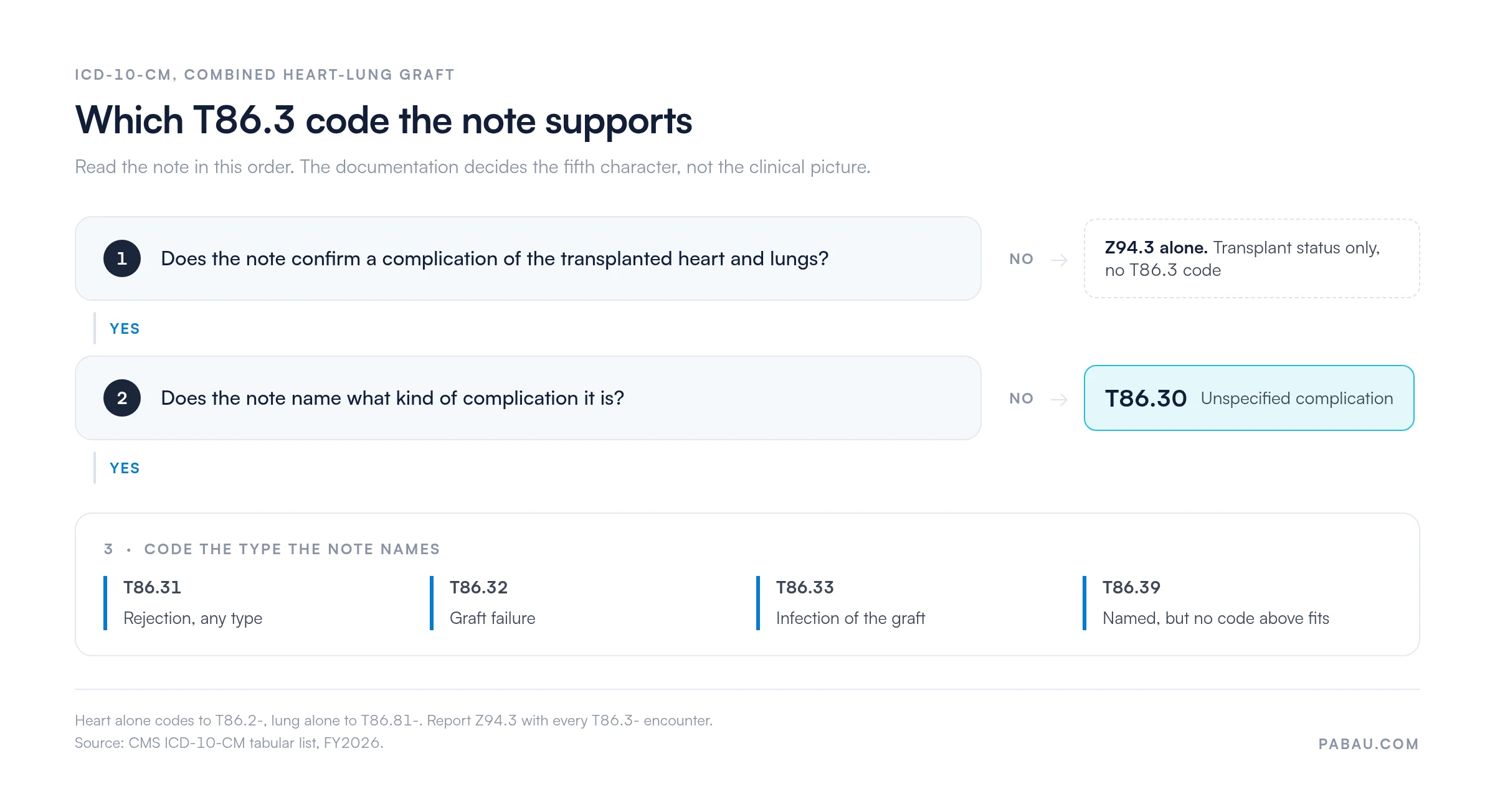
Working through the note in a set order settles which of the five codes applies.
T86 sits in chapter 19 and gathers every complication of a transplanted organ or tissue. Each organ gets its own subcategory, and the organ decides the code long before the complication does.
A useful pattern runs through the block. Where a subcategory is subdivided, the fourth character 0 is the unspecified complication, and rejection sits one digit further along. T86.20 and T86.21 behave exactly as T86.30 and T86.31 do. The 0 digit never means rejection anywhere in T86.
The bone marrow subcategory follows the same shape. T86.00 is the unspecified complication of a bone marrow transplant, and T86.01 is rejection.
Organ mismatch is the other frequent error. A heart-alone recipient with a graft complication codes to T86.2-, and a lung-alone recipient codes to T86.81-. Reporting T86.30 for either one contradicts the surgical history in the chart, and payers cross-check that history. Within T86.81-, the unspecified entry is T86.819, the lung-alone counterpart of T86.30.
T86.30 rarely travels alone. The transplant status code establishes the history that makes the complication plausible, and the tabular list adds an instructional note that several coders miss.
The use-additional-code note at T86 is an official instruction, not a suggestion. Where graft-versus-host disease, a transplant-associated malignancy, or PTLD is documented alongside the unspecified complication, those codes belong on the claim too.
Sequencing follows the reason for the encounter. T86.30 is the principal diagnosis when the complication is what brought the patient in, with Z94.3 reported afterwards. Where the visit is really about immunosuppressant management, the sequence changes under section I.C.19 of the official guidelines.
Unspecified codes attract scrutiny because they carry so little clinical information. The official guidelines expect coding to the highest level of specificity the record supports. A claim built on T86.30 therefore says as much about the note as about the patient. Fixing that sits with the query process, not the claim form. Pabau’s guide to denial codes covers the reason codes these claims come back with.
Read the note for a named complication before you settle on T86.30. If the clinician named the problem and no sibling code fits it, the right answer is T86.39. T86.30 is only for a documented complication with no type attached to it at all.
Documentation checklist for a T86.30 claim:
Common triggers for a denial or a records request on T86.30:
Legacy payer systems and retrospective audits sometimes ask what T86.30 looked like before October 2015. The CMS general equivalence mappings answer that, and the answer is a pair of codes rather than a single one.
ICD-9-CM had no combined heart-lung category, so the mapping splits the graft into its two organs. That is why the entry lists two codes joined together rather than one equivalent. The same pairing applies across T86.31, T86.32, T86.33, and T86.39.
One crosswalk error circulates widely and is worth naming. V42.7 is sometimes given as the ICD-9-CM equivalent of T86.30, which is wrong twice over. V42.7 is liver replaced by transplant, and heart transplant status is V42.1. Both are status codes for a transplant history, so neither one reports a complication.
The ResDAC guide to ICD codes in Medicare files explains how the GEMs behave across the transition, including combination entries like this one. For the current tabular list and its instructional notes, the CDC ICD-10-CM web tool is the primary reference.
Every unspecified complication claim starts as a documentation problem. The coder can only work with the words in the note, so the moment worth fixing is the encounter itself. Practice management software like Pabau shapes that moment with structured clinical forms. The clinician records what the complication is while the patient is still in the room.
From there the code stays attached to the encounter it came from. Pabau’s claims management software lets billing staff build the claim against the note and pair T86.30 with Z94.3. The submission then routes through the Claim.MD clearinghouse for validation before it reaches the payer.
The outcome is fewer unspecified codes leaving the practice by accident. A note that names the complication produces a specified sibling code, and the claims that still need T86.30 carry the query trail that justifies it.


Pabau pairs structured clinical documentation with claims management, so post-transplant encounters reach billing with the complication named and the status code attached. Specified codes go out, and unspecified ones get queried first.

T86.30 earns its place on a claim only when the record confirms a heart-lung graft complication and declines to say which one. Read the note first for a named complication, then for a named type. Rejection, failure, and infection each have their own code, and a named complication without a code of its own belongs at T86.39.
Treat a run of T86.30 claims as a signal about the documentation rather than the coding. Each one represents a query that could have been raised while the clinical detail was still fresh. Book a demo to see how Pabau keeps transplant documentation and claim coding in the same workflow.

Need a framework for managing claim denials on complex codes? Denial management in healthcare covers how to identify, appeal, and prevent common ICD-10 claim rejections.
Looking for a clean-claim checklist for billing compliance? Medical billing compliance outlines the documentation and coding standards that keep transplant complication claims audit-ready.
Want to understand how ERA files map back to your submitted codes? Electronic remittance advice explains how payer response files work and how to reconcile them against ICD-10 submissions.
ICD-10 code T86.30 is the billable ICD-10-CM diagnosis code for an unspecified complication of heart-lung transplant. It applies when the record documents a complication of a combined heart-lung graft without identifying the complication as rejection, failure, infection, or another specified type.
Yes. T86.30 is a valid, billable five-character code and needs no seventh character. Its parent, T86.3, is a subcategory header and cannot be submitted on a claim, so the five-character child is what goes out.
T86.31 is the code for documented heart-lung transplant rejection, covering acute, chronic, and hyperacute rejection. T86.30 carries no clinical type at all. Choose T86.31 whenever rejection appears in the note, and keep T86.30 for a complication the clinician confirmed but never classified.
Use T86.39 when the clinician names the complication and no other T86.3 code covers it, such as an anastomotic problem. Use T86.30 only when the complication is documented but unnamed. The difference is whether the record identifies the problem, not whether a code exists for it.
Z94.3 for heart and lungs transplant status belongs on every T86.3- encounter. Add Z79.899 when the patient is on long-term immunosuppression. The T86 use-additional-code note also calls for D89.81- for graft-versus-host disease, C80.2 for transplant-associated malignancy, and D47.Z1 for PTLD.
The CMS general equivalence mapping pairs T86.30 with 996.83 and 996.84, the ICD-9-CM codes for complications of a transplanted heart and a transplanted lung. ICD-9-CM had no combined heart-lung category. V42.7 is not the equivalent, since it reports liver transplant status rather than a complication.