ICD-10 Code T32.21: Corrosions involving 20-29% of body surface
ICD-10 Code T32.21: Quick reference ICD-10 Code T32.21 is the billable ICD-10-CM...

Last Updated: Oct 19, 2026
Billable Code Specific Code
T32.95 is the billable ICD-10-CM code for corrosions involving 90% or more of body surface with 50-59% third degree corrosion. It records extent only, so it is reported alongside the codes for the chemical, the intent and each corroded body site.
The code belongs to the T32 category for chemical corrosion injuries, which classifies corrosions by how much body surface they cover. The fifth character 5 applies only when the clinician documents both the total body surface area and a third-degree share of 50-59%.
Let Pabau's smart automation suggest the right codes, reduce claim denials, and keep your practice compliant—effortlessly.
Automate repetitive tasks and focus on what matters most—your patients.
Reduce coding errors and ensure compliance with the latest regulations.
Clean claims, fewer denials, and faster reimbursements.
Powerful insights and reporting to help your practice thrive.
HIPAA compliant SOC 2 certified GDPR-compliant Trusted by 4,000+ clinics worldwide

T32.95 requires a documented total body surface area of 90% or more and a separately documented third-degree share of 50-59%.
Corrosions (T32) are caused by chemical agents, while thermal burns belong in the T31 category.
The chemical and intent code from T51-T65, such as T54.91XA, is sequenced first, ahead of the site codes and T32.95.
A Y92 place-of-occurrence code is added to every corrosion claim, as the tabular list instructs.
Without a documented third-degree percentage, a coder cannot support T32.95 and has to query the physician.
ICD-10 Code T32.95 is a billable, specific diagnosis code for corrosions involving 90% or more of body surface with 50-59% third degree corrosion. That wording is the full official descriptor, valid from FY2016 through the current fiscal year.
The code sits in category T32 (Corrosions classified according to extent of body surface involved), which runs from T32.0 through T32.99. Like the rest of the ICD-10 diagnostic codes for injuries, it lives in chapter S00-T88.
T32.95 has two independently documented axes. The fourth character (9) encodes a total body surface area (TBSA) of 90% or more. The fifth character (5) encodes third-degree corrosion covering 50-59% of the body surface.
A coder cannot select T32.95 when the record shows only a total TBSA figure, because the third-degree percentage must appear as its own stated value.
According to the CDC/NCHS ICD-10-CM web tool, T32.95 needs no seventh character and carries no “not billable” flag. It is valid on inpatient and outpatient claims, though nearly every encounter at this extent is an inpatient burn-center admission.
Every T32.9x code shares the same TBSA band of 90% or more. The fifth character records only how much of the body surface carries third-degree corrosion, so it never stands for a second TBSA measurement. The full T32.9x hierarchy is:
The bands climb in unbroken 10-point steps. A documented third-degree share of 48% therefore codes to T32.94, while 61% codes to T32.96. The CMS ICD-10-CM tabular list confirms each band for the current fiscal year.
TBSA estimation drives the whole T32.9x code selection. The American Burn Association (ABA) endorses two tools: the Rule of Nines for adults and the Lund-Browder chart for children. A child’s head-to-limb proportions differ from an adult’s.
A TBSA of 90% or more on the Rule of Nines means nearly every body region is involved at once. That pattern usually follows an industrial chemical incident, a mass-casualty corrosive release, or a severe chemical assault.
The Lund-Browder chart adjusts head and thigh percentages by age, and burn centers usually prefer it for children under 15.
To turn a TBSA assessment into the correct T32.9x subcode, work through four checks:
Thermal burns belong in T31, and chemical corrosions belong in T32. Section I.C.19 of the ICD-10-CM guidelines draws the line by cause.
Burns come from heat sources such as fire, hot objects and radiation, while corrosions come from chemicals such as acids, alkalis and caustic substances. The extent axes work identically in both categories, so T31.9x and T32.9x share the same fifth-character logic.
When the record is unclear about whether the injury was thermal or chemical, query the attending physician before coding. The wrong parent category makes the whole claim incorrect, however accurate the TBSA and third-degree percentages are.
Five documentation elements support ICD-10 Code T32.95. Missing any one forces a different code and creates medical billing compliance problems that are hard to correct after discharge.
Review the attending physician’s burn diagram before abstracting T32.95. If it shows total TBSA but no separate third-degree percentage, query the physician before coding. Guessing the fifth character misstates the severity of a high-acuity stay and invites additional documentation requests from payers.
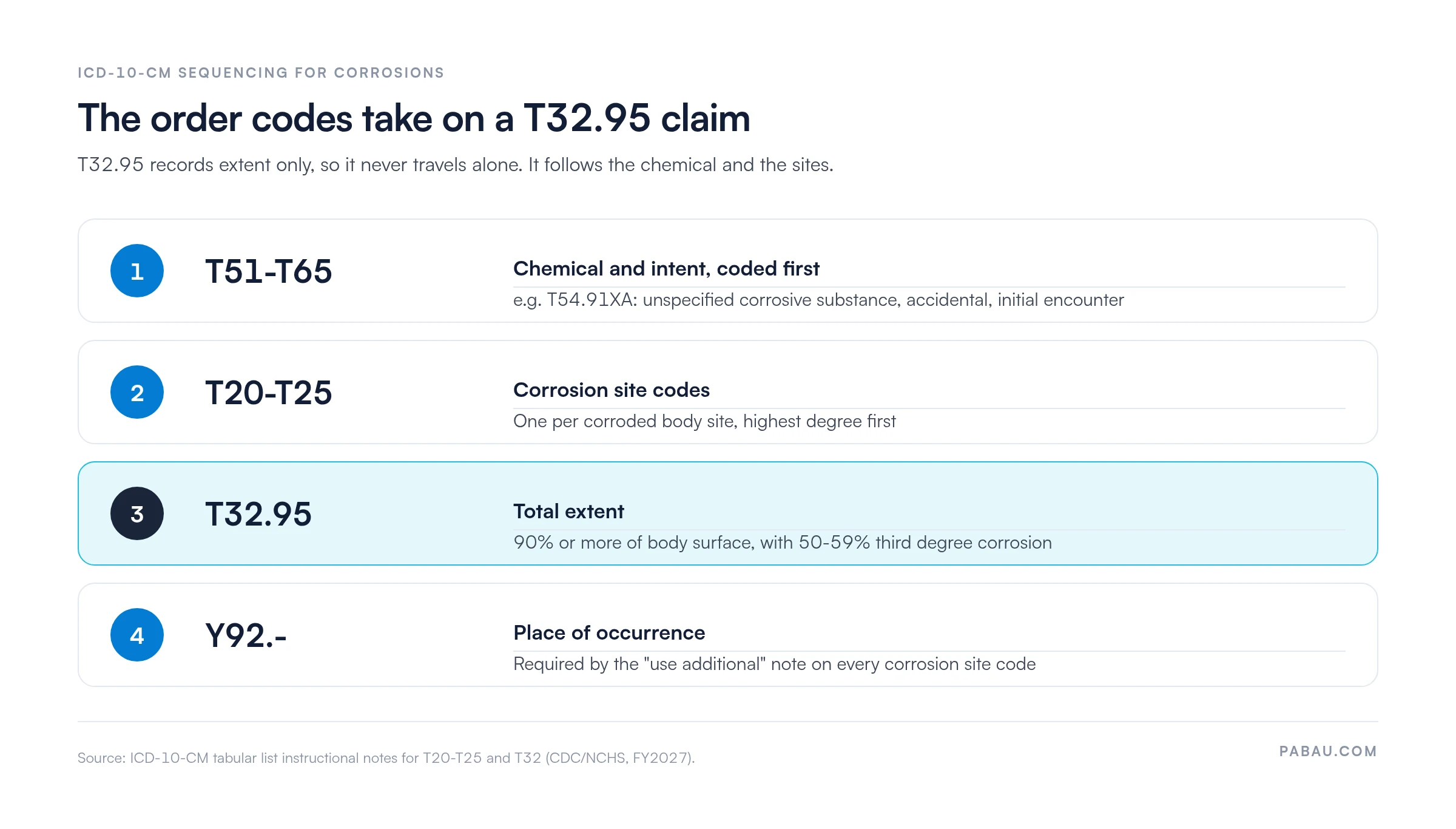
The ICD-10-CM tabular list sets the order for corrosion encounters. Every corrosion site code in T20-T25 carries a “code first” note for T51-T65, so the chemical and intent code leads the claim. The site codes follow, highest degree first, and T32.95 comes after them to record total extent.
The diagram below lays out that order for a typical initial encounter.
A clean claim submission for a T32.95 encounter usually needs several more codes alongside the corrosion codes:
Placing a complication code ahead of the chemical and corrosion codes is a common sequencing error on these claims. The principal diagnosis drives DRG assignment, so a misordered claim can group to the wrong DRG and underpay or deny.
Two more code types complete every T32.95 claim. A T51-T65 toxic-effect code identifies the chemical and the intent, and a Y92 code records the place of occurrence. When the corrosive substance is not specified, the T54.9- codes apply, with the sixth character carrying intent:
When the record names the chemical, use the matching subcategory instead. That means T54.0- for phenol, T54.1- for other corrosive organic compounds, T54.2- for corrosive acids, or T54.3- for corrosive alkalis. The sixth character works the same way, and the seventh is A, D or S depending on the encounter.
Report the place of occurrence with a Y92.- code, and the patient’s activity with a Y93.- code where your facility collects it. The AAPC ICD-10-CM lookup tool helps confirm each code is active for the current fiscal year.
Inpatient extensive-burn cases with a skin graft or inhalation injury group to MS-DRGs 927-929. Extensive or full-thickness burns without a graft group to MS-DRGs 933-934 instead. Check the current fiscal year’s grouper version before relying on either range.
Most major payers require prior authorization for burn-center admission and for skin graft procedures. Authorization thresholds and required documentation vary, so confirm them with each payer.
The most frequent denial reasons for T32.95 claims, based on patterns reported in coding community sources, are:
Good denial management workflows for burn-center billing flag T32.9x claims for a second documentation review before submission. Catching a missing third-degree percentage at that point costs far less than working a denial later.
Corrosion covering 90% or more of the body surface is one of the most severe injury patterns in clinical medicine. The scenarios that produce it are narrow:
Cases at this level are almost always managed in ABA-verified burn centers. Daily wound assessments, repeated TBSA re-evaluations and multiple surgical procedures are the norm. Coders abstracting these cases should expect long operative reports and daily progress notes that track TBSA changes over time.
These are long-stay, high-cost admissions that attract intensive payer scrutiny. In revenue cycle management for burn-center billing, each step of T32.95 coding affects DRG assignment and reimbursement. That runs from the first TBSA note to the final sequencing decision.
Burn and wound-care physicians bill their professional services on CMS-1500 claims, separate from the hospital’s facility claim. Each follow-up visit carries the same chemical, site, extent and place codes. An error on the first claim tends to repeat on every visit after it.
Pabau, the practice management platform we build, includes claims management software that opens each claim pre-filled from the invoice. Its claim validation catches missing or invalid details before the claim goes to Claim.MD, and eligibility checks run before the visit.
When a payer rejects a claim, Pabau shows the reason so your team can correct it and resubmit. Payments settle straight from electronic remittance advice (ERA) files, so nobody rekeys a remittance for a long burn-center follow-up course.


Pabau validates each claim before it reaches Claim.MD, checks eligibility before the visit, and settles payments from ERA files. Rejected claims come back with a reason, so your team can fix and resubmit them quickly.

T32.95 is only as defensible as the two numbers behind it. Before abstracting, confirm the chart states a TBSA of 90% or more and a third-degree share of 50-59%. If either figure is missing, query the physician rather than estimating it.
Then build the claim in tabular order: the chemical and intent code, the site codes, T32.95 and the Y92 place code. That order takes a few minutes per claim and spares your team a denial that is slow to reverse after discharge.
Book a demo to see how Pabau’s claim validation and ERA posting keep complex corrosion claims moving.

Need guidance on clean claim requirements? Clean claim submission covers what payers require for a first-pass acceptance on complex inpatient claims.
Want to understand the clearinghouse step? Medical claims clearinghouse explains how 837P/CMS-1500 claims move from the practice to the payer and where corrosion coding errors are typically caught.
ICD-10 Code T32.95 is the billable diagnosis code for corrosions involving 90% or more of body surface. Third-degree (full-thickness) corrosion covers 50-59% of the body. It belongs to the T32 category, which classifies chemical corrosions by the extent of body surface involved.
T31 classifies burns caused by heat sources such as fire, hot objects and radiation. T32 classifies corrosions caused by chemicals such as acids, alkalis and caustic substances. Both use the same fourth-character TBSA bands and fifth-character third-degree bands, so the causative agent alone decides the category.
The fifth character 5 records that third-degree corrosion covers 50-59% of the body surface, within a total TBSA of 90% or more. It is not a second TBSA measurement. It refines the fourth character by stating how much of the body has full-thickness tissue destruction.
Most denials trace to four problems. The physician did not document the third-degree percentage, or the claim lacks the T51-T65 chemical code and the Y92 place code. Otherwise, prior authorization for the admission or skin graft is missing, or a complication code sits ahead of the corrosion codes.
The Rule of Nines divides the adult body surface into regions of 9% or 18%, so clinicians can estimate total body surface area involvement. That TBSA figure sets the fourth character of the T32 code. The separately documented third-degree percentage then sets the fifth character.
A T51-T65 code, sequenced first, identifies the chemical and intent, for example T54.91XA for an accidental corrosion from an unspecified substance. A Y92 code records the place of occurrence, and a Y93 activity code can be added. T32.95 itself captures neither intent nor agent.