

ICD-10 code S61.201A: Open wound of left index finger without nail damage
ICD-10 code S61.201A covers a left index finger wound of unstated type ICD-10 co...

Last Updated: Oct 16, 2026
Billable Code Specific Code
T32.94 is the billable ICD-10-CM code for corrosions involving 90% or more of body surface with 40-49% third degree corrosion.
It sits in category T32, which classifies chemical injuries by total extent rather than by site. The fourth character (9) records total body surface involved, and the fifth (4) records the third-degree share. Assign it only when the physician documents both percentages and the chemical agent.
Let Pabau's smart automation suggest the right codes, reduce claim denials, and keep your practice compliant—effortlessly.
Automate repetitive tasks and focus on what matters most—your patients.
Reduce coding errors and ensure compliance with the latest regulations.
Clean claims, fewer denials, and faster reimbursements.
Powerful insights and reporting to help your practice thrive.
HIPAA compliant SOC 2 certified GDPR-compliant Trusted by 4,000+ clinics worldwide

T32.94 is a billable ICD-10-CM code for corrosions covering 90% or more of body surface, with 40-49% third-degree involvement, and it is unchanged in FY2027.
T32 codes classify corrosions from chemical agents only, and thermal burns of the same extent use T31.94 instead.
Report the chemical with a T51-T65 code and the place of occurrence with a Y92 code alongside T32.94.
When the corrosion site is documented, sequence the site-specific code (T20-T25) first and add T32.94 to show total extent.
Pabau, the practice management platform we build, checks each claim for missing insurer details before it can be sent.
ICD-10 Code T32.94 classifies corrosions involving 90% or more of body surface, with 40-49% of body surface involving third-degree (full-thickness) corrosion. It applies only to chemical injuries, so thermal burns of the same extent take T31.94. The table below summarizes the facts a coder needs before submitting a claim.
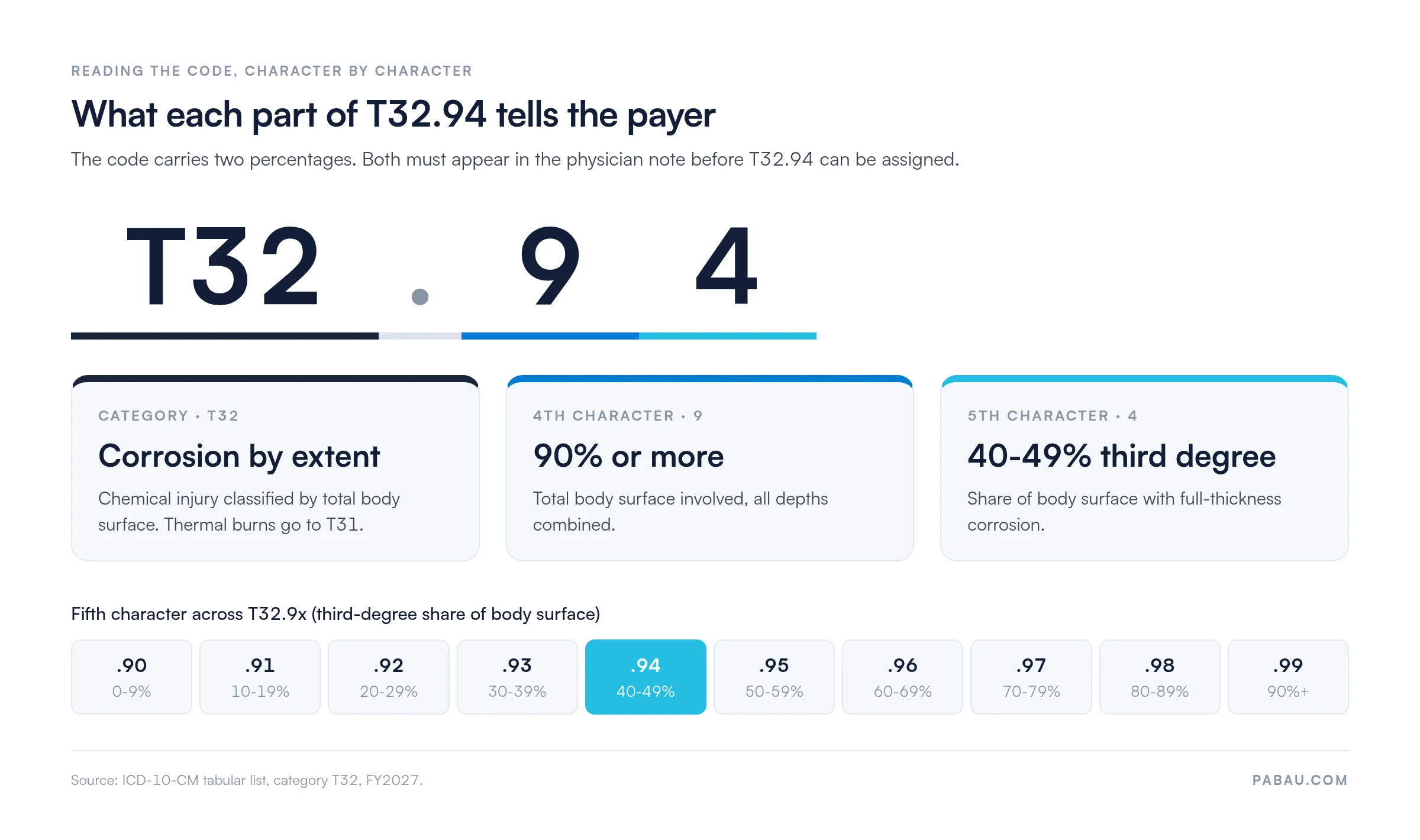
T32.94 encodes two percentages at once. The fourth character (9) records total body surface involved, which is 90% or more. The fifth character (4) records the share of body surface with third-degree corrosion, which is 40-49%. Physician documentation must state both values to support the code, as the breakdown below shows.
Corrosion, in ICD-10-CM terms, means injury caused by a chemical or caustic agent such as an acid or alkali.
A patient with 92% TBSA burns from a house fire is coded with T31 (burns classified by extent). A patient with 92% TBSA injuries from industrial acid exposure is coded with T32 (corrosions classified by extent). The causative mechanism, not the clinical appearance, determines the category.
Every T32 code from T32.1 through T32.99 encodes two numbers: total TBSA and third-degree TBSA. For T32.94, 40-49% of the body surface has full-thickness damage that destroys every skin layer, including the dermis. This severity almost always means ICU admission, skin grafting, and a prolonged inpatient stay billed under a major burn DRG.
T31.94 and T32.94 share identical TBSA and third-degree parameters but differ on one axis: the causative agent. T31.94 applies when the injury source is thermal (flame, hot surface, steam, radiation). T32.94 applies when the source is chemical or corrosive.
When documentation says only “severe burns from chemical exposure” without TBSA percentages, neither T31.94 nor T32.94 can be assigned. The physician must document both the percentage range and the causative mechanism.
Two accepted clinical methods exist for estimating TBSA in corrosion cases:
For T32.94 to be coded, the physician note must state that corrosions cover 90% or more of total body surface. It must also state that 40-49% of body surface involves third-degree corrosion.
A note documenting “extensive chemical burns” or “nearly total body involvement” without specific percentages does not support T32.94. The coder must query the physician rather than infer the percentages.
Documentation should also identify the chemical agent. That detail supports the T51-T65 code for the substance and strengthens the record for any payer audit. Per the CDC ICD-10-CM coding tool, the tabular list organizes the whole T32 category by the extent of body surface involved.
All T32.9x codes share the same total of 90% or more of body surface. The fifth character specifies the third-degree share. T32.94 sits in the middle of this severity spectrum.
The most common coding error within the T32.9x family is selecting T32.90 when third-degree corrosion is documented but not quantified. The mirror-image error is selecting T32.99 when the physician estimates “nearly all” third-degree involvement. Both require a physician query for a documented percentage range rather than an inference from vague language.
The AAPC ICD-10-CM code lookup and the ICD List reference tool provide quick subcategory views for the full T32 family.
T32.94 rarely stands alone on a claim. ICD-10-CM directs coders to identify the chemical with a T51-T65 code and the place of occurrence with a Y92 code. The table below lists each companion code category and when it applies.
Payers differ on whether they check external cause codes at the claim level. Leaving out the agent and place codes still weakens the record if the claim is audited. Sound medical billing fundamentals capture each applicable companion code during the coding pass, not during denial remediation.
ICD-10-CM Official Guidelines Section C.19.d.1 governs burn and corrosion sequencing. The rules differ by care setting and by whether site-specific codes are also present.
Query the attending physician when documentation says ‘extensive corrosions’ without specifying a TBSA range. Coding T32.94 from vague documentation creates audit risk. A brief physician query with a percentage clarification takes minutes and protects the claim.
T32.94 is one of the most severe corrosion classifications, so Medicare and commercial payers review these claims closely. They typically group to MS-DRG 927-929 (with skin graft) or 933-935 (without). Verify the mapping against the current IPPS grouper.
Payer requirements commonly include:
For Medicare Administrative Contractor (MAC) policies, consult the CMS ICD-10-CM code files and annual updates. They include coverage details for burn and corrosion inpatient cases.
T32.94 denials follow predictable patterns. The table below maps each common denial cause to its resolution. Robust denial management workflows begin with preventing these during the initial coding pass rather than correcting them post-submission.
For claim remark codes tied to corrosion and burn denials, see our guide to denial codes in medical billing. A working grasp of medical billing compliance helps practices build pre-submission checks that catch these errors before they reach the payer.
A T32.94 encounter almost always involves multiple procedure codes across a prolonged inpatient stay. The following CPT codes are commonly associated with corrosion over 90% or more of body surface.
Grafting on the trunk and limbs usually opens with 15100, and the first 30-74 minutes of each day’s critical care bill as 99291. Payer edits vary, so verify coverage and prior authorization with your MAC and commercial contracts.
A T32.94 stay produces one of the largest claims a facility sends, and it often goes back for a missing detail. A blank membership number or authorization code is enough to stall payment on weeks of burn care.
Pabau’s claims software for practices runs validation checks in the background each time a claim is sent. If a membership number or authorization code is missing, the Send button stays disabled until someone fixes it.

For US practices, Pabau’s Claim.MD integration submits claims electronically to thousands of payers and runs real-time eligibility checks first. Each claim is then tracked from pending to paid, with ERA remittances posted against the right invoice. That visibility supports a clean claim process, because a rejected claim surfaces the day it fails.

Pabau checks every claim for missing insurer details before it can be sent, and Claim.MD carries US claims to thousands of payers.

T32.94 holds up in review when three conditions are met. The physician note states both percentages, it names the chemical, and the agent and place codes travel with the claim.
The practical step is a standing physician query for any corrosion case documented as “extensive” without numbers. A short addendum costs far less than an appeal on an inpatient stay that runs for weeks. Book a demo to see how Pabau keeps complex claims complete before they reach the payer.

Want to know how a clearinghouse checks claims before payers see them? Medical claims clearinghouse guide explains how electronic claims reach payers through a clearinghouse and what clean claim validation looks like.
Need to read the denial reasons payers send back? Electronic remittance advice (ERA) covers how 835 remittance files communicate denial reason codes and CARC codes back to the billing team.
Curious how T32.94 travels inside an electronic claim? 837 file format and claim submission outlines the EDI structure that carries T32.94 diagnoses and companion codes to payers.
ICD-10 Code T32.94 is the diagnosis code for corrosions involving 90% or more of body surface, with 40-49% of body surface involving third-degree (full-thickness) corrosion. The injury must come from a chemical or caustic agent. It sits in Chapter 19 of ICD-10-CM, in block T30-T32, which classifies burns and corrosions by extent of body surface involved.
Yes. T32.94 is a billable ICD-10-CM code at the highest level of specificity, not a header code. It remains valid in FY2027, which began on October 1, 2026, with no change from FY2026.
Both codes describe injuries covering 90% or more of body surface with 40-49% third-degree involvement. T31.94 applies to thermal burns from flame, heat or radiation. T32.94 applies to corrosions from chemicals such as acids or alkalis. The causative agent documented in the physician note decides which code applies.
The chemical should be identified with a T51-T65 code for the toxic effect of the substance, plus a Y92 place of occurrence code. No ICD-10-CM X-code identifies contact with a corrosive substance. Activity (Y93) and external cause status (Y99) codes are added when the record documents them.
The physician note must state that corrosions involve 90% or more of body surface and that 40-49% of body surface involves third-degree corrosion. It must also identify the causative chemical agent. Vague language such as “extensive chemical burns” or “nearly total body involvement” does not support T32.94. Query the physician for an addendum before coding.
Common denial reasons include missing agent or place codes, TBSA not documented to the required specificity, and conflicting thermal versus chemical documentation. Sequencing errors also cause denials, such as T32.94 listed as principal when a site-specific code should lead. So does an outpatient claim for an injury whose severity requires inpatient care.



