ICD-10 code S61.201A: Open wound of left index finger without nail damage
ICD-10 code S61.201A covers a left index finger wound of unstated type ICD-10 co...

Last Updated: Oct 16, 2026
Billable Code Specific Code
T32.96 is the billable ICD-10-CM code for corrosions involving 90% or more of body surface with 60-69% third degree corrosion.
Most denials on this code trace back to three avoidable errors. Coders submit the non-billable parent T32.9 instead of the specific subcode. They leave out the external cause code naming the chemical agent, which is recommended and sometimes payer-required. Or the total body surface area (TBSA) percentages in the record do not add up.
Let Pabau's smart automation suggest the right codes, reduce claim denials, and keep your practice compliant—effortlessly.
Automate repetitive tasks and focus on what matters most—your patients.
Reduce coding errors and ensure compliance with the latest regulations.
Clean claims, fewer denials, and faster reimbursements.
Powerful insights and reporting to help your practice thrive.
HIPAA compliant SOC 2 certified GDPR-compliant Trusted by 4,000+ clinics worldwide

T32.96 is a billable ICD-10-CM code valid for FY2026, and its non-billable parent T32.9 cannot go on a claim.
The code carries two measurements at once, 90% or more of body surface involved and 60-69% of that area at third degree.
An external cause code naming the chemical agent is recommended rather than nationally mandated, and payers may deny claims without it.
Every T32.9x sibling maps a 10-point band of third degree corrosion, and T32.90 covers 0% to 9%.
Practice management software like Pabau routes claims and remittances through a clearinghouse, so billing teams work in one system rather than several payer portals.
ICD-10 code T32.96 is the specific, billable ICD-10-CM code for corrosions involving 90% or more of body surface with 60-69% third degree corrosion. It is confirmed valid for HIPAA-covered transactions during fiscal year 2026 by both the CDC/NCHS ICD-10-CM tool and CMS’s ICD-10 coding resources.
The code carries two measurements that must both be documented to justify its use. First, the total body surface area (TBSA) involved by corrosion is 90% or more. Second, 60-69% of that corroded area meets the clinical threshold for third-degree, or full-thickness, injury. Both figures have to appear in the clinical record.
A corrosion, in ICD-10-CM terms, is a chemical burn caused by contact with a caustic or corrosive substance rather than a heat source. That distinction drives the coding. A thermal flame burn and a hydrofluoric acid exposure with identical surface area involvement map to entirely different code categories.
T32.96 describes a presentation at the extreme end of corrosion severity. The T32 category classifies corrosions by extent, using the Rule of Nines or a Lund-Browder chart to calculate TBSA. Two separate percentage thresholds have to be met and documented.
Clinically, patients coded T32.96 usually need intensive care, fluid resuscitation, and surgery. That severity also carries substantial weight in MS-DRG assignment, which the reimbursement section below covers in detail.
ICD-10-CM separates burns caused by heat from corrosions caused by chemicals, and it does so at the category level. Getting that split right prevents one of the most common miscoding errors on high-acuity injury cases. The agent named in the record, rather than the size of the injury, decides which family of codes applies.
The clinical note has to identify the causative substance. “Chemical exposure” on its own will not support a T32 code. Name the agent, or at least describe it as a corrosive or caustic chemical. That wording backs a corrosion code over a thermal burn code.
The block structure below is where most of the confusion starts, because two different ranges both carry burns and corrosions.
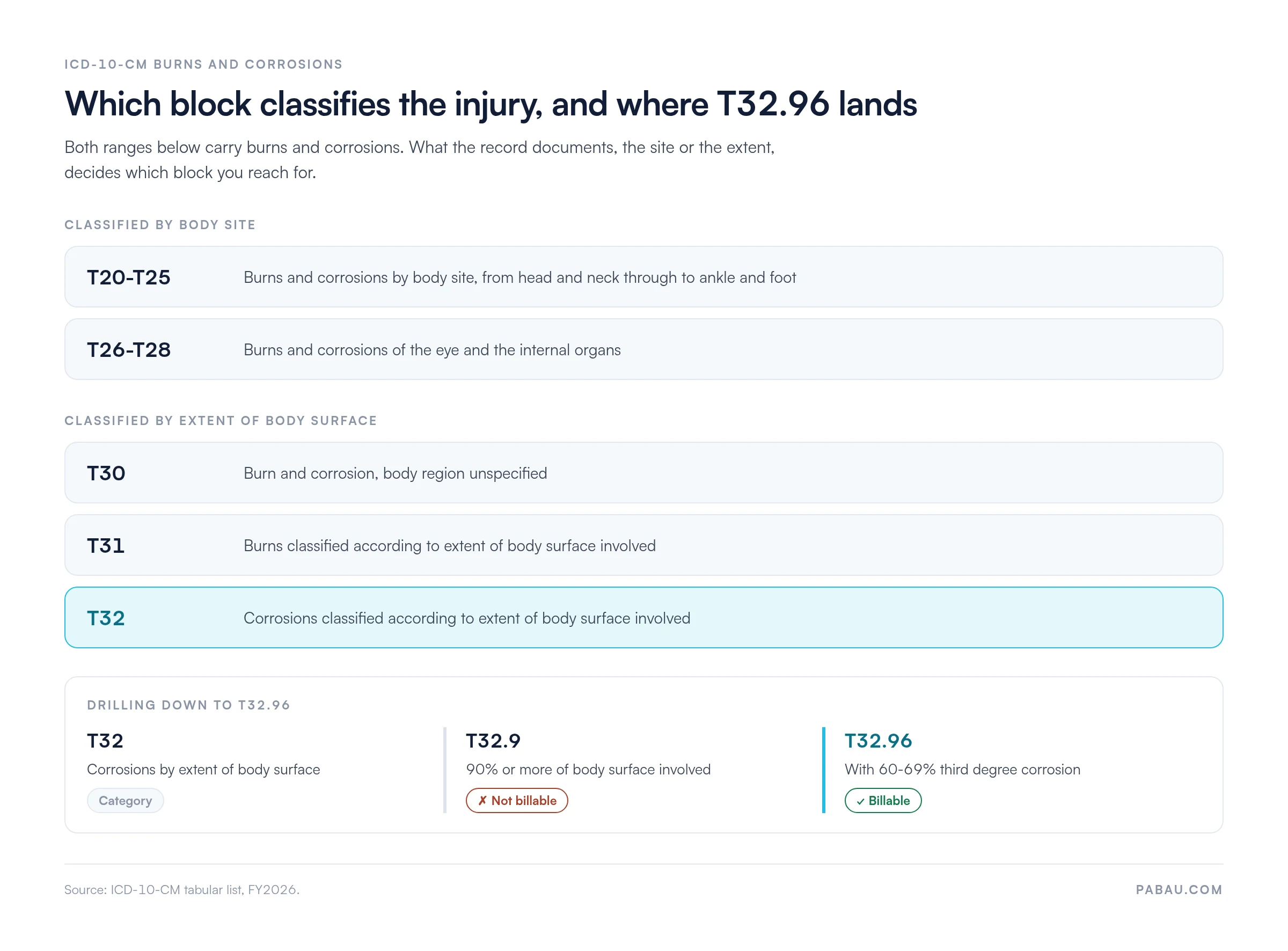
T32.96 sits five levels deep in the ICD-10-CM structure. Each level narrows the clinical description, and only the most specific billable code at the bottom can go on a claim. Neighboring corrosion codes follow the same path, which the ICD-10-CM code reference lays out chapter by chapter.
The sibling subcodes inside T32.9 follow one pattern. The final digit represents the band of third-degree involvement. T32.90 covers 0% to 9% third degree corrosion, and T32.91 through T32.99 each step up by 10 percentage points. T32.96 marks the 60-69% third-degree band within that 90%+ TBSA subcategory.
The ICD-10-CM Official Guidelines for Coding and Reporting, issued by CMS and NCHS, govern how T32.96 is sequenced and supported. Coders and clinical documentation specialists should apply the rules below whenever this code comes up.
Two percentage figures must appear in the medical record, and each has to be derived independently rather than copied from another provider’s note. Thin documentation on a high-acuity injury code costs money. A downcode from T32.96 to a lower-specificity T32.9x code can shift the MS-DRG weight materially.
The corrosion code leads the claim when the corrosion is the condition chiefly responsible for the admission. External cause codes are reported as additional codes, never as the principal diagnosis.
Encounter type, meaning initial, subsequent or sequela, is captured by the 7th character on the site-specific corrosion codes in T26-T28. T32.96 is an extent code, so it carries no 7th character at all.
Run a documentation query before submitting T32.96 claims. Confirm the record carries two distinct percentage figures, the total TBSA and the third-degree subset, plus the chemical agent name. A record that says only ‘extensive chemical burns to 90% BSA’ will not support T32.96 on audit.
T32.96 groups into the burn and corrosion MS-DRGs under the CMS Inpatient Prospective Payment System (IPPS). The code describes extreme corrosion severity, so it typically drives a high-weight DRG that reflects the resource intensity of the admission.
CMS updates MS-DRG assignments annually. Verify the specific DRG number against the current-year IPPS grouper rather than a prior-year reference.
Accurate coding of the third-degree percentage feeds straight into DRG weight. Coding T32.90 instead of T32.96 because the chart was thin can change the relative weight substantially, and the payment with it. That turns the documentation query into a revenue step rather than a compliance formality.
For facilities managing complex burn and corrosion admissions, the billing workflow matters as much as the clinical record. Clean claims leave the facility with the extent code, the third-degree percentage and the external cause code already reconciled against each other. Reconciling the remittance afterward tells the finance team whether the DRG paid as expected.
Audit risk runs high on high-weight burn DRGs. Documentation has to stand on its own, because querying the physician once the bill has dropped is far harder than querying before discharge.
Four mistakes account for most denials and audit findings on high-acuity corrosion cases. Each one is visible in the record before the claim goes out, which is what makes a pre-submission check worth the few minutes it takes.
T32.9 is not a valid claim submission code. It is a non-billable parent that exists for classification grouping. Coders under time pressure sometimes stop at T32.9 rather than extending to the specific subcode.
Any claim carrying T32.9 in the diagnosis field rejects on a specificity edit. The correct code is T32.96, or whichever subcode the documented third-degree percentage supports.
ICD-10-CM Guideline I.C.20.a sets no national mandate for Chapter 20 external cause codes, so leaving one off does not automatically invalidate a T32.96 claim. Reporting it is still recommended.
The appropriate X-code identifies the corrosive agent and belongs in the additional diagnosis fields. Some states and some payers do require it on inpatient corrosion claims, and omitting it raises audit exposure either way.
Build the external cause code into the pre-submission check instead of treating it as optional detail. It costs a coder seconds, and it removes the audit finding that turns up most often on this code.
T32.96 applies only when the causative agent is chemical. A flame burn or scald involving 90%+ TBSA maps to the T31.9x codes instead, with T31.96 as the direct thermal counterpart.
If the record does not say “chemical” or name a corrosive substance, query the provider before assigning T32.96. Coding a thermal burn as a corrosion, or the reverse, will not survive an external audit.
The subtlest error shows up when the TBSA figure in the admission history differs from the operative note or the burn diagram. If the admission note says “approximately 88% TBSA” and the burn specialist’s note says “92% TBSA,” the coder cannot pick T32.96 over a lower-extent code.
A clinical documentation query has to resolve the discrepancy first. Submitting T32.96 on conflicting TBSA calculations leaves the claim exposed on review.
A pre-submission checklist catches all four. Flag any TBSA discrepancy, any missing third-degree percentage, and any absent external cause code on every T32.x claim before it reaches the clearinghouse.
Build a T32.96 documentation query template for your clinical documentation team. Have it ask for the total TBSA percentage, the third-degree subset percentage, the causative chemical agent, and the external cause code. Queries resolved before discharge remove the most common denial triggers on this code.
Coding T32.96 correctly is one job. Moving the claim, tracking it and reconciling the payment is another. That second job usually happens in a tool with no access to the chart behind it.
Pabau keeps both in one place. Claims go out through a clearinghouse integration, Claim.MD in the US, so the submission leaves from the same system that holds the documentation. Remittances come back to the same record. A rejected T32.96 claim therefore lands in front of the person who can open the burn diagram and see why.
Pabau does not grade your coding. Code validation, grouper checks and missing-code prompts sit outside what the platform does, so accuracy on T32.96 stays with your coders and your documentation team. What shortens is the distance between a denial arriving and someone acting on it.
Every subscription includes the full platform. A facility billing a handful of high-acuity claims a month gets the same cleaner claims management as a multi-location group.


Pabau sends claims through the Claim.MD clearinghouse and pulls remittances back into the patient record. See how that works for complex injury admissions.

T32.96 rewards a record that was built properly the first time. Two percentages and a named chemical agent have to be in the chart before the coder ever opens it. No downstream check can create them afterward. The facilities that get paid correctly on this code are the ones that query before discharge.
The trade-off is a small one. A documentation query costs a few minutes. Letting T32.96 go out on a thin record can cost a DRG. Software will not make the coding decision for you.
Keeping the claim, the remittance and the chart together means you find out quickly when one does not land. Book a demo to see how Pabau handles injury billing from chart to remittance.

Coding the thermal version of the same injury? ICD-10 code T31.96 covers burns at the same 90% TBSA and 60-69% third-degree thresholds.
Struggling with claim denials on complex diagnosis codes? Denial management in healthcare explains how to identify, track, and resolve ICD-10-CM-related denials systematically.
Want to see how a clearinghouse handles your claims? Claim.MD clearinghouse review walks through submission, real-time eligibility, and ERA processing.
Yes. Extent codes such as T32.96 are reported in addition to the site-specific corrosion codes in T20-T28 when the record supports both. Sequence the code for the most severe corrosion first, then add T32.96 as an additional code.
Report Y when the corrosion was present before the inpatient admission order was written. That is the usual case for a transfer or an emergency admission. A corrosion that happens during the stay takes N instead.
The code does not change, but the percentage behind it can. Children carry different body proportions, so a Lund-Browder chart gives a more accurate TBSA figure than the Rule of Nines. Name the chart the burn team used in the record.
The causative agent, and nothing else. T31.96 covers a thermal burn at the same thresholds, 90% or more of body surface with 60-69% third degree. T32.96 covers the chemical equivalent.
Through September 30, 2026. ICD-10-CM codes run on the federal fiscal year, so check the October 1 update each year before assuming a code carried over unchanged.