

ICD-10 Code S53.013D: Anterior subluxation of unspecified radial head
ICD-10 Code S53.013D: Quick reference summary Use the table below as your first ...

Last Updated: Nov 6, 2026
Billable Code Specific Code
S99.291P is the billable ICD-10-CM code for other physeal fracture of phalanx of right toe, subsequent encounter for fracture with malunion. It applies at a follow-up visit for a growth plate fracture of a right toe phalanx that has healed out of alignment.
The 7th character P marks a subsequent encounter for a fracture healed with malunion. The treating provider's documentation of malunion, supported by imaging, moves the code from D to P. "Other" means a Salter-Harris type outside Types I to IV, such as Type V.
Let Pabau's smart automation suggest the right codes, reduce claim denials, and keep your practice compliant—effortlessly.
Automate repetitive tasks and focus on what matters most—your patients.
Reduce coding errors and ensure compliance with the latest regulations.
Clean claims, fewer denials, and faster reimbursements.
Powerful insights and reporting to help your practice thrive.
HIPAA compliant SOC 2 certified GDPR-compliant Trusted by 4,000+ clinics worldwide

S99.291P is a billable 7-character ICD-10-CM code, while the parent code S99.291 without a 7th character is non-billable and fails payer edits.
7th character P means a subsequent encounter for a fracture that healed with malunion. The treating doctor’s records of malunion (supported by scans) determines P instead of D.
The most common coding error is using S99.291D (routine healing) when the medical record notes malunion.
Pabau’s claims management software submits claims and tracks them through Claim.MD, so correct 7th-character selection stays a coder responsibility.
ICD-10 Code S99.291P is the billable ICD-10-CM diagnosis code for other physeal fracture of phalanx of right toe, subsequent encounter for fracture with malunion. It is also valid for FY2026 and FY2027 (starting October 1, 2026).
It is a 7-character leaf-node code, so it needs no more detail and goes straight on a claim. Still, the parent code S99.291 is non-billable on its own, so payer claim edits reject any claim that omits the 7th character.
A physeal fracture of a right toe phalanx affects the physis, the cartilage growth plate near the end of a growing bone. The growth plate is the weakest point in a child’s bone, so it gives way before the nearby ligaments do. Because the physis closes in the late teens, these fractures occur mostly in children and teens.
In this wording, “other physeal fracture” means a Salter-Harris type outside Types I through IV, such as a Type V injury. For example, each of the first four types has its own right toe code: S99.211 (Type I), S99.221 (Type II), S99.231 (Type III), and S99.241 (Type IV). In contrast, a physeal fracture whose type is not specified goes to S99.201_, not S99.291_.
First, the 7th letter P records two facts at once. The visit is later, because the patient has already been seen for this fracture. The fracture has also healed with malunion, meaning a crooked bone or angulation. Both must be true to assign S99.291P. So, the treating doctor’s notes on malunion (supported by scans) determines P.
Malunion occurs when the bone ends heal out of place, which can cause loss of function, a changed gait, or pain. Also, ICD-10-CM keeps it separate from nonunion (7th letter K) and from routine or delayed healing (7th letters D and G).
First, S99.291D applies when the patient returns for routine check-up and there are no problems. In contrast, S99.291P applies when the treating doctor notes that the fracture has united out of line, often supported by scans. Last, S99.291S applies only after active treatment has ended and a lasting effect, such as chronic toe pain or stiffness, persists.
In fact, the D-to-P switch is the decision that goes wrong most often in this code group. A coder assigns D at the first check-up because healing looks on track. D then carries forward to every later visit without anyone rechecking the doctor’s notes.
Once the doctor notes malunion, say after a two-month X-ray, the visit should be coded S99.291P. Leaving it on D instead misstates the patient’s status.
Both decisions that build the full code fit on one page, from the Salter-Harris type to the 7th letter.
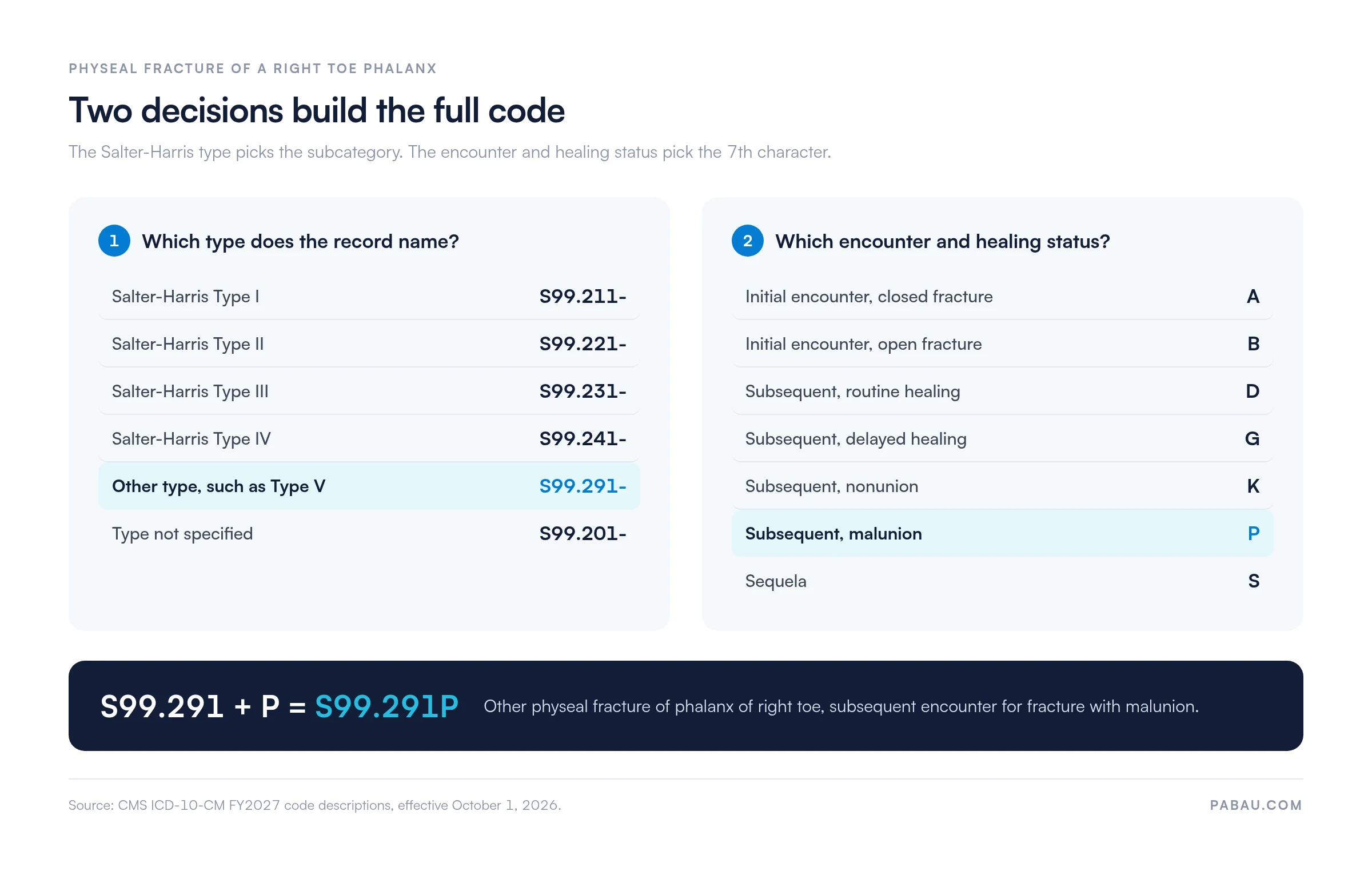
The table below sets the three most-used later and sequela codes side by side.
Read the treating provider’s note and the radiology report together at each subsequent visit before you assign the 7th character. The provider’s documented healing status, not the visit type, decides whether D, G, K, or P applies. If the radiologist describes malunion and the provider’s note does not, query the provider before coding.
S99.291 is the non-billable parent code for other physeal fracture of the phalanx of the right toe. First, its hierarchy starts at S99 (Other and unspecified injuries of ankle and foot). It narrows through S99.2 (Physeal fracture of phalanx of toe) and S99.29 (Other physeal fracture of phalanx of toe). S99.291 then specifies the right toe.
Salter-Harris Types I-IV have their own codes (S99.211_, S99.221_, S99.231_, S99.241_), so assign those instead. For example, using S99.291P when the scan report or operative note names one of those four types is a coding error that can trigger an audit.
Getting ICD-10 Code S99.291P right depends on specific details being present in the medical record before you assign the code. As a result, missing any one of them creates grounds for payer denial or post-payment audit recovery. Following CMS ICD-10-CM coding guidelines, coders should check each one before filing.
In addition, good medical billing compliance practices mean building a records query workflow for any later fracture visit with scans. Also, coders who see the visit note without the scan report have less to go on when the healing status is unclear.
First, the CPT code paired with S99.291P must match the service performed at the later visit. In fact, two mismatches trigger most claim edits: a first fracture treatment code at a later visit, or a routine E/M visit when a procedure was performed.
Next, always verify CPT codes against the current-year AMA CPT codebook. The toe fracture treatment codes (28490-28496 great toe; 28510-28525 other toes) split by toe. For example, a great toe code billed for another toe leaves the claim out of line with the record. Malunion repair is often an osteotomy instead, such as 28310 for the great toe’s proximal phalanx.
Commercial payers, Medicare, and Medicaid each apply their own medical necessity criteria to claims tied to fracture malunion. ICD-10 Code S99.291P reports a subsequent encounter for a fracture that healed with malunion. As a result, payers often expect more detail behind it than behind a routine check-up coded S99.291D.
So, filing a clean claim for S99.291P-related services often needs these elements to come with or before the claim.
Most S99.291P-related denials can be prevented at the coding and records stage instead of through appeals. So, good denial management workflows for orthopedic practices address these before filing.
Knowing denial codes in medical billing is the fastest way to triage why a specific claim failed. For a 7th letter or diagnosis mismatch, expect these Claim Adjustment Reason Codes (CARCs):
Still, CARC 4, 5, and 97 point to other problems on the same claim. They cover a modifier issue, a place-of-service mismatch, and a bundled service, in that order.
Entering ICD-10 Code S99.291P the right way in an EHR means confirming that the system accepts and transmits the full 7-character code. Some older EHR platforms truncate ICD-10-CM codes at five or six characters, quietly turning S99.291P to the non-billable S99.291.
The claim then fails payer edits, but the ERA shows a code-not-found rejection rather than pointing to the truncation.
If your practice runs a separate charting system, confirm that codes reach the billing module intact. Also, manual re-entry between systems is a second truncation risk. A grounding in medical billing basics helps a team build one clear code entry workflow.
A fracture check-up claim often passes through several hands. A coder picks the 7th letter, a biller keys the claim, and someone checks a payer portal to see whether it paid.
Pabau’s claims management software brings filing and tracking into one place. Claims then go out through Claim.MD, Pabau’s US clearinghouse partner, to thousands of US payers. Also, real-time eligibility checks confirm the patient’s coverage before the visit.
Pabau does not choose the 7th letter for you. Instead, that stays with your coders and the doctor’s records. What changes is tracking: a claim denied for a missing 7th letter or a wrong diagnosis stays tracked until your team corrects and resubmits it.
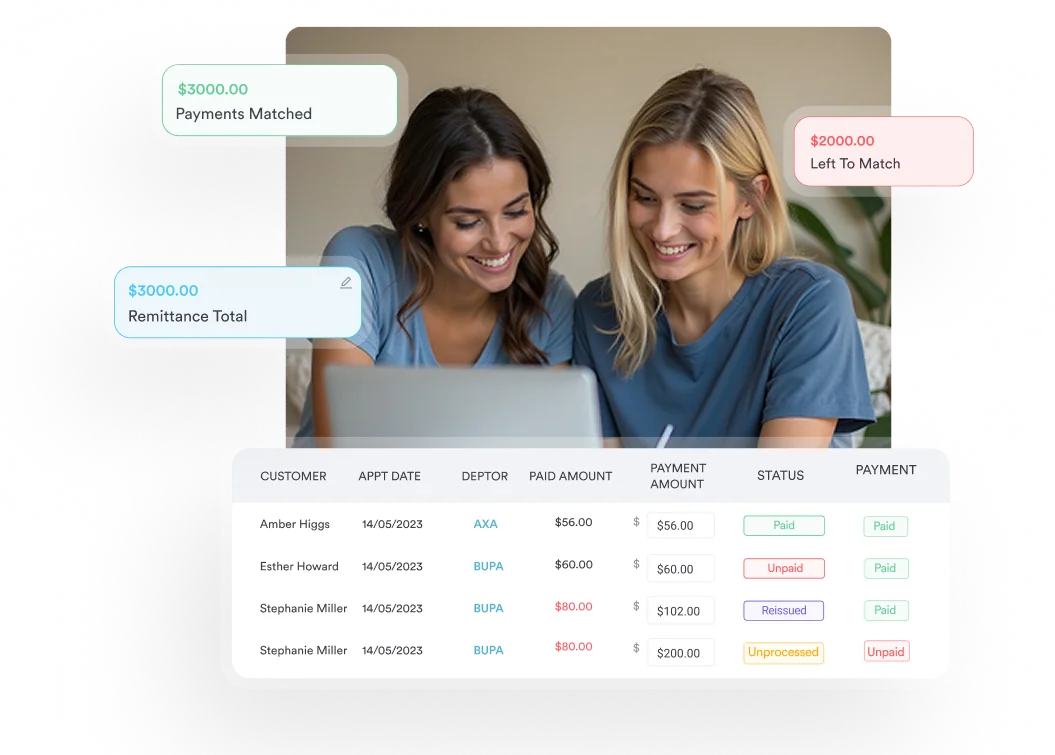

Pabau’s claims management sends claims through Claim.MD, runs real-time eligibility checks, and tracks denied claims. Your billing team stops chasing fracture follow-up claims across payer portals.

The difference between S99.291D and S99.291P comes down to noted malunion. Once the treating doctor records it, later visits for that fracture take the letter P. Staying on D after that point codes the patient’s case too low and creates audit risk.
So put the check into the visit rather than the appeal. Have coders read the doctor’s healing note at every later fracture visit, and query when the note and the scan report disagree.
Submission, eligibility checks, and denial tracking can then run through Claim.MD inside Pabau, as the Claim.MD clearinghouse guide explains. Book a demo to see how Pabau keeps fracture check-up claims moving from submission to payment.

Want to see how US claims reach payers? Claim.MD clearinghouse guide explains how Pabau’s US clearinghouse partner handles 837P claim submission and real-time eligibility for orthopedic practices.
Seeing recurring fracture code denials on your ERAs? Electronic remittance advice explained breaks down how to read 835 remittance files and identify CARC codes tied to 7th character mismatches.
Want to reduce claim rejection before adjudication? Revenue cycle management overview outlines how pre-submission edits fit into the end-to-end billing workflow for musculoskeletal practices.
ICD-10 Code S99.291P is the billable ICD-10-CM code for other physeal fracture of the right toe phalanx. It covers a subsequent encounter for a fracture healed with malunion. It is a 7-character leaf-node code valid for FY2026 and FY2027 (starting October 1, 2026). The parent code S99.291 is non-billable without the 7th character.
S99.291D applies when the fracture is healing routinely and in line at a later visit. S99.291P applies when the treating doctor notes that the fracture has healed with malunion, meaning a crooked bone or angulation. Using D when malunion is noted is the most common coding error in this code group.
Use P when the treating doctor notes malunion at a later visit, often supported by scans. Use D when the fracture is healing in line with no problems. Use S for a lasting condition, such as chronic pain or stiffness, that results from the fracture. The doctor’s noted healing status drives the 7th character, not the visit number.
Yes. S99.291P is a billable, valid 7-character ICD-10-CM code for FY2026 and FY2027 (starting October 1, 2026). The parent code S99.291 without the 7th character is non-billable, and payer claim edits reject it if submitted on its own.
S99.291P needs the treating doctor’s records of malunion, supported by scans. The record must also show a later visit, a right-sided injury, and a fracture of a toe phalanx rather than a metatarsal or calcaneus. Last, it should show growth plate damage with a Salter-Harris type outside Types I to IV.



