

CCSD code G5100: Bypass of duodenum billing guide
CCSD code G5100 bills a bypass that leaves the duodenum in place CCSD code G5100...

Last Updated: Oct 16, 2026
28310 is the CPT code for osteotomy, shortening, angular or rotational correction of the proximal phalanx of the first toe (separate procedure). It is most often reported for an Akin osteotomy performed on its own, with no bunionectomy on the same claim.
The separate procedure designation means 28310 bundles into a more comprehensive foot procedure at the same site. When the Akin is part of a hallux valgus correction, report 28298, or 28299 for a double osteotomy, instead.
Let Pabau's smart automation suggest the right codes, reduce claim denials, and keep your practice compliant—effortlessly.
Automate repetitive tasks and focus on what matters most—your patients.
Reduce coding errors and ensure compliance with the latest regulations.
Clean claims, fewer denials, and faster reimbursements.
Powerful insights and reporting to help your practice thrive.
HIPAA compliant SOC 2 certified GDPR-compliant Trusted by 4,000+ clinics worldwide

CPT Code 28310 describes osteotomy of the proximal phalanx of the great toe. See CPT 28312 for other phalanges of any toe.
The separate procedure designation means 28310 can’t be billed with a more comprehensive foot procedure. The exception is a distinct, unrelated diagnosis, reported with modifier 59.
When the Akin osteotomy is part of a bunionectomy, report 28298, or 28299 for a double osteotomy, instead of 28310.
A 90-day global surgery period applies under Medicare, so routine follow-up visits in that window are included in the surgical payment.
Pabau’s claims management software checks insurance eligibility, submits electronic claims and tracks each claim’s status through to remittance.
CPT Code 28310 is defined by the American Medical Association as: Osteotomy, shortening, angular or rotational correction; proximal phalanx, first toe (separate procedure). The “(separate procedure)” note belongs to the official descriptor. It sets the bundling rules that decide when 28310 can be billed at all.
The code sits in the 283xx range of the CPT musculoskeletal system chapter, which organizes foot and toe procedures by anatomical site. 28310 covers only the proximal phalanx of the great toe. Osteotomy of other phalanges of any toe, including the proximal phalanx of a lesser toe, is reported with 28312.
The procedure is a surgical bone cut (osteotomy) through the proximal phalanx of the great toe. It is typically a medial closing wedge that reduces hallux valgus or interphalangeal deformity. The Akin procedure is the most frequently performed variant, though the code also applies to other osteotomy configurations at this site.
The operative note must document each of the following for audit purposes:
A missing element won’t always trigger a denial on submission. An audit that finds a vague operative note can still reclassify the service or recoup the payment.
The “separate procedure” label means CPT Code 28310 counts as a component of broader foot procedures at the same site. That applies when both happen in the same operative session. In that situation it is bundled and can’t be billed on its own.
Three conditions allow separate reporting:
The National Correct Coding Initiative (NCCI) maintains column-pair edits that define which codes bundle with 28310. These edits are updated quarterly, so a pair that was separately billable last year may be bundled today. Always check the current NCCI table before submitting, not a reference from a prior year.
Before billing 28310 alongside any hallux valgus correction code (28296, 28298, 28299), pull the current NCCI column 1/column 2 edit table. Check whether the pair carries modifier indicator 1 (modifier allowed) or 0 (modifier not allowed). A modifier indicator of 0 means the two codes cannot be billed together under any circumstances.
Modifier selection for CPT Code 28310 depends on the job the modifier does. It may bypass a bundling edit, identify the toe, or place the service within a global period. The table below covers the six modifiers that come up most often.
CMS has issued specific guidance on modifier 59 misuse. The agency’s preferred approach for Medicare claims is to use the more specific X-modifiers (XE, XS, XP, XU) when available, though 59 remains valid. Payers vary in which they accept, so check payer policy before substituting.
28310 is the only code for an osteotomy of the great toe’s proximal phalanx performed on its own. An osteotomy of a lesser toe’s proximal phalanx, or of any other phalanx, is 28312. 28308 covers a lesser metatarsal osteotomy.
When the osteotomy is part of a bunionectomy, a hallux valgus code replaces 28310 altogether. The chart below maps each scenario to its code, and the operative note’s bone site decides which applies.
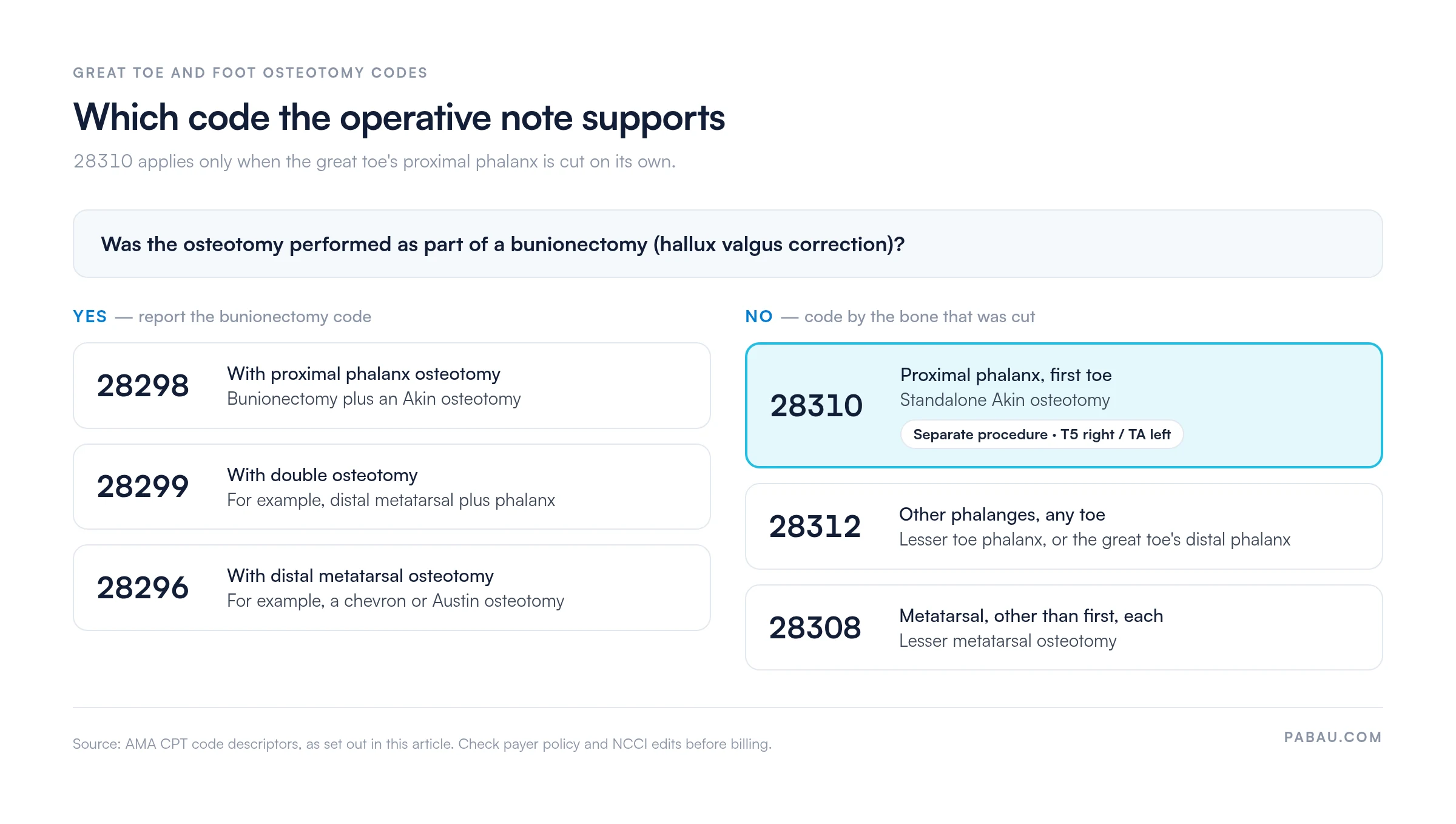
The table adds separate procedure status and a typical scenario for each code.
The pairing to watch is 28310 against 28298 and 28299. When an Akin osteotomy accompanies a bunionectomy, 28298 reports the whole procedure. When the correction combines two osteotomies, such as a distal metatarsal cut plus the Akin, 28299 applies. Both codes already include the phalanx osteotomy, so adding 28310 duplicates it and triggers an NCCI edit denial.
Medical necessity for CPT Code 28310 rests on a documented foot deformity that requires surgical bone correction at the proximal phalanx of the great toe. The ICD-10-CM codes below are the most frequently accepted pairings. Always confirm that the code reflects the documented condition rather than a presumed diagnosis.
A claim whose toe modifier and ICD-10 code point to different feet is an avoidable denial. Before every submission, confirm that T5 pairs with a right-foot code such as M20.11 and TA with a left-foot code such as M20.12.
Medicare reimbursement for CPT Code 28310 is determined by the CMS Medicare Physician Fee Schedule (MPFS), which updates each January. The RVUs below are national values, and the payment in each locality applies geographic adjustments on top. Always look up the current rate for the specific MAC jurisdiction before quoting a payment to a patient or payer.
The 90-day global period means Medicare bundles all routine follow-up care related to the surgery into the surgical payment. Billing a related E&M visit within that window without modifier 24 or 79 will deny. Commercial payers set their own global period rules, which may differ significantly from Medicare’s. CMS also updates CMS’s list of CPT/HCPCS codes each year alongside the MPFS.
Prior authorization requirements for CPT Code 28310 are payer-specific, not universal. Medicare fee-for-service generally does not require prior authorization for this outpatient surgical code, but Medicare Advantage plans operate independently and some do require it. Always verify with the specific plan before scheduling.
Commercial and Medicaid payer positions vary widely:
The practical rule: treat every surgical claim for 28310 as requiring prior authorization until confirmed otherwise by the specific plan’s current policy document. A verbal approval isn’t enough. The reference number belongs in the chart and on the claim.
Claim auditors reviewing 28310 focus on whether the operative note establishes medical necessity and procedural specificity. A vague or templated note is the fastest path to a medical record request or recoupment.
The operative note must include:
Templated notes that describe a “standard Akin procedure” without patient-specific detail rarely survive an audit. CMS expects the operative report to describe the procedure this patient received, in this patient’s terms.
Most denials for CPT Code 28310 fall into five categories. Each has a clear corrective action and appeal path.
Practices running high volumes of podiatric surgery can track denials by CARC code to catch systemic issues early. Repeated CO-97 denials on 28310 claims usually trace back to bundling or modifier choices made at claim build. Our guide to denial codes in billing has the full CARC/RARC crosswalk.
A denial management process that logs each denial by code and payer shows whether 28310 problems cluster around one plan. Working through a clean claim checklist before submission catches a missing toe modifier before the payer does.
Set a quarterly calendar reminder to pull the updated NCCI table from CMS. Bundling edits for the 283xx code family change during the year. A pair that was separately billable in January may be bundled by Q3. Catching the change proactively prevents a backlog of unappealable bundled denials.
Billing CPT Code 28310 cleanly depends on four manual steps. Your team confirms coverage and prior authorization, checks NCCI edits, applies the right modifiers and tracks the 90-day global period. Each step is a point where a denial can start.
Pabau, the practice management platform we build, connects to the Claim.MD clearinghouse for US insurance billing. Your team runs real-time eligibility checks before the surgery date, then sends 28310 as an electronic CMS-1500 claim.
Claim status and remittance come back into the claims dashboard of Pabau’s claims management software. Your billers see a bundling or modifier denial as soon as it posts. They can correct and resubmit it while the operative note is fresh.
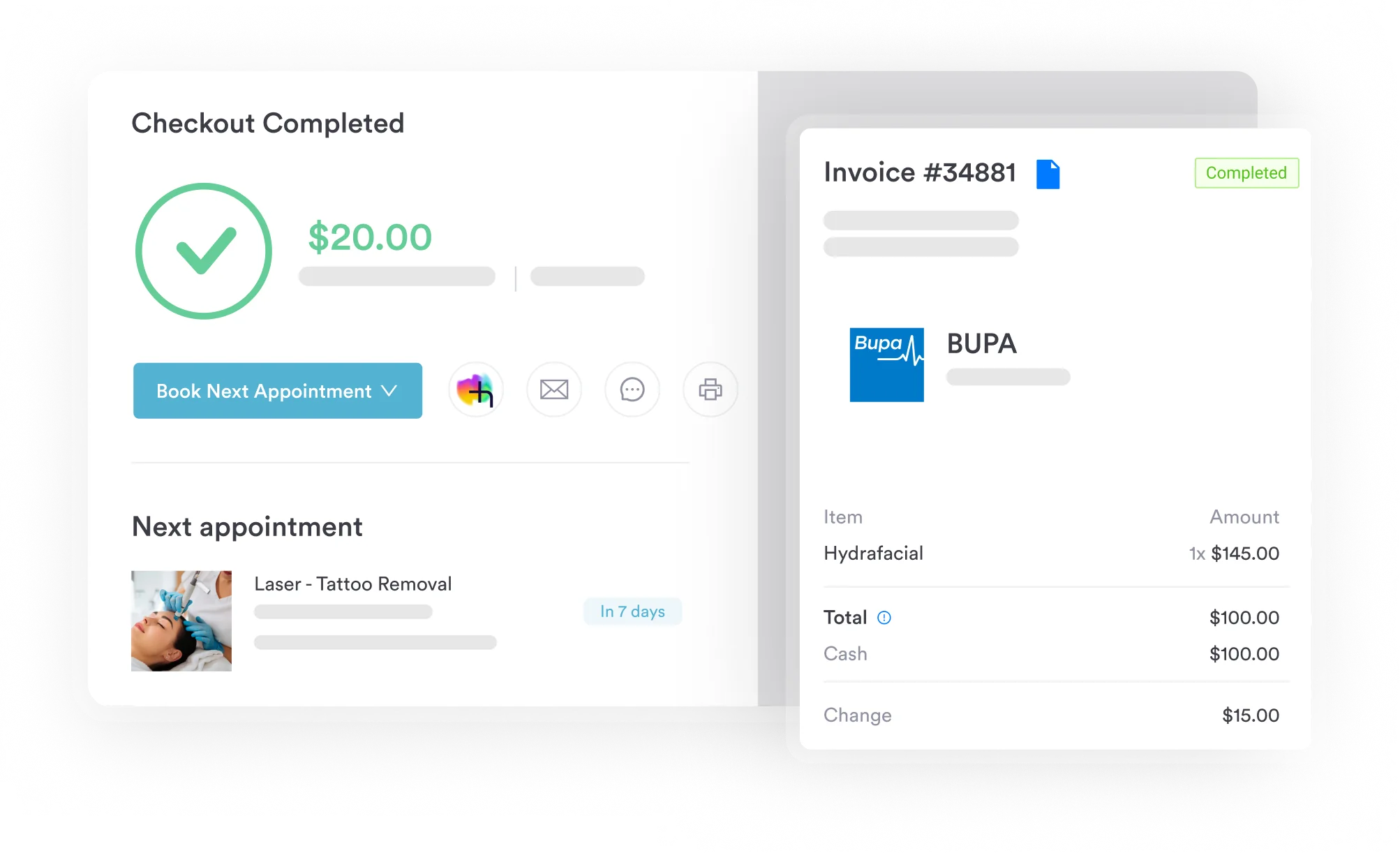

Pabau checks eligibility in real time, submits electronic CMS-1500 claims and tracks each 28310 claim to remittance. Your billing team catches denials early and spends more time on reimbursement.

28310 is a narrow code: one bone, one toe, and only when the osteotomy stands on its own. Before the claim goes out, confirm three facts from the operative note.
Settle those at scheduling and the claim rarely needs a second look. Leave them to the billing stage and you may spend the 90-day global period appealing a procedure your surgeon has already performed.
Pabau keeps eligibility checks, electronic claims and status tracking in one place. Book a demo to see how it handles claims for your podiatric surgery cases.

Need a structured denial tracking reference? Denial codes in medical billing covers CARC and RARC codes with corrective action guidance for each denial category.
Want to understand what a clean claim requires before submission? Clean claim submission checklist details the elements every outgoing claim must contain to avoid front-end edits.
Billing for multiple foot procedures in one session? Superbill setup guide covers how to build a superbill that captures surgical codes, modifiers and diagnosis linkages.
Was the Akin part of a bunionectomy? CPT code 28298 covers hallux valgus correction with a proximal phalanx osteotomy.
Correcting a lesser toe deformity instead? CPT code 28285 covers hammertoe correction and how it differs from a phalanx osteotomy.
CPT Code 28310 covers osteotomy of the proximal phalanx of the great toe. It is commonly performed as the Akin procedure to correct hallux valgus or interphalangeal deformity. The code includes the bone cut, any fixation, and wound closure at that site.
Yes. The “separate procedure” designation is part of the official CPT descriptor. It means 28310 is considered a component of more comprehensive foot procedures performed at the same site. It can be billed separately only when performed for a distinct diagnosis or at a distinct anatomical site, supported by modifier 59.
Medicare reimbursement rates for CPT Code 28310 vary by geographic locality and update each January. The 2026 work RVU is 5.43, with total RVUs of 16.92 non-facility and 10.47 facility. Use the CMS MPFS look-up tool to confirm the current rate for your jurisdiction.
The top denial reasons are NCCI bundling, missing or mismatched toe modifiers, no prior authorization on file, and global period conflicts. Bundling denials follow 28310 billed with a comprehensive hallux valgus code and no modifier 59. Modifier denials follow a T5 or TA that does not match the ICD-10 laterality. Global period denials follow billing within 90 days of a related surgery without modifier 79 or 78.



