ICD-10 Code S62.622A: Displaced fracture of middle phalanx of right middle finger
ICD-10 code S62.622A is the billable code for a displaced fracture of the middle...

Last Updated: Nov 4, 2026
Billable Code Specific Code
S63.427A is the billable ICD-10-CM code for traumatic rupture of palmar ligament of left little finger at metacarpophalangeal and interphalangeal joint, initial encounter. It applies while the patient is still in active treatment for the tear.
The code turns on three details in the note: the palmar ligament, the left hand, and the fifth digit. An unspecified ligament of the left little finger takes S63.407A, and the same palmar tear on the right takes S63.426A. When the note names neither the ligament nor the finger, the code is S63.409A.
Let Pabau's smart automation suggest the right codes, reduce claim denials, and keep your practice compliant—effortlessly.
Automate repetitive tasks and focus on what matters most—your patients.
Reduce coding errors and ensure compliance with the latest regulations.
Clean claims, fewer denials, and faster reimbursements.
Powerful insights and reporting to help your practice thrive.
HIPAA compliant SOC 2 certified GDPR-compliant Trusted by 4,000+ clinics worldwide

S63.427A is a billable ICD-10-CM code for traumatic rupture of the palmar ligament of the left little finger, initial encounter.
The 7th character A applies while the patient is in active treatment. Switch to D once visits move to routine healing.
The 5th character names the ligament, so a volar plate tear takes S63.437A and an unspecified ligament takes S63.407A.
The note has to name the left hand, the little finger, and the palmar ligament, or the code and the record will not match.
External cause codes are not a national requirement, but many commercial payers and workers’ compensation carriers expect them.
ICD-10 Code S63.427A is the official ICD-10-CM diagnosis code for traumatic rupture of the palmar ligament of the left little (fifth) finger, initial encounter. It sits in category S63, dislocation and sprain of joints and ligaments at wrist and hand level. It is a billable 7-character code, valid in the current fiscal year’s CMS tabular list.
Breaking down the alphanumeric structure helps coders select it with confidence:
The parent code S63.427 is not billable without a 7th character. A claim carrying the 6-character parent is rejected, so every submission needs A, D, or S.
The official descriptor comes from the CMS ICD-10-CM tabular list. It reads: Traumatic rupture of palmar ligament of left little finger at metacarpophalangeal and interphalangeal joint, initial encounter.
Confirm the current-year version using the CDC/NCHS ICD-10-CM web tool, which mirrors the official tabular list for each fiscal year effective October 1.
The palmar ligament of the little finger runs along the palm side of the fifth digit’s metacarpophalangeal (MCP) and interphalangeal (IP) joints. It stabilizes those joints against hyperextension.
Clinicians often describe the same region as the volar or palmar plate, but ICD-10-CM classifies volar plate rupture separately. A note that names the volar plate points to S63.437A, not S63.427A.
Traumatic rupture usually follows one of three mechanisms. Each produces a distinct presentation, and the note has to capture it to support S63.427A over a sprain code:
Hand surgery and physical therapy practices treating these injuries should document the joint affected (MCP, PIP, or DIP), the mechanism, and the imaging findings. Without that detail, the note does not support S63.427A over a less specific sprain code.
The 7th character records which phase of care the encounter represents, as defined in the CMS ICD-10-CM coding guidance. The three options are:
Active treatment can run across several providers at once. A hand surgeon who first sees the patient weeks after the injury still uses A, not D. Active treatment is still ongoing at that visit. The switch to D comes once the injury is stable and care shifts to routine healing.
S63.427A sits in a grid of closely related codes. The 5th character names the ligament: 0 for unspecified, 1 for collateral, 2 for palmar, and 3 for volar plate. The 6th character names the finger and side, with 6 for the right little finger and 7 for the left. The chart shows how those two characters combine for the little finger.
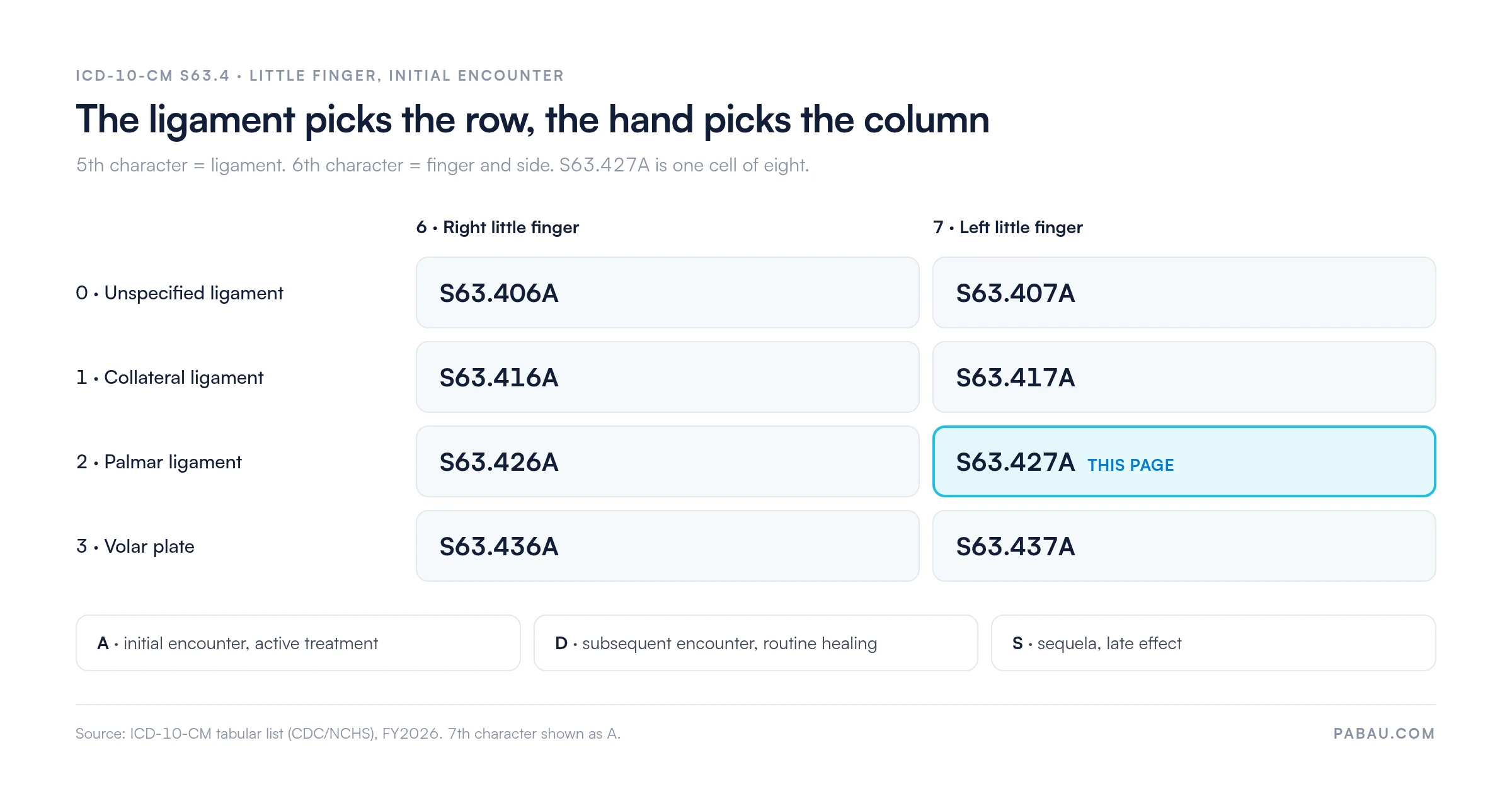
The table covers the neighbors coders most often confuse with S63.427A.
Also separate S63.427A from the finger sprain codes in subcategory S63.6-. A sprain stretches the ligament without disrupting it, while a traumatic rupture is a complete or near-complete tear.
The note should say so plainly, with terms such as complete rupture, full-thickness tear, or avulsion of the palmar ligament. Words like sprain or strain point the coder to a different subcategory.
Category S63 carries instructional notes to review before finalizing S63.427A. An Excludes2 note means the excluded condition is not part of S63.427A, but both may be coded when both are documented.
HIPAA names ICD-10-CM as the standard diagnosis code set for covered entities. The AAPC ICD-10-CM lookup is a quick way to check current Excludes notes and cross-references during coding reviews.
There is no national requirement to report external cause codes with S63.427A. Many commercial payers and workers’ compensation carriers expect them, though, and some states mandate them. A claim without a mechanism code can come back with a request for more information.
Select external cause codes from these categories:
Sending the diagnosis, mechanism, activity, and place codes together on the first submission is part of a clean claim submission. It saves the resubmission cycle that a returned claim costs.
Where the payer expects external cause data, report one W-code for the mechanism, one Y93 activity code, and one Y92 place-of-occurrence code with S63.427A. Workers’ compensation carriers often return claims that carry only the diagnosis code. Adding all three takes about a minute at the point of coding.
S63.427A is a diagnosis code only. Every claim also requires at least one CPT procedure code that reflects the services rendered during the encounter. Common pairings vary by treatment approach:
The AMA updates CPT codes every year, so check current-year pairings in the CMS Physician Fee Schedule lookup tool before billing. The pairings above reflect common practice but do not replace a payer-specific coverage check. For the open repair itself, see our page on CPT 26540.
A claim submitted with S63.427A is only as strong as the clinical note behind it. Ligament ruptures can lead to surgery and often involve workers’ compensation, so payers have reason to look closely at the record.
The clinical note supporting S63.427A must include all of these elements:
Capturing these details at the point of care is easier with a structured note template. A template with fields for hand, digit, ligament, and mechanism makes an incomplete note harder to sign off.
S63.427A denials follow a predictable pattern, and most trace back to the claim or the note rather than the code. A denial management workflow that tracks these causes catches repeats early. The usual triggers are:
The CARC (Claim Adjustment Reason Code) on each denial tells the team which fix applies. It may be a documentation correction, a code correction, or a resubmission with external cause data. Our guide to medical billing denial codes explains the common ones. For the wider billing cycle, see medical billing fundamentals.
Workers’ compensation is a high-frequency payer for traumatic hand ligament injuries, particularly those occurring in manufacturing, construction, food processing, and manual labor roles.
Workers’ comp coding for S63.427A follows the same ICD-10-CM rules as commercial payers but with additional mandatory code and documentation elements that vary by state.
Most problems on an S63.427A claim start when the note and the claim live in different systems. The coder re-keys the hand, the digit, and the ligament, and one slip turns a clean claim into a denial.
Pabau, the practice management platform we build, keeps the clinical record and the claim in one place. Pabau’s software for cleaner claims scrubs every claim for missing or invalid details before it goes out. Claims route through the Claim.MD clearinghouse, which reaches thousands of US insurance payers.
Eligibility checks, claim status, and electronic remittance advice come back against the same patient record. When a workers’ comp carrier returns an S63.427A claim, the billing team sees the reason next to the note it needs to fix.
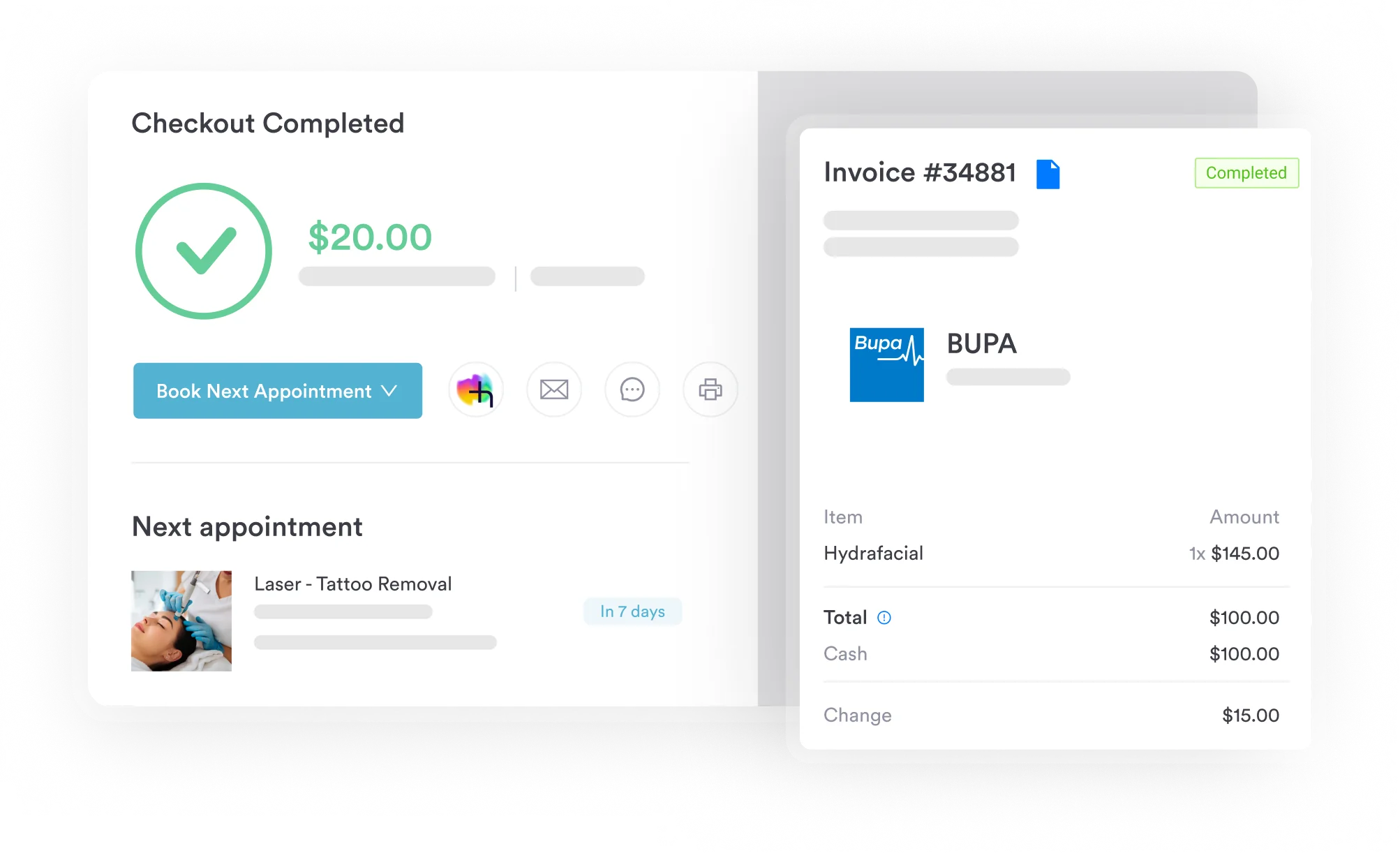

Pabau’s claims management software scrubs each claim for missing or invalid details, submits it through Claim.MD, and posts remittances against the patient record. See how it handles hand injury billing.

S63.427A is an easy code to look up and an easy one to get wrong. The note decides it: left hand, little finger, palmar ligament, complete rupture, and active treatment. If one of those five details is missing, the claim is coded from a guess.
Make those details fields in the note template, and check the ligament first whenever the record mentions the volar plate. The 7th character and the external cause codes then follow from the same note. Book a demo to see how Pabau keeps hand injury notes and claim submission in one workflow.

Want claims checked before they reach the payer? Claim.MD clearinghouse overview explains how clearinghouse validation reduces rejection rates before submission.
Looking for structured ICD-10 coding workflows across your billing team? Medical billing compliance guide covers documentation standards, audit readiness, and payer-specific requirements.
Handling high volumes of occupational injury claims? Insurance eligibility verification outlines how pre-visit checks reduce downstream coding and coverage denials.
ICD-10 Code S63.427A is the billable diagnosis code for a traumatic palmar ligament rupture of the left little finger, initial encounter. The tear sits at the metacarpophalangeal or interphalangeal joint. The code is used during the phase of active treatment, not for follow-up visits once healing is underway.
Use S63.427A for any encounter where active treatment is being provided, including emergency visits, initial surgical consultations, and splinting decisions. Switch to S63.427D when the injury has stabilized and the patient is in routine healing. Use S63.427S only when the patient presents with a late effect, such as chronic joint stiffness or deformity, after the original rupture has fully healed.
Where the payer expects external cause data, pair S63.427A with a W-series mechanism code, a Y93-series activity code, and a Y92-series place-of-occurrence code. Examples are W22.8XXA for striking against or struck by other objects, and W50.0XXA for an accidental hit or strike by another person. Many workers’ compensation carriers and commercial payers expect all three. Check each payer’s own rules for current requirements.
Yes. S63.427A is a valid code on a workers’ compensation claim when the rupture happened in the course and scope of employment. Workers’ comp carriers require external cause codes confirming occupational mechanism, an activity code, and clinical documentation explicitly linking the injury to workplace duties. Rules vary by state, so verify your state’s specific form and coding requirements before submitting.
S63.407A is traumatic rupture of an unspecified ligament of the left little finger, initial encounter. It applies when the note confirms the left little finger but does not say which ligament tore. S63.427A applies once the note names the palmar ligament. If the finger is not identified either, the code is S63.409A, which should be avoided whenever the record allows more detail.
Common denials involve a missing 7th character, A on a follow-up visit that belongs under D, missing external cause codes, or a laterality mismatch. A note that names the volar plate or a collateral ligament while the claim carries S63.427A is another. Sprain language in a note coded as a rupture is also a frequent audit trigger. Checking the S63 instructional notes before submission catches combination errors before they reach the payer.