CPT code 59618: Cesarean after attempted VBAC billing guide
CPT code 59618 bills a cesarean after a VBAC attempt CPT code 59618 is the globa...

Last Updated: Nov 4, 2026
26540 is the CPT code for repair of collateral ligament, metacarpophalangeal or interphalangeal joint. It covers a primary repair of the native ligament with no graft and no local-tissue reconstruction. The classic case is an acute thumb MCP ulnar collateral ligament tear, known as skier's or gamekeeper's thumb.
Code choice turns on the operative note. An MCP collateral ligament reconstructed with a tendon or fascial graft is 26541. One reconstructed with local tissue, such as adductor advancement, is 26542. Most denials trace back to that level choice or to missing laterality on the paired S63 ICD-10 code.
Let Pabau's smart automation suggest the right codes, reduce claim denials, and keep your practice compliant—effortlessly.
Automate repetitive tasks and focus on what matters most—your patients.
Reduce coding errors and ensure compliance with the latest regulations.
Clean claims, fewer denials, and faster reimbursements.
Powerful insights and reporting to help your practice thrive.
HIPAA compliant SOC 2 certified GDPR-compliant Trusted by 4,000+ clinics worldwide

CPT 26540 covers primary repair of a collateral ligament at the MCP or IP joint, using the native ligament with no graft or local-tissue reconstruction.
26541 and 26542 are MCP-joint reconstructions. 26541 uses a tendon or fascial graft, and 26542 uses local tissue such as adductor advancement.
The operative note decides the code through two facts: repair versus reconstruction, and which joint was treated.
Laterality is required on every paired S63 ICD-10 code, and a missing right/left character is the leading denial trigger for this code.
Pabau, the practice management platform we build, flags NCCI bundling pairs and incomplete laterality before the claim is submitted.
CPT Code 26540 is described by the American Medical Association (AMA) as: Repair of collateral ligament, metacarpophalangeal or interphalangeal joint. This is a primary repair using the existing ligament tissue only, with no tendon graft, fascial graft or local-tissue reconstruction. Once the operative note describes a reconstruction, the code changes.
The 26540/26541/26542 family splits on two facts in the operative note. The first is whether the surgeon repaired the native ligament or reconstructed it. The second is which joint was treated.
CPT 26540 is a repair at the MCP or IP joint. CPT 26541 and 26542 are reconstructions of a single MCP joint collateral ligament, and they differ only in the tissue used. The decision path below asks those questions in order.
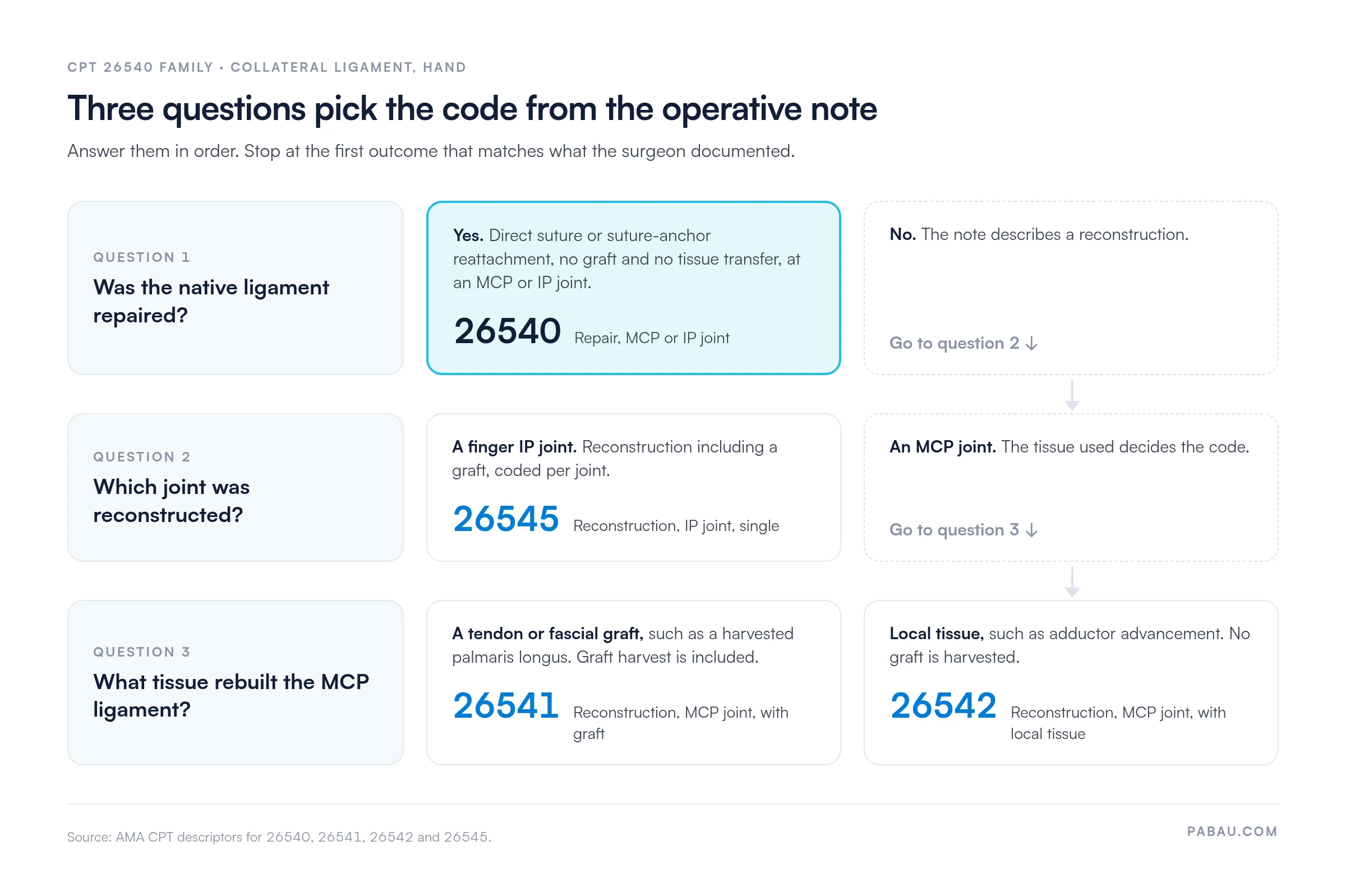
The most common miscoding error is billing 26540 when the note documents a palmaris longus graft harvested to reconstruct the ligament after a Stener lesion. That is 26541, and the graft harvest is included in the code.
A reconstruction with local tissue, such as adductor advancement, is 26542. The joint matters too, because 26541 and 26542 apply only at the MCP joint. A graft reconstruction at a finger IP joint is 26545.
The level also moves payment. Under the 2024 Medicare Physician Fee Schedule, 26541 carries 8.81 work RVUs and 26542 carries 6.95. A wrong level means an underpaid claim or an overcoded one.
CPT Code 26540 most commonly appears in hand surgery and sports medicine billing. The underlying injuries, collateral ligament tears at the MCP and IP joints, are frequent in athletes and trauma patients. These are the scenarios where 26540 is appropriately selected:
CPT 26540 is not appropriate when the operative note documents a reconstruction instead of a repair. At the MCP joint, reconstruction with a tendon or fascial graft is 26541, and reconstruction with local tissue is 26542. At an IP joint, reconstruction including a graft is 26545.
It also does not fit a ligament repair performed with a separately coded fracture fixation. An arthroscopic repair falls under the arthroscopy codes instead.
Every claim for CPT Code 26540 requires a diagnosis code that supports medical necessity. Payer adjudication systems check that the ICD-10 code reflects an acute or chronic ligament injury at the appropriate joint. Laterality is mandatory on S63 codes, and a missing right/left character is the leading denial cause for this procedure.
Always append the correct 7th character. For surgical intervention on an acute injury, the encounter is “A” (initial). If the patient returns to address a complication, use “D” (subsequent) or “S” (sequela) as appropriate.
Use the AAPC Codify CPT-to-ICD-10 crosswalk or CrossCoder to verify valid pairings before submitting the claim. To check an S63 descriptor word for word, look the code up in our searchable ICD-10-CM code archive.
The operative note alone determines which code in the 26540/26541/26542 family is correct, and payers auditing hand surgery claims pull it first. A missing element below invites a coding downgrade or a post-payment recoupment request. Sound medical billing compliance means a documentation checklist the surgeon signs off before the note is finalized.
The CMS Medicare Physician Fee Schedule (MPFS) determines payment for CPT 26540 in Medicare populations. RVU values are updated every January.
The figures below reflect the 2024 MPFS, so verify them against the current CMS data file before quoting rates to patients or payers. Use FastRVU’s 2026 lookup tool to pull the most current values by geographic practice cost index (GPCI) location.
The 90-day global surgical package bundles any related evaluation and management service into the CPT 26540 payment. That covers the day of the procedure through 90 days post-op. Bill a separate E/M only for a clearly unrelated condition, appending modifier -24 (postoperative E/M, unrelated diagnosis).
The National Correct Coding Initiative (NCCI) publishes quarterly edit tables that define which code pairs cannot be billed together. Submitting a claim for CPT Code 26540 alongside a bundled component code results in automatic denial of the lesser code.
Pabau runs NCCI edit checks through its claims management tools and its Claim.MD clearinghouse integration, so these pairs surface at submission.
NCCI edits update quarterly. Always verify the current table at the CMS website before billing combinations not listed here. Chapter IV of the NCCI Policy Manual, which covers CPT codes 20000-29999 (musculoskeletal system), is the definitive reference.
Download the current NCCI procedure-to-procedure edit file from CMS as a CSV and load it into your billing software’s code-pair check. Running CPT 26540 through the file before claim submission takes under ten seconds and prevents the most common bundling denials before they happen.
Modifiers signal to the payer that circumstances exist which alter how the base code is paid. Using the wrong modifier, or omitting a required one, is a common denial trigger for hand surgery claims.
CPT Code 26540 is a surgical procedure that commonly requires prior authorization from commercial payers. Medicare generally does not require prior auth for this code, but many Medicare Advantage plans do.
Payer requirements change without notice, so verify at the time of scheduling. Effective denial management workflows start at scheduling, before the patient reaches the OR.
Submitting a clean claim for CPT 26540 requires validating laterality, authorization status, and NCCI conflicts before the claim leaves your practice management system.
Practices using automated claim scrubbing through Pabau’s Claim.MD clearinghouse integration catch these errors at submission. Practices without automated scrubbing typically discover them on the 835 remittance, which adds two to three weeks of rework per denied claim.
Hand surgery billing teams working in a disconnected EHR-plus-billing-clearinghouse stack lose time to manual data re-entry between the operative note, the superbill, and the claim.
A practice management system with integrated billing pulls the CPT 26540 code and modifiers from the procedure template. It then applies the correct ICD-10 pairing and runs the claim through NCCI edit checks in one workflow.
Key features to look for when processing CPT 26540 through your billing platform:
Pabau’s denial-reducing claims management software works with Claim.MD to handle CMS-1500 and 837P submissions, real-time eligibility, and ERA matching across thousands of US payers. Claims management comes with every Pabau subscription, so the clearinghouse connection needs no add-on.

Pabau’s claims management software scrubs CPT 26540 claims for NCCI bundling conflicts, missing laterality, and modifier errors before they reach the payer. Your hand surgery billing team fixes each problem before a denial letter is ever written.

CPT Code 26540 rewards coders who read the operative note before they open the code list. If the surgeon repaired the native ligament, 26540 holds at any MCP or IP joint. If the surgeon reconstructed an MCP ligament, the tissue decides between 26541 and 26542. An IP joint reconstruction moves to 26545.
Get that call right and attach laterality to every S63 code, and the two most common denial patterns disappear. The cost is a few extra minutes of op-note review per case, far less than reworking a corrected claim.
Book a demo to see how Pabau catches missing laterality and NCCI conflicts on hand surgery claims before they reach the payer.

Want to understand how clearinghouses process your claims? Medical claims clearinghouse guide explains how 837P files are validated before they reach the payer.
Looking for clean claim benchmarks? Clean claim requirements covers the data elements payers check on every surgical claim submission.
CPT Code 26540 covers the primary repair of a collateral ligament at the metacarpophalangeal (MCP) or interphalangeal (IP) joint of the hand. The surgeon uses the native ligament, without a graft or local-tissue reconstruction. This includes acute UCL and RCL repairs at the thumb MCP joint (skier’s/gamekeeper’s thumb) and collateral ligament repairs at the finger PIP or DIP joints.
CPT 26540 is a repair of a collateral ligament at the MCP or IP joint using the native ligament. CPT 26541 is a reconstruction of a single MCP joint collateral ligament with a tendon or fascial graft, and it includes obtaining the graft. If the operative note describes a harvested graft, such as palmaris longus, at the MCP joint, bill 26541. If the surgeon sutured or reattached the native ligament alone, 26540 applies.
Medicare payment for CPT 26540 is its total RVU multiplied by the CMS conversion factor, adjusted by the GPCI for the practice’s location. Rates change annually. Use the CMS MPFS Look-Up Tool or FastRVU to find the current non-facility and facility payment amounts for your area.
Prior authorization requirements vary by payer and are not standardized. Most commercial plans require prior auth for elective surgical procedures, including CPT 26540. Traditional Medicare typically does not, but Medicare Advantage plans often do. Always verify authorization requirements with the specific payer before scheduling the procedure.
The most common pairing is S63.641A or S63.642A, sprain of the right or left thumb MCP joint, initial encounter. Finger interphalangeal joint repairs pair with an S63.63- code, such as S63.630A for the right index finger. Every S63 code needs its full 6th character for side and digit. For chronic ligament insufficiency, M24.241 or M24.242 (disorder of ligament, right or left hand) may fit better than an acute sprain code.
The two most common denial triggers are missing laterality on the ICD-10 code and a code-level mismatch. Laterality fails when the 6th-character right/left designator is left off an S63 code. A level mismatch happens when 26540 is billed for an MCP reconstruction. That is 26541 with a tendon or fascial graft, or 26542 with local tissue. NCCI bundling conflicts and missing prior authorization are the next most frequent causes. Automated claim scrubbing catches all four before the claim reaches the payer.
Modifier -51 (multiple procedures) applies to the secondary procedure when CPT 26540 is billed alongside another surgical code on the same date. Do not append -51 to 26540 itself when it is the primary procedure. Verify whether any same-day codes are on the modifier-51 exempt list before applying the modifier to the secondary line item.