ICD-10 Code S53.013D: Anterior subluxation of unspecified radial head
ICD-10 Code S53.013D: Quick reference summary Use the table below as your first ...

Last Updated: Nov 6, 2026
Billable Code Specific Code
S62.346B is the billable ICD-10-CM code for nondisplaced fracture of base of fifth metacarpal bone, right hand, initial encounter for open fracture. It applies when imaging confirms the base fracture has not shifted and the wound communicates with the fracture site.
Coders most often confuse it with S62.346A, the closed version of the same fracture. The other common mix-up is S62.366B, a nondisplaced open fracture of the fifth metacarpal neck. A left-hand injury takes S62.347B instead.
Let Pabau's smart automation suggest the right codes, reduce claim denials, and keep your practice compliant—effortlessly.
Automate repetitive tasks and focus on what matters most—your patients.
Reduce coding errors and ensure compliance with the latest regulations.
Clean claims, fewer denials, and faster reimbursements.
Powerful insights and reporting to help your practice thrive.
HIPAA compliant SOC 2 certified GDPR-compliant Trusted by 4,000+ clinics worldwide

ICD-10 Code S62.346B covers a nondisplaced open fracture at the proximal end of the right fifth metacarpal, reported only at the initial active-treatment encounter.
The ‘B’ suffix is mandatory whenever clinical documentation confirms skin-to-fracture wound communication. Using ‘A’ (closed) when the notes describe a wound is the top denial trigger.
Laterality is built into the code: S62.346B is the right hand, and a left-hand injury takes S62.347B.
Classic boxer fractures involve the fifth metacarpal neck (S62.336x displaced, S62.366x nondisplaced), not the base. The segment changes both the code and the paired CPT.
Pabau’s claim validation checks every claim for missing or invalid details before it leaves the practice, so errors get fixed before submission.
ICD-10 Code S62.346B is a valid, billable ICD-10-CM diagnosis code for fiscal years 2024 through 2027. Its official descriptor comes from the CMS ICD-10-CM Tabular List.
It reads “Nondisplaced fracture of base of fifth metacarpal bone, right hand, initial encounter for open fracture.” The code sits in the S00-T88 injury chapter and the S60-S69 block for injuries to the wrist, hand and fingers. Within that block, it belongs to category S62.
The hierarchy runs from S62 to S62.3 (fracture of other and unspecified metacarpal bone), then to S62.34 (nondisplaced fracture of base of other metacarpal bone). S62.346 narrows it to the fifth metacarpal of the right hand, and the B suffix marks the initial encounter for an open fracture.
The sixth character carries laterality. S62.346 is the right hand only, and its left-hand equivalent is S62.347, so the same open fracture in the left hand is coded S62.347B. A left fifth metacarpal fracture documented outside the base, shaft and neck moves to the S62.39- codes instead. Its routine-healing follow-up is the S62.397D code.
The “B” 7th character in ICD-10-CM fracture codes denotes an initial encounter for an open fracture. “Initial encounter” means the patient is receiving active treatment for the condition. That covers the ED visit, the operative procedure, and any other visits during the active-treatment phase.
Every code in the S62.346 family shares the same anatomical descriptor and differs only in the 7th character. That single character communicates both the encounter phase and the fracture type (open vs closed). Using the wrong character is the single most common coding error on this code family.
An ICD-10-CM guideline states that when documentation does not specify displaced or nondisplaced status, the coder defaults to displaced. For S62.346B to apply, the medical record must explicitly confirm nondisplaced alignment, typically through imaging.
S62.346A covers a nondisplaced fracture of the base of the fifth metacarpal at the initial encounter for a closed fracture. S62.346B covers the identical anatomical event but at the initial encounter for an open fracture. The wound description in the clinical record decides which one applies.
The most frequent error is coding S62.346A when the operative note describes irrigation, debridement, or a wound over the fracture site. Any documentation suggesting the wound communicates with the fracture makes the “B” suffix mandatory.
The base of the fifth metacarpal is the proximal end of the bone, where it articulates with the hamate at the carpometacarpal (CMC) joint. Base fractures usually follow an axial load, a fall on a closed fist, or a direct blow to the side of the hand.
Nondisplaced means the fracture fragments have not shifted from their normal anatomical alignment. Radiographic confirmation is the standard of documentation, and the imaging report should explicitly state “nondisplaced” for this code to hold on audit. The matrix below maps each segment and displacement status to its right-hand code.
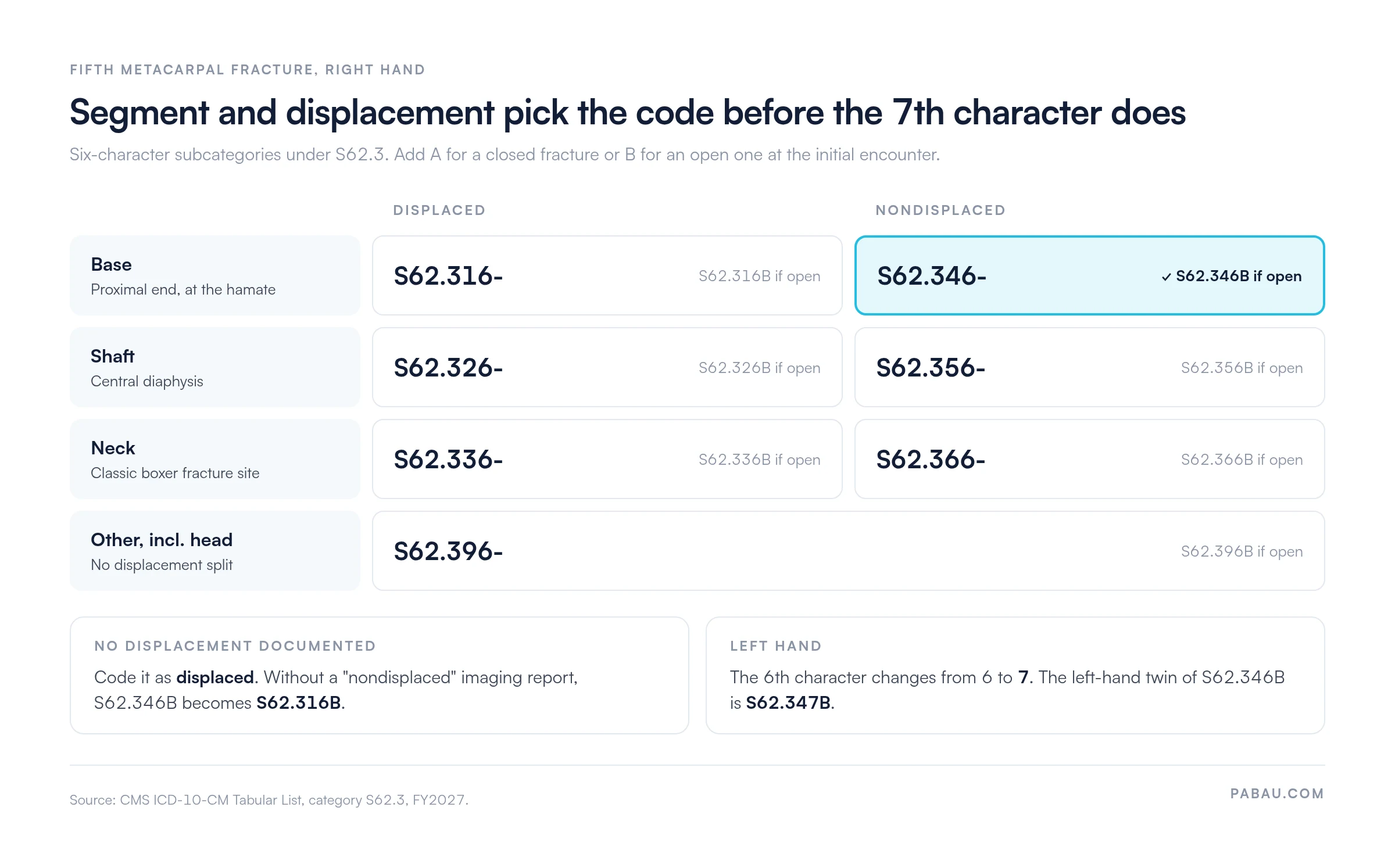
No. S62.346B is not the code for a boxer fracture. The classic boxer fracture involves the fifth metacarpal neck, not the base. On the right hand, neck fractures fall under S62.336x (displaced) and S62.366x (nondisplaced), so the open initial-encounter codes are S62.336B and S62.366B. S62.346B covers fractures at the proximal end of the bone, a distinct anatomical and biomechanical injury.
This is one of the most frequent coder errors on fifth metacarpal injuries. A patient comes in after a punch, and the clinician notes a “fifth metacarpal fracture.”
The coder then defaults to “boxer fracture” terminology without confirming whether the break is at the neck or the base. The two sites have different coding families, different typical CPT pairings, and sometimes different clinical management paths.
Always check the radiology report for the specific fracture location within the fifth metacarpal. ‘Fifth metacarpal fracture’ in a clinical note is not enough to distinguish base (S62.346x) from neck (S62.336x or S62.366x) from shaft (S62.326x or S62.356x). The imaging report’s anatomical descriptor is the deciding document.
Supporting S62.346B on audit requires four documentation elements. Missing any one of them converts a straightforward claim into a denial. Orthopedic and sports medicine practices treating hand injuries should build these checkpoints into their operative and ED note templates.
S62.346B is specific to the right hand. A left-hand injury takes S62.347B, so the side named in the operative report must match the code on the claim. Payers also flag a mismatch between the claim and the operative site when bilateral injuries are coded.
The CPT code paired with S62.346B must align with the open fracture status encoded in the diagnosis. Pairing an open fracture ICD-10 code with a closed-treatment CPT is the second most common denial trigger on this code. Running each claim through claims software with validation gives the biller a final check before the payer sees it.
For a surgically managed open fracture, CPT 26615 is the standard pairing. Generating an accurate superbill with that CPT-ICD pair cuts submission errors before the claim leaves the practice. When the surgeon pins the fracture through the skin without opening the site, 26608 percutaneous fixation is the code to check.
Verify current CPT descriptors against the AMA’s CPT coding resources before each fiscal year, as code descriptors change annually.
Most denials on ICD-10 Code S62.346B stem from one of six well-documented failure patterns. Sound denial management workflows address each at the point of documentation, before the EOB arrives.
Tracking your denial codes in medical billing by category helps identify which pattern is most prevalent in your practice.
Several codes share the same anatomical region or the same encounter suffix as ICD-10 Code S62.346B. The CDC/NCHS ICD-10-CM tool displays adjacent codes in context; using it alongside this reference reduces the risk of selecting a neighbor code in error.
The S62 category carries coding notes that apply to S62.346B by inheritance. Coders must review these before adding secondary codes.
Medicare generally does not require prior authorization for fracture evaluation or closed-treatment procedures. Open fractures requiring surgical management may need hospital notification under inpatient admission guidelines.
When the encounter shifts from outpatient to inpatient, the payment mechanism changes from APC (Ambulatory Payment Classification) to DRG (Diagnosis-Related Group), which affects reimbursement substantially.
Commercial payers including Anthem, UHC, and Aetna may require prior authorization for open-reduction procedures (CPT 26615). Authorization should be confirmed before the operative case is scheduled when the fracture management plan includes surgical fixation.
Wound care for an open fracture may also need separate wound management CPT codes. Some payers require medical necessity documentation for each wound care visit.
Submitting claims electronically through a clearinghouse that scrubs each claim catches many rejections before the payer reviews the case. The guide to submitting a clean claim covers the pre-submission checklist that prevents the most common rejection categories.
Before ICD-10-CM replaced ICD-9-CM for US covered entities in October 2015, metacarpal fractures were coded with far less anatomical granularity. The approximate ICD-9-CM equivalent for S62.346B is 815.12 (open fracture of base of other metacarpal bone(s)).
ICD-9 code 815.1x covered open metacarpal fractures, while 815.0x covered closed variants. Neither the fifth metacarpal nor the hand was independently distinguishable in the ICD-9 structure.
GEM (General Equivalence Mapping) crosswalks are approximate for this code family because ICD-9 did not capture nondisplaced vs displaced or base vs neck vs shaft.
Legacy billing audits, EHR data migrations and workers’ compensation claims dated before October 2015 all need the specific GEM mapping. Verify it against the CMS ICD-10 conversion files.
Check current bidirectional mappings in the AAPC ICD-10 code lookup before applying them to active claims.
An S62.346B claim usually passes through several hands before it reaches a payer. The clinician documents the wound, the coder picks the 7th character, and a biller keys the CPT code into a separate system. Each handoff is a chance for an A to replace a B.
Pabau, the practice management and billing platform we build, opens each claim pre-filled from the invoice. Its claim validation scrubs every claim for missing or invalid details before it leaves Pabau, so each fix takes seconds.
Pabau also connects to the Claim.MD clearinghouse and checks insurance eligibility before the visit. Remittance files then settle payments against the original claim, so open fracture claims close without manual reconciliation.

Pabau’s claim validation checks every claim for missing or invalid details before submission. See how orthopedic and sports medicine practices use it to cut rework on fracture claims.

Code S62.346B only when the record shows three facts. The fracture is at the base of the right fifth metacarpal, imaging says “nondisplaced,” and the wound reaches the bone. If one is missing, the correct code is S62.346A, S62.316B, S62.347B or a neck code instead.
The cheapest fix sits upstream. Add hand, segment and displacement prompts to your ED and operative note templates, and most of the denials in this guide never get written. Book a demo to see how Pabau validates each fracture claim before it reaches the payer.

Need the full electronic remittance process explained? Electronic remittance advice (ERA) walks through how 835 files map payment back to submitted claims.
ICD-10 Code S62.346B is the billable ICD-10-CM code for a nondisplaced fracture of the base of the right fifth metacarpal bone. It applies at the initial encounter for an open fracture. The “S62.346” segment identifies the bone, segment, displacement status and side. The “B” 7th character marks the fracture as open and the visit as part of initial, active treatment.
Yes. S62.346B is a valid, billable ICD-10-CM code for fiscal years 2024 through 2027. It is included in the CMS ICD-10-CM Tabular List and can be submitted on professional and facility claims without requiring an additional specificity code.
S62.346A is the code for a closed fracture (skin intact over the fracture site) at the initial encounter. S62.346B is the code for an open fracture (wound communicating with the bone) at the same initial encounter. The anatomy and displacement status are identical, and only the 7th character and the fracture type differ. Operative or ED documentation must explicitly confirm wound communication before S62.346B can be assigned.
No. A classic boxer fracture involves the fifth metacarpal neck, not the base. On the right hand it is coded under S62.336x (displaced) or S62.366x (nondisplaced). S62.346B applies specifically to fractures at the proximal base of the fifth metacarpal. Confirm the fracture location from the radiology report before selecting between neck and base codes.
CPT 26615 (open treatment of metacarpal fracture) is the most common surgical pairing. CPT 26608 (percutaneous skeletal fixation) may also pair when performed in the context of open fracture management. Closed-treatment codes (26600, 26605) should not be paired with S62.346B, as the open fracture ICD-10 diagnosis conflicts with a closed-treatment procedure.
The top denial reasons are using the “A” suffix when documentation supports an open fracture, and pairing S62.346B with a closed-treatment CPT code. Missing radiology confirmation of nondisplaced status is the third. The fourth is continuing to bill S62.346B at follow-up visits that should use S62.346D or S62.346G.
S62.346B is used during the initial active-treatment phase of a nondisplaced open base-of-fifth-metacarpal fracture. S62.346S is the sequela code. It applies when the patient presents with a complication or late effect of a past fracture, such as chronic pain or stiffness.