

HCPCS code E0198: Water pressure pad billing guide
HCPCS code E0198 is a water pad for a standard mattress HCPCS code E0198 is the ...

Last Updated: Oct 13, 2026
26615 is the CPT code for open treatment of metacarpal fracture, single, includes internal fixation, when performed, each bone.
Three documentation failures account for most denials on this code. The claim is missing laterality, or the ICD-10 code does not match the operative findings. Modifiers also get misapplied when several metacarpals are repaired in one session.
Let Pabau's smart automation suggest the right codes, reduce claim denials, and keep your practice compliant—effortlessly.
Automate repetitive tasks and focus on what matters most—your patients.
Reduce coding errors and ensure compliance with the latest regulations.
Clean claims, fewer denials, and faster reimbursements.
Powerful insights and reporting to help your practice thrive.
HIPAA compliant SOC 2 certified GDPR-compliant Trusted by 4,000+ clinics worldwide

CPT 26615 covers open surgical treatment of one metacarpal fracture, with internal fixation bundled in when used.
The code is billed per bone, so two metacarpals treated open in one session means two units of 26615. Modifier -51 goes on the second unit.
Every claim needs a laterality modifier, RT or LT, and missing it is the most common denial trigger.
Practice management software like Pabau flags modifier and ICD-10 mismatches before submission, which prevents denials on surgical codes like 26615.
CPT Code 26615 is defined by the American Medical Association as: “Open treatment of metacarpal fracture, single, includes internal fixation, when performed, each bone.” Three phrases in that descriptor control how the code is applied.
First, “open treatment” requires a surgical incision giving the surgeon direct visualization of the fracture site. A percutaneous approach, where instruments pass through skin without a formal incision, does not qualify.
Second, “includes internal fixation, when performed” bundles plate-and-screw constructs, K-wire fixation and intramedullary devices into 26615. None of them is billed separately. Third, “each bone” sets the unit of service. One unit of 26615 covers one metacarpal treated, not one operative session.
Osteoclasis is the intentional surgical fracturing of a bone to correct deformity. Per guidance from the American Academy of Professional Coders (AAPC), it may be reported using 26615 when performed on a metacarpal.
The operative report must document the surgical intent and technique clearly, as some payers require extra clinical justification for this application.
The metacarpal fracture code family runs from 26600 to 26615 and is ordered by surgical approach. Two variables decide the code. The first is how the surgeon reached the fracture. The second is whether manipulation or fixation was part of the treatment. The chart below asks those questions in the order a coder should work through them.
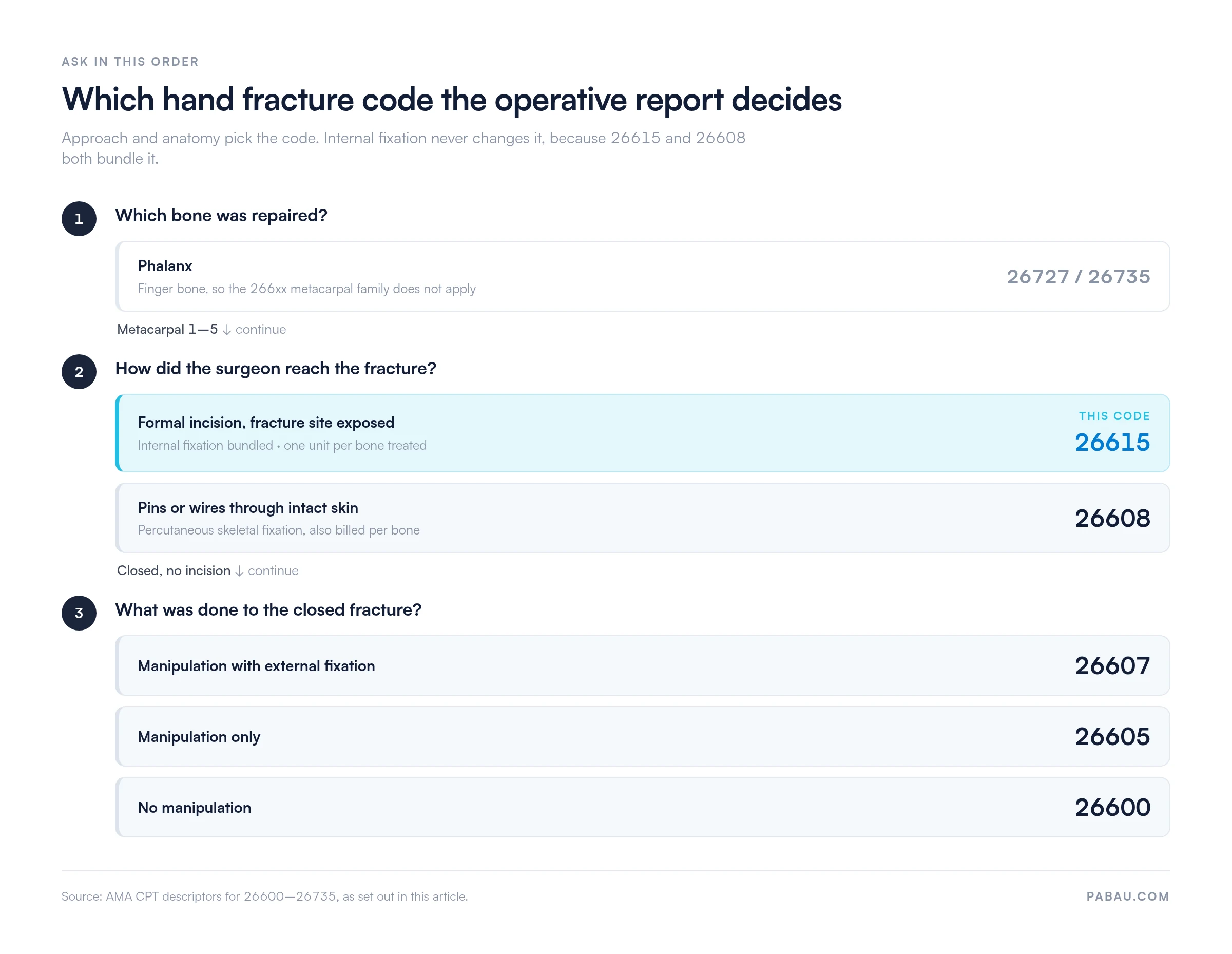
The most common miscoding involves 26615 versus 26608. If the surgeon passes K-wires through intact skin without opening the fracture site, the correct code is 26608, not 26615.
Look for language in the operative report such as “incision made,” “fracture site exposed,” or “direct visualization.” Those phrases confirm that 26615 applies. Do not reach for 26727 here, because that code describes a phalangeal shaft fracture rather than a metacarpal one.
When the operative report describes an open repair of a phalanx instead, CPT 26735 is the code that fits. It uses the same open approach and bundles internal fixation, but on a different bone.
CPT 26615 is a per-bone code. Two metacarpals treated open with fixation in one operative session generate two billable units of 26615. Coders who default to one unit, no matter how many bones were repaired, under-bill the case. On a two-metacarpal repair that leaves the second unit unclaimed.
The billing sequence follows the standard multiple-procedure protocol.
Some payers override the AMA per-bone rule with their own bundling logic. Always verify your specific payer’s multiple-procedure policy before submitting two units of 26615 on a single claim.
Modifier selection on CPT 26615 claims is where a high proportion of denials originate. Four modifiers are commonly applicable, and each has a distinct trigger.
NCCI (National Correct Coding Initiative) edits change quarterly. Before appending -59 to override a bundling edit, verify that the edit is current and that clinical circumstances justify unbundling. The Centers for Medicare and Medicaid Services (CMS) publishes quarterly NCCI policy updates at cms.gov.
Run a modifier audit on your 26615 claims each quarter. Pull every claim where RT or LT is absent, then check which of those denied. A pre-submission modifier checklist catches the same omissions before the claim ever leaves the practice.
Every CPT 26615 claim requires an ICD-10 diagnosis code that supports medical necessity for open surgical treatment. Metacarpal fractures are split across two separate families in the ICD-10-CM code set, and choosing from the wrong one is a frequent source of denials.
The thumb has its own family. Fractures of the first metacarpal are coded from S62.2-, which carries named codes for the Bennett and Rolando patterns.
Metacarpals two through five are coded from S62.3-, titled “Fracture of other and unspecified metacarpal bone.”
No thumb code appears anywhere in S62.3-. Within each family the codes are then organized by fracture site, displacement status, and laterality.
Displaced fractures are the standard ICD-10 pairing with CPT 26615. Displacement is the finding that most often drives the decision to proceed with open reduction. Nondisplaced metacarpal fractures can be treated open, but the operative note should explain why conservative management was not appropriate.
The 7th character “A” denotes an initial encounter for a closed fracture and is the usual designation on the operative claim. Use “B” when the fracture itself is open, “D” for routine healing, and “S” for sequelae. An open boxer’s fracture of the left hand, for example, pairs 26615 with S62.337B rather than the closed-fracture code.
Always confirm that the laterality in the ICD-10 code matches the laterality modifier on the CPT line item. A right-side RT modifier paired with a left-side ICD-10 code triggers an automatic clinical inconsistency denial.
Two code ranges are worth a second look before submission. S62.301A is often mistaken for a thumb code, but it means an unspecified fracture of the second metacarpal of the left hand.
The S62.31- codes are also mistaken for shaft fractures, when they in fact describe displaced fractures of the base. Displaced shaft fractures of the second through fifth metacarpal sit in S62.32- instead.
Under the Medicare Physician Fee Schedule (MPFS), CPT 26615 carries a 90-day global surgical period. Most evaluation and management (E&M) visits in the 90 days after surgery are therefore included in the procedure payment. They cannot be billed separately unless a distinct, unrelated condition is documented and modifier -24 is appended.
The work relative value units (wRVUs) and national payment rates for CPT 26615 are published annually by CMS. Practices can look up current figures using the CMS Physician Fee Schedule search tool or verify RVU values through FastRVU’s 2026 RVU lookup. The figures below are national and unadjusted, so what a practice actually receives moves with its geographic locality.
Practice management software like Pabau folds claims management software into the same record that already holds the operative note. Claim status is tracked against the global period automatically. Any E&M submission inside the 90-day window that lacks the required modifier is flagged before it goes out.
Prior authorization (PA) requirements for open metacarpal fracture repair vary by payer class. There is no universal rule, but the patterns below reflect typical payer behavior for hand surgery procedures.
Skipping prior auth when the payer requires it does not always deny at claim submission. The denial often arrives later, after payment has been posted or during a payer audit. Building PA verification into the scheduling step, rather than the billing step, prevents that recoupment.
Denial patterns on CPT 26615 claims are consistent across payers. Knowing the top causes helps billing teams build prevention into their pre-submission workflow rather than spending resources on appeals.
Track the CARC reason codes on rejected 26615 claims and group them by denial type. That shows billing teams which failure is most prevalent, so the upstream process gets fixed instead of the claims one by one.
Diagnosis specificity carries as much weight as modifier hygiene, because the ICD-10 code has to support the treatment the operative report describes.
The operative report is the primary documentation source for CPT 26615. Payers reviewing a denied claim will pull the operative report before making a coverage determination. If the report does not contain the following elements, the claim is vulnerable regardless of how correctly it was coded.
Practices using Pabau can configure the surgical note template to prompt for each of these fields. That reduces the chance a coder receives an incomplete operative report.
Ask surgeons to dictate each metacarpal as a separate numbered step in the operative report when multiple bones are treated. This creates an unambiguous record for billing multiple units of 26615. Payer reviewers then have what they need to approve the additional units without a medical records request.
A 26615 error usually surfaces only after the payer finds it. The claim goes out, and the remittance comes back with a laterality or bundling rejection. A billing team member reworks it weeks later. By then the operative report has to be pulled again, and the coder has lost the context.
Pabau moves that check to the front of the process. Claim lines built from the operative note carry RT or LT as a required field, so a 26615 line cannot leave the practice without laterality. The system also compares the side stated in the ICD-10 code against the modifier on the CPT line. That catches the mismatch the pairing table above is built to prevent.
Global periods are tracked per patient, so an E&M visit that falls inside the 90-day window is flagged before anyone bills it. Claims then route out through the Claim.MD clearinghouse with eligibility already verified. Billing teams spend less time reworking hand surgery claims, and the ones that go out clean get paid sooner.

Pabau’s claims tools flag missing modifiers, track global periods, and route 26615 claims through verified payer channels before submission. See how hand surgery practices cut denials with automated pre-submission checks.

CPT Code 26615 is a straightforward per-bone surgical code. Billing problems start when documentation is incomplete, or when modifiers are applied without reading the operative report.
Three points carry the most risk on every claim. Those are laterality modifier completeness, ICD-10 specificity matching the operative findings, and correct per-bone unit billing on multi-metacarpal repairs.
Pabau runs those checks before submission, and the Claim.MD integration catches modifier and diagnosis mismatches before a claim reaches the payer. To see how hand surgery practices use Pabau to reduce 26615 denials, book a demo.

Need a guide to medical claims clearinghouses? How medical claims clearinghouses work explains the role clearinghouses play in routing surgical claims to payers and catching errors before submission.
Want to understand superbill requirements for surgical procedures? Superbill documentation guide covers what a complete superbill must include to support CPT billing for outpatient surgical encounters.
Looking for guidance on credentialing before submitting surgical claims? Getting credentialed with insurance companies outlines the process for hand surgery practices entering new payer networks.
CPT Code 26615 covers open treatment of a single metacarpal fracture, including internal fixation when performed, billed per bone. The code requires a formal surgical incision with direct visualization of the fracture site. Internal fixation devices such as plates, screws and K-wires are bundled into the payment and cannot be billed separately.
CPT 26615 requires an open surgical incision with direct visualization of the metacarpal fracture. CPT 26608 describes a percutaneous approach, where pins or wires pass through intact skin without formally opening the fracture site. Use 26615 when the operative report documents an incision and an exposed fracture site. Use 26608 when fixation was placed percutaneously. CPT 26727 is a different bone altogether, because it covers phalangeal shaft fractures rather than metacarpal ones.
Yes, CPT 26615 can be billed multiple times on the same date when multiple metacarpals are treated open with fixation in a single operative session. Bill the first unit without a modifier and append modifier -51 to each additional unit. The operative report must document each bone as a separately performed step. Some payers override this with bundling policies, so verify before submitting multiple units.
Metacarpal fractures are split across two ICD-10-CM families. Fractures of the second through fifth metacarpal use S62.3-, and displaced shaft fractures are the most frequent pairing with CPT 26615. An example is S62.321A, a displaced fracture of the shaft of the second metacarpal of the left hand, initial encounter for closed fracture. Thumb fractures are coded from S62.2- instead, which includes Bennett fracture at S62.211A and S62.212A. No thumb code appears anywhere in the S62.3- family.
The most common denial reason is a missing laterality modifier, with RT or LT absent from the claim line. Next is an ICD-10 specificity mismatch, where the diagnosis code’s side contradicts the modifier. Billing 26615 inside the 90-day global period of a prior procedure without modifier -78 also denies, as does missing prior authorization. NCCI bundling conflicts when 26615 is billed alongside 26600 or 26605 on the same date also generate frequent denials.
Yes, CPT 26615 is covered by Medicare when medical necessity criteria are met. Traditional Medicare does not require prior authorization for this code, but Medicare Advantage plans may impose their own PA requirements. The code carries a 90-day global surgical period under the Medicare Physician Fee Schedule, which bundles most post-operative visits into the procedure payment. The 2026 national unadjusted payment is $547.77 in both facility and non-facility settings.



