ICD-10 Code S62.622A: Displaced fracture of middle phalanx of right middle finger
ICD-10 code S62.622A is the billable code for a displaced fracture of the middle...

Last Updated: Nov 4, 2026
Billable Code Specific Code
S62.397D is the billable ICD-10-CM code for other fracture of fifth metacarpal bone, left hand, subsequent encounter for fracture with routine healing.
It applies to follow-up visits after the initial treatment decision, while the fracture heals as expected. The sixth character 7 encodes both the bone and the side, so the note must name the fifth metacarpal of the left hand. A common error is carrying S62.397A over from the acute visit, which payers flag as a duplicate initial claim.
Let Pabau's smart automation suggest the right codes, reduce claim denials, and keep your practice compliant—effortlessly.
Automate repetitive tasks and focus on what matters most—your patients.
Reduce coding errors and ensure compliance with the latest regulations.
Clean claims, fewer denials, and faster reimbursements.
Powerful insights and reporting to help your practice thrive.
HIPAA compliant SOC 2 certified GDPR-compliant Trusted by 4,000+ clinics worldwide

S62.397D covers routine-healing follow-up care for an other fracture of the fifth metacarpal bone of the left hand.
The sixth character 7 encodes both the bone and the side, so the code applies only to a left fifth metacarpal fracture.
The D seventh character applies to any visit in the routine healing phase after the initial treatment decision, not only the second visit.
Delayed healing, nonunion and malunion take G, K and P instead of D, and an open fracture at the first visit takes B.
ICD-10 Code S62.397D is a valid, billable ICD-10-CM diagnosis code. Its full official descriptor is “Other fracture of fifth metacarpal bone, left hand, subsequent encounter for fracture with routine healing.”
The code sits in category S62, fracture at wrist and hand level. It is a complete seven-character code, so it is acceptable for claim submission as written.
Every character in an ICD-10-CM trauma code carries a specific meaning. So reading them left to right reveals the full clinical story that the payer expects the note to support.
The 5th character (9) and the 6th character (7) answer different questions. First, the 9 places the fracture in the “other fracture” subcategory, outside the base, shaft and neck codes.
The 7, by contrast, names the bone and the side together: the fifth metacarpal of the left hand. As a result, a note that documents the right hand, or a different metacarpal, needs a sibling code instead.
The S62.3 metacarpal codes are organized by fracture site and displacement. Subcategories S62.31 through S62.36 cover displaced and nondisplaced fractures of the base, shaft and neck. S62.39, “other fracture of other metacarpal bone,” is the residual subcategory. In other words, the ICD-10-CM Alphabetic Index sends a documented metacarpal fracture there when it fits none of those site codes.
However, the code does not capture a fracture where the record describes neither the site nor the fracture type. That record points to S62.30- instead.
For this reason, coders should read the radiology report before choosing between them. If the report places the fracture at the base, shaft or neck, it goes to the site-specific codes. S62.39- then covers what remains.
The seventh character D denotes a subsequent encounter for a fracture with routine healing, per ICD-10-CM Official Guidelines Section I.C.19.a. In other words, the term “subsequent” refers to the phase of care, not the visit number.
For example, a patient has closed reduction in the emergency department, then returns two weeks later for a cast check. That visit is a subsequent encounter. So is a tenth follow-up X-ray six months into healing, as long as the fracture stays on track.
S62.397 takes the full fracture extension set: A, B, D, G, K, P and S. However, D is only for routine healing. A follow-up visit for delayed healing takes S62.397G, nonunion takes S62.397K, and malunion takes S62.397P.
Similarly, an open fracture at the initial encounter takes S62.397B rather than A. The chart below turns that choice into three questions, asked in order.
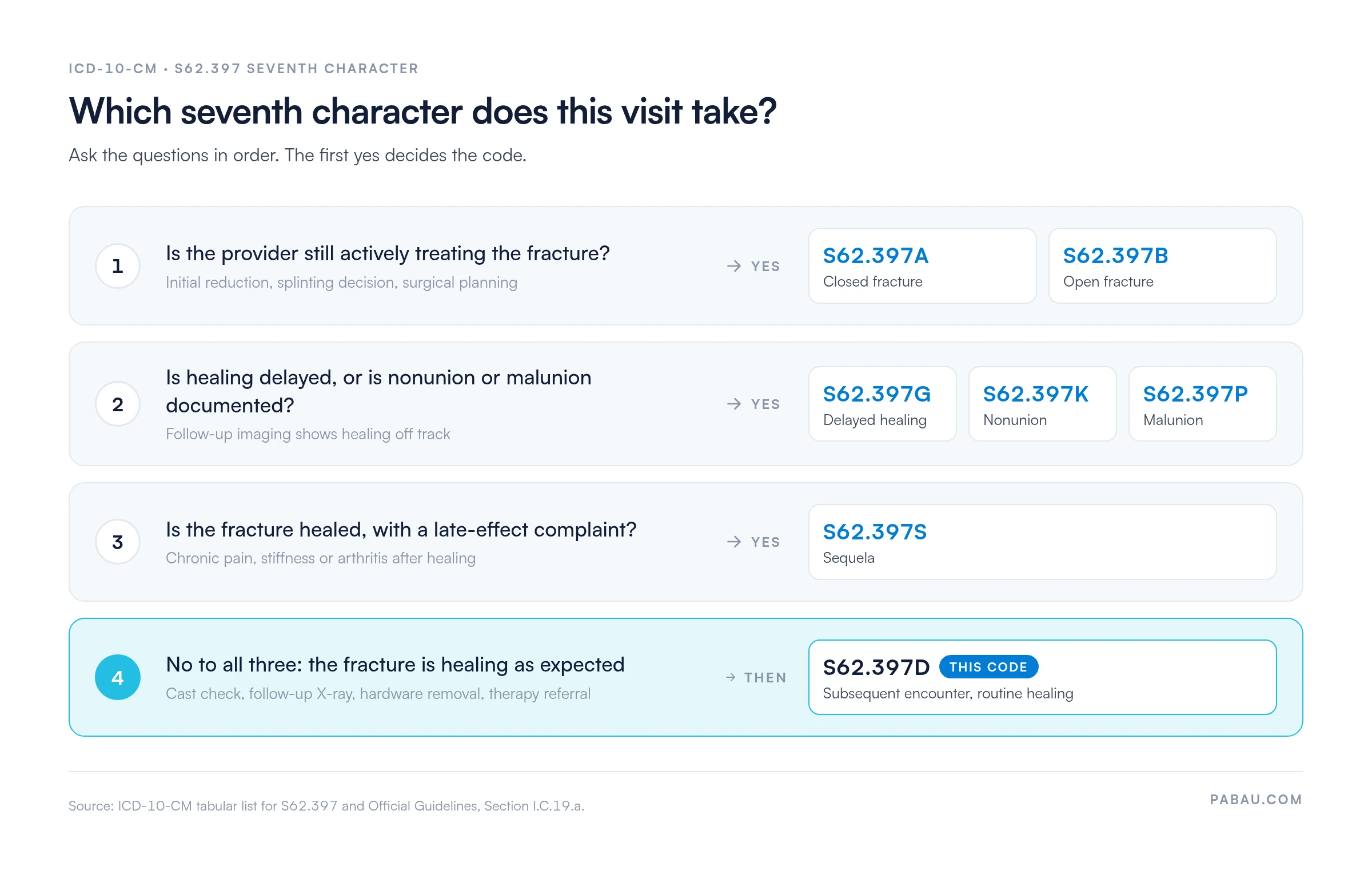
The three seventh-character variants of S62.397 describe the same fracture pattern across three distinct care phases. As a result, the wrong choice is a frequently audited error in the S62.39x group. This is because payers cross-check the encounter date against prior claims for the same patient.
Run a three-question check before assigning the seventh character. (1) Is this still active treatment? If yes, use A, or B for an open fracture. (2) Is healing delayed, or is nonunion or malunion documented? If yes, use G, K or P. (3) Is the fracture healed, with a late-effect complaint? If yes, use S. Routine healing in between is D.
S62.397D is one of ten sibling codes in S62.39-. Its sixth character pins it to the fifth metacarpal of the left hand. So when the note names a different bone or the right hand, use the matching sibling code instead. The table below maps the full S62.39xD family for subsequent encounter visits.
When a physical therapy practice manages the subsequent care, the therapist’s notes should reference the referring diagnosis from the orthopedic note. Linking that diagnosis to the therapy episode keeps one code across the care team. As a result, the ortho claim and the therapy claim match.
To support a subsequent encounter claim, the clinical note must establish several facts that payers check on audit. Missing one of them does not automatically cause a denial. However, it weakens the claim and raises the risk of a documentation request.
Understanding medical billing workflows end to end also helps practices build documentation habits that prevent audit requests. For example, with one shared checklist for aftercare visits, the note usually holds what the payer needs.
Coverage policies for metacarpal fracture follow-up visits vary by payer. Medicare generally covers orthopedic fracture aftercare visits without prior authorization. However, commercial plans and workers’ compensation programs often apply different rules.
Therefore, always verify coverage specifics against the payer’s local coverage determination (LCD) or benefit plan language before billing.
Maintaining medical billing compliance for fracture aftercare means mapping each payer’s auth rules at the practice level. A single universal rule will not hold. After all, payer policies update every year, so last year’s auth rule may no longer apply.
The five denial patterns below come up most often on S62.397D claims. Fortunately, each has a straightforward fix.
Effective denial management in healthcare for hand fracture visits starts before submission. In practice, a pre-submission review catches most S62.397D denials at the front door. First, it checks the seventh character. Then it confirms the bone and side in the note and matches the CPT code to the service.
A working knowledge of denial codes helps the billing team sort rejected S62.397D claims quickly. The team can then correct them before they age into write-offs.
At a subsequent encounter, the procedure codes billed with S62.397D reflect the aftercare services, not the original fracture treatment. By contrast, initial fracture-treatment codes such as 26600 and 26615 pair with S62.397A or S62.397B, not with the subsequent encounter code.
However, if the same provider billed a fracture-care code, its 90-day global period already includes routine follow-up visits. So report them with 99024, not a separate E/M code.
Fracture-care CPT codes (26600, 26605, 26615) usually pair with S62.397A or S62.397B, not S62.397D. A follow-up visit for implant removal (20670, 20680) can still carry S62.397D. The fracture is still in its healing phase, and the hardware is what is being treated.
Fracture aftercare claims usually fail on small details. For example, a seventh character carries over from the acute visit, or the claim’s side does not match the note. Each is easy to catch before submission but slow to fix after a denial.
Practice management software like Pabau keeps the clinical note and the claim in one system. As a result, the billing team codes from the record itself. Pabau’s claims management software handles submission, eligibility checks, claim status and remittance posting in that same place.
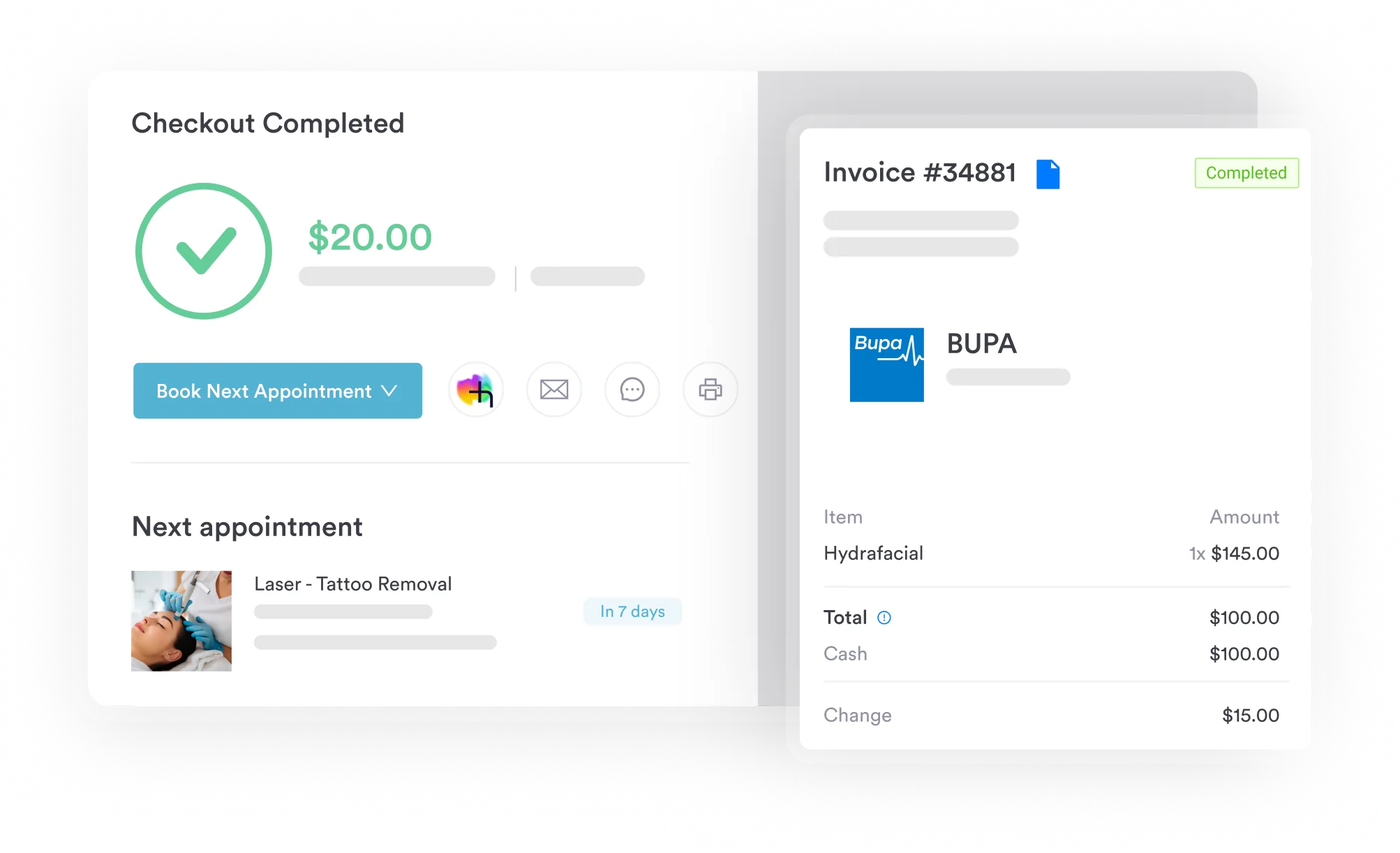
Claims go out through the Claim.MD clearinghouse, our US partner, which reaches thousands of US payers. In addition, eligibility responses and electronic remittance advice come back against the same patient record. The goal is a clean claim on the first submission, with the seventh character and side already confirmed against the note.

Pabau’s claims management software submits claims through the Claim.MD clearinghouse, checks patient eligibility, and posts remittances against the patient record. See how it handles fracture aftercare billing.

Getting S62.397D right comes down to three checks. The note names the fifth metacarpal of the left hand, the fracture belongs in the “other fracture” subcategory, and healing is routine. Each check maps to a character in the code. So any auditor can spot a mismatch between note and claim.
That makes most S62.397D denials avoidable, because the chart already holds the facts the code needs. The remaining work is making sure the claim says what the note says, at every visit. Book a demo to see how Pabau keeps fracture aftercare notes and claims in one workflow.

Want to reduce front-end billing errors before claims submit? What is revenue cycle management outlines how end-to-end RCM workflows reduce rework and improve collection rates.
ICD-10 Code S62.397D is the billable diagnosis code for an other fracture of the left fifth metacarpal bone. It applies at a subsequent encounter with routine healing, so the patient is receiving follow-up care after the initial treatment decision. Also, the fracture falls in the other fracture subcategory rather than a base, shaft or neck code.
S62.397A applies at the initial encounter, while the treating provider is actively deciding on fracture management (reduction, splinting, surgical planning). By contrast, S62.397D applies at later visits while the fracture heals routinely. These visits cover aftercare such as cast checks, X-ray review, or occupational therapy referral. Using A for every visit, whatever the care phase, is a leading denial cause for this code.
Use D from the first visit after the provider makes and documents the initial treatment decision. Then keep using it until the fracture is clinically healed. It is not tied to visit number, so a patient can have D on their second visit or their twelfth. However, delayed healing, nonunion and malunion take G, K and P instead.
S62.397D refers to the fifth metacarpal bone of the left hand, the bone behind the little finger. The sixth character 7 encodes both the bone and the side. In contrast, a right fifth metacarpal fracture takes S62.396D. Similarly, an other fracture of an unspecified metacarpal takes S62.399D.
The most common denial reason is using seventh character A for a follow-up visit. Next comes using S62.397D for a right-hand or non-fifth-metacarpal fracture, so confirm both the fifth metacarpal and the left hand. Other causes include billing D when healing is delayed or has failed, and a CPT-to-ICD mismatch. A follow-up note with no radiology reference is another.
No. S62.397D is for subsequent encounters only. Active treatment visits, where the provider decides how to manage the fracture, use S62.397A instead. For an open fracture, use S62.397B. Billing D at an initial treatment visit misrepresents the care phase, so auditors may flag it as a coding error.