

ICD-10 Code S53.013D: Anterior subluxation of unspecified radial head
ICD-10 Code S53.013D: Quick reference summary Use the table below as your first ...

Last Updated: Nov 6, 2026
Billable Code Specific Code
S62.024G is the billable ICD-10-CM code for a nondisplaced fracture of the middle third of the right scaphoid, at a subsequent encounter with delayed healing. It applies once active treatment is complete and the provider documents that the fracture is healing more slowly than expected.
The seventh character follows the provider's note. Without written delayed-healing or delayed-union language, the visit takes S62.024D. A documented nonunion takes S62.024K, and a left-wrist fracture takes S62.025G.
Let Pabau's smart automation suggest the right codes, reduce claim denials, and keep your practice compliant—effortlessly.
Automate repetitive tasks and focus on what matters most—your patients.
Reduce coding errors and ensure compliance with the latest regulations.
Clean claims, fewer denials, and faster reimbursements.
Powerful insights and reporting to help your practice thrive.
HIPAA compliant SOC 2 certified GDPR-compliant Trusted by 4,000+ clinics worldwide

S62.024G codes a subsequent encounter for a nondisplaced middle-third scaphoid fracture of the right wrist where the provider has documented delayed healing.
The seventh character G is only valid when the treating physician explicitly documents delayed union or delayed healing in the clinical note.
Common denial triggers: G without delayed-healing documentation, the right-wrist code on a left or unstated side, and G and K filed together.
Pabau, our practice management platform, checks each claim for missing or invalid details before sending it to payers through Claim.MD.
ICD-10 Code S62.024G is a billable ICD-10-CM diagnosis code valid for FY2027 encounters (from October 1, 2026). Each character carries a specific clinical meaning. Knowing the breakdown is the fastest way to catch miscoding before a claim leaves the practice.
The full descriptor reads: “Nondisplaced fracture of middle third of navicular [scaphoid] bone of right wrist, subsequent encounter for fracture with delayed healing.”
The code is valid for outpatient visits, office encounters, and rehabilitation settings, as long as the provider note supports the G suffix. Verify the current billable status against the CDC/NCHS ICD-10-CM web tool before submitting any claim.
The scaphoid is the most commonly fractured carpal bone, accounting for roughly 70% of all carpal fractures according to the AAPC’s orthopedic coding resources. It sits in the proximal wrist row and bridges two joints.
Its blood supply enters distally, leaving the proximal pole dependent on retrograde perfusion. A fracture at the middle third interrupts this supply and raises the risk of delayed healing and avascular necrosis (AVN).
For coders at sports medicine and orthopedic practices, the anatomy has a direct billing consequence. ICD-10-CM requires specificity on fracture site, displacement, and laterality. S62.024G captures the middle third (5th character 2) and a nondisplaced fracture of the right wrist (6th character 4).
In this subcategory, the 6th character carries displacement and laterality together. Values 1, 2 and 3 are displaced right, left and unspecified; values 4, 5 and 6 are nondisplaced right, left and unspecified.
The ICD-10 seventh character G means “subsequent encounter for fracture with delayed healing,” as defined in ICD-10-CM Official Guidelines Section I.C.19.c. The seventh-character set governs every follow-up visit for a traumatic fracture. Picking the wrong character is a top denial driver in orthopedic and physical therapy billing.
The order from D to G to K follows the provider’s findings. G needs a documented turning point, where the provider states that healing is delayed. Per the ICD-10-CM Official Guidelines, the seventh character follows the provider’s documentation. Time since injury and the coder’s own clinical view do not decide it.
S62.024G fits a narrow clinical picture: a nondisplaced fracture through the waist of the right scaphoid that the provider says is healing too slowly. These scenarios show where the code applies and where it does not.
S62.024G sits in the S62.02 subcategory, where the sixth character encodes displacement and laterality together. The table maps all six delayed-healing variants, so you can match the code to what the note documents. The seventh character works the same way across all six.
When the provider note documents delayed healing but does not yet use the word “nonunion,” use G, not K. Nonunion has a stricter clinical threshold. It typically means imaging shows a persistent fracture gap without callus over an extended period. The coder cannot upgrade from G to K based on time alone.
Laterality and displacement check: S62.024G already specifies the right wrist and a nondisplaced fracture. Before billing, confirm the note says both. If it names the left wrist, use S62.025G; if it omits the side, use S62.026G. If it states displacement, use S62.021G instead. The decision path below runs the same three checks in order.
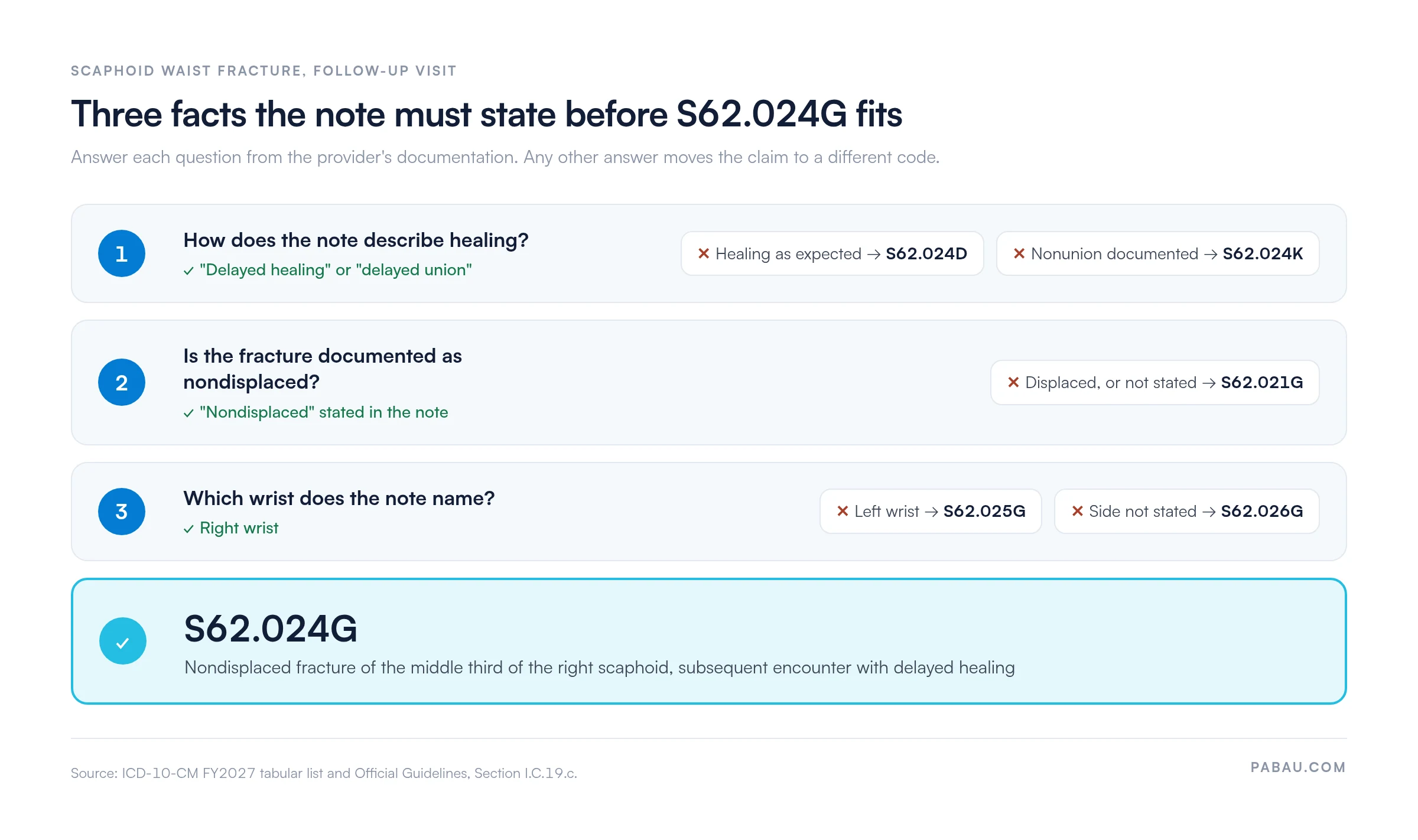
Proper medical billing documentation is the foundation for assigning S62.024G. A coder cannot use this code based on clinical inference alone. The provider note must contain specific elements, and missing any one of them is sufficient grounds for a payer to deny or downcode the claim.
Audit your orthopedic follow-up notes for the phrase ‘delayed healing’ or ‘delayed union’ before assigning S62.024G. If the provider writes only ‘fracture follow-up’ or ‘healing well,’ the correct code is S62.024D, regardless of time elapsed since injury. Provider education on documentation specificity is the single most effective denial-prevention step for this code family.
S62.024G appears on claims for office visits, imaging orders, bone stimulator applications, therapy sessions, and surgical consultations. Submitting the ICD-10 code without the matching CPT code for the service provided is a near-certain denial.
The table below covers the most common pairings. Confirm coverage and local coverage determination (LCD) requirements with your payer before billing, since CPT descriptors and coverage criteria change annually.
Delayed healing often means another round of immobilization. The CPT 29085 guide covers how a replacement gauntlet cast is billed, including its modifiers and supply codes.
Medicare and commercial payers apply specific coverage criteria to claims using delayed-healing seventh characters. These rules are not uniform and change annually, so treat the guidance below as a framework rather than a definitive coverage determination.
Maintaining payer compliance documentation from the first delayed-healing visit creates an audit trail that supports every subsequent G-suffix claim in the episode. Practices should verify coverage via ResDAC’s ICD coding in Medicare files resource when building payer-specific billing policies.
Each denial type below maps to a corrective action practices can build into their pre-submission workflow. Effective denial management workflows address these upstream, before the claim reaches the payer.
Reference the full denial code taxonomy via common medical billing denial codes to map payer CARC/RARC codes to these root causes.
Physical and occupational therapy providers rely heavily on subsequent encounter codes. S62.024G is valid for rehabilitation visits once the treating orthopedist has documented delayed healing in a recent note. Therapists do not assign the G suffix on their own. They rely on updated physician documentation.
For physical therapy teams, the key step is a refreshed physician note. Request one when the G suffix is first used, or when the patient returns after weeks without a visit. That note protects the practice if Medicare audits the therapy claims. Therapeutic exercise is billed in timed units, and the CPT 97110 guide covers how to count them.
Section I.C.19.c of the ICD-10-CM Official Guidelines for Coding and Reporting governs fracture encounter type assignment. Its core principle is that the treating provider’s documentation decides the seventh character. The coder’s own clinical judgment does not.
The guidelines are published annually. Access the current FY version directly from the CMS ICD-10 coding guidelines page. Coding Clinic advisories from the AHA provide authoritative interpretations when the guidelines are ambiguous on a specific scenario.
Most S62.024G denials start with a mismatch nobody spotted. A G suffix goes out without delayed-healing language, or a right-wrist code goes out on a left-wrist note. Coders catch these by rereading notes line by line, which slows the billing queue.
Pabau keeps the clinical note, the diagnosis code and the claim in one patient record. The coder checks the suffix against the note without switching systems. Its faster claims management tools scrub each claim for missing or invalid details before it leaves Pabau. US claims then reach payers through Claim.MD.
When a claim does come back rejected, Pabau flags it as Needs action and links straight to the field to correct. Your team fixes fracture follow-up claims in minutes, so less time goes to appeals.
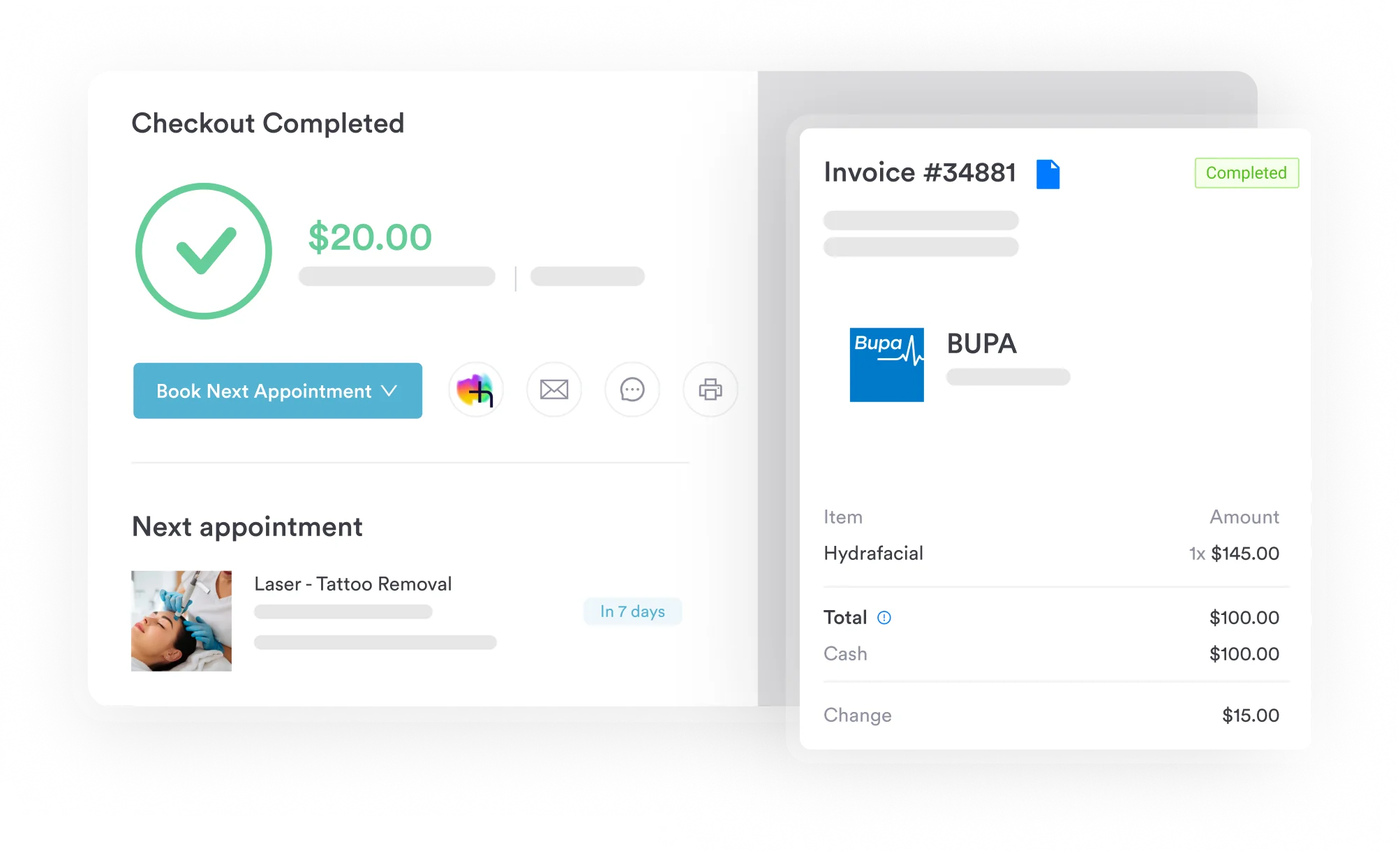

Pabau scrubs each claim for missing or invalid details before it goes to payers through Claim.MD. Rejected claims come back flagged, with a link to the field that needs fixing.

The most preventable S62.024G denial comes from a note that describes slow healing in clinical terms but never writes “delayed healing.”
A short talk with providers about that wording protects more of these claims than any coding fix. Once the note supports the G suffix, the rest of the claim follows the standard subsequent-encounter workflow.
Treat the side and the displacement with the same care as the suffix. Six codes share this fracture site, and only one of them fits a nondisplaced right-wrist fracture. Strong revenue cycle management depends on getting that match right the first time. Book a demo to see how Pabau validates fracture follow-up claims before they leave your practice.

Submitting claims to Medicare for fracture follow-up? Claim.MD clearinghouse overview explains how electronic claim validation catches ICD-10 errors before payer submission.
ICD-10 code S62.024G is the billable code for a nondisplaced fracture of the middle third of the right scaphoid with delayed healing. It applies to subsequent encounters only. The “G” seventh character distinguishes this from a routine follow-up (D) or established nonunion (K).
Yes, S62.024G is a billable ICD-10-CM code valid for FY2027. Verify the current-year status against the CDC/NCHS ICD-10-CM tabular list before submitting claims.
G applies when the provider documents that healing is slower than expected (delayed union). K applies when the provider documents established nonunion, meaning the fracture has failed to heal. K is a more severe, definitive diagnosis. G does not automatically progress to K over time without explicit physician documentation of nonunion.
Use S62.024G when the physician’s note explicitly states delayed healing or delayed union, and imaging supports this finding. If the note reflects routine healing progress without any documentation of delayed healing, use S62.024D regardless of how many weeks have passed since injury.
Common pairings include E/M codes 99213-99215 for office visits, 73100 for wrist X-ray, 20974-20975 for bone stimulation, and therapy codes 97110 and 97530 for rehabilitation. Verify coverage and LCD requirements with your payer before billing, as CPT descriptors and coverage criteria change annually.
The most common reason is assigning G without physician documentation of delayed healing. Others include billing this right-wrist code for a left or unstated side, coding G and K together, and missing imaging evidence. Each denial maps to a correctable documentation or coding error.



