

HCPCS Code L0472: Hyperextension TLSO billing guide
HCPCS code L0472: Official descriptor and device definition HCPCS code L0472 des...

Last Updated: Nov 5, 2026
29085 is the CPT code for application of cast; hand and lower forearm (gauntlet). It covers fitting a rigid, circumferential cast that runs from the lower forearm across the hand.
Billers often confuse it with CPT 29075, the short arm cast from elbow to finger, and with CPT 29125, a static short arm splint. Orthopedic, hand surgery, and sports medicine practices use 29085 for distal radius fractures, scaphoid injuries, and wrist sprains that need firm immobilization.
Let Pabau's smart automation suggest the right codes, reduce claim denials, and keep your practice compliant—effortlessly.
Automate repetitive tasks and focus on what matters most—your patients.
Reduce coding errors and ensure compliance with the latest regulations.
Clean claims, fewer denials, and faster reimbursements.
Powerful insights and reporting to help your practice thrive.
HIPAA compliant SOC 2 certified GDPR-compliant Trusted by 4,000+ clinics worldwide

CPT code 29085 covers application of a gauntlet cast to the hand and lower forearm, not a splint or a short arm cast.
Casting materials such as fiberglass and plaster are not included in 29085. Bill them with HCPCS Q4013 to Q4016 when furnished in an office setting.
Inside a 90-day fracture care global, 29085 is bundled. Billing it separately needs modifier -59 and a documented distinct encounter.
Pabau’s claims management software flags NCCI bundling edits and prompts the correct modifier before submission, reducing denials on musculoskeletal procedures.
CPT code 29085 is the AMA-assigned procedure code for “Application of cast; hand and lower forearm (gauntlet).” A gauntlet cast covers the hand and lower forearm only, immobilizing them as a single rigid, circumferential unit. A short arm cast, CPT 29075, runs from the elbow to the fingers, so it extends well past the wrist.
The procedure is performed with the patient’s forearm in a neutral or slight extension position. The practitioner applies stockinette and padding, then wraps plaster or fiberglass casting tape from the lower forearm down over the hand. The result is a fully circumferential, rigid device. That circumferential characteristic is what separates 29085 from splint codes in the 291xx range.
The code covers the professional work of cast application: Patient positioning, material molding, and initial fitting. It does not cover the casting materials themselves.
A key practical point: Casting material coverage varies by payer and setting. CMS covers HCPCS casting supply codes when the service is furnished in a physician office setting. Facility settings (hospital outpatient, ASC) typically bundle materials into the facility fee. Always verify with the specific payer before billing supply codes in a facility.
CPT code 29085 covers application labor only. When the practice purchases and furnishes the casting materials directly in an office setting, separately bill the appropriate HCPCS code. Q4013 through Q4016 are the gauntlet cast supply codes, split by the patient’s age and the cast material.
Coverage of these HCPCS codes is not universal. Some Medicare Administrative Contractors (MACs) have Local Coverage Determinations (LCDs) that restrict which supply codes are payable for which cast types. Review your MAC’s LCD before billing supply codes, and document the material type in the clinical note.
The most common coding error in this family is billing 29125 or 29126 when the clinician applied a gauntlet cast, or the reverse. The second is billing 29085 for a short arm cast that runs to the elbow. Two questions settle the code, as the diagram below shows: Is the device rigid and circumferential, and how far does it reach?
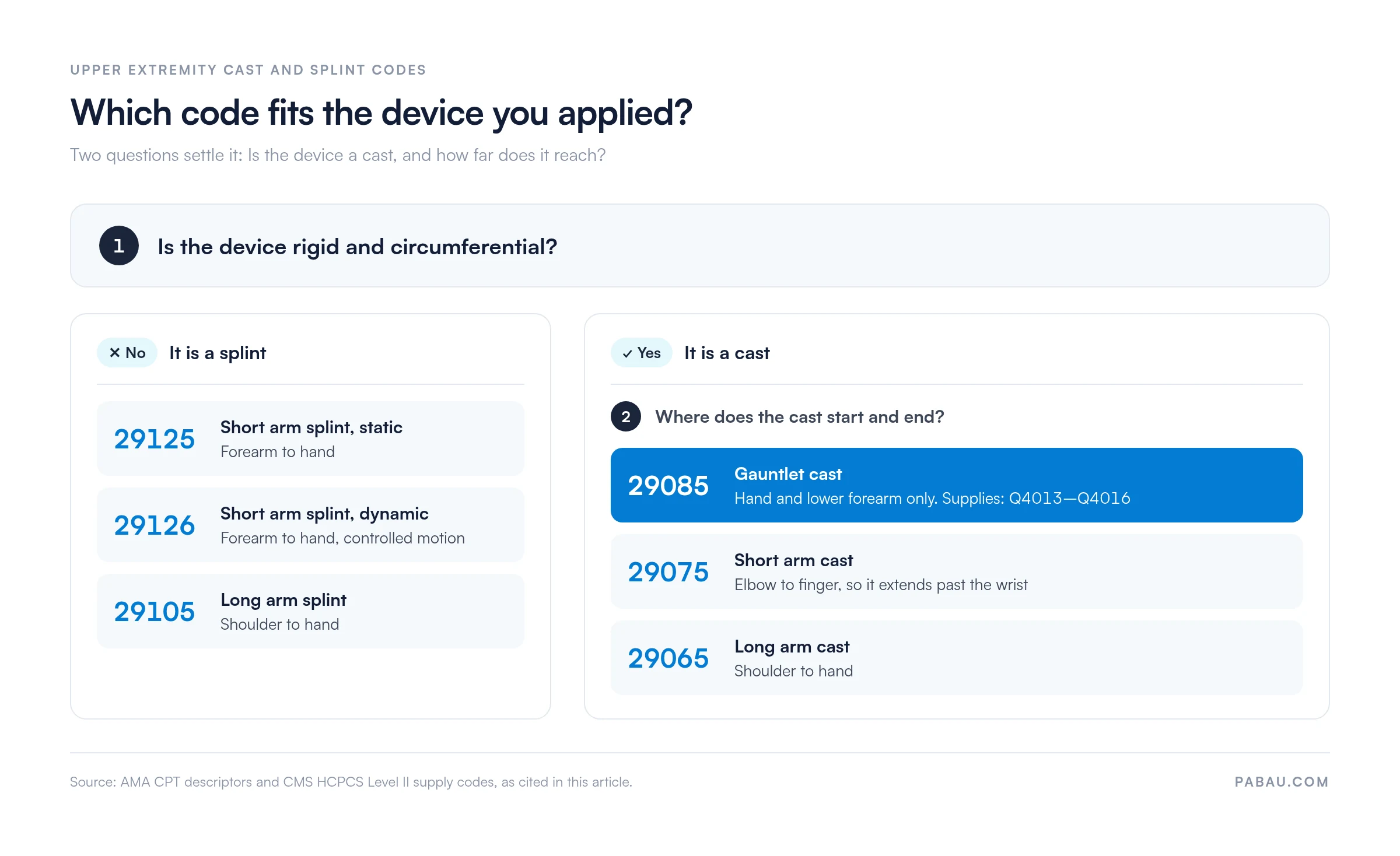
Code the device the clinician applied. If it was a gauntlet cast, bill CPT code 29085 regardless of what the order sheet or template says. Payer auditors read the procedure note to confirm the device type. A mismatch between the note and the billed code is a fast path to overpayment recoupment.
When the injury extends beyond the hand and lower forearm, a different cast code applies. The table below covers the upper extremity cast codes most often billed alongside CPT code 29085. Our library of CPT codes covers the rest of the casting and strapping range.
Document the exact boundaries of the cast in every procedure note. Record the proximal extent (such as ‘lower forearm’), the distal extent on the hand, and whether the device is circumferential. This one habit resolves the two most common audit triggers for cast application codes.
Modifiers on CPT code 29085 claims fall into three functional categories: Laterality, NCCI bundling override, and same-day service distinction. Use the wrong modifier (or omit a required one) and the claim denies.
On same-day E/M claims, modifier -25 belongs on the E/M code, not on 29085. The evaluation must be documented as a distinct medical decision beyond the mechanics of applying the cast. For example, reviewing imaging, formulating a treatment plan, or assessing neurovascular status supports a separately payable E/M; simply documenting cast material and position does not.
Yes, CPT code 29085 can be billed on the same day as an E/M service. The evaluation has to be separately identifiable and address a medical problem beyond the cast application itself. The E/M code requires modifier -25 to signal the distinction to the payer.
What makes a same-day E/M payable: The physician reviews imaging, decides on treatment (cast, surgery, or referral), or assesses neurovascular status. A separate complaint addressed at the visit also counts. What does not support a separately payable E/M: A note that only documents the cast materials used, the limb position, and post-care instructions.
CMS and most commercial payers recognize same-day E/M with modifier -25 as valid. Some payers apply heightened documentation review to these claims. Write the E/M documentation as a distinct, standalone note section rather than embedding it in the cast application note.
CPT code 29085 carries a 0-day (000) global period under the CMS Physician Fee Schedule, so no post-procedure follow-up is bundled into the payment. This is straightforward when 29085 is billed as a standalone procedure.
The complication arises when a fracture care code is also billed. Fracture care CPT codes (such as 25600 for distal radius fracture, closed treatment, or 25628 for carpal bone fracture) carry a 90-day global period.
Under CMS global surgery rules, the initial cast application is included in the fracture care code’s global surgical package. Billing 29085 separately in that scenario is an NCCI bundling violation.
This bundling trap is where orthopedic and hand surgery practices lose the most revenue on cast codes. A cast applied at week two to replace a failed initial cast after fracture care is separately billable. The initial application was bundled, but the re-application is a new service. Document the clinical reason for re-application and submit 29085 with modifier -76.
A well-matched diagnosis code is required on every 29085 claim. Payers audit cast application codes against the diagnosis to confirm the device is clinically appropriate for the reported condition. The following ICD-10-CM codes are the most commonly paired with CPT code 29085.
Always use the most specific code available. “S” encounter codes require a 7th character: A (initial encounter), D (subsequent encounter), or S (sequela). A cast applied at the initial fracture visit takes the A encounter code. A re-application visit uses the D code. Using A at a follow-up encounter is a common audit finding.
Medicare pays for CPT code 29085 based on the Relative Value Unit (RVU) structure in the CMS Physician Fee Schedule. The work RVU reflects the physician’s clinical effort; the practice expense RVU reflects overhead; the malpractice RVU reflects liability cost. These three components are multiplied by the conversion factor and adjusted by geographic locality.
Reimbursement amounts change annually when CMS updates the conversion factor, so published static figures go stale. Use the FastRVU lookup tool to retrieve the current-year RVU values for your locality.
The RVU profile for 29085 reflects a brief, low-complexity procedure. The work component is modest compared to fracture care codes. The practice expense component still carries supply cost assumptions from when casting materials were bundled into the fee.
Separately billing HCPCS supply codes in an office setting recovers the material cost that the fee schedule does not fully account for.
Commercial payer rates vary significantly. Some payers pay a fixed percentage of the Medicare allowable; others use proprietary fee schedules. Do not assume commercial rates mirror Medicare. Submit a superbill with the correct code, modifier, and diagnosis code combination, then post the payment received to track your effective rate per payer.
Medicare Part B covers CPT code 29085 when medical necessity is established and a qualified practitioner provides the service. The documentation must also support the diagnosis and device type. Coverage specifics are governed by MAC Local Coverage Determinations, which vary by jurisdiction. Review your MAC’s active LCDs for casting codes before billing.
Prior authorization is not universally required for CPT code 29085, but commercial payer requirements vary. Some plans require authorization for musculoskeletal casting, particularly for non-fracture indications. Verify with the specific plan before the appointment. Failure to obtain required authorization is a common denial reason that cannot be corrected on appeal.
Setting-of-service affects reimbursement. When 29085 is performed in a facility (hospital outpatient department, ASC), the physician is paid the facility rate. That rate is lower than the non-facility rate. The facility receives a separate facility fee.
When performed in a physician office (place of service code 11), the non-facility rate applies and separate HCPCS supply codes may be billed. Verifying medical billing compliance requirements for your setting before billing prevents systematic underpayment.
The five denial patterns below account for the majority of claim failures on CPT code 29085 across orthopedic and hand surgery practices. Each has a specific corrective action.
Structured denial management workflows that flag these patterns at the point of claim scrubbing before submission prevent write-offs that are difficult to recover on appeal. Submitting a clean claim on the first attempt is always faster than the appeal cycle.
When a payer audits a cast application claim, the procedure note is the first document it reads. The note for 29085 must include the following elements to withstand review.
A note that says only “short arm cast applied” will not support CPT code 29085 under audit. That phrase supports 29075, the elbow-to-finger cast. Write “gauntlet cast applied, hand and lower forearm” so the note matches the code you bill.
A clean CPT code 29085 claim depends on four decisions that a coder makes every time:
Each one becomes a denial risk when it is checked by hand. Pabau, the practice management and billing platform we build, moves those checks into claim creation.
Pabau’s claims management software combines NCCI edit checks, built-in CPT and ICD-10 catalogs, and modifier prompts. Enter 29085 alongside a fracture care code on the same date, and the system flags the possible global period bundle before submission. The claim reaches the payer already checked, so your team spends less time on corrected claims.
For sports medicine and orthopedic practices billing high volumes of musculoskeletal procedure codes, that pre-submission check is where revenue gets protected.
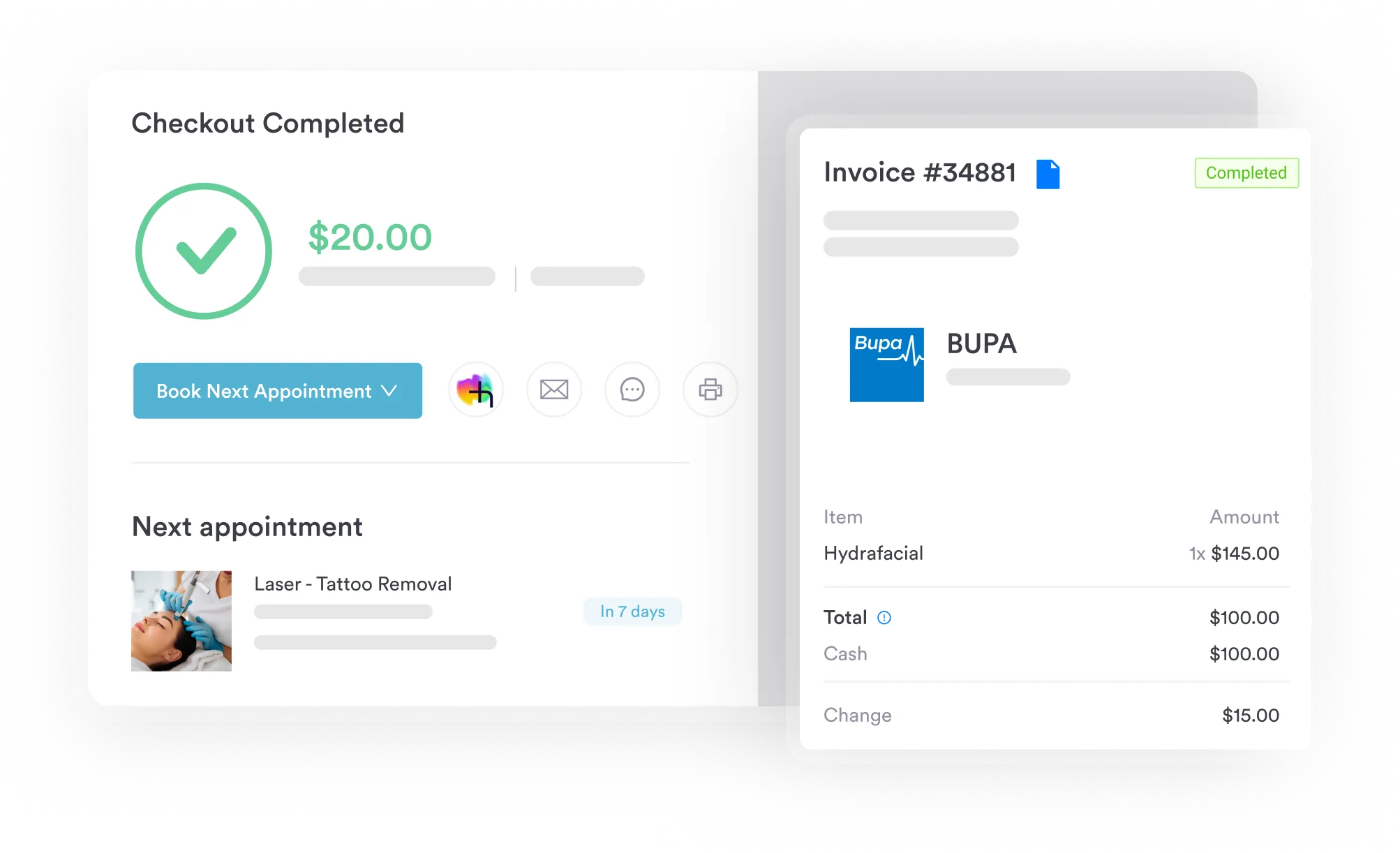

Pabau’s built-in NCCI edit checks and modifier prompts flag bundling issues before submission, so your CPT 29085 claims go out clean the first time.

Billing 29085 correctly starts with the device on the patient’s arm. A cast that stops at the lower forearm is a gauntlet, and it takes Q4013 to Q4016 for supplies. A cast that reaches the elbow is 29075, whatever the order sheet says.
The bigger revenue risk comes after the cast goes on. A 29085 billed inside a fracture care global, or a same-day E/M without modifier -25, is the claim most likely to come back denied. Both are preventable when the claim is checked before it leaves the practice.
Book a demo to see how Pabau’s claim checks catch cast bundling issues before your 29085 claims reach the payer.

Need guidance on managing claim denials systematically? Denial codes in medical billing covers the most common CARC reason codes and how to respond to each one.
Billing musculoskeletal procedures with Medicare? Electronic remittance advice (ERA) explains how to read 835 ERA files and reconcile Medicare payments against your expected allowables.
Looking to streamline your entire claims workflow? Claim.MD clearinghouse integration walks through how Pabau connects to 4,000+ US payers for electronic claim submission and real-time eligibility.
CPT code 29085 covers the application of a gauntlet cast, a rigid, circumferential device that immobilizes the hand and lower forearm. The code includes the professional work of applying and fitting the cast. It does not include casting materials, which are billed separately using HCPCS supply codes in an office setting.
CPT 29085 is a cast: Rigid, circumferential, and limited to the hand and lower forearm. CPT 29125 is a static short arm splint: Non-circumferential and running from the forearm to the hand. Bill the code for the device that was applied. The two are not interchangeable under payer or NCCI rules.
No, not in most circumstances. Cast application is included in the global surgical package for fracture care codes with a 90-day global period. Billing 29085 separately in the same encounter as a fracture care code violates NCCI bundling rules. Exceptions exist when the cast is applied at a distinct encounter or by a provider outside the global, with modifier -59 and supporting documentation.
Yes. In an office (non-facility) setting, casting materials are billed separately using HCPCS Q codes such as Q4014 (adult fiberglass) or Q4013 (adult plaster). In a facility setting, do not bill supply codes on the professional claim. The facility bills for materials separately.
Commonly paired codes include S62.001A (scaphoid fracture, initial encounter), S52.501A (distal radius fracture, initial encounter), and S62.311A (thumb metacarpal fracture, initial encounter). Match the 7th character to the visit type: A for initial, D for subsequent. Unspecified pain codes without a fracture or ligament injury do not reliably establish medical necessity for a gauntlet cast.
The top denial reasons are bundling inside an active fracture care global and a missing modifier -25 on a same-day E/M visit. Others include a non-specific ICD-10 encounter character, supply codes billed in a facility, and thin device documentation. Most are fixable with pre-submission claim edits rather than appeals.



