ICD-10 Code Z74.8: Other problems related to care provider dependency
ICD-10 Code Z74.8: Definition and code details ICD-10 Code Z74.8 is the billable...

Last Updated: Oct 19, 2026
Billable Code Specific Code
S56.412D is the billable ICD-10-CM code for strain of extensor muscle, fascia and tendon of left index finger at forearm level, subsequent encounter.
The D seventh character applies once active treatment is complete and the patient is receiving routine care during healing or recovery. Assignment turns on the phase of treatment, not on whether the treating provider has seen the patient before. A wrong seventh character is the most common source of rejections on S56 claims.
Let Pabau's smart automation suggest the right codes, reduce claim denials, and keep your practice compliant—effortlessly.
Automate repetitive tasks and focus on what matters most—your patients.
Reduce coding errors and ensure compliance with the latest regulations.
Clean claims, fewer denials, and faster reimbursements.
Powerful insights and reporting to help your practice thrive.
HIPAA compliant SOC 2 certified GDPR-compliant Trusted by 4,000+ clinics worldwide

ICD-10 code S56.412D covers strain of the extensor muscle, fascia, and tendon of the left index finger at forearm level, at a subsequent encounter.
The seventh character D applies to routine care during the healing phase, once active treatment for the injury is complete.
Laterality sits in the sixth character: 1 is the right index finger and 2 is the left.
S66 wrist and hand injuries carry an Excludes2 note, so they can be reported alongside S56.412D when both are documented.
Pabau, the practice management platform we build, submits claims to US payers through Claim.MD and tracks status and ERA remittances.
ICD-10 Code S56.412D identifies strain of the extensor muscle, fascia, and tendon of the left index finger at forearm level during a subsequent encounter. “Subsequent encounter” means the patient has already had an initial visit where the injury was diagnosed and treated. This code applies to the visits that follow.
The code sits inside category S56, injury of muscle, fascia and tendon at forearm level. Subcategory S56.4 covers injury of the extensor muscle, fascia and tendon of other and unspecified finger at forearm level. Group S56.41 narrows that to strain, and the index finger is identified further along the code.
The anatomical anchor is the forearm, not the wrist or hand. That single word in the descriptor decides whether S56.412D applies at all.
In ICD-10-CM, a strain is an injury to muscle, fascia, or tendon caused by overstretching or tearing, and that includes traumatic rupture. The Alphabetic Index routes traumatic rupture of a muscle or tendon to the strain code for the site. There is no separate rupture code inside S56.4 to reach for instead.
The extensor muscles relevant here are the extensor digitorum, which extends all four fingers, and extensor indicis, which extends only the index finger. Both originate in the posterior forearm, which is why the anatomical level is forearm rather than hand.
Reading the code one character at a time shows where each of those decisions is recorded.
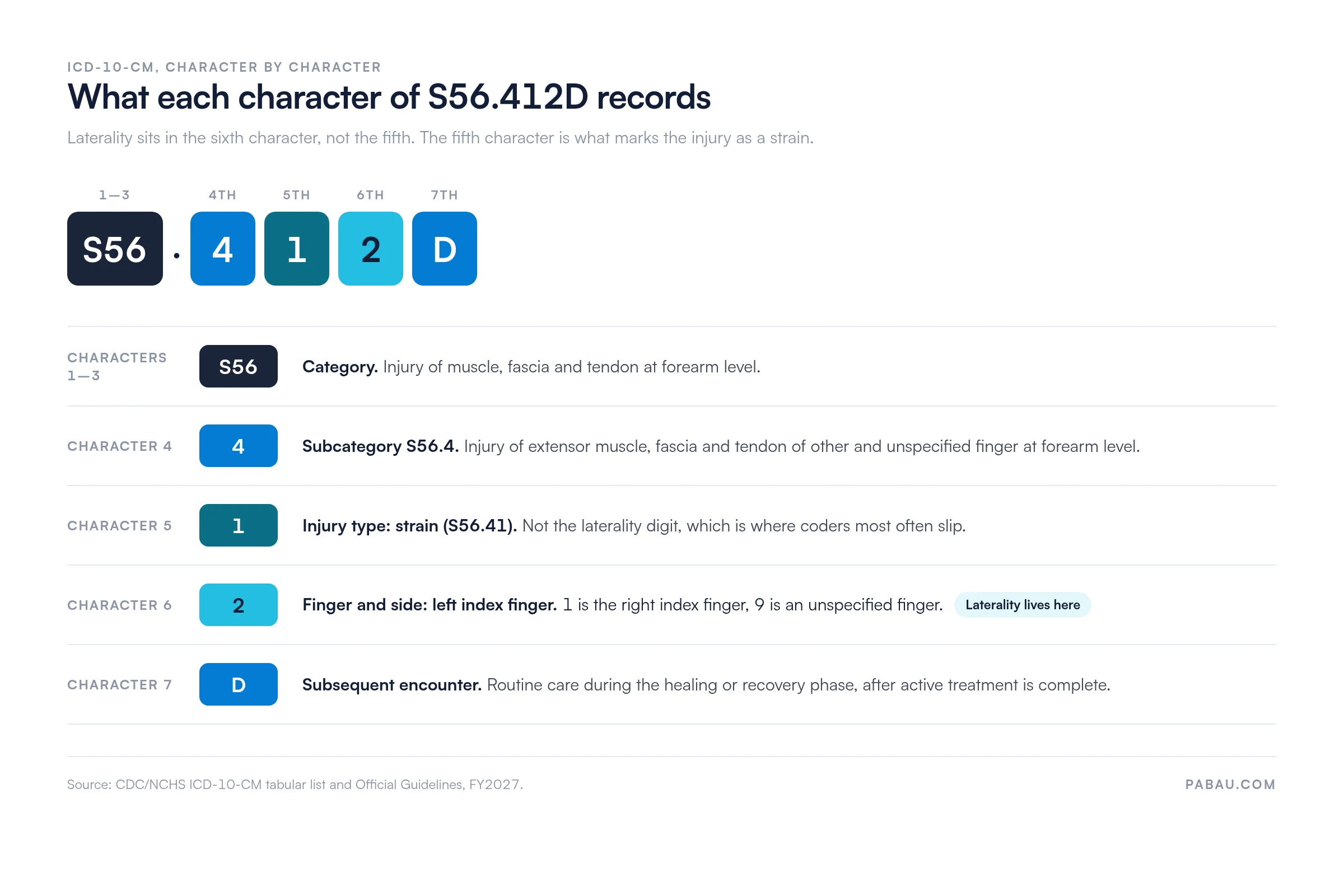
The seventh character D applies once the patient has completed active treatment for the injury. It covers routine care during the healing or recovery phase. The CMS ICD-10-CM Official Guidelines name cast changes, medication adjustments, and follow-up visits after treatment as examples of that routine care.
Character A covers the opposite phase. It applies to every encounter where active treatment for the condition is still being provided, including the first one.
The distinction between the three seventh characters is where most S56.412 coding errors originate. Reporting D while active treatment is still running understates what was delivered at the visit. Reporting S before the injury has resolved claims a late effect that the chart does not support.
A new provider does not change the character on its own. The guidelines say assignment turns on whether the patient is undergoing active treatment. Whether that provider is seeing the patient for the first time does not matter. A new orthopedist who takes over active treatment still reports A.
S56.411D codes the right index finger and S56.412D codes the left index finger. The sixth character carries the finger and the side. Here, 1 is the right index finger, 2 is the left index finger, and 9 is an unspecified finger. The fifth character, 1, is what marks the injury as a strain rather than another S56.4 injury type.
S56.419D is a payer denial target. Use it only when the record does not document which finger is affected, which should be rare for an upper extremity injury.
Confirming laterality against the initial visit record before applying S56.412D prevents a mismatch that payers flag automatically during claim adjudication. The other finger and side combinations in this range are listed in the ICD-10-CM code index.
Category S56 carries three coding notes that set the boundaries of S56.412D. Both of its exclusion notes are Excludes2, which changes what you are allowed to report alongside it.
The S66 boundary trips up many coders. If the documented injury sits at or below the wrist, S56.412D is not the code for it. The forearm level anchor in the descriptor is the decisive criterion.
The note is Excludes2 rather than Excludes1. A patient with a forearm-level strain and a separate wrist-level injury can therefore carry a code from each category on the same claim.
Supporting S56.412D requires documentation that confirms both the anatomical specificity and the encounter type. Payers reviewing subsequent encounter claims look for evidence that the injury is still healing. They also want the note to show routine follow-up rather than a fresh course of active treatment.
Carrying a brief mechanism-of-injury line into every follow-up note, not just the initial encounter, strengthens medical necessity for claims reviewers who audit at random.
Document functional status at every subsequent visit with objective measures. Grip dynamometer readings, goniometer range-of-motion values, and standardized outcome tools all qualify. The DASH questionnaire, covering disabilities of the arm, shoulder, and hand, is one of them. Objective findings are harder for payers to dispute than subjective pain descriptions alone.
S56.412D is a diagnosis code, so a complete claim needs a procedure code alongside it. Which CPT codes pair with this diagnosis depends on the visit type and the treating specialty. Reviewing the pairing before the claim leaves your insurance claims software reduces rejections from mismatched procedure-diagnosis combinations.
These CPT pairings are commonly used in clinical practice. Payer acceptance is not guaranteed and varies by plan, policy year, and network status. Confirm medical necessity crosswalk requirements with each payer before billing.
Pabau submits electronic claims to US payers through the Claim.MD clearinghouse, whose published payer directory currently lists more than 4,000 payers. Claim status and ERA remittances come back into the billing workflow rather than sitting in a separate portal.
Three denial patterns account for most S56.412D rejections. Recognizing them before submission is far more efficient than managing appeals after the fact. Structured denial management workflows can catch all three at the pre-submission stage.
Reporting S56.412A once the patient has moved into routine healing care is the most frequent error. Payers compare claim dates against prior submissions.
Say the payer already paid a claim with S56.412A six weeks ago. A second A-coded claim for the same patient and diagnosis then flags as a duplicate, or as an undocumented new injury. Switch to D once active treatment is finished and the visits become routine follow-up.
Submitting S56.412D (left) when the initial encounter was coded S56.411D (right) creates a data conflict across the episode of care. Payers and auditors track laterality across visits. If the physical exam at follow-up documents right-hand pain but the code says left, the claim fails clinical review. Cross-check laterality at every subsequent visit against the initial encounter record.
A subsequent encounter claim without objective functional status documentation reads as a social visit rather than managed recovery. Payers deny claims where the notes show only “patient reports mild improvement” without measurable findings.
Grip strength, range-of-motion values, or validated outcome scores in every note turn subjective improvement language into a defensible medical necessity record. Submitting a clean claim from the start avoids the rework cost of appeals.
Medicare, Medicaid, and commercial payers each apply different rules to ongoing injury management claims using D-suffix codes. No blanket rule covers all payers. The guidance below reflects common policy patterns, not universal requirements. Always verify with the individual payer’s LCD (Local Coverage Determination) or policy bulletin.
Medicare does not typically require prior authorization for follow-up office visits or standard physical therapy sessions for musculoskeletal injuries. Outpatient therapy billed above the annual KX-modifier threshold is a different matter. Past that point the practice has to append the KX modifier and hold documentation that continued therapy is medically necessary.
Claims without documented functional improvement across visits risk medical necessity denials on post-payment audit. Understanding medical billing compliance requirements helps practices avoid these audits.
Prior authorization for extended physical therapy (typically beyond 6-8 visits) is common among commercial plans. Some plans apply step therapy requirements, needing a documented trial of home exercise before authorizing supervised PT. Check the payer’s online authorization portal using the specific CPT codes planned before scheduling multiple PT visits.
Extensor tendon strains at the forearm level are a recognized occupational injury pattern, particularly in manufacturing, construction, and repetitive manual work. Workers’ compensation claims require the injury to be linked to a specific workplace event or cumulative occupational exposure in the initial clinical documentation. Subsequent encounter claims for occupational injuries must maintain that causation link through all follow-up notes.
The AAPC’s ICD-10-CM code lookup and the CDC/NCHS official ICD-10-CM web tool are the primary references for confirming code validity and annual updates. CMS publishes revised ICD-10-CM code files each October 1, so verify S56.412D against those files at the start of each fiscal year.
The WHO ICD-10 browser is useful for context on the parent classification only. It does not carry the US clinical modification’s seventh characters, so it cannot confirm that S56.412D is valid.
A seventh-character or laterality error on an injury claim usually surfaces weeks later, when the remittance advice comes back. The claim has then been worked twice, and the medical billing cycle has to run again from charge capture.
Pabau keeps the diagnosis code with the treatment note that supports it. The coder reads the documented laterality, the phase of care, and the functional findings from one patient record, rather than from three screens.
From there, Pabau turns the invoice into an electronic CMS-1500 claim and submits it through Claim.MD. Claim status comes back from the payer, denied claims are flagged for rework, and ERAs are matched to the claims they pay.
Eligibility is checked against the payer before treatment, so a coverage problem surfaces at the front desk rather than in a denial weeks later.

Pabau turns invoices into electronic CMS-1500 claims, submits them through Claim.MD, and brings status and ERA remittances back into billing. See how it fits your practice.

ICD-10 code S56.412D survives adjudication when three elements line up. The seventh character has to match the phase of care, and the laterality has to read left. The note then has to show where the patient sits in recovery.
The character that causes the trouble is defined by treatment phase, not by visit number. Read the chart before choosing between A and D, and the appointment history stops being the deciding factor.
Pabau keeps that documentation next to the claim it supports. Book a demo to see how it handles musculoskeletal injury coding and follow-up billing.

Need to verify claim submission routes for injury codes? Pabau’s Claim.MD clearinghouse guide covers how electronic claims move from EHR to payer and where rejections occur.
Seeing repeated denials on musculoskeletal claims? Denial codes in medical billing explains the most common CARC codes and how to respond to each one.
Want to understand ERA processing for injury follow-up claims? Electronic remittance advice explained shows how 835 remittance files communicate payer decisions back to your practice.
S56.412D is the billable ICD-10 code for a left index finger extensor strain at forearm level, subsequent encounter. It covers the muscle, fascia, and tendon of that finger, and applies to follow-up visits during healing after active treatment is complete.
Use A (S56.412A) for every encounter where the patient is still receiving active treatment for the strain. Use D (S56.412D) once active treatment is complete and the visits become routine care during healing or recovery. A change of provider does not change the character.
S56.411D covers the right index finger and S56.412D covers the left index finger. Both describe the same injury at forearm level for a subsequent encounter. The sixth character carries the difference: 1 is the right index finger, 2 is the left.
Yes, S56.412D is commonly used as the primary diagnosis on physical therapy claims for a left index finger extensor strain in the recovery phase. Payer acceptance varies, and the notes must document measurable functional progress at each visit to support medical necessity.
The three most common reasons are a wrong seventh character, a laterality mismatch, and thin medical necessity documentation. A wrong seventh character usually means A was reported once the patient had moved into routine healing care. A laterality mismatch means the current claim disagrees with the initial encounter record.
Yes. S56.412D is a valid billable ICD-10-CM code in the FY2027 code set, effective October 1, 2026 through September 30, 2027. CMS publishes revised code files each October 1, so check the CDC/NCHS ICD-10-CM web tool at the start of each fiscal year.