ICD-10 Code Z74.8: Other problems related to care provider dependency
ICD-10 Code Z74.8: Definition and code details ICD-10 Code Z74.8 is the billable...

Last Updated: Oct 19, 2026
Billable Code Specific Code
S56.411D is the billable ICD-10-CM code for strain of extensor muscle, fascia and tendon of right index finger at forearm level, subsequent encounter.
Let Pabau's smart automation suggest the right codes, reduce claim denials, and keep your practice compliant—effortlessly.
Automate repetitive tasks and focus on what matters most—your patients.
Reduce coding errors and ensure compliance with the latest regulations.
Clean claims, fewer denials, and faster reimbursements.
Powerful insights and reporting to help your practice thrive.
HIPAA compliant SOC 2 certified GDPR-compliant Trusted by 4,000+ clinics worldwide

S56.411D is the billable ICD-10-CM code for a right index finger extensor strain at forearm level, subsequent encounter.
The code is not a recent addition. It has been in ICD-10-CM since October 1, 2015, and FY2026 leaves it unchanged.
The 7th character D means active treatment has finished and the patient is now in follow-up care.
The treatment phase decides between A and D, not how many days have passed since the injury.
Its closest siblings are S56.412D for the left index finger and S56.413D for the right middle finger.
S56.411D is a billable ICD-10-CM code for a strain of the extensor muscle, fascia, and tendon of the right index finger. Specifically, the injury sits at forearm level, and the code covers a subsequent encounter. As a result, use it for follow-up visits rather than the parent-level or non-specific codes in the S56 category.
The code is not a recent addition. In fact, it has been in ICD-10-CM since the code set took effect on October 1, 2015, and the FY2026 edition leaves it unchanged. As a result, it remains valid for HIPAA-covered electronic transactions.
The S56.4 subcategory covers injury of the extensor muscle, fascia, and tendon of other and unspecified finger at forearm level. In addition, its parent category, S56, covers injury of muscle, fascia, and tendon at forearm level. Indeed, the CDC/NCHS ICD-10-CM web tool confirms the billable status and carries the FY2026 tabular list.
The extensor muscles of the hand originate at the lateral epicondyle of the humerus and the posterior forearm. Additionally, they run along the dorsal surface, pass through fibrous sheaths, and attach at the dorsal aspect of each finger. Specifically, at forearm level, the extensor digitorum communis and extensor indicis proprius are the primary structures serving index finger extension.
A strain at this level means those structures have been overstretched or partially torn. As a result, three findings usually appear together in the note:
The injury typically follows forceful gripping, repetitive extension loading, or direct trauma. Because of this, coders should read “at forearm level” literally. Specifically, the pathology sits in the muscle-tendon unit proximal to the finger, not at the tendon insertion on the digit.
Accurate use of this code requires the note to confirm the structure, the digit, the anatomical level, and the encounter type. Otherwise, missing any of those elements pushes the coder to a nonspecific code, which may affect reimbursement.
The 7th character decides which S56.411 code goes on the claim, and one question settles it. Is the provider still delivering active treatment for the injury?
Per the CMS ICD-10-CM coding guidance, the distinction turns on whether the provider is still actively treating the injury. For example, a patient may return two days after initial splinting for a cast check. In that case, the visit is D, because care has moved from active intervention to recovery management.
The reverse also holds. For instance, a patient who presents weeks after an undiagnosed injury and receives first treatment still takes A, whatever the elapsed time.
Payers apply claim edits against these encounter characters, so a D where A was warranted can trigger a denial or an audit flag. Consequently, physical therapists and occupational therapists treating extensor strains after the acute phase will almost always reach for the D character. Still, practices that review common denial codes line by line tend to catch this mismatch early.
Knowing where S56.411D sits in the tabular hierarchy helps coders navigate parent codes, excludes notes, and related categories. Indeed, the AAPC Codify ICD-10-CM lookup displays this hierarchy in full.
Neither S56.4 nor S56.41 is billable on its own, and S56.411 still needs a 7th character. Consequently, submitting any of the three returns a code-validity rejection. So, check that the full seven-character string is on the claim before it leaves the practice.
The hierarchy also shows where wrong sibling codes come from, one character at a time.
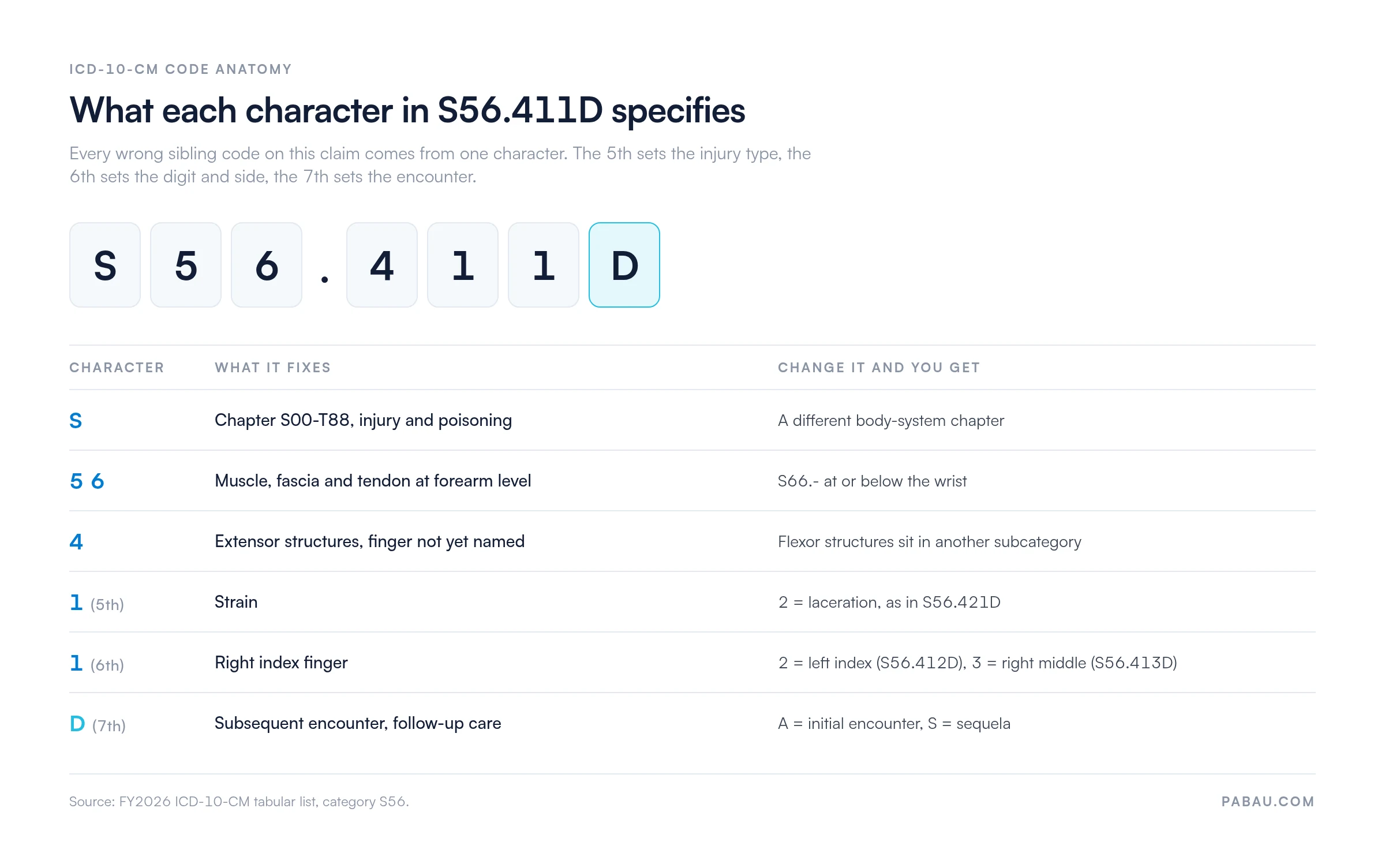
S56.411D belongs to a family of closely related codes in the S56.4 subcategory. In fact, picking the wrong sibling is one of the most common accuracy errors on musculoskeletal injury claims. Specifically, the differences come down to laterality, digit, injury type, and encounter type.
When a patient strains both index fingers, report S56.411D and S56.412D together. Nevertheless, watch the 5th character as closely as the 6th, because S56.42- covers laceration rather than strain of the same structures. The digit pattern carries across the subcategory, so the sequela of a right ring finger strain is ICD-10 code S56.415S.
Clinical documentation often uses descriptive language rather than ICD-10-CM code terminology. Nonetheless, these synonyms map to S56.411D in the alphabetical index and should prompt the coder to confirm the selection.
Documentation that reads only “hand injury” or “finger tendon pain” will not support S56.411D. Instead, the note has to name extensor rather than flexor structures, the specific digit, and the anatomical level. So, coders should query the treating provider when any of the three is ambiguous.
The S56 category carries notes that govern code selection and sequencing. Both of them, in fact, apply directly to S56.411D.
Excludes1 notes prohibit reporting two codes together for the same condition. In contrast, Excludes2 notes allow it when two distinct conditions coexist. Since category S56 carries no Excludes1 note, nothing at that level is mutually exclusive with S56.411D.
The anatomical level still matters. For example, an extensor tendon injury at the digit itself falls under a different code, and it should not be reported as S56.411D for the same site. Instead, the tabular hierarchy governs here, not the code descriptor alone.
Category S66 holds the counterpart codes at wrist and hand level. There, S66.391A covers other injury of the left index finger extensor tendon, initial encounter.
The index pathway to S56.411D follows a branching structure. So, coders should trace the lead term first, then move to the tabular list for final verification.
After locating S56.41- in the index, the coder moves to the tabular list. There, the digit is confirmed and the 7th character is added, which gives S56.411D. Overall, this two-step process, index then tabular, is required under the ICD-10-CM official coding guidelines.
Flag any documentation that reads only ‘finger strain’ or ‘forearm injury’ without specifying extensor vs. flexor, right vs. left, or encounter type. Querying the provider before submission prevents a nonspecific code from reaching the payer and potentially triggering a medical necessity review.
Accurate coding of S56.411D depends on what appears in the clinical note, not on what the coder infers. Specifically, four documentation elements must be present to support this specific code.
Two mistakes account for most errors on this code. First, coders use A for every visit because the note records the injury without the treatment phase. Second, they submit S56.411 with no 7th character, which as a result is not a billable string.

Once S56.411D reaches the payer, it is adjudicated against medical necessity policy. Afterward, the payer returns an electronic remittance advice showing payment, adjustment, or denial. In particular, for subsequent encounter codes, payers usually want documentation that links the initial encounter to the current follow-up.
Denials on subsequent encounter codes commonly cite insufficient evidence of continued medical necessity. Instead, the note should record the current state of healing rather than repeat the original injury description. For instance, partial resolution of pain, an ongoing therapy protocol, or a strength re-evaluation all serve that purpose.
Practices that audit S56 category codes periodically should treat 7th-character accuracy as its own audit dimension. Indeed, it is the element most likely to be wrong and least likely to be noticed.

A 7th-character error usually surfaces only after the payer sends the claim back. As a result, the correction cycle then costs a resubmission and several weeks of delay on a low-value claim.
Practice management software like Pabau keeps the documentation and the claim in one system. Specifically, the encounter note, the injury history, and the assigned diagnosis code sit on the same client record. As a result, a coder can then see whether the visit was active treatment or follow-up before the claim goes out.
For US practices, Pabau integrates with the Claim.MD clearinghouse for electronic claim submission and real-time eligibility checks. In addition, its cleaner claims management tracks each claim after submission, so denials surface in days. Overall, this matters most on low-value injury codes, where a month-end discovery leaves the claim already aging.


Pabau puts the encounter note and the diagnosis code on one client record, then submits through the Claim.MD clearinghouse and tracks the result. Follow-up injury claims stop coming back for rework.

S56.411D turns on four documentation anchors. Specifically, the note has to show extensor structures, the right index finger, forearm-level anatomy, and subsequent encounter status.
In short, two errors are worth guarding against. First, the parent code is submitted without a 7th character. Second, A is used where D belonged. Since both start in the clinical note rather than at the coding desk, that is where the fix belongs.
Fix the note template once and the code looks after itself on every follow-up visit. Then, book a demo to see how Pabau keeps injury follow-up documentation and claim submission in one workflow.

Need a guide on medical billing fundamentals? What is medical billing walks through the end-to-end claims process from code assignment to payment posting.
Want to understand how ERA workflows reduce rework? Electronic remittance advice explains how 835 files connect payer adjudication back to your practice management system.
Seeing repeat denials on injury codes? Denial management in healthcare sets out how to triage, appeal, and prevent the denials that follow coding errors.
Want the claim accepted first time? Clean claim explains which fields payers check before adjudication, and what makes a claim fail on submission.
S56.411D is a billable diagnosis code for a strain of the right index finger’s extensor muscle, fascia, and tendon at forearm level. The 7th character D marks a subsequent encounter, so it reports follow-up visits after active treatment has started.
Yes. In fact, S56.411D is a billable and specific ICD-10-CM code, valid for HIPAA-covered electronic transactions. It has been in the code set since October 1, 2015, and the FY2026 edition leaves it unchanged. However, the parent code S56.411 without a 7th character is not billable.
S56.411A is for the initial encounter, used when the patient is receiving active treatment for the first time. S56.411D is for subsequent encounters. Use it during the recovery phase, when the patient is in follow-up, in rehabilitation, or having cast changes.
The 7th character D designates a subsequent encounter. It means the patient has already received active treatment and is now in the healing or follow-up phase. It does not count visits. Instead, it names the phase of care.
For a subsequent encounter, the correct forearm muscle strain ICD-10 code for the right index finger extensor is S56.411D. For an initial encounter, use S56.411A. For the left index finger subsequent encounter, use S56.412D.
Category S56 carries two Excludes2 notes. One covers injury of muscle, fascia and tendon at or below the wrist (S66.-). The other covers sprain of joints and ligaments of the elbow (S53.4-). As a result, Excludes2 means either code may be reported alongside S56.411D when both conditions are documented.