ICD-10 Code Z86.73: Personal history of TIA
ICD-10 Code Z86.73: Definition, descriptor, and code hierarchy ICD-10 Code Z86.7...

Last Updated: Nov 20, 2026
Billable Code Specific Code
X50.3XXD is the billable ICD-10-CM code for overexertion from repetitive movements, subsequent encounter. It records how an injury happened, such as repeated keyboard work or assembly-line tasks, at a follow-up visit after active treatment has ended.
The code is never the principal diagnosis. It sits behind a nature-of-injury code, such as a shoulder strain or a tendinopathy, that names the condition being treated. The 7th character D marks routine care in the healing or recovery phase, while visits during active treatment take X50.3XXA.
Let Pabau's smart automation suggest the right codes, reduce claim denials, and keep your practice compliant—effortlessly.
Automate repetitive tasks and focus on what matters most—your patients.
Reduce coding errors and ensure compliance with the latest regulations.
Clean claims, fewer denials, and faster reimbursements.
Powerful insights and reporting to help your practice thrive.
HIPAA compliant SOC 2 certified GDPR-compliant Trusted by 4,000+ clinics worldwide

X50.3XXD codes overexertion from repetitive movements, subsequent encounter. It records how an injury happened, and a separate code names the injury.
The 7th character D applies once active treatment has ended. Use A for each visit during active treatment and S for late effects.
Always sequence X50.3XXD after a nature-of-injury code such as M54.50 or M77.11, because it is never the principal diagnosis.
External cause codes have no national reporting mandate, so check whether the payer or the state requires X50.3XXD.
Pabau, the practice management platform we build, supports insurance billing and electronic claims in the US through Claim.MD.
ICD-10 code X50.3XXD is the external cause code for overexertion from repetitive movements at a subsequent encounter, once active treatment for the injury has ended. CMS’s FY 2027 ICD-10-CM code descriptions list it as a valid code under category X50, in Chapter 20. It always follows a nature-of-injury code on the claim, and it is never the principal diagnosis.
Check each fact in the table below against the code set in effect on the date of service, because ICD-10-CM updates every October 1.
X50.3XXD means overexertion from repetitive movements at a subsequent encounter. The visit is routine follow-up care after active treatment for the injury has ended. Breaking the code down character by character shows what each part tells the payer.
The code covers a broad patient population, including:
At each follow-up visit, X50.3XXD documents how the injury happened. The condition being treated gets its own code.
The three valid 7th character extensions for X50.3 describe the phase of care, not the severity of injury. A wrong extension is one of the most common errors with this code family.
Key rule: The 7th character reflects the phase of care, so the number of earlier visits does not decide it. A patient can have several initial encounters if they seek active treatment at more than one facility. Every physical therapy session for the same injury uses D, from session 1 through session 20, because active treatment ended when the PT program began. The timeline below follows one injury through all three phases.
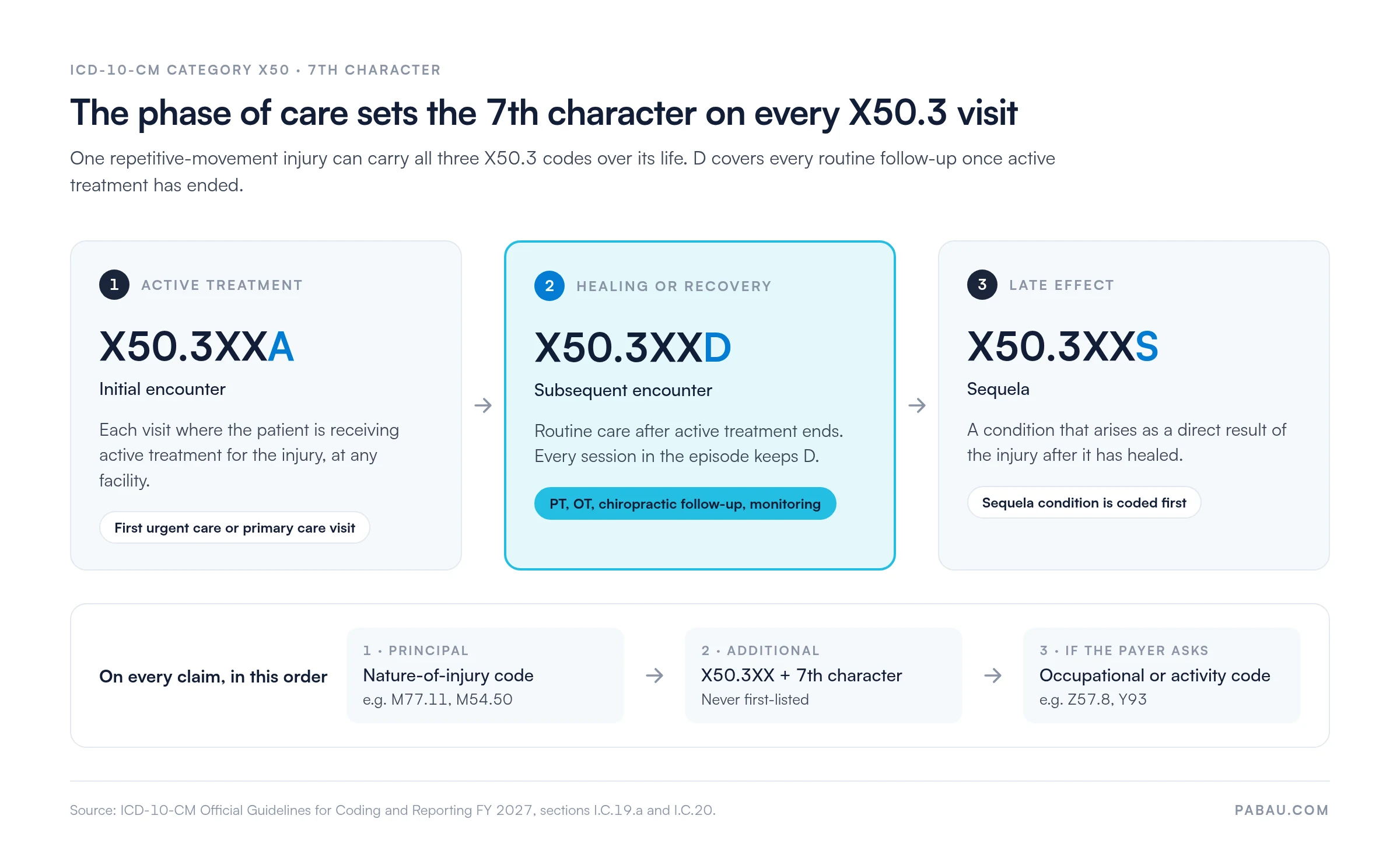
X50.3XXD applies when the patient is receiving routine care, rehabilitation, or monitoring for a repetitive movement injury and the active treatment phase has ended. Confirm each point on this checklist before the D extension goes on a claim.
Workers compensation context: Many repetitive movement injuries are billed to a workers compensation carrier. When the encounter is work-related, coders often add a Z57 occupational exposure code alongside X50.3XXD where the payer asks for occupational context. The D extension applies on every follow-up visit for the whole rehabilitation episode. That holds whether the payer is a workers comp carrier or a commercial plan.
Check the original encounter date in the chart before assigning X50.3XXD. A new facility may be seeing the injury for the first time. Clinical judgment then decides whether active treatment is still ongoing (use A) or the patient is transferring mid-rehabilitation (use D). The 7th character follows the phase of care, not the facility or provider seeing the patient today.
X50.3XXD is never the principal diagnosis, because it describes the external cause of an injury. The FY 2027 ICD-10-CM Official Guidelines state that external cause codes should never be sequenced as the first-listed or principal diagnosis. They are reported as additional codes after the nature-of-injury diagnosis.
On a physical therapy follow-up claim, the musculoskeletal or soft-tissue injury code is listed first. X50.3XXD follows as an additional code. On an electronic claim, that means the nature-of-injury code fills the principal diagnosis field and X50.3XXD sits in a secondary diagnosis slot.
Submitting X50.3XXD in the principal diagnosis field will result in a claim rejection. Many clearinghouses flag Chapter 20 codes in the principal position automatically, but payer-level edits vary. Get the sequencing right when the visit is coded, so a denial never has to correct it.
The X50 category covers all overexertion-related external causes. Selecting the most specific subcategory prevents down-coding and payer queries about medical necessity.
Use X50.3 when the clinical record documents repetitive movement as the mechanism, such as assembly work, data entry, or repeated overhead reaching. Use X50.0 for heavy lifting or a strenuous load, and X50.1 for prolonged or awkward postures. A sport context is recorded with a separate Y93 activity code. If the documentation is vague (“strenuous activity”), query the provider before defaulting to X50.9XXD.
Because X50.3XXD is always a secondary code, the nature-of-injury code determines whether the claim makes clinical sense to a payer. The following musculoskeletal diagnoses are commonly paired with overexertion from repetitive movement. Several of them need further characters for laterality before they are billable.
Note on M54.5: This code was retired as of October 1, 2021, and replaced by more specific lumbar spine codes (M54.50, M54.51, M54.59). If a coder is still pairing X50.3XXD with M54.5, the claim will reject. Where the record gives no further detail, M54.50 covers low back pain, unspecified.
Payers reviewing X50.3XXD claims look for documentation that confirms two things. The mechanism was repetitive movement, and active treatment for the injury has ended. Documentation for this code should capture all of the following before the claim is submitted.
External cause codes like X50.3XXD are treated differently depending on the payer type. Understanding those differences prevents incorrect assumptions about mandatory use. Good revenue cycle management processes include payer-specific edit rules that flag these distinctions before claims go out.
Most denials on X50.3XXD claims trace back to a small set of correctable errors. A guide to fixing denial codes explains what each claim adjustment reason code on the remittance asks for.
Identifying the denial reason early makes denial management in healthcare faster, since most of these are clean-claim issues rather than medical necessity disputes. Submitting a clean claim means catching each of these before the claim leaves the practice.
The ICD-10-CM tabular list attaches one Excludes2 note to X50.3. Overuse from prolonged static or awkward postures codes to X50.1. Its one inclusion term is “use of hand as hammer.” The wider X50 category and Chapter 20 set further boundaries for cases that overlap with adjacent categories.
When documentation is ambiguous about whether an injury is cumulative or acute, query the treating provider before coding. The CMS ICD-10-CM coding resources and the CDC/NCHS ICD-10-CM web tool both carry the official tabular list. Each shows the notes attached to specific codes for the current fiscal year.
Verify X50.3XXD’s validity each October 1, when ICD-10-CM codes update with the new fiscal year. A code valid in FY2026 may be revised, retired, or have new excludes notes added in FY2027. Run your practice’s active code list through the current-year CDC/NCHS tabular before the October changeover to avoid submitting claims with outdated codes.
Consistent use of X50.3XXD in accordance with the ICD-10-CM Official Guidelines is part of broader medical billing compliance for musculoskeletal and rehabilitation practices. Per the AAPC ICD-10-CM code library, X50.3XXD remains a valid code for the current fiscal year.
Three compliance risks specific to this code deserve attention at the practice level:
A repetitive strain episode can run to a long series of follow-up visits, and each one goes out as its own claim. Every one of those claims carries the nature-of-injury code first and X50.3XXD after it. When a workers compensation carrier pays, the case details and any authorization have to travel with each claim too.
Pabau supports insurance billing and electronic claims in the US through Claim.MD. Its built-in claims management sends CMS-1500/837P claims, runs eligibility checks, and receives ERA remittances, including for secondary claims. The authorization code, dates, and approved sessions are tracked on the patient’s case, and Pabau warns you when one is missing.
Your billing team works the whole episode from one patient record. Each follow-up claim draws on the same case as the first, so the visit-by-visit work shrinks to checking the codes for that session.
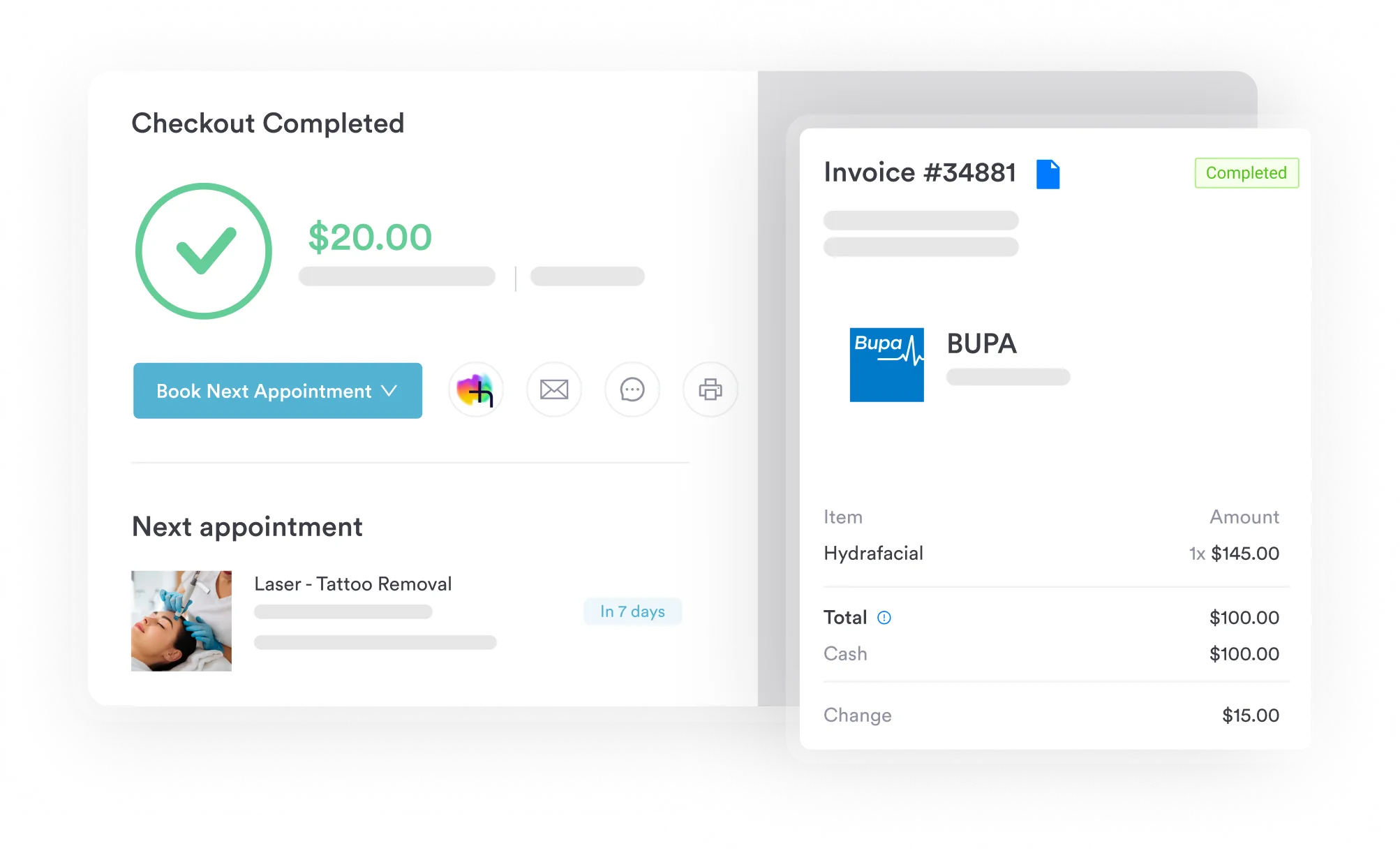

Pabau supports insurance billing and electronic claims in the US through Claim.MD. Your team sends each X50.3XXD follow-up claim, checks eligibility, and tracks remittances from the patient record.

Treat the 7th character as a phase-of-care decision you make once per episode. When active treatment ends, every routine follow-up for that injury takes X50.3XXD, listed after the nature-of-injury code.
The trade-off is effort against payoff. External cause codes are optional for many payers, but a workers compensation carrier or a state mandate can make them required. Settle which rule applies before the first follow-up claim, and the rest of the episode follows the same pattern.
Book a demo to see how Pabau sends US insurance claims for rehabilitation follow-up visits through Claim.MD.

Need to understand how claims move from code entry to payment? Revenue cycle management explained covers the end-to-end workflow from diagnosis coding through ERA posting.
Seeing repeated denials across your musculoskeletal claims? Denial codes in medical billing breaks down the most common CARC and RARC codes and what each one requires for appeal.
Looking for clearinghouse submission guidance for US practices? Medical claims clearinghouse guide explains how clearinghouses validate, route, and confirm ICD-10 coded claims before payer adjudication.
Working a case with no specific mechanism documented? ICD-10 code X50.9XXD covers follow-up coding for other and unspecified overexertion.
Pairing X50.3XXD with a low back pain diagnosis? ICD-10 code M54.50 explains the code that replaced M54.5 for unspecified low back pain.
ICD-10 code X50.3XXD is an external cause code meaning overexertion from repetitive movements, subsequent encounter. It documents the mechanism of a repetitive strain injury at a follow-up visit after active treatment has ended. It is always reported alongside a primary nature-of-injury diagnosis code and cannot appear as the principal diagnosis.
Yes, X50.3XXD is a valid, billable ICD-10-CM code confirmed in the current CMS tabular list. It is billable as a secondary code. It must be paired with a primary nature-of-injury diagnosis code and cannot stand alone as the only code on a claim.
X50.3XXA (7th character A) is used for each visit while the patient is receiving active treatment for the injury. X50.3XXD (7th character D) is used for routine follow-up visits once active treatment has ended, including physical therapy, occupational therapy, and chiropractic follow-up. Using A on a follow-up visit is a common coding error and denial cause for this code family.
No. Chapter 20 external cause codes, including X50.3XXD, are never principal diagnoses per the ICD-10-CM Official Guidelines for Coding and Reporting. Placing X50.3XXD in the principal diagnosis field will trigger an automatic rejection at most clearinghouses and payer systems.
Yes, X50.3XXD applies to workers compensation claims involving repetitive movement injuries. Some workers compensation carriers and states require external cause codes. Check the payer’s or state’s rules, including the payer’s billing manual, before submitting.
X50.3XXS is used when the patient presents with a late effect or complication that developed after the original overexertion injury has healed. Examples include chronic nerve entrapment or scar tissue formation from a prior repetitive strain. When sequela coding applies, the residual condition becomes the principal diagnosis and X50.3XXS is added as the external cause. Use D for ongoing rehabilitation of the original injury, and use S only after that injury is considered resolved.