ICD-10 Code S59.011G: Salter-Harris Type I physeal fracture, right ulna
ICD-10 Code S59.011G: Quick reference ICD-10 Code S59.011G is the billable code ...

Last Updated: Nov 6, 2026
Billable Code Specific Code
S53.013D is the billable ICD-10-CM code for anterior subluxation of unspecified radial head, subsequent encounter. It applies to follow-up visits when the record does not say which elbow was injured.
Coders most often reach for this code when billing physical therapy rehabilitation visits, orthopedic or sports medicine follow-ups, and workers' compensation progress appointments. They use it once the original reduction or conservative treatment is complete. The code sits in ICD-10-CM Chapter 19 (Injury, Poisoning, and Certain Other Consequences of External Causes). It falls under category S53 (Dislocation and sprain of joints and ligaments of elbow).
Let Pabau's smart automation suggest the right codes, reduce claim denials, and keep your practice compliant—effortlessly.
Automate repetitive tasks and focus on what matters most—your patients.
Reduce coding errors and ensure compliance with the latest regulations.
Clean claims, fewer denials, and faster reimbursements.
Powerful insights and reporting to help your practice thrive.
HIPAA compliant SOC 2 certified GDPR-compliant Trusted by 4,000+ clinics worldwide

ICD-10 Code S53.013D covers follow-up care for anterior subluxation of the radial head when the record does not say which elbow was injured.
When the note names the side, S53.011D (right) or S53.012D (left) is the correct code. Query the provider before falling back on S53.013D.
The 7th character D means definitive treatment is complete and the patient is healing. Billing A at every visit is the most common encounter error.
Pabau’s claims management software keeps the documented side, the encounter type, and the claim in one record, so mismatches surface before submission.
Use the table below as your first check before reviewing documentation or submitting a claim. It covers the facts a coder or biller needs to confirm before assigning S53.013D.
Each character in S53.013D carries a specific meaning according to the CMS ICD-10-CM code structure. Reading them left to right decodes the anatomy, the injury type, the side, and the encounter.
In clinical terms, the radial head slipped partly forward, out of its normal alignment with the capitellum, and was treated at an earlier encounter. The patient now returns for care while the joint heals. The “unspecified” in the descriptor comes from the documentation. The note describes the subluxation but never states whether it was the right or the left elbow.
Coders can almost always recover the side from somewhere in the episode. An elbow examined in person has a side, and a reduction note or imaging report usually names it. S53.013D belongs on a claim only when the side cannot be confirmed from the record or from a provider query.
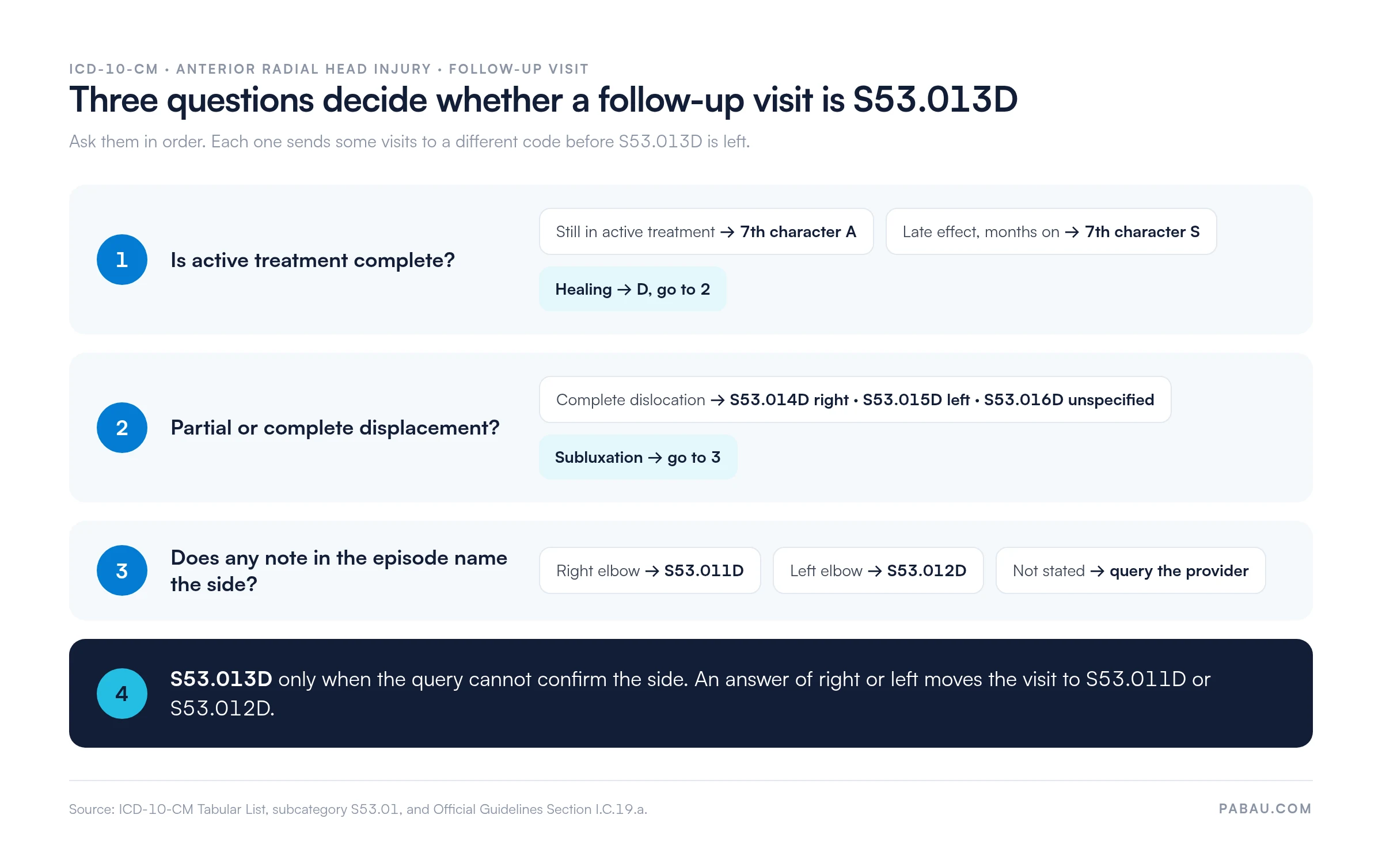
The 7th character is the most consequential coding decision in this code set. Per ICD-10-CM Official Guidelines Section I.C.19.a, three values apply to S53.013 and they are not interchangeable.
The subsequent encounter designation applies even when a different provider manages the follow-up care. A patient reduced in the emergency department and referred to an orthopedic practice is coded with D there from the first visit. That holds even though it is the orthopedist’s first contact with the patient.
Using A for every visit is a widespread coding error in the S53 family, and it drives avoidable claim denials. The distinction hinges on whether active treatment is still being rendered at that specific visit.
Consider a typical scenario. An adult falls on an outstretched arm, and the urgent care physician reduces an anterior radial head subluxation. The triage note never records which arm. That visit is coded S53.013A, and the coder queries the provider for the side.
Two weeks later the patient attends a follow-up for a range-of-motion check, and the reduction is stable. That visit is S53.013D, unless the query answer or today’s note names the side. If it does, the follow-up becomes S53.011D or S53.012D. Six months later, residual stiffness from the injury would be coded S53.013S if the side is still unrecorded, alongside a code for the stiffness.
The sequela character is rarely right in an acute-care or early rehabilitation setting. Coders who default to S for any “old injury” visit are misapplying it while the injury is still healing. D remains the right choice throughout the healing phase.
S53.013D sits in a six-code family under S53.01, anterior subluxation and dislocation of the radial head. The 6th character carries two facts at once: whether the joint subluxed or fully dislocated, and which side. The table maps the full set at the subsequent encounter.
Two errors account for most mistakes in this family. The first is reaching for S53.013D when the chart names the side. Payers read unspecified laterality as a sign of incomplete documentation, and some reject it outright. The second is reading S53.014D as a left subluxation code. It is a right-sided dislocation, a different injury.
Watch for two neighboring codes as well. Nursemaid’s elbow, the pediatric pulled-elbow injury, has its own subcategory, S53.03-, and does not belong under S53.01. A radial head dislocation with an ulnar shaft fracture is a Monteggia fracture-dislocation, coded from S52.27-, which S53.0 excludes.
Put together, a follow-up visit reaches S53.013D only after three questions, asked in order. The flow below shows where each other answer leads.
Accurate documentation is what turns a clinically reasonable code into a defensible claim. Responsibility for record content sits with the treating provider. These are the elements payers and Recovery Audit Contractors look for during review.
Ensuring medical billing compliance for musculoskeletal follow-up visits means capturing these elements in the first treatment record. They should then carry forward in progress notes, not be reconstructed after a denial arrives.
Before submitting any S53.013D claim, search the whole episode for the word “right” or “left.” Check the ED note, the imaging report, and the referral letter. If any of them names the side, switch to S53.011D or S53.012D. If none does, send a laterality query and hold the claim until it comes back.
Physical and occupational therapists frequently bill this code family for rehabilitation sessions after a reduction. Understanding medical billing fundamentals for musculoskeletal conditions helps avoid the pairing errors that generate rejections. Therapy intake is also a natural point to confirm the side, since the therapist examines the elbow directly.
The CPT codes most often paired with this code family in a therapy setting include:
Verify CPT-ICD pairings against the Local Coverage Determination of the practice’s Medicare Administrative Contractor (MAC). Coverage criteria for musculoskeletal therapy vary by region.
Workers’ comp claims for elbow injury follow-up carry extra coding obligations. Many carriers expect a Chapter 20 external cause code alongside the injury code to show how the occupational injury happened. The mechanism code takes the same 7th character, so a fall reported with W19.XXXD fits a follow-up visit.
Activity (Y93), place of occurrence (Y92), and external cause status (Y99) codes are different. The guidelines report them only once, at the initial encounter, so they do not repeat on S53.013D claims.
Carriers also want documentation linking the visit to the accepted claim, including the claim number and date of injury. Return-to-work notes carry legal weight, so record any functional limitations or restrictions explicitly.
Understanding the full revenue cycle management workflow for occupational claims helps avoid the delays common with these payers.
Denials for S53.013D cluster around a predictable set of errors. Sound denial management workflows catch most of them before submission. The table maps each denial reason to a specific fix.
A clean claim for S53.013D starts with the documentation. The billing error is usually a symptom of an incomplete or ambiguous clinical note, and the missing side is the most common one.
When a claim does bounce, the remittance carries a claim adjustment reason code (CARC). Our rundown of the top CARC denial codes explains how to fix each one.
Most S53.013D claims begin with a note that left the side out. The side was examined but never written down, or it sits in an imaging report the coder never opened. By the time a payer questions the unspecified code, the episode is weeks old and the query is harder to answer.
In Pabau’s practice software, the clinical note, the encounter history, and the claim share one patient record. The claims management software lets the coder see every earlier note in the episode before choosing between S53.011D, S53.012D, and S53.013D. For therapy practices, the diagnosis selected at intake carries through to the claim.
Claims go out as CMS-1500s through the Claim.MD clearinghouse, after claim validation checks each one for missing or invalid details. Rejections and remittances come back against the same record, so a laterality denial is visible the day it arrives.

Pabau keeps the clinical note, the encounter history, and claim submission in one record, so coders can confirm laterality before a claim goes out. See how it works for orthopedic and therapy practices.

S53.013D is a correct code with a narrow job. It exists for the follow-up visit where nobody recorded which elbow was injured. In most charts someone did, and the right answer is S53.011D or S53.012D.
Treat every S53.013D in a claim queue as a prompt to look again. A short laterality query costs less than a specificity denial, and it fixes the record for every later visit in the episode. Book a demo to see how Pabau keeps documentation and claims in one place so the side is never lost between them.

Billing insurance for therapy sessions after an elbow injury? Insurance billing for therapists walks through the claim process step by step, from coverage checks to follow-up.
ICD-10 Code S53.013D is the billable diagnosis code for anterior subluxation of unspecified radial head, subsequent encounter. It covers follow-up visits after the injury was first treated, when the record does not state which elbow was involved. If the side is documented, use S53.011D for the right elbow or S53.012D for the left.
Use S53.013D once active treatment is complete and the patient returns for follow-up, rehabilitation, or care during healing. Use S53.013A while active treatment is still being given, such as at the emergency department visit where the reduction is performed. Billing A at follow-up visits is a common denial trigger.
Yes, if the therapy record and the referral both leave the side undocumented. A therapist examining the elbow can usually confirm the side, and the session should then be coded S53.011D or S53.012D. Common CPT pairings include 97110, 97530, and 97140. Verify pairings against the Local Coverage Determination for your jurisdiction.
Yes. Many workers’ comp carriers also expect a Chapter 20 external cause code describing how the injury happened. That code takes the same 7th character as the injury code. Activity, place, and status codes are reported only at the initial encounter. A workers’ comp record nearly always names the injured arm, so check whether S53.011D or S53.012D applies first.
They describe different injuries. S53.013D is an anterior subluxation, a partial displacement, of the radial head on an unspecified side. S53.014D is an anterior dislocation, a complete displacement, of the right radial head. S53.014D is not a left-side subluxation code; the left subluxation code is S53.012D.
The record must confirm the original anterior subluxation, with its date and first treatment. It must show the current visit is in the healing or rehabilitation phase, and justify continued care. It should also show that the side could not be confirmed, ideally through an unanswered provider query. Objective measures such as range-of-motion values strengthen medical necessity.