ICD-10 code S61.201A: Open wound of left index finger without nail damage
ICD-10 code S61.201A covers a left index finger wound of unstated type ICD-10 co...

Last Updated: Oct 16, 2026
Billable Code Specific Code
S53.013S is the billable ICD-10-CM code for anterior subluxation of unspecified radial head, sequela.
Let Pabau's smart automation suggest the right codes, reduce claim denials, and keep your practice compliant—effortlessly.
Automate repetitive tasks and focus on what matters most—your patients.
Reduce coding errors and ensure compliance with the latest regulations.
Clean claims, fewer denials, and faster reimbursements.
Powerful insights and reporting to help your practice thrive.
HIPAA compliant SOC 2 certified GDPR-compliant Trusted by 4,000+ clinics worldwide

S53.013S is the billable ICD-10-CM code for anterior subluxation of unspecified radial head, sequela, and it is valid for FY2026 claims
Unspecified describes the side of the body, not the diagnosis. The direction of displacement and the encounter phase are both fully specified in this code
If the record names the right or left elbow, code S53.011S or S53.012S instead. Unspecified is a fallback, not a default
The S 7th character means sequela, or late effect. Mistaking it for D, the subsequent encounter character, is the most common denial trigger on this code
Practice management software like Pabau can flag a missing 7th character before submission. Only a clearer provider note moves a claim off the unspecified code
ICD-10 code S53.013S is the billable ICD-10-CM diagnosis code for anterior subluxation of unspecified radial head, sequela. It is valid for FY2026 claims. That code set runs from October 1, 2025 through September 30, 2026 under ICD-10-CM as maintained by the CDC/NCHS.
The code is complete because it already carries a 7th character, so it can go on a claim as it stands. The parent code S53.013, without that 7th character, is not billable and will fail clearinghouse validation.
Two characters do the work on an elbow subluxation claim. The sixth carries laterality and the seventh carries the encounter phase. Unspecified describes the side of the body only, and that setting has to be earned by the record rather than chosen for convenience.
The 7th character is not a formality. It tells the payer which treatment phase the claim covers, and the wrong one generates an instant denial. All three characters in the S53.013 series carry that risk equally.
Sequela coding follows a specific logic set out in the ICD-10-CM Official Guidelines maintained by CMS. The sequela code applies when the encounter addresses a late effect or residual of the original injury, not the injury itself. That distinction separates correct coding from a chronic denial pattern.
Critical distinction: S53.013S does not mean the patient still has an active subluxation. It means the current encounter treats a condition that exists because of that past subluxation, such as stiffness, pain, or reduced range of motion. When the subluxation is still under active treatment, S53.013A or S53.013D applies instead.
One caution before you move on. Changing the 7th character never supplies a side the note left out. If the side is missing, every character in the S53.013 family is still an unspecified-laterality code. The grid below sets the two decisions side by side.
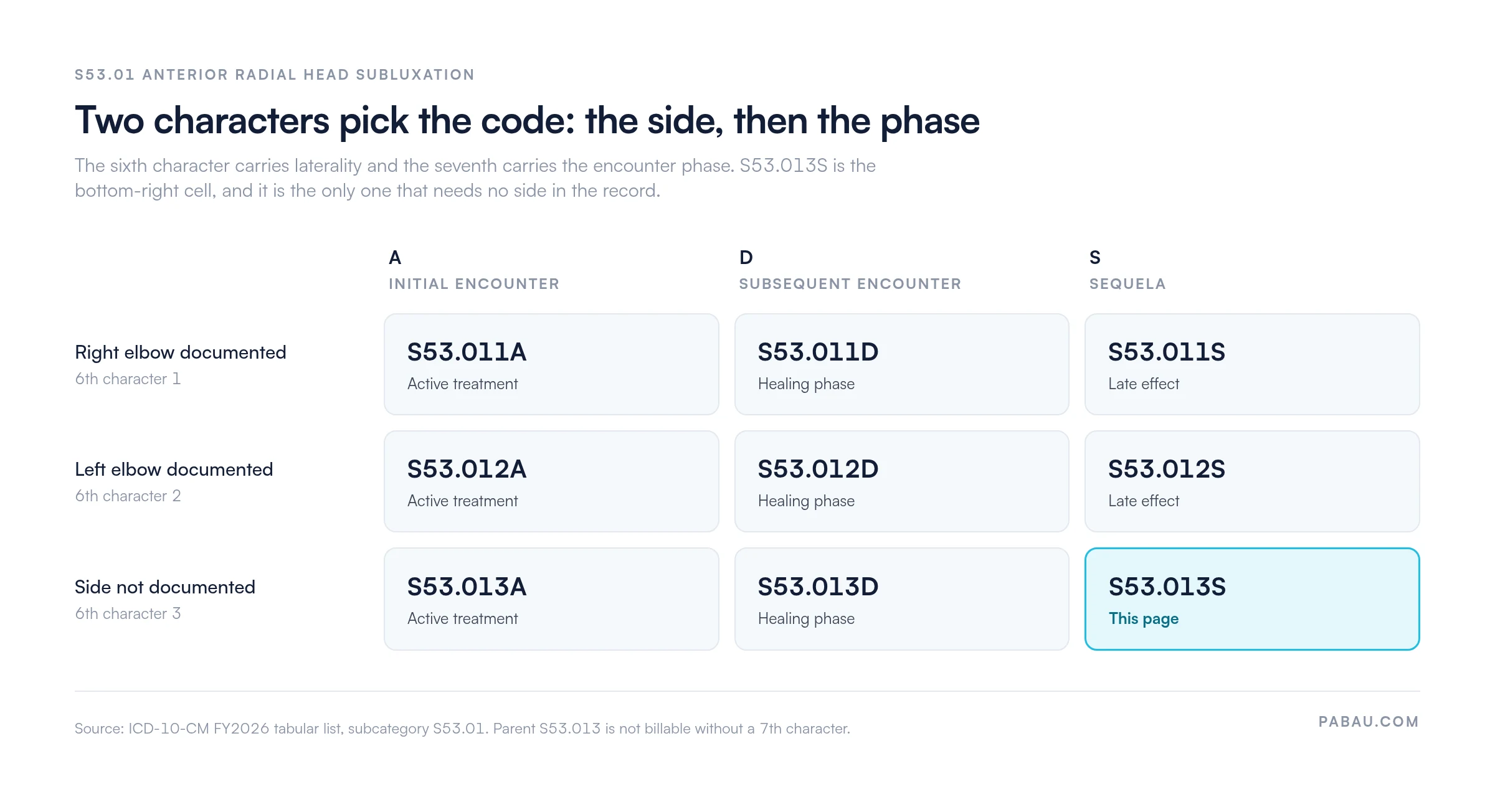
Radial head subluxation occurs when the radial head partially displaces from its articulation at the capitellum. The anterior variant involves forward displacement, usually from a hyperextension mechanism or a fall on an outstretched hand. Physical therapy and orthopedic teams see the sequela presentations months or years after the original event.
Three facts drive code selection here. They are the direction of displacement, the side, and the treatment phase. S53.013S is the code you assign when the direction is documented as anterior and the phase as a late effect. For this code the record never names a side. The anatomy is identical on both sides, so the choice turns on documentation rather than on any clinical difference.
Every code in the S53.01 series offers a laterality choice, and unspecified is one of the three valid options. It carries a defined meaning and a narrow use. It is correct only when the record fails to identify a side, which is a narrower situation than most claim mixes suggest.
A short list of situations genuinely supports the unspecified code.
Sports medicine and orthopedic practices treating unilateral elbow injuries should reach this point rarely, because the side is almost always in the chart.
The ICD-10-CM Official Guidelines settle the order of preference in Section I.B, on specificity. Codes are assigned to the highest level of detail the record supports, so a laterality code takes precedence whenever the note names a side. Submitting S53.013S against a note that says left elbow is under-coding, and an audit will match the two. If S53.013S appears more often in your claim mix than S53.011S and S53.012S combined, the problem sits in documentation rather than in coding.
S53.013S sits within a structured hierarchy. Knowing where it falls helps coders confirm the right level of specificity and avoid submitting a parent code in place of the billable child. Every injury category in ICD-10-CM branches the same way.
Coders working elbow subluxation claims need the full picture of the S53.0 siblings to avoid both under-coding and cross-coding errors. The table below covers the codes most often confused with S53.013S.
Nursemaid’s elbow is a pediatric condition caused by sudden longitudinal traction on the forearm. That traction traps the annular ligament between the radial head and the capitellum. It is not the same anatomical event as anterior subluxation, and the codes are not interchangeable. The series carries its own laterality digits.
Flag nursemaid’s elbow claims on adult patients before submission. Payers treat the S53.03 series as a pediatric code group. Applying one to an adult encounter creates an age-mismatch flag that delays or denies payment. Check the patient age in the demographic record against the code selected.
Providers almost never write the code descriptor. Recognizing the phrasing they do use keeps you from missing this code or reaching for a sprain code by mistake. The wording below all points at an anterior radial head subluxation in its late-effect phase.
Notice what none of these phrases supplies: a side. That absence is what makes S53.013S the right code. As soon as the note names the right or left elbow, move to S53.011S or S53.012S.
Claim denials on sequela codes almost always trace to the record rather than to the coder. The record has to establish a chain from the original injury to the current encounter. Without that chain, the payer has no basis for accepting the sequela code.
The checklist below covers what the record must contain to support S53.013S on a claim. Miss any element and you either change the code or absorb a denial.
One habit separates a defensible unspecified code from a lazy one. When the note omits the side, query the provider before you code and record the answer. A query that comes back empty is evidence that S53.013S was the only option available to you.
Five errors account for most S53.013S rejections, and each one is preventable with a structured pre-submission review. Tracking denial codes for this code family surfaces the same patterns month after month.
Error 1: Using D instead of S for a late-effect encounter. The subsequent encounter character applies during the healing phase of the original injury. If the patient presents months later with chronic pain from a subluxation that has already healed, S is the correct character. Using D at that stage misstates the encounter type and can be flagged as upcoding during an audit.
Error 2: Reaching for unspecified when the record names a side. This is the error that matters most for S53.013S. Once the clinical note says right elbow or left elbow, S53.011S or S53.012S is the only correct code. Payers running audit protocols match the code against the record and flag the discrepancy. The fix is a pre-submission laterality check, not an appeal.
Error 3: Submitting the parent code S53.013 with no 7th character. S53.013 is not billable and will fail validation at the clearinghouse before a payer ever sees it. Every code in the family needs A, D, or S to be valid. Catch it at pre-submission validation rather than after the denial.
Error 4: Applying a nursemaid’s elbow code to an adult. The S53.03 series describes a pediatric annular ligament injury. Confirm the patient age in the demographic record before you select it, and confirm the mechanism in the note.
Error 5: Assigning S with no sequela chain in the record. The S character asserts a causal link between a past injury and a present condition. If the note never makes that link, the assertion is unsupported. Query the provider or code the presenting condition on its own instead.
S53.013S is a billable ICD-10-CM diagnosis code and is accepted across most US payers. Sequela codes carry timing and documentation requirements that differ from initial encounter codes. Getting those requirements right prevents the timing errors behind many avoidable denials.
One extra consideration applies to this code specifically. A number of payers apply edits to unspecified-laterality codes, ranging from a documentation request to an outright denial on higher-cost services. Check the policy for your top payers before you build a therapy episode around S53.013S.
Confirm each CPT pairing against a crosswalk before submission. A therapy episode built on this diagnosis often starts at 97161 and moves through the exercise codes as function returns. The CMS ICD code lists confirm which codes are valid for Medicare Section 111 reporting.
A missing side usually surfaces twice, and both times too late. A coder spots it days after the visit, when the provider has moved on to another twenty patients. Or nobody spots it, the claim goes out as unspecified, and the payer sends a documentation request three weeks later.
Pabau, our practice management software, moves that check upstream. Charting templates can require the side of the body as a completed field before a note is signed. The elbow gets named while the patient is still in the room.
Diagnosis codes stay on the client record alongside the note that supports them. Our Claim.MD integration then submits and tracks those codes for US claims. Pabau submits what your coder assigned, and it does not decide laterality for you.
The outcome is a shorter list of unspecified codes rather than a faster appeals process. A structured pre-submission review inside claims software for billers catches both problems early. A missing 7th character and a missing side are cheap to fix at that stage.

Pabau captures laterality in the note and submits the codes your coder assigned. Missing 7th characters and unspecified-side claims get caught at review, not after a denial. See how it works for elbow and musculoskeletal claims.

The costliest ICD-10 errors on this code are rarely exotic. They are character-level slips on a familiar code, such as D where S belongs, or a parent code no payer system will accept. Worse still is an unspecified laterality code sitting on a note that clearly says left elbow.
S53.013S answers one question. It tells you what to do when the side is genuinely unknown. Treat it that way and it works as intended. Treat it as a default and you build audit exposure one claim at a time.
The fix sits upstream of the coder. Make the side a required field in the note, and query the provider when it is missing. Reserve S53.013S for the records that truly cannot supply it. To see how Pabau fits that workflow, book a demo.

Coding another elbow injury from the same category? ICD-10 code S53.116D covers anterior ulnohumeral dislocation at a subsequent encounter, and shows how the 7th character shifts with the treatment phase.
Working a sprain code where the side is documented? ICD-10 code S53.442D walks through an ulnar collateral ligament sprain of the left elbow, the specific-laterality case this page does not cover.
Worried about sequela denials across your musculoskeletal claims? Denial management in healthcare explains how to track, categorize, and resolve the payer denial patterns behind encounter-type mismatches.
Want to see where coding accuracy sits in the wider billing process? Revenue cycle management fundamentals shows how accuracy upstream of the claim shapes reimbursement timing and denial rates downstream.
ICD-10 code S53.013S is the billable ICD-10-CM diagnosis code for anterior subluxation of unspecified radial head, sequela. It applies when a patient is treated for the late effect of an earlier anterior radial head subluxation. Typical residual complaints are chronic elbow stiffness, pain, or instability. Unspecified refers only to the side of the body, which the record does not identify. The direction of displacement and the encounter phase are both fully specified.
Yes. S53.013S is a billable ICD-10-CM code valid for FY2026 claims, the code set running from October 1, 2025 through September 30, 2026. It already carries a 7th character, so it can be submitted as it stands. Being billable is not the same as being the best code available. If the record names the right or left elbow, S53.011S or S53.012S is the correct choice.
Nursemaid’s elbow is coded in the S53.03 series. It describes a pediatric condition caused by annular ligament entrapment from sudden traction, usually in children under five. That series carries its own laterality digits, so the sequela codes are S53.031S, S53.032S, and S53.033S. S53.013S applies to adolescents and adults with anterior radial head subluxation from hyperextension or fall mechanisms. The two are not interchangeable.
Common pairings for sequela encounters include the physical therapy evaluation codes 97161, 97162, and 97163, therapeutic exercise 97110, manual therapy 97140, and neuromuscular re-education 97112. These apply when the sequela involves chronic stiffness or instability. Validate every pairing clinically per encounter, since payer policies differ and no pairing is universally required.