CPT Code 44960: Appendectomy for ruptured appendix
CPT Code 44960: official descriptor and quick reference CPT Code 44960 is define...

Last Updated: Oct 20, 2026

CPT code 95819 is a routine electroencephalogram (EEG) that records brain activity both awake and asleep
It differs from 95816 (awake and drowsy) and 95822 (asleep only), and the wrong pick is a top denial trigger
Medicare pays about $482 nationally for the global service in 2026, and about $57 for the professional component with modifier -26
Place of service does not change what 95819 pays, because the facility and non-facility practice expense RVUs are identical
The technician report has to name a sleep marker such as spindles or K-complexes, or 95816 is the correct code
CPT code 95819 covers a routine EEG recorded while the patient is awake and then asleep. The sleep state is what separates it from its two siblings, 95816 and 95822. Choose the wrong one and the claim comes back weeks later with a records request attached.
Length sets a second test. A study that runs 41 to 60 minutes counts as extended monitoring and bills as CPT code 95812.
One number frames the rest. Billed globally, 95819 pays about $482 nationally in 2026, while the interpretation alone pays about $57. So the modifier you choose moves more money than the code does.
What follows is the descriptor, the 2026 rates, the documentation payers ask for, and the denials that hit EEG claims hardest.
Two layers decide a 95819 claim. The AMA descriptor sets the scope of the service, and the billing metadata sets what it pays. That metadata covers RVUs, place of service, and modifier eligibility.
The table below puts both in one place.
The decisive word in the descriptor is “including.” To bill 95819 you need documentation that the awake recording and the sleep recording happened in the same session.
Capture only one state and a different code applies. Which one depends on what the technician recorded, and that single choice drives the denial pattern below.
The three routine EEG codes differ by recording state, not by technique. That makes the technician report the deciding document.
Payers audit for upcoding when a biller reports 95819 without evidence of both an awake and a sleep recording.
The line between drowsy (95816) and asleep (95819) is the one to watch. Drowsy is a transitional state. Asleep means the technician’s report shows sleep-state patterns, such as sleep spindles, K-complexes, or other Stage 2 markers.
Payers flag claims where the report describes drowsiness only and the biller still chose 95819.
Medicare prices CPT code 95819 through the Medicare Physician Fee Schedule (MPFS), which CMS updates every year. For 2026 the code carries 14.44 total RVUs, and the conversion factor is $33.4009.
The global service therefore pays about $482.31 nationally. Your own rate then moves with the geographic practice cost index (GPCI) for your locality.
Place of service does not move these amounts. CPT 95819 carries the same practice expense RVU of 13.28 in facility and non-facility settings. POS 11, POS 21, and POS 22 therefore all price the same.
What the setting decides is which line you may bill. In an office that owns the equipment, you bill the global code and collect about $482.31. In a hospital, the facility bills the technical side, so the physician reports 95819 with modifier -26 for about $56.78.
Important: These figures are national averages from the 2026 MPFS relative value file. Verify your own rate in the official CMS Physician Fee Schedule lookup tool, which applies your locality’s GPCI. Commercial payers negotiate their own rates, and those often differ sharply from Medicare.
The relative value units (RVUs) below come from the CMS national physician fee schedule relative value file. CMS republishes that file every year, so re-check the values each January.
The practice expense line does most of the work here. Equipment, electrodes, and technologist time account for 13.28 of the 14.44 total RVUs.
That is why the technical component is worth roughly seven and a half times the professional component, as the split below shows.
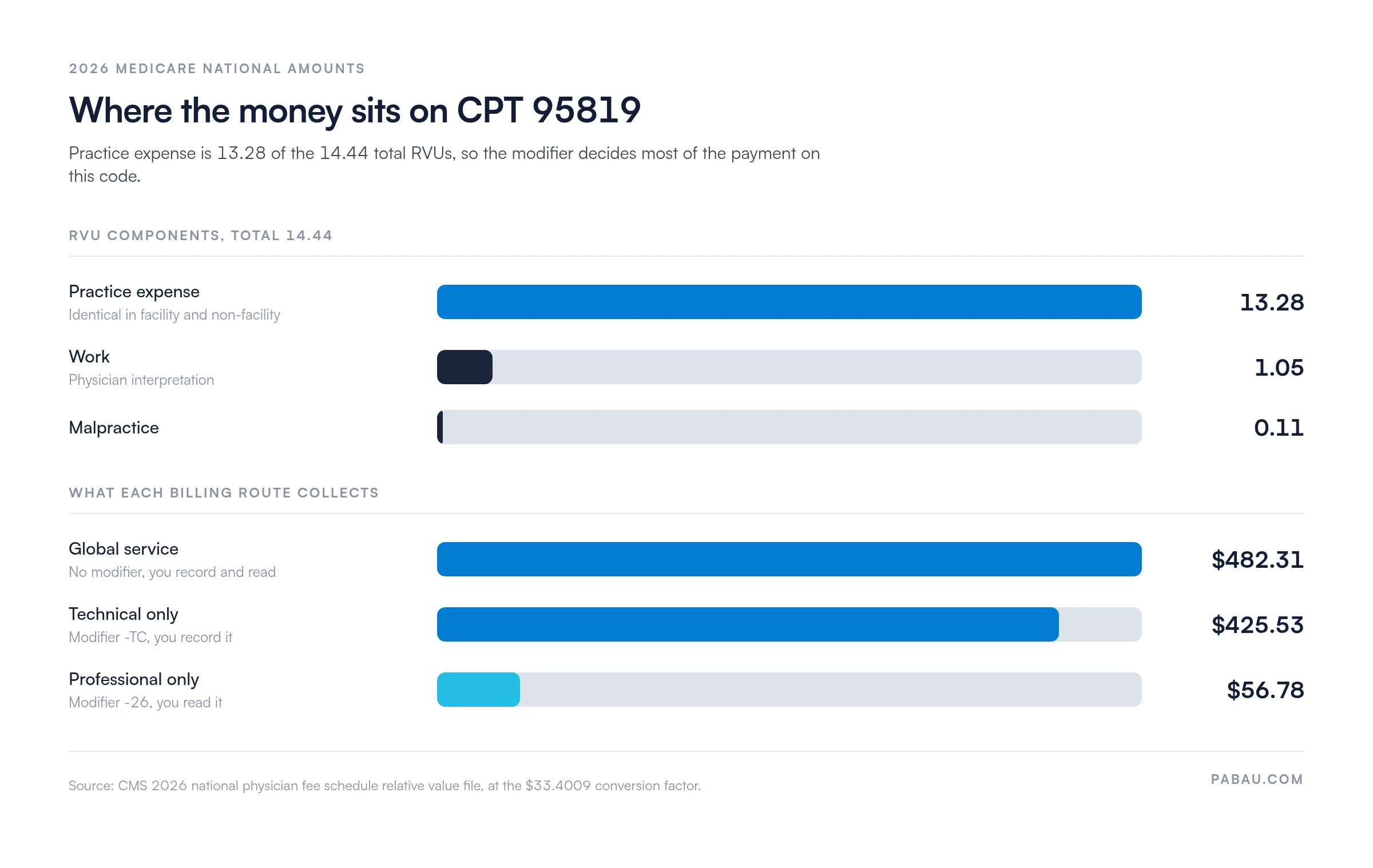
Run your locality’s GPCI against these base RVUs in the CMS MPFS lookup before you quote a number to a physician or an administrator. High-cost localities sit well above the national average. San Francisco runs about 38% higher on this code and Manhattan about 16%, because the practice expense GPCI dominates a code this equipment-heavy.
Documentation is the second most common denial trigger on 95819 claims, behind wrong code selection. Payers want evidence that the patient reached a sleep state and that the recording captured it.
A clean claim on this code needs every element below in the medical record:
One nuance causes repeat denials. Some payers want the physician interpretation as a separate signed document rather than a co-signature on the technician report. Check the payer’s Local Coverage Determination (LCD) before you assume a co-sign will do.
Modifiers sort out who gets paid when more than one party contributes to the EEG. On this code the choice is worth several hundred dollars a claim, because the recording carries far more value than the reading.
The table below shows what each one collects.
Critical coder note: Check the modifier rules in each payer’s own policy before you submit. Some commercial payers do not recognize -TC on outpatient claims, and a wrong modifier invites an audit. Cross-reference your LCD or payer contract, and treat the guidance here as general CMS principle rather than payer-specific instruction.
Every 95819 claim needs an ICD-10 diagnosis code that establishes medical necessity. Payers set out the codes they accept for EEG in their Local Coverage Determinations.
The table below lists the pairings that come up most often. Confirm each one against your MAC’s LCD first, because a diagnosis outside the covered list denies however good the chart is.
ICD-10 codes change every year. The codes above reflect the 2026 ICD-10-CM version, so check them in the CDC ICD-10-CM lookup tool before you submit. Some MACs deny outright when the version year and the date of service do not line up.
Medicare does not require prior authorization for CPT 95819 in most outpatient settings. Commercial payers are a different story, and their rules vary by plan, state, and diagnosis.
Check the following before you put the recording on the schedule:
Verify the requirement in the payer’s provider portal, then file the authorization number with the order. Run an eligibility check at the same time, since a lapsed plan produces the same denial as a missing authorization.
Practices that bill EEG codes in volume see the same five denials over and over. Preventing them is faster than working a denial queue. Our guide to medical billing denial codes shows how payers signal each one on the remittance.
Every pattern below comes with its fix:
Track denials by code, not only by claim. When 95819 denies for the same reason code across several patients, the fix belongs in the process rather than in an appeal. Log the CARC on every denial and route it to whoever owns that step.
Audit your last 90 days of 95819 claims. Filter for denials with CARC code 4 (denial for incorrect code) and CARC code 97 (payment included in allowance for another service). Those two codes catch most wrong-code and bundling errors on EEG claims. Fix the process, not just the individual claims.
Most 95819 denials are catchable in the two minutes before the claim leaves the practice.
Walk this list in order:
Clear all five and the claim runs the normal path, from clearinghouse to payer adjudication to an ERA with the allowed amount. A box left unchecked tends to come back as a records request three weeks later.
In most neurology practices the EEG charge and the evidence behind it live in separate places. The technologist writes the recording report, and the reading physician signs an interpretation elsewhere.
A biller then picks between global, -26, and -TC from whatever is visible. On a code where that choice is worth more than $400, guessing is expensive.
Pabau is practice management software for practices that bill insurers, and its billing tools build the claim from the encounter record. The service’s CPT code lands on the charge line, and the diagnosis comes from the patient’s recorded problem list. Built-in CPT and ICD-10 libraries let a biller confirm a pairing without leaving the claim.
Pabau’s claims management software also holds a claim back until every required payer field is complete, so an unfinished EEG claim never leaves the practice. Submission then runs through the clearinghouse for your region, which in the US is Claim.MD. That connects the practice to thousands of US payers, with real-time eligibility checks.
Remittances come back as ERA/835 files and post against the original charge, so you can see whether 95819 paid what you expected. When it does not, the difference shows up on the claim rather than in a month-end reconciliation.

Pabau’s claims management software connects to thousands of US payers through Claim.MD, with built-in CPT and ICD-10 catalogs and automated ERA processing. See how neurology practices cut denials and get paid faster.

CPT code 95819 fails more often over the chart than over payer policy. The sleep state is the part to get right. If the technician report does not confirm one, 95816 is the correct code, and billing 95819 anyway invites an audit.
Modifier choice decides the rest, and equipment ownership decides the modifier. That is what tells you whether the claim is worth about $482.31 or about $56.78. Pair it with an ICD-10 code from your MAC’s covered list and the two biggest denial patterns disappear before submission.
Pabau’s claims management software connects neurology practices to US payers through Claim.MD, with built-in CPT and ICD-10 catalogs and ERA/835 tracking. Book a demo to see how it cuts EEG claim errors and shortens your payment cycle.

Need to see how a claim actually reaches the payer? What is a medical claims clearinghouse? traces the path from submission to ERA and shows where claims stall.
Want the documentation side buttoned up? What is a superbill? covers the elements that support a clean claim on a diagnostic procedure code.
Curious how the Claim.MD integration works? Pabau’s Claim.MD clearinghouse review explains how it reaches thousands of US payers for eligibility and ERA processing.
Working a denial queue every month? Denial management in healthcare sets out how to log CARC codes and route each denial to its fix owner.
Not sure whether 95819 paid correctly? What is electronic remittance advice? shows how to read the 835 and spot payments below your contracted rate.
No. A sleep study is polysomnography, coded 95810 or 95811, and it records breathing, oxygen, and heart rhythm alongside brain activity. CPT 95819 records the EEG only, across an awake and a sleep state, in a session that usually runs 20 to 40 minutes.
95819 covers one short routine recording. Continuous monitoring of two hours or more belongs to the 95700 to 95726 family, which splits the technical and professional work into separate codes. Do not stretch 95819 to cover an overnight or multi-day study.
Yes, when the recording captures both an awake and a sleep state. Sleep deprivation is a preparation technique, not a separate CPT code. Code by the states the technician documented, so a sleep-deprived study that never reaches sleep is still 95816.
No national frequency limit applies. Individual MACs and commercial plans can restrict repeat routine EEGs, so check the policy before you schedule a second study. Document what changed clinically since the last recording, because that is what supports the repeat.
A qualified physician, usually a neurologist or an epileptologist, has to read the study and sign a separate report. A technologist cannot supply the interpretation. The recording on its own supports the technical component with modifier -TC and nothing more.