HCPCS code A4714: Treated water for peritoneal dialysis billing guide
HCPCS code A4714: Official descriptor, code type, and payment status HCPCS code ...

Last Updated: Oct 15, 2026
CPT code 95816 is the procedure code for a routine electroencephalogram (EEG) that records brain electrical activity in both the awake and drowsy states.
The study runs 20 to 40 minutes and must close with a signed interpretation from a qualified neurologist. It is billable globally, or split into a professional component with modifier 26 and a technical component with modifier TC. This reference covers the AMA descriptor, Medicare RVUs, ICD-10 pairings, modifier rules, and the documentation payers audit most often.

CPT code 95816 covers a routine EEG that records awake and drowsy states across a 20 to 40 minute study.
Use 95819 instead when the recording extends into sleep, since choosing between these two codes is the most common EEG billing error.
The Medicare work RVU is 1.05, so confirm the current facility and non-facility dollar amounts in the CMS Physician Fee Schedule.
A signed interpretation report must exist before the claim goes out, because an unsigned read is a standing denial reason.
Pabau’s claims management links the EEG report to claim preparation, so coders catch code and modifier errors before submission.
CPT code 95816 is defined by the American Medical Association (AMA) as: “Electroencephalogram (EEG); including recording awake and drowsy.” The recording has to capture brain electrical activity across wakefulness and the transition into drowsiness. Once the tracing reaches sleep, the study belongs to CPT 95819 instead.
The code sits within the Neurology and Neuromuscular Procedures section of the CPT code set. It carries a zero-day global period, so no pre- or post-service bundling applies beyond the day of service itself.
The work RVU of 1.05 reflects physician cognitive effort alone. Total reimbursement varies by setting, and by whether you bill globally, the professional component with modifier 26, or the technical component with TC. Check the CMS Physician Fee Schedule lookup for current dollar amounts before finalizing claims.
CPT code 95816 is appropriate when a neurologist orders a routine EEG to evaluate brain electrical activity from wakefulness into drowsiness. The study typically runs 20 to 40 minutes and captures spontaneous brain waves without requiring sleep. Common clinical triggers appear below, all governed by the CMS Local Coverage Determination (LCD) for electroencephalography.
Documentation has to tie the study to a specific clinical indication, not a bare request for an “EEG for follow-up.” Payers reviewing claims under the LCD expect a physician-documented reason attached to a covered ICD-10 diagnosis. Recording that reason at the ordering stage prevents most medical-necessity denials for this code.
Pairing CPT code 95816 with a diagnosis the LCD recognizes as supporting medical necessity is non-negotiable. The table below lists the ICD-10-CM codes used most often with this EEG procedure. Always verify your own payer’s covered-diagnosis list, since LCD coverage varies by Medicare Administrative Contractor (MAC).
Use the most specific code available. Defaulting to R56.9 when a more specific epilepsy code applies signals insufficient specificity and invites a medical-necessity review. The AAPC crosswalk tool helps coders pair CPT and diagnosis codes for EEG procedures. Our ICD-10-CM code library covers the neurology diagnoses that support medical necessity on this claim.
Selecting between CPT 95816 and CPT 95819 is the most consequential coding decision in routine EEG billing. A single sleep stage separates them. Where 95816 stops at drowsy, 95819 carries the recording into sleep, and the EEG report has to say which one happened. A claim that contradicts the report on that point draws a denial or a post-payment audit.
The documentation differentiator row is the one that settles disputes. Train technologists to annotate the state of consciousness in the report itself, rather than logging the total recording time alone. That single line is what an auditor reads to confirm the code you billed.
CPT code 95816 sits within a family of EEG procedure codes that differ by duration and by the states recorded. Knowing when each one applies prevents upcoding and keeps your billing defensible during a payer audit. EEG run as continuous monitoring during surgery falls outside this family, and that time bills in 15-minute units under CPT code 95940.
Two facts decide which of these codes a claim carries. The first is how long the recording ran, and the second is which states the signed interpretation documents. Once a recording passes 40 minutes it leaves the routine tier, and 41 to 60 minutes bills as CPT code 95812. The chart below works through that decision in order.
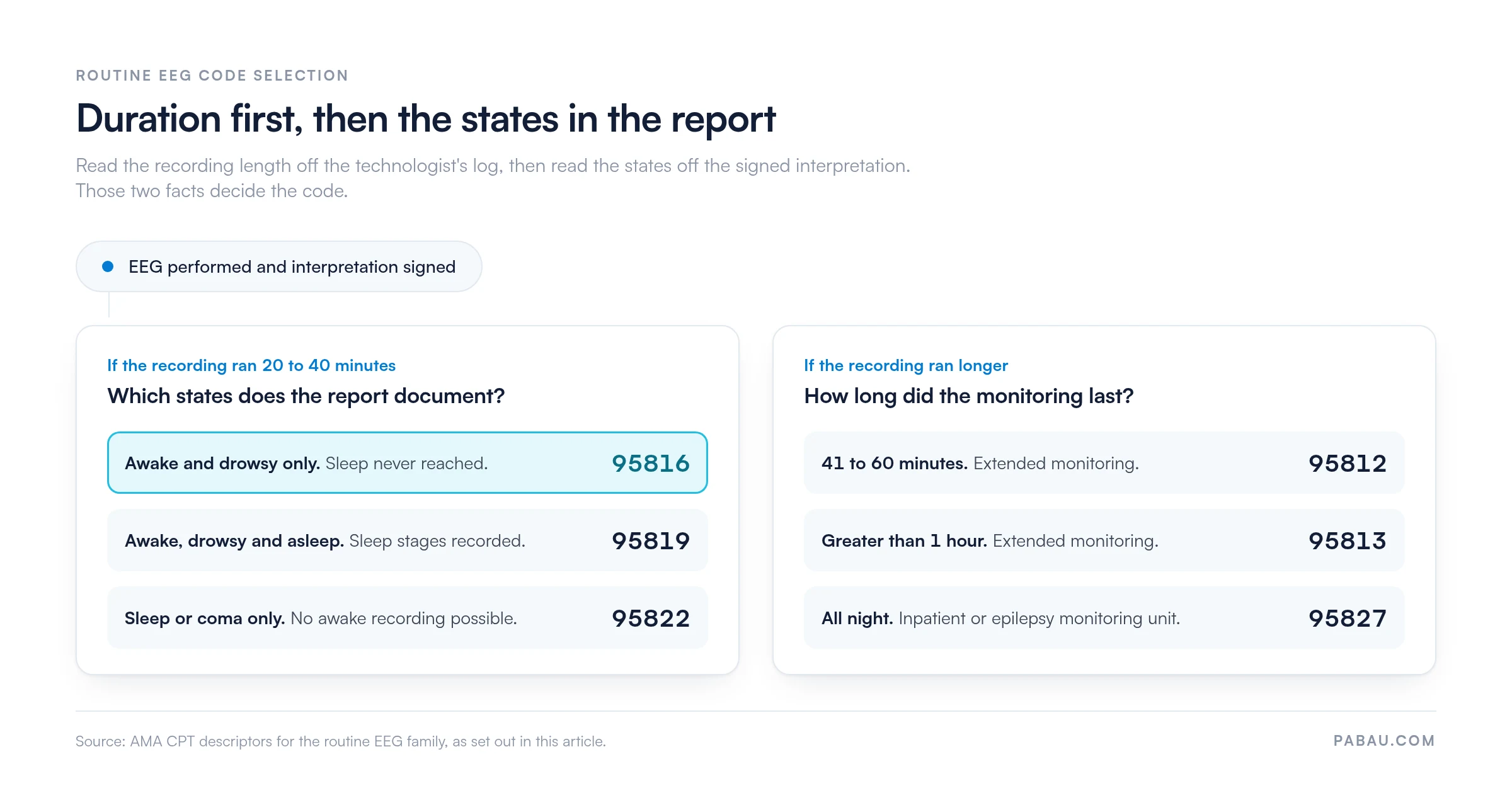
Medicare reimbursement for CPT code 95816 depends on the billing scenario. The three scenarios are global billing, the professional component with modifier 26, and the technical component with modifier TC. Rates update annually with the Medicare Physician Fee Schedule (MPFS), so confirm current-year dollar amounts before you submit.
Practices submitting through a clearinghouse can match payment postings back to individual claims automatically. Practice management software like Pabau handles the 837P submission and the 835 remittance file in one place. That cuts the manual reconciliation work a neurology billing team faces after a payment posts.
Modifier 26 and modifier TC split CPT code 95816 into its two billable components when the physician and the recording facility are separate entities. Applying the wrong modifier, or omitting one when splitting is required, leads reliably to a denial or an overpayment recovery.
Commercial payer rules on modifier splitting vary. Some carriers require prior authorization before the technical component is billable separately. Check each payer’s provider manual, because the Medicare rules described here may not apply to a commercial plan. Record which entity owns the equipment at the time of service, and modifier errors stop appearing downstream.
Payers auditing CPT code 95816 claims look for five documentation elements. A claim missing any one of them can be denied or recouped. Running that checklist before submission catches the omission while the clinical record can still be amended.
When the EEG report and the claim live in the same system, coders can cross-check the interpretation against the code selection in seconds. Pulling the two from separate records is where transcription errors enter the billing submission.
Audit a sample of 10 recently submitted CPT 95816 claims. Check whether each EEG interpretation report explicitly states that the patient remained in awake and drowsy states only. If the report is silent on sleep, your claim is vulnerable to down-coding during payer review.
Medicare does not require prior authorization for a routine outpatient CPT code 95816 under most MAC jurisdictions. Commercial payers are a different story. Authorization requirements for EEG procedures vary by plan and by state, and several carriers have tightened their criteria for outpatient neurodiagnostic testing.
Practices billing 95816 to commercial plans should verify insurance eligibility before the study. Check specifically whether the patient’s plan requires prior authorization for an outpatient EEG. A denial for missing authorization usually cannot be appealed on clinical grounds alone.
For emergent EEGs, prior authorization is rarely practical, so document the clinical urgency clearly in the record. Most commercial payers allow concurrent or retrospective review for emergent neurodiagnostic studies when the documentation supports it. The request should include the ordering physician’s note, the presenting symptoms, and the ICD-10 code driving the decision.
CPT code 95816 denial patterns are well documented across neurology billing teams. The most frequent rejections fall into four categories, each with a preventable root cause.
Tracking denial reasons by CPT code is the fastest way to see which of these errors is hitting your practice. Review the pattern monthly rather than case by case. A revenue cycle management dashboard breaks denials down by code. That lets a billing manager intervene upstream, before one claim becomes a recurring problem across the EEG schedule.
Most 95816 errors happen at the handoff between the EEG study and the claim. A coding reference site defines the code accurately, but it cannot see the study details sitting in the clinical record. Cleaner claims management software runs inside the practice’s own workflow, so the coder can check one against the other.
Pabau connects the clinical documentation to the claim preparation step. When the neurologist finishes the EEG interpretation in the same system that generates the claim, the study details carry straight across. The coder confirms the recording states, the duration, and the signature before submission.
Clearinghouse validation then runs the claim against payer-specific edits before transmission. That catches the modifier and diagnosis errors that would otherwise come back weeks later as denials. The difference is a claim you fix in a minute instead of one you appeal.
Practices tracking 95816 denial rates can use Pabau’s reporting to find the source. It shows which diagnosis pairings, modifier combinations, or ordering physicians generate the most rejections. Fixing that source beats appealing claims one at a time.
Run a monthly query on CPT 95816 claims denied for medical necessity. If the same ICD-10 diagnosis code keeps appearing, check whether your MAC has issued an updated LCD excluding that diagnosis from coverage. LCDs are revised without broad notification. A coverage change can produce a sudden denial spike on a code your team has billed for years.

Pabau connects clinical documentation with claims preparation. Your neurology billing team can check modifier assignments, diagnosis pairings, and signed interpretations before submission, not after a denial.

The hard part of CPT code 95816 is rarely the descriptor. It is proving, months after the study, that the recording stopped at drowsy. That proof lives in one line of the technologist’s annotation and one signature on the interpretation.
So the useful change sits upstream of billing. Make state of consciousness a required field on the EEG report template, and the 95816 versus 95819 argument stops happening at claim review. Coder review, modifier assignment, and appeal drafting all get shorter as a result.
That is worth doing this quarter, and it costs a template edit rather than a new process. Book a demo to see how Pabau links the EEG interpretation to the claim before a 95816 denial is ever filed.

Need to understand how clearinghouse submissions work end to end? Medical claims clearinghouse guide walks through 837P transmission, payer edits, and ERA matching in plain language.
Want a structured approach to reducing denial rates across your code set? Denial codes in medical billing covers the most common CARC reason codes and how to triage rejections by root cause.
Looking for guidance on the superbill format for neurodiagnostic services? Superbill guide covers the required elements of a compliant superbill, including signature, diagnosis linkage, and procedure detail.
CPT code 95816 is the billing code for a routine electroencephalogram (EEG) that records brain electrical activity during both awake and drowsy states. It is used to evaluate seizure disorders, epilepsy, syncope, encephalopathy, and other neurological conditions in outpatient and some inpatient settings.
CPT 95816 records awake and drowsy states only. CPT 95819 extends the recording into sleep. If the patient falls asleep and sleep stages are captured in the EEG report, bill 95819. If sleep is not achieved, bill 95816. Billing 95819 when the report documents only awake and drowsy states is an upcoding error.
Modifier 26 is appended when the physician bills only for the professional interpretation and does not own the recording equipment. Modifier TC is used by the facility billing only for the technical recording component. When one entity owns the equipment and the physician performs the interpretation, bill the global code with no modifier.
Five elements are required. The record must name the ordering physician and the clinical indication. It must carry a signed neurologist interpretation confirming the awake and drowsy recording states. Most payers expect at least 20 minutes of interpretable data. Technologist credentials apply where state or MAC policy requires them. A medical necessity statement should link the EEG to the patient’s symptoms and covered diagnosis.
Medicare generally does not require prior authorization for a routine outpatient CPT 95816, but commercial payers vary significantly. Some commercial plans require prior auth for outpatient EEG procedures. Always verify the plan’s requirements before scheduling the study. For emergent cases where authorization cannot be obtained in advance, document the clinical urgency in the record.
Five reasons account for most 95816 denials. The first is incorrect code selection between 95816 and 95819. The second is a missing or unsigned EEG interpretation report. The third is medical necessity documentation that never links the EEG to a covered diagnosis. The fourth is missing prior authorization from a commercial payer. The fifth is a modifier error in a split-billing arrangement.