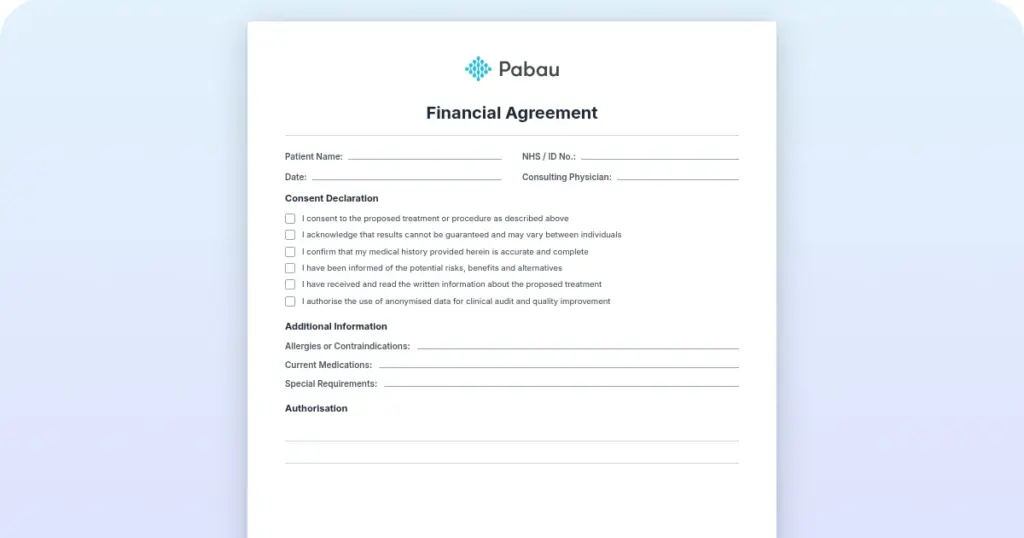
Free patient financial agreement template for practices
A financial agreement is the form a patient signs before treatment to confirm wh...

2
Last Updated: Oct 23, 2026

Patient collections is the process of collecting the portion of a medical bill owed directly by the patient, including copays, deductibles, and coinsurance.
A good patient collection rate is 95% or higher. Most practices fall short because they bill too late and follow up too infrequently.
Collecting at the point of service is the single highest-impact improvement most practices can make to their collection rate.
Pabau’s built-in invoicing, automated payment reminders, and online booking portal help practices close the difference between billed and collected without adding billing staff.
Most practices lose revenue at the billing desk, not the treatment room. A patient receives excellent care, then gets a confusing statement weeks later and never pays. Industry benchmarks from the Medical Group Management Association (MGMA) show that practices collect only 50-70% of what patients owe after a visit. That rate climbs above 90% when payment is addressed before or during the appointment.
This guide covers what patient collections means and the five metrics that reveal where your practice stands. Then it walks through the specific steps, from point-of-service collection to automated reminders, that raise your collection rate.
Patient collections is the process of collecting the portion of a medical bill that a patient owes directly, rather than their insurance company. This also shows up online as the patient collections definition, patient collections in healthcare, or healthcare patient collections. Different searches, same concept. As high-deductible health plans (HDHPs) have expanded, patient financial responsibility has grown substantially.
The Kaiser Family Foundation’s 2023 survey found the average annual deductible for single coverage reached $1,735, according to its employer benefits survey. Patients now shoulder a meaningful share of every clinical encounter’s cost.
Patient billing and collections covers four distinct payment types that your front desk, billing team, and invoicing workflow must each handle differently:
Knowing which category a balance falls into shapes how you communicate it, when you collect it, and what happens if it goes unpaid. This is also the core of what is collections in medical billing: matching the right payment type to the right process. Mixing these up at the front desk is a common source of collections breakdowns at independent practices.
For a broader look at how billing fits into practice finances, see the guide on med spa franchise finances. It covers the revenue structures that make collections planning easier.
HDHP enrollment has shifted a growing share of healthcare costs onto patients. Many arrive at appointments unaware of what they owe. When the bill arrives 30 days post-visit, the emotional connection to the care has faded and willingness to pay drops sharply.
Three structural trends are making patient collections more difficult for independent practices:
Each trend adds friction to everyday billing collection work at the front desk. The American Medical Association (AMA) recommends that practices address patient financial obligations well before the visit to reduce post-service collection burden. Getting ahead of the conversation is not just good practice etiquette. It directly affects your bad debt rate.
The post on payment reconciliation integrations explains how connecting payment data across systems reduces these billing mismatches.
The patient collections process runs through four stages, from before the visit to final payment. Most practices that struggle with collections have a weak point in one or more of these stages.
Before the patient arrives, verify insurance eligibility and estimate their cost responsibility. The No Surprises Act, in effect since January 2022, requires providers to offer good faith cost estimates to self-pay and uninsured patients. Proactive eligibility checks for insured patients catch plan lapses, out-of-network issues, and deductible statuses. This happens before they become post-visit billing surprises.
Practices that provide upfront cost estimates consistently see higher point-of-service collection rates. Patients who know what to expect are more likely to bring a payment method and less likely to dispute the final bill. Verify coverage at least 48 hours before the appointment, not on the morning of the visit when the schedule is already running.
Point-of-service patient collections is the highest-leverage moment in the entire workflow. Collecting copays, estimated deductible balances, and any outstanding amounts at check-in or check-out dramatically reduces the need for follow-up billing. Once a patient leaves the building, collection probability drops with every passing day.
Front desk staff should be trained to ask for payment as a routine, non-apologetic step in checkout, not as an afterthought. Offer card-on-file at intake so future balances can be collected automatically. When an estimate collected at check-in runs higher than the final adjudicated amount, your patient refund policy sets how fast the difference goes back.
For practices that want this smoother, Pabau, our practice management platform, lets staff collect deposits and balances through built-in payment processing at booking or checkout. The guide on aesthetics business deposits covers how upfront payment collection changes the economics of patient collections from the first interaction.
Send the statement as soon as insurance adjudication is complete, ideally within 5-7 days of the visit. Long delays between service and statement correlate directly with higher bad debt rates. The statement itself must be readable. It needs to:
Offer multiple delivery channels. Many patients prefer a text link or email over a paper statement. A patient portal with online bill pay removes every friction point between the patient receiving the bill and actually paying it.
Patients who can pay in 30 seconds from their phone are far more likely to pay. Those who need to write a check and find a stamp often don’t.
Most practices need a structured reminder cadence:
Each touchpoint should offer the patient a way to pay immediately or set up a payment plan. The tone of a collections letter to a patient matters as much as timing. Stay factual: state the balance, the due date, and the option to set up a payment plan.
When a balance is too large for an in-house plan, third-party financing moves the receivable to a lender. The lender pays the practice upfront, minus a merchant fee, and carries the default risk.
Automated workflows can trigger this cadence without staff manually tracking overdue accounts. The post on clinic revenue automations shows how automated follow-up sequences reduce accounts receivable without adding administrative overhead.
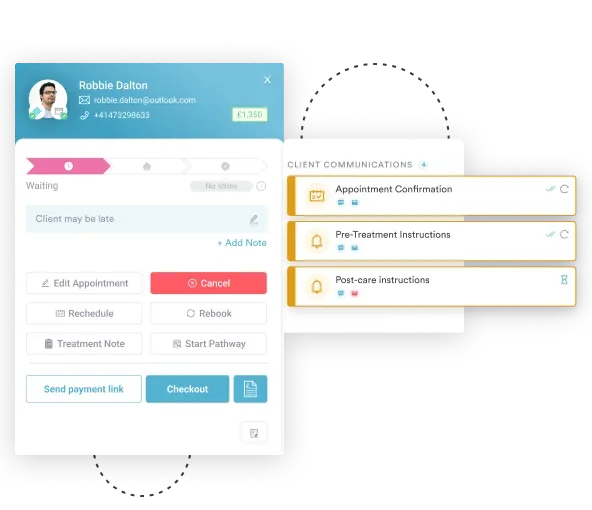
Build your reminder cadence around payment plans, not just payment demands. Patients who feel they have a realistic path to clearing their balance are far less likely to ignore communications. Offer a plan at the 14-day reminder stage, before the account feels adversarial.
Improving patient payment collections usually comes down to five operational habits. The difference between a 60% and a 90% collection rate is rarely about effort. None of them require a large billing department or expensive specialist software. Here’s how to maximize collections from patient services billing without adding headcount:
For practices managing multiple revenue streams, the guide on integrated payment processing outlines how unifying payment channels reduces write-offs across service types. Unifying channels also simplifies billing collection reporting across locations.
The practice management software guide covers how consolidating scheduling, billing, and collections into one platform reduces handoff errors. Fewer handoff errors mean less bad debt in the first place.
Your collection rate is collected dollars divided by collectable dollars, times 100, and it’s the most important of five metrics that reveal your practice’s performance. Track them monthly, not annually.
Some practices call this same figure their collection ratio instead of collection rate.
The 95%+ benchmark for patient collection rate comes from MGMA and HFMA industry guidance. Average medical billing collection rates for independent practices sit at 50-70%, which means the shortfall is operational, not structural.
Cost to collect revenue cycle benchmarks measure what it takes in staff time and fees to collect each dollar, and lower is better. When your days in accounts receivable run past 45, the problem is almost always statement timing or reminder cadence. The med spa KPI guide covers how to track these numbers alongside other operational metrics in one dashboard.
Medical billing software and practice management platforms remove the manual work behind consistent patient collections. Here’s what changes at each stage of the billing collection workflow:
Practices managing invoicing outside their booking system create data silos that slow collections. When a patient’s appointment, clinical record, invoice, and payment history live in separate tools, billing staff lose time reconciling records. That’s time not spent following up on outstanding balances, whether the practice runs a med spa or a general practice.
Billing clarity affects patient satisfaction too, as the measuring patient satisfaction guide explores. Clear, fair billing generally earns higher satisfaction scores than confusing or delayed statements.
Send a patient to collections only after 90 to 120 days of non-payment, at least three documented contact attempts, and a declined payment-plan offer. Referring a patient to a third-party agency before then carries reputational and regulatory risk without clear justification.
Patients who search “can hospitals send you to collections” are asking about this same threshold. The timing rules are similar across most provider types, and the standard criteria for escalation review are:
Third-party collections agencies must follow the Fair Debt Collection Practices Act (FDCPA), a federal law covered in the CFPB’s debt collection guidance. As the original creditor, your practice’s own collections communications are not covered by the FDCPA, but many states have analogous consumer protection rules that apply. Document every contact attempt before referral.
The cancellation policy guide is worth reading alongside this. Practices with clear upfront financial policies generate fewer escalated collections disputes than those with surprise charges.
Also note HIPAA’s privacy requirements when transmitting patient account data to a collections agency. Protected health information shared for billing purposes is permissible under the treatment, payment, and operations exception. Your Business Associate Agreement with the agency must be in place before any data transfers.
Pabau is an all-in-one practice management platform that connects scheduling, clinical notes, invoicing, and payment collection in one place. Fragmented tools are the primary driver of collections delays for independent practices and med spas.
The claims management software handles insurance billing and outstanding balance tracking, while built-in payment processing supports card-on-file, deposits at booking, and point-of-service collection. Automated workflows trigger payment reminder sequences based on invoice age. Overdue accounts get followed up consistently without anyone on the team tracking them by hand.
The patient portal gives patients a direct link to view and pay their balance from any device. This same workflow supports physician billing and collections beyond aesthetics, for practices with insurance-heavy caseloads.
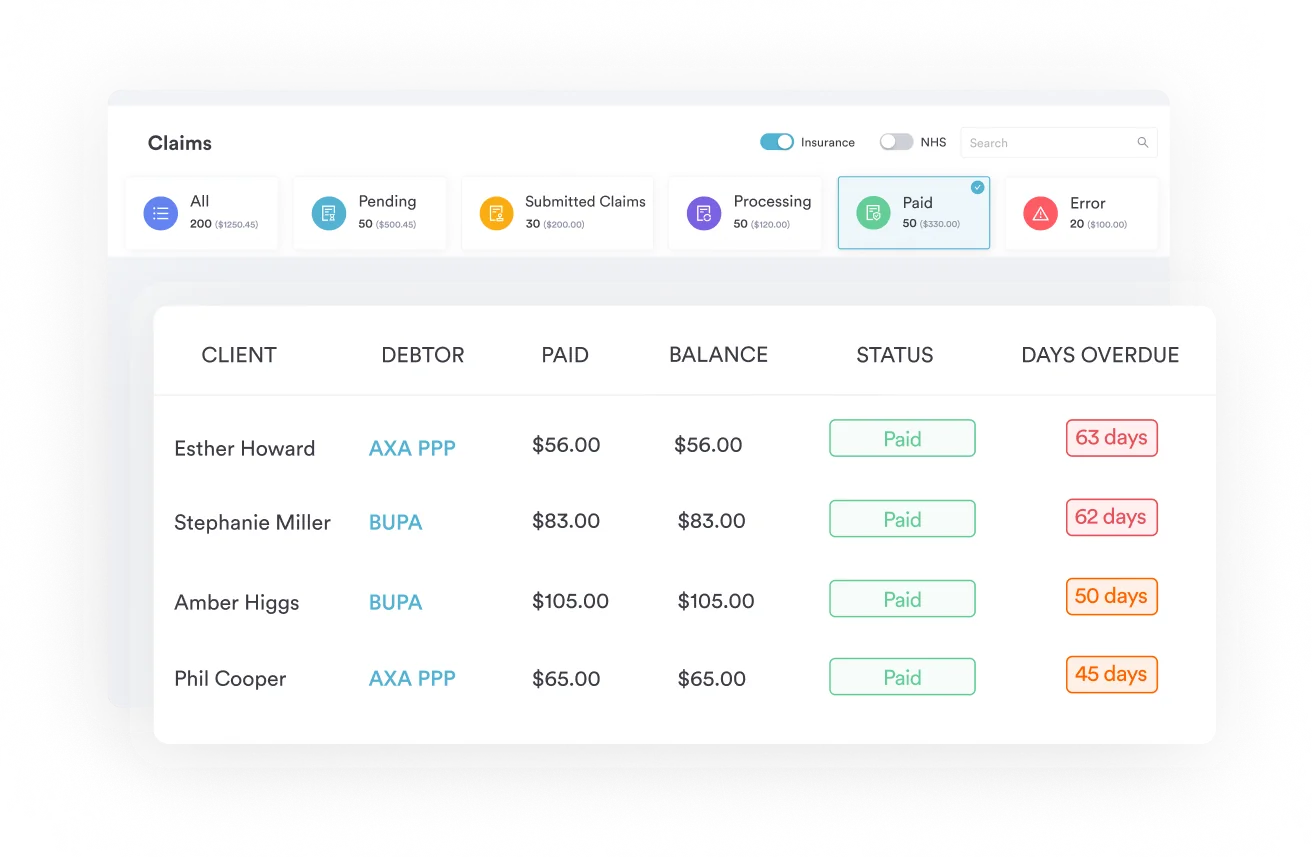
Pabau’s built-in reporting already gives every practice visibility into collections and accounts receivable. For multi-location groups, Insights Plus, Pabau’s additional reporting and analytics add-on, consolidates AR aging, collection rates, and outstanding balances across every location in one dashboard. Practice managers can identify which location or provider has the longest days in AR. They can then fix the workflow issue at the source, rather than discovering a collections problem at month-end.
See how the medical spa software integrates these capabilities for aesthetic practices specifically.

Pabau brings invoicing, automated payment reminders, and online collections into one platform built for independent practices. See how practices are closing the difference between billed and collected.

Patient collections failures are almost always process failures, not payment failures. Most patients are willing to pay. They just need a clear bill, a convenient way to pay it, and a timely reminder before the balance ages into bad debt.
Pabau’s integrated invoicing, automated payment reminders, and client portal give independent practices the same collections workflow that large billing departments run manually. Book a demo to see how it handles your patient collections process from first booking to final payment.

Wondering how your collection rate affects what your practice is worth? Practice valuation guide walks through the factors buyers scrutinize most closely.
Worried about where payments touch protected health information? HIPAA compliant payment processing explains what to check in your payment processor.
Need a signed form before you charge a card? Credit card authorization form is a one-page template with sample wording included.
Patient collection in medical billing is the process by which a healthcare provider collects the portion of a patient’s bill not covered by insurance. This includes copays, deductibles, coinsurance, and self-pay balances. It is distinct from insurance claims processing, which handles the portion billed to the payer.
A good patient collection rate is generally 95% or higher, according to MGMA and HFMA benchmarks. Most independent practices collect 50-70% of patient-owed balances. That shortfall is largely operational, and process improvements plus automation can close it.
In patient collections, the responsible party is the individual legally obligated to pay the balance owed to the provider. This is typically the patient themselves, or for minors, the parent or legal guardian. The guarantor on the intake form is the designated responsible party and should be confirmed at every visit.
Most practices refer accounts to a collections agency after 90-120 days of non-payment. This requires at least three contact attempts and a declined payment-plan offer. Document every contact attempt before referral, and confirm your Business Associate Agreement with the agency is in place for HIPAA compliance.
Patient collections works as a staged process with five steps. First, verify insurance and estimate costs before the visit. Next, collect copays and known balances at the point of service. Then send a clear statement within 5-7 days of insurance adjudication, and follow up with automated reminders on a 14-30-45 day cadence. Escalate to a collections agency only after exhausting these internal follow-up steps.