CRM for chiropractors: how to manage patients, bookings and marketing
A CRM for chiropractors is a patient relationship management system built around...

Last Updated: Oct 13, 2026

Men’s health patients hide their searches, so every local SEO tactic needs re-engineering for discretion first.
Google Business Profile is the biggest single lever on local visibility for a men’s health practice.
NAP details written differently across directories split your review signals between two entities.
A review request that never names the visit reason stays HIPAA-compliant and still earns replies.
Specialty directories such as the AUA’s Find a Urologist beat general listings for medical search intent.
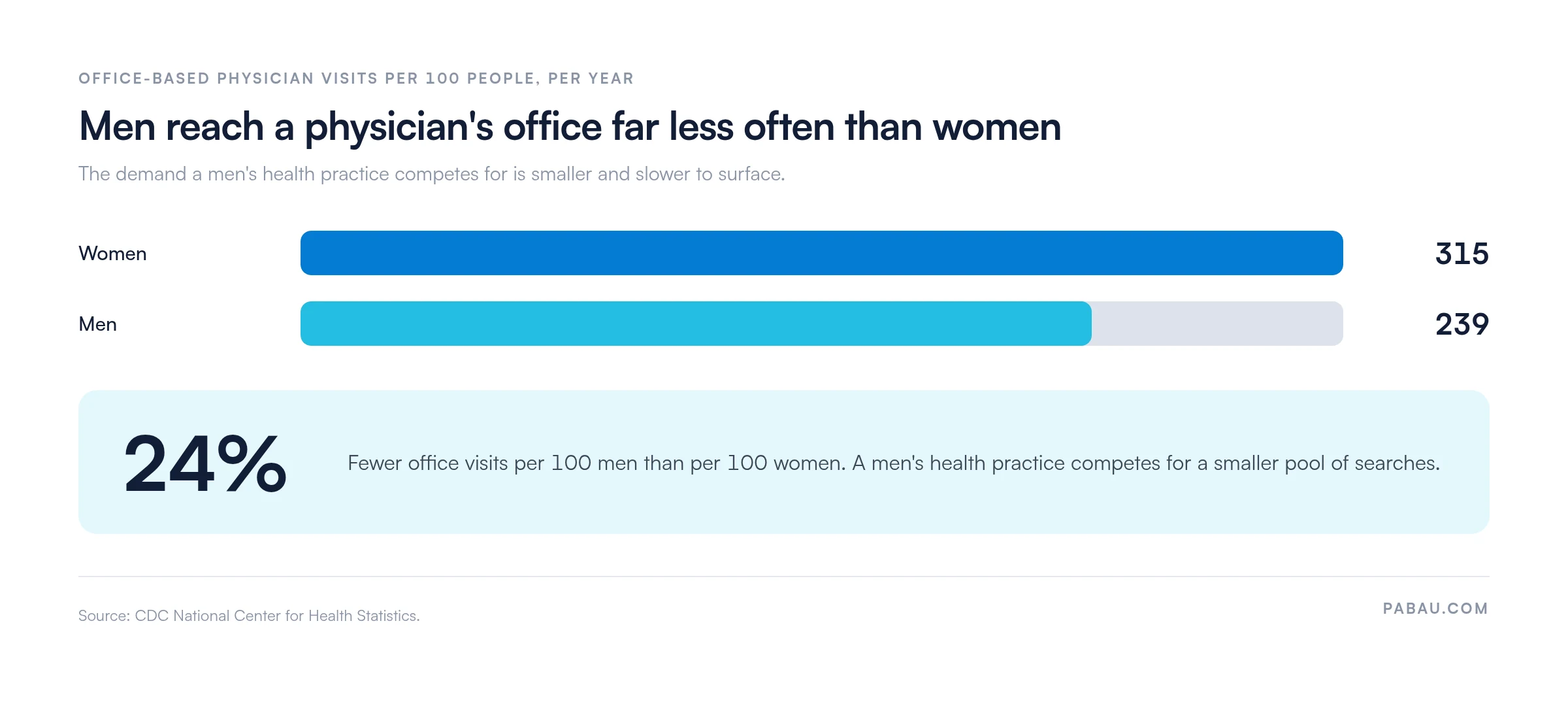
Local SEO for men’s health practices has to solve a discovery problem before it ever solves a clinical one. CDC data shows US men make roughly 239 office-based physician visits per 100 men each year, against 315 per 100 women. Men reach a physician’s office 24% less often as a result. The men who do search for ED treatment, testosterone therapy, or mental health support want a discreet provider nearby. They are not looking for a pitch from a national telehealth brand like Hims or Roman.
Plenty of that demand never reaches the practice closest to the patient. Contact details sit three clicks deep, directory listings show old addresses, and Google Business Profiles miss the categories patients actually search. The result is a steady leak of booked appointments. They go to whoever ranks in the local pack for “testosterone therapy near me” or “men’s health clinic [city]”.
Discretion is the design constraint that makes this specialty different, and it is the organizing idea of this guide. Call it the Discretion-First Local SEO Framework. Before you run a standard local tactic, ask whether it forces the patient to be seen searching. Review requests, social geo-tagging, and public testimonials all fail that test in their default form.
Most of this applies to healthcare SEO generally. Men’s health simply adds a privacy constraint that reshapes each tactic rather than removing it. One signal does transfer cleanly, though. Medical-reviewer credentials, license details, and named physician bios on your profile and site strengthen the trust signals Google weighs hardest in health topics.
The size of that shortfall is worth seeing before you plan a single tactic.
Men’s health clinic SEO differs from general practice marketing because patients hide searches for ED, testosterone, and mental health care, which changes which tactics work. The visibility mechanics are the same as any local business. The behavior on the other end of the search is not.
Local SEO determines which providers appear in Google’s local pack, the map-based block showing three businesses above the organic listings. BrightLocal’s analysis notes that at least 93% of Google searches with local intent return a local pack. Almost every patient typing “men’s health clinic near me” sees those three spots before any organic result. More than 75% of patients research providers online before booking.
Men’s health practices operate in a privacy-sensitive vertical. Patients rarely want a search history linked to ED medication or hormone therapy. They browse privately, skip social check-ins, and avoid review platforms that require a full name. That behavior rewards anonymized engagement and location signals over social proof.
The traditional local SEO playbook also collides with HIPAA. Every tactic has to protect patient confidentiality while it runs. A review request that references a specific treatment can become an impermissible PHI disclosure once the patient replies in public. Compliance works as a design input here, not a final-step review.
Most local SEO advice for doctors treats category selection as a one-line task, telling you to pick the nearest medical category and move on. Men’s health needs more granularity than that. “Medical Clinic” and “Men’s Health Physician” pull completely different query sets, and the second one is where the appointments are.
Search intent also varies by treatment category. “Low testosterone doctor” signals a patient researching ongoing care. “Walk-in STI testing” signals immediate need, where proximity outweighs reputation. Your strategy has to serve both the research-phase query and the transactional one.
Online booking inside practice management software like Pabau surfaces open slots directly. That removes the friction men avoid most, which is asking for the appointment out loud. Once the slot is booked, a ready initial consultation note keeps the first visit short and documented.
Google Business Profile is the single biggest lever on local healthcare visibility, because every field you complete feeds the ranking model behind the local pack. Business category, service menu, and appointment URL all count. A documented case study of Huddle Men’s Health Clinic showed targeted profile work producing #1 rankings and 20X organic traffic growth in twelve months.
An incomplete profile or a wrong primary category caps local pack potential before you write a single blog post. Fixing both costs an hour in the profile dashboard and no money at all.
Choose one primary category and make it the most specific accurate description of your practice, because Google weights that single field heavily. “Men’s Health Physician” ranks a practice for testosterone, ED, and preventive care queries. “Urologist” pulls surgical and specialist searches. “Medical Clinic” dilutes specificity and loses to targeted competitors.
Run a competitor audit before you commit. Search your city’s top men’s health query and note the primary category on every local pack result. Match their specificity or exceed it.
Then add secondary categories with restraint. “Endocrinologist” captures hormone therapy searches and “Mental Health Clinic” targets men’s counseling queries. Keep to roughly five relevant categories, because more is a known spam-filter trigger. A profile that stacks a dozen entries like “Weight Loss Service” and “Hair Transplantation Clinic” alongside core services usually gets downranked for category stuffing.
List every service in patient search language rather than clinical shorthand. “Testosterone Replacement Therapy” performs better than “TRT” or “Hypogonadism Treatment”. Include pricing where you can, because a patient who has already cleared the cost question is far more likely to tap “directions”. Service-level pricing also gives Google a structured field to match against queries like “affordable TRT [city]”.
Structure the menu by patient journey stage. Group preventive screenings such as PSA tests and cholesterol panels separately from treatment services such as ED prescriptions and hormone pellet insertion. Patients searching “men’s wellness exam Phoenix” then see your preventive offerings first. Those searching “ED injection therapy Phoenix” land on treatment services instead.
NAP stands for name, address, and phone number, and it must match exactly across every online property. That means the website footer, directory listings, social profiles, and the patient portal. Inconsistencies confuse Google’s entity recognition.
The common failure is the same suite written two ways. “123 Main St, Suite 200” on the website and “123 Main St #200” in a medical directory can read as two separate entities. Google then splits review signals and citation authority between them. Standardize the formatting: spell out “Suite”, use state abbreviations consistently, and include or exclude country codes uniformly.
Implement LocalBusiness schema markup on your site as well. Structured data tells search engines what your practice offers and where, so include opening hours, accepted payment methods, and booking URLs. Men’s health practice software with built-in schema generation saves technical implementation time. Test the markup with Google’s Rich Results Test, because errors here hit local rankings directly.
Citations are mentions of your practice name, address, and phone number on third-party sites, and specialty directories carry more weight than general ones. Each mention validates your location to search engines. High-authority medical listings beat low-quality aggregators by a wide margin.
Start with the core healthcare directories. Claim and complete profiles on Healthgrades, WebMD Physician Directory, and Vitals, which rank well for “[specialty] near me” searches. Backlinks from medical associations and industry directories strengthen credibility signals too. Audit the top eight directories already ranking on page one for your target queries, because Google already trusts those for your specialty.
Guidance written for hospital SEO points toward broad institutional listings and health-system directories, which suits an organization with twenty departments. A men’s health practice gets more from a short list of niche, specialty-specific directories.
The American Urological Association’s “Find a Urologist” and the Sexual Medicine Society of North America’s provider directory both signal topical relevance directly. Regional men’s health networks do the same job at city level. Advocacy nonprofits and patient support communities are not directories, so they carry no citation value.
Discretion changes how you should read that list. A patient who will not leave a public Google review will still read a specialty directory profile before calling. Those listings do double duty as a trust surface. The table below sorts the directories this article names by what each one buys you.
| Directory | Type | Why it matters for men’s health SEO |
|---|---|---|
| Healthgrades | General healthcare | Ranks on page one for “[specialty] near me”, so a complete profile intercepts the search before your own site does. |
| WebMD Physician Directory | General healthcare | A recognized brand that reassures a patient researching symptoms anonymously, before they are ready to name a practice. |
| Vitals | General healthcare | Another high-authority profile carrying your NAP, which reinforces the location signal Google is trying to match. |
| SMSNA “Find a Provider” | Sexual medicine specialty | A member listing that reaches patients searching for ED and hormone care, and it doubles as a credential signal. |
| AUA “Find a Urologist” | Urology specialty | An association listing that doubles as a credential signal, which matters in a YMYL vertical like this one. |
| Regional men’s health networks | Local specialty | Combines specialty relevance with geographic proximity, the two signals the local pack weighs most. |
| Yelp, Yellow Pages | General business | Worth claiming for NAP consistency alone. They rarely decide medical search intent, so do not lead with them. |
Audit existing citations quarterly. Tools like Moz Local or BrightLocal scan for NAP inconsistencies across 50 or more directories. After a phone number change, expect a long tail of stale listings that quietly split call-tracking data and misroute patients for years. Fixing them consolidates the citation profile and usually improves local rankings within a few audit cycles.
Avoid citation-building services that spam low-quality directories. A sudden burst of hundreds of new citations across unrelated sites is one of the clearest manipulation signals Google reads. That pattern routinely triggers profile suspensions. Twenty authoritative citations outperform 200 irrelevant ones.
A compliant review request asks the patient to rate their experience without ever naming the treatment, the condition, or the reason for the visit. Reviews still move local rankings and still influence booking decisions. The constraint is on the wording and the trigger, not on asking at all.
In practices we onboard, the review workflow is almost always the first one we rebuild. The old version is a receptionist deciding case by case who seems comfortable enough to ask. That is a compliance risk and an inconsistent review stream at the same time.
Send review requests 48 to 72 hours after non-sensitive appointments such as annual wellness exams or preventive screenings. Patients who visited for routine care feel more comfortable leaving public reviews. Never request a review straight after an ED consultation, STI testing, or a mental health session. Those requests trigger privacy concerns that cut response rates and raise complaint risk.
Here is the request itself, written to the Discretion-First rule. Copy it and change the practice name.
The last four words of that message are the part that matters. “No details needed” tells a man who booked an ED consultation that nobody expects him to write about it. That fear is what kills response rates in this specialty.
Automate the trigger rather than the judgment call. Review management tied to your scheduling system can fire requests by appointment type. Configure the rules once. Wellness visits get a Google review link, and sensitive consultations get an internal satisfaction survey instead. That survey never asks for a public testimonial.
Respond to every review, positive and negative, without disclosing protected health information. A compliant response thanks the patient and invites them to discuss concerns privately. The precedent is documented. In 2022 the HHS Office for Civil Rights imposed a $50,000 civil monetary penalty on a dental practice. That practice had disclosed a patient’s PHI in a public reply to a negative Google review.
Monitor platforms beyond Google as well. Patients leave men’s health reviews on Healthgrades, RateMDs, and specialty forums. Forum posts naming specific staff or describing treatment protocols can rank on page one for your practice name within days. Most platforms have a dispute process for content that breaches their privacy policies, so catching those posts early gives you options.
Google prioritizes content that demonstrates local expertise. A generic “Testosterone Therapy 101” post ranks behind one titled “Testosterone Replacement Therapy in [City]: Insurance, Costs, and Local Providers”. Locally relevant medical information improves rankings and patient trust together.
Generic healthcare SEO advice rewards broad educational pages that answer a condition question for anyone, anywhere. Local rankings reward the opposite. Write treatment-specific pages tied to one city and one set of insurers.
Address that local intent directly. If your city has high testosterone therapy volume, write “Testosterone Therapy Costs in [City]: What Insurance Covers” instead of a national pricing guide. Reference local insurers such as Blue Cross Blue Shield of Arizona or Florida Blue. Add regional health factors and state-specific rules like California’s AB-890 on nurse practitioner autonomy.
Publish service area pages for nearby suburbs and neighborhoods too. A practice in a large metro can build “Men’s Health Services in [neighborhood A]” and “ED Treatment in [neighborhood C]”. Give each page genuine detail on parking, transit, and nearby pharmacies. Those hyper-local pages capture long-tail searches a single main location page will always miss.
Then take the local link opportunities. Sponsor community health events, partner with local gyms for men’s wellness workshops, or contribute to regional health publications. A handful of gym or community-center partnerships each produce one genuine inbound link. That beats a quarter of generic guest posts for “men’s health [city]” rankings. Google is rewarding community presence here, not link count.
SEO for clinic groups with multiple locations means every site gets its own Google Business Profile, its own page URL, and its own written content. Sharing any of the three is what collapses a multi-site group into one weak listing.
Give each location a profile with its own address and its own local phone number. A single central number routed to every site makes the locations look like duplicates of one entity. Name the physicians who actually work at that site, and set that site’s real opening hours.
Then hold NAP consistency across the whole group. Every location’s address format has to follow the same convention, on your site and in every directory. A group with six sites has six times the surface area for the suite-number mismatch described earlier.
Build a dedicated page per location, with local team bios, parking instructions, nearby landmarks, and the insurance plans accepted at that site. The failure pattern is publishing near-identical pages that differ only by address. Google flags those as thin or duplicate content and suppresses them in the map pack. Roughly 300 words of genuinely site-specific information is the consistent fix.
Service-area pages then sit underneath each location page rather than beside it. That structure tells Google which site serves which suburb, which is the question a “[service] near [suburb]” query is really asking.
Voice queries arrive as full spoken questions with the location implied, so pages written around keyword density lose to pages written the way patients talk. Patients ask an assistant for a “men’s health clinic open now” or a “testosterone doctor near me”. Both phrasings are conversational and question-shaped.
Structure content in those natural question formats. Build FAQ sections around the questions patients ask aloud. Good ones include “What does a men’s health clinic treat?” and “Do I need a referral for ED treatment?”. When you write them, cite the studies behind any clinical claim to strengthen credibility.
Voice assistants pull answers from featured snippets and structured FAQ schema. A well-built FAQ page carrying 10 to 15 voice-shaped questions can become a practice’s main voice-search entry point within a quarter.
Keep mobile largest contentful paint under roughly 2.5 seconds. Google prioritizes fast-loading sites for mobile and voice searches, so compress images, remove render-blocking scripts, and use a content delivery network. Cutting load time from 4-second territory to under 2 seconds routinely drops bounce rate and lifts local search traffic.
Implement click-to-call site-wide. Display the phone number prominently with tap-to-call markup in the header, the footer, and on every service page. Track those clicks as a distinct conversion event, separate from desktop form submissions. Without that split, mobile call volume hides inside the same dashboard as web form leads, and the channel driving bookings gets undervalued.
Most of the work above lands on the front desk. One person remembers which patients can safely be asked for a review. Another keeps the NAP straight across six directories. The call log lives in a phone carrier’s dashboard that nobody opens twice a month.
Pabau moves the Discretion-First rule out of memory and into configuration. You set which appointment types trigger a public review link and which trigger an internal survey. The system then applies that rule to every visit, so a locum covering reception on a Friday cannot get it wrong.
Multi-location groups get the same benefit on the scheduling side. Each site keeps its own calendar, staff, and opening hours, while the client record follows the patient between them. A patient who books at one location and rebooks at another stays one record, not two.
Tracking is where most local SEO work goes quiet. Google Business Profile Insights tells you how many people tapped “call”. Google Search Console tells you which queries surfaced the practice. Call tracking tells you the phone rang. None of them knows whether the call became a patient who came back.
A bolted-on healthcare SEO service reports on the visibility layer and stops at the click. Pabau’s reporting starts there instead. The booking, the visit, the communications, and the rebooking all sit against one client record. You can measure which local queries produce patients who return.

Pabau’s patient communications trigger review requests by appointment type, so a sensitive men’s health visit never receives a public review link. Multi-location scheduling and reporting sit in the same record.

If you fix one item this week, make it the Google Business Profile. Confirm the primary category, standardize NAP across every directory, and route mobile traffic to a working click-to-call number. Citations, location pages, compliant review workflows, and voice-ready FAQs all compound on top of a clean profile.
The trade-off worth remembering is speed against trust. Discretion-first tactics build review velocity more slowly than an aggressive request campaign would. They also keep you out of the position that cost one dental practice $50,000, and they suit patients who chose you because you looked discreet.
Men’s health patients reward operational consistency over clever tactics. Book a demo to see how one men’s health practice runs review, scheduling, and follow-up from a single client record.

Examining a young male patient today? Cremasteric reflex explains how to elicit the reflex and what an absent result means for torsion.
Building out a hormone service line? Hormone pellet insertion walks through the procedure, from site preparation to aftercare instructions.
Adding STI prevention to your service menu? Doxy-PEP protocol sets out the CDC guidance a practice needs before it prescribes.
Standardizing your men’s wellness exam? Genitourinary physical exam is a clinical reference for the exam your service menu advertises.
Local SEO for doctors is the work of making a practice appear in Google’s local pack and map results for nearby patient searches. It covers the Google Business Profile, NAP consistency across directories, reviews, and location-specific pages. Men’s health local SEO is a specialized subset of that work. The same mechanics apply, but HIPAA and patient discretion decide how you can run each one.
Pay for scope rather than for a headline retainer figure, because local SEO is mostly a fixed setup job followed by light maintenance. Claiming your Google Business Profile, correcting NAP across directories, and building location pages are one-time tasks a practice manager can do in-house. An agency earns its fee on the work that recurs, such as content, citation audits, and review workflow design. Most price by monthly retainer, so ask what the deliverable is in month four. A provider that cannot name one is selling you a report.
Send generic review requests that never reference why the patient visited. Use automated workflows triggered by appointment type, so wellness visits get review requests and sensitive consultations do not. Never mention treatments, conditions, or medical information in review request text. Compliant language: “Thanks for choosing our practice. If you’re comfortable, please share your experience on Google.” Non-compliant: “Thanks for your testosterone consultation. Please review us on Google.”
Citations are mentions of your practice name, address, and phone number on third-party websites, typically directories. They don’t need to link to your site. Backlinks are hyperlinks from other websites to yours. Both matter for local rankings, but citations validate your location while backlinks signal authority and relevance. Focus on citations first (Healthgrades, WebMD, Vitals), then build backlinks through local partnerships and community involvement.
Social signals carry minimal local SEO weight compared with Google Business Profile optimization and citations. Men’s health patients rarely engage publicly on social platforms because of privacy concerns. Use social media for branded searches and reputation management instead. Maintain active profiles so patients searching “[practice name] Facebook” find current information, but don’t expect social activity to improve local pack rankings.
Google Business Profile optimizations show results within 2 to 4 weeks. Citation building and cleanup take 6 to 8 weeks to affect rankings. Content-based strategies such as location pages and blog posts require 3 to 6 months to gain traction. Review velocity improvements appear within 4 to 6 weeks of implementing compliant request workflows. Local SEO is cumulative, so each tactic builds on previous work. Expect meaningful ranking improvements within 90 days of consistent implementation.
Yes. Each physical location requires its own profile with a unique address, phone number, and content. Never create profiles for areas you don’t physically serve, because Google penalizes virtual locations. Multi-location practices should create individual profiles, then link them through a shared website with dedicated location pages. This structure maximizes visibility for “[service] near [suburb]” searches across all your service areas.
Telehealth practices face limitations, because Google requires a physical location for a Business Profile. If you operate from a registered office, create a profile and mark it as “online appointments only” with service area coverage. Focus on organic local content instead, such as “[city] testosterone therapy: telehealth options” targeting location-specific searches. State licensing determines where you can practice, so content should only target states where you hold active medical licenses.