Fertility clinic marketing: Strategies that attract & convert patients
Fertility clinic marketing is how a fertility practice attracts, educates, and c...

Last Updated: Oct 14, 2026

A massage gift certificate is a prepaid voucher for a named service, so it brings your practice cash upfront and first-time clients.
Federal law under the Credit CARD Act keeps every gift certificate valid for at least five years from the purchase date.
California and Washington prohibit expiration dates entirely, and Massachusetts requires a minimum seven-year validity period.
Eight fields make a certificate usable: practice name, contact details, the service, the value, both dates, a certificate number, redemption steps, and terms.
Practice management software like Pabau sells, delivers, and tracks vouchers, so redemption and expiration stop living in a spreadsheet.
A print-ready certificate with fields for the recipient, the service booked, the value, and both the issue and expiration dates. It also carries a certificate number, your terms and conditions, and the redemption steps your front desk follows.
Download templateA massage gift certificate is a prepaid voucher that lets one person buy a treatment for another. For your practice, that is money today against a service you deliver later. It also brings in people who have never booked with you before.
Design templates are easy to find. What they leave out is the compliance and accounting side, which is where certificates usually cause trouble. This guide covers the eight fields a certificate needs and the expiration rules that apply in your state. It also sets out the redemption workflow that keeps unclaimed value tracked.
A massage gift certificate entitles the holder to a named massage service, or to a dollar credit, at your practice. Unlike a retail gift card, it has to turn into a booking. Someone schedules the recipient, delivers the treatment, and reconciles the payment against the original sale.
For the buyer, the appeal is certainty. They know the recipient gets a treatment from a licensed therapist rather than a guess at a present. For you, the sale lands months before the work does, which is why the accounting treatment matters.
Gift recipients also arrive as new clients with their first visit already paid for. Whether they come back is a retention question, so treat the redemption visit like any first appointment. Confirm what they want, capture their history, and rebook before they leave. Start a massage log at that first visit so the next therapist knows what worked.
Eight elements make a certificate usable at the front desk. Miss one and somebody ends up guessing at checkout. Pair the certificate with digital intake forms so the recipient’s health history is on file before the massage starts.
Federal law gives every gift certificate at least five years of validity from the purchase date. Several states go further, and a few remove expiration dates altogether.
The federal floor. The Credit CARD Act of 2009 and the Consumer Financial Protection Bureau’s implementing rule require gift certificates to stay valid for at least five years. You cannot expire one sooner, and the expiration date has to be printed clearly on the certificate itself.
State rules. California and Washington prohibit expiration dates on gift certificates entirely. Massachusetts requires a minimum seven-year validity period, and a Massachusetts certificate becomes perpetual only when no expiration date is printed on it. Other states permit expiration but set their own minimum. Check your state attorney general’s office, because these rules are amended periodically.
Inactivity fees. Federal rules bar dormancy and service fees in the first year after purchase. After that they are capped at one per month and must be disclosed on the certificate. For a single-site practice, charging none at all is simpler and reads better.
Revenue recognition. Most practices book a certificate sale as deferred revenue and recognize the income when the massage is delivered. Your accountant will want the outstanding balance tracked. Some states also apply unclaimed property rules to unredeemed value, so ask which apply to you.
Sports medicine clinics manage programs like this in sports medicine software, tracking recovery milestones for each athlete.
Three delivery methods cover almost every buyer. The right mix depends on who is buying from you. That might be a corporate account, a regular client, or someone shopping at 9pm on Christmas Eve. Most wellness practice software can issue all three from the same record.
Offering all three costs little. Default to email, make print at home free, and charge $2 to $5 for a physical card to cover the printing and envelope. Price that add-on the same way you would price anything else in your pricing strategy.
A single generic voucher leaves money on the table. Three variations cover most of what people actually want to buy.
Couples massage. The anniversary and Valentine’s Day seller. Write “two simultaneous 60-minute sessions” on the face of it, so nobody turns up expecting to split one hour between two people. Price it as a package rather than two separate certificates.
Prenatal and postnatal massage. A dedicated certificate signals that you have a therapist trained for it, which is the buyer’s main worry. Send your massage intake form with the booking confirmation, and print any contraindication note on the certificate itself.
Spa packages. Bundle the massage with a facial, a body scrub, or sauna access. The higher price point suits corporate buyers, and the recipient meets more of your menu in one visit. Packages work well alongside membership programs for the same reason.
Redemption is where certificates go wrong, usually because two people handle the same voucher and neither writes anything down. Give the team five steps and keep them the same every time.
Keep one record of every certificate you issue. It needs the certificate number, the sale date, the value, the expiration date, the recipient, the redemption date, and the service delivered.
The same log answers your accountant’s first question at year end. Unredeemed certificates are a liability sitting on your balance sheet, and you cannot size that liability from memory or from a drawer of paper stubs.
If your current setup cannot produce that list on demand, it is worth comparing wellness clinic software that tracks vouchers natively. A spreadsheet works until two people edit it in the same week.
Most practices run certificates on paper and memory. A spreadsheet lists what sold and the front desk checks it by hand. Nobody spots an expired voucher until someone is standing at the counter holding it.
Practice management software like Pabau handles the whole lifecycle instead. Clients buy a voucher from your website. Inside spa practice management, the balance sits on the client record where any therapist can see it.
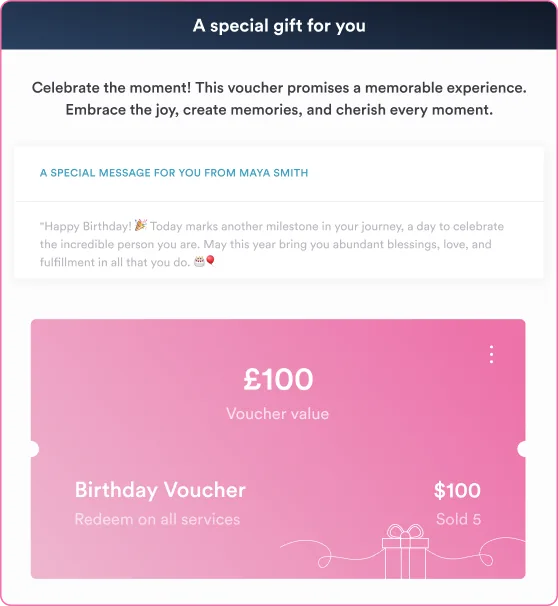
Redemption is one click at checkout, and an expired or already-used certificate is flagged before the therapist starts. Automated delivery emails the buyer and the recipient.
That also opens the door to upsells. Someone redeeming a $75 certificate can move up to a hot stone session for $25 more. The front desk sees that option at the point of booking.

Pabau sells gift vouchers from your website and delivers them by email with a personal message. Every redemption and expiration date is tracked against the client record. Your front desk stops checking a spreadsheet at checkout.

The certificate itself is the easy part. What decides whether gift sales help or hurt is the record behind them. A voucher nobody logged is a liability you cannot size and a dispute you cannot settle.
So set the expiration date to whatever your state allows and print it on the face of the certificate. Log every sale the day it happens. Then plan the redemption visit properly. That first massage is your only chance to turn a one-time gift into a regular client.
Book a demo to see how Pabau sells, delivers, and tracks gift certificates alongside your bookings and payments.

Choosing software for your practice? top salon software platforms compares seven salon software platforms for UK beauty businesses, covering pricing and feature differences.
Deciding how to structure your business? booth rental vs commission compares booth rental and commission pay models and how each affects day-to-day salon operations.
A usable certificate carries eight things. Those are your practice name, contact details, the service, the value, both dates, a certificate number, redemption instructions, and your terms. A certificate showing only a dollar amount creates arguments at checkout.
Usually yes, but not for at least five years. The federal Credit CARD Act sets that floor from the date of purchase. California and Washington prohibit expiration dates entirely, and Massachusetts requires a minimum seven-year validity period. A Massachusetts certificate becomes perpetual only when no expiration date is printed on it. Check your state attorney general’s office, since these rules change.
Download the template at the top of this page and open it in any PDF editor. Fill in your practice name, the service, the value, and both dates, then print it or send it by email. For any volume, sell and track certificates through your practice management software instead.
US law treats the two terms the same way. In everyday use, a gift card is a plastic card with a code and a certificate is a printed voucher. What matters more is whether the value is tied to one named service or usable across your whole menu.
Sell them from your own website through practice management software like Pabau, which takes the payment, emails the voucher, and tracks redemption for you. A simpler setup is a product page on your site plus a branded PDF you send by email.
Sales tax generally applies at redemption, when the certificate pays for a taxable service, rather than when the certificate is sold. Income treatment is separate, and most practices defer the revenue until the massage is delivered. Ask your accountant or state tax authority, since the rules vary by jurisdiction.