CRM for chiropractors: how to manage patients, bookings and marketing
A CRM for chiropractors is a patient relationship management system built around...

Last Updated: Oct 13, 2026
Yes, a private GP can refer to NHS specialists directly, as long as the patient would be eligible for that NHS referral anyway.
The private GP assesses the patient and sends the referral to the NHS Trust, by a route the two agree. Private GPs cannot use the NHS e-Referral Service (e-RS), so some Trusts still ask for routine cases to come through the patient’s NHS GP. Urgent suspected cancer referrals should be accepted either way.
NHS eligibility and clinical criteria still decide the outcome. A private referral adds clinical detail to the NHS decision, but it does not move the patient up the NHS queue.

A private GP can refer directly to NHS services, provided the patient would be eligible for that NHS referral.
Private GPs have no e-RS access, so they refer by letter or secure email. Some Trusts still route routine cases through the NHS GP.
A private GP referral letter needs the history, the examination findings, any test results already completed, and the specialty requested.
Urgent suspected cancer referrals sent outside e-RS should not be rejected, and emergencies go straight to A&E or the on-call team.
Pabau, the practice management platform we build, keeps the referral letter on the patient record, so the practice can confirm it was received.
A private GP referral reaches an NHS specialist in four steps. Where the Trust accepts direct referrals, none of them needs the NHS GP.
BMA guidance on private healthcare says private providers can refer to NHS services without going back to the GP. The one condition is that the patient would be eligible for NHS referral.
What private GPs lack is access to e-RS, the referral system NHS GPs are required to use. The private practice and the receiving Trust agree another route instead. NHS GP practices should not routinely be asked to re-create these referrals.
Almost all NHS specialist services need a GP referral before an appointment can be booked. In practice, some Trusts and integrated care boards (ICBs) still insist on an NHS GP referral for routine cases. Many are routed through the patient’s NHS GP as a result. That requirement is set locally, with no national rule behind it. The diagram below shows the three routes.
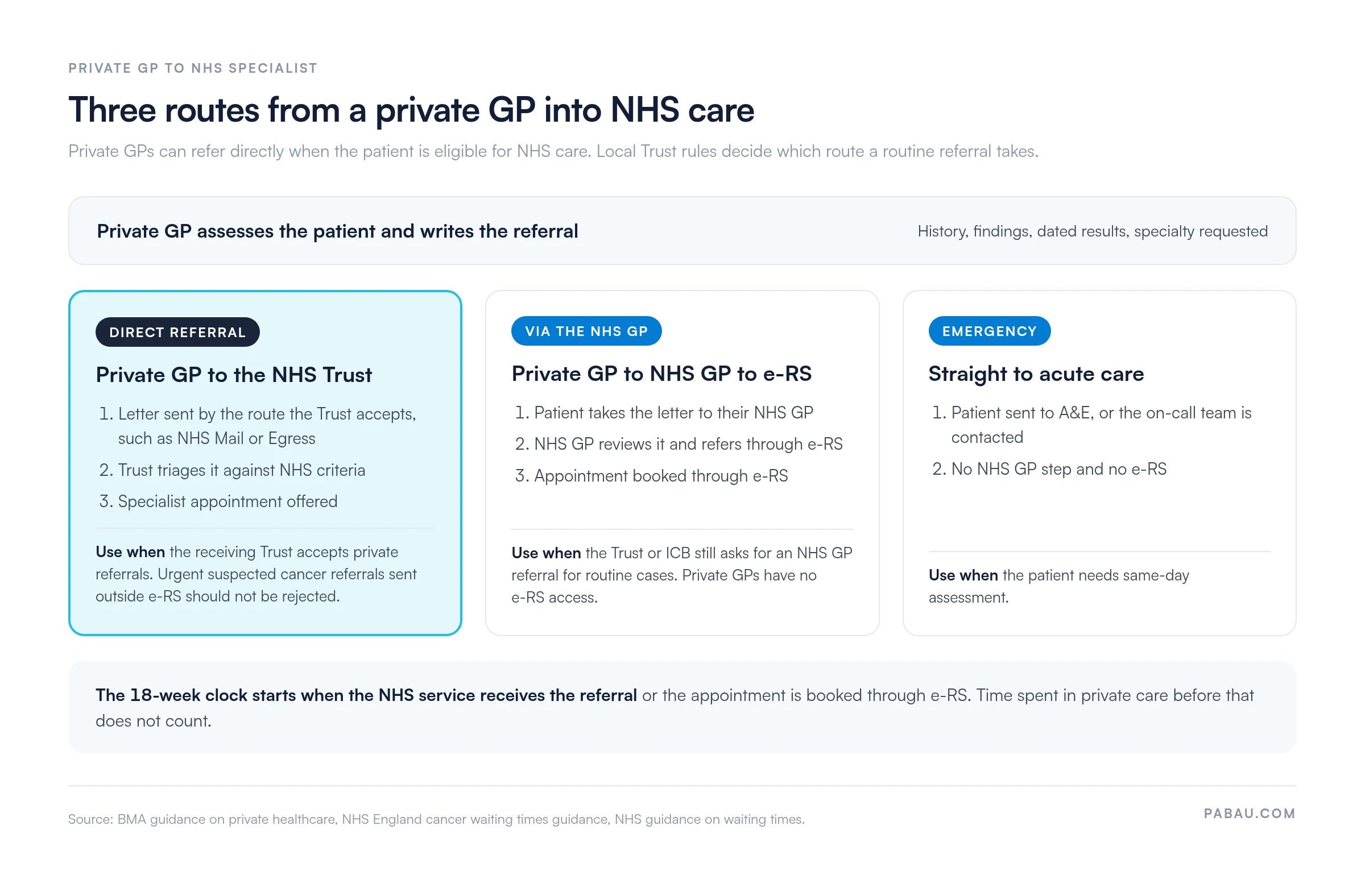
The timing follows from that sequence. NHS guidance sets a maximum 18-week wait for non-urgent, consultant-led treatment. That clock starts when the appointment is booked through e-RS, or when the service receives the referral letter, according to NHS guidance on waiting times. The private appointment that began the process does not start it.
Urgent cases follow their own rules. NHS England cancer waiting times guidance says urgent suspected cancer referrals received outside e-RS should not be rejected, for patient safety. A patient who needs emergency care goes straight to A&E, or the private GP calls the hospital’s on-call team.
The NHS GP holds the patient’s central NHS record, and a private consultation appears there only when someone sends them a copy of the letter.
Private care is not written into NHS records automatically. No shared system connects a private practice to NHS primary care. The referral letter is the transfer mechanism, and how a GP referral works has not changed because the first appointment was paid for.
The NHS GP’s gatekeeping role applies to NHS referrals they make themselves. A private GP who refers directly carries the clinical responsibility for that referral instead. The NHS GP stays involved in two ways:
In that second case, the NHS GP applies NHS criteria and may reassess the patient before referring.
A private GP referral letter should carry the history, the examination findings, any test results already completed, and the specialty being requested.
A Trust triaging a thin letter usually returns it or asks for more detail, and an NHS GP usually reassesses the patient. Both outcomes add weeks. The letter has to give whoever receives it enough to act without starting again.
A GP referral letter for private treatment does a different job. That letter names a private provider and the patient pays, so no NHS eligibility test applies to it. A letter aimed at NHS treatment has to meet NHS criteria when it is triaged.
Dates matter more than they look. A clinician who cannot see when bloods were taken will usually order them again.
Yes. A referral written by a UK-registered online private GP carries the same standing as one written in person.
The delivery channel does not change the rules in either direction. An online GP consultation still produces a referral letter. The online provider can send it to the Trust directly, or the patient’s NHS GP refers where local policy asks for that.
NHS referrals do not travel the other way. e-RS routes NHS patients to NHS-commissioned services, so a private online provider is not a destination on it. The traffic runs one way, from the private consultation toward NHS care.
The evidence base behind the letter is what changes. An online GP who has not examined the patient cannot record examination findings. The letter then leans harder on history and on tests arranged separately. Flag that to the receiving clinician rather than leaving them to notice it.
Two checks are worth making before a practice relies on a virtual provider. Online GP services UK patients reach through an app should still be registered with the Care Quality Commission (CQC) in England. The prescriber should also be verifiable on the GMC register.
When the two systems line up, the patient gets the speed of private assessment and the depth of NHS secondary care. When they do not, the patient pays twice and waits anyway.
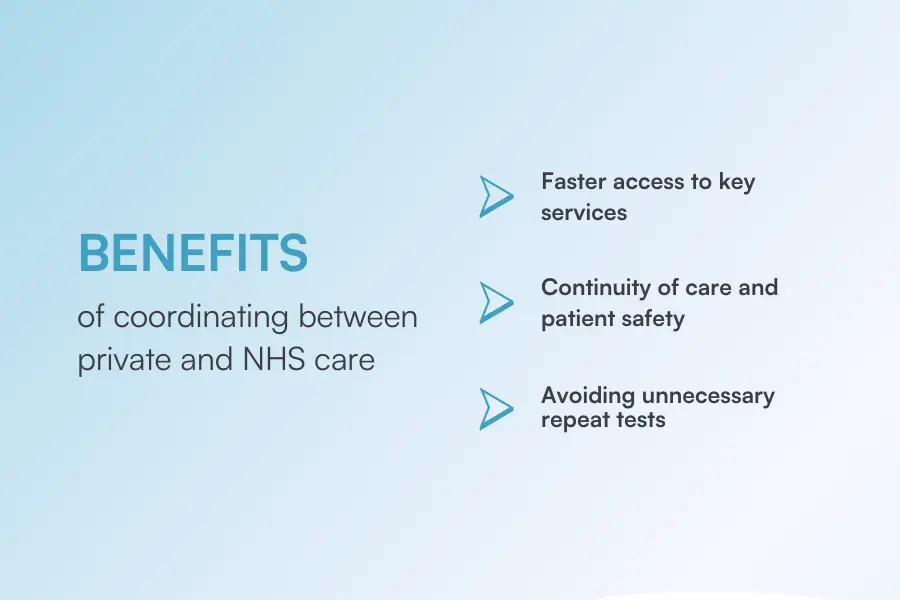
A private GP can usually see a patient within days rather than weeks. That shortens the time to a working diagnosis, which any referral needs before it can be written.
For a time-sensitive symptom, the private assessment can be the difference between a referral written this week and one written next month. The NHS wait that follows is unchanged, but it starts sooner.
Private doctors share information with the NHS through letters and reports sent to the NHS GP or the Trust, never through a shared record.
No live data connection exists between private practice systems and NHS primary care records. Diagnoses, results, and medication changes travel as documents, and a document nobody sends never arrives.
Medication history is the highest-risk item in that handover. A private prescription the NHS GP never sees can collide with what they prescribe next, which matters most for patients already taking several medicines.
Repeat bloods and repeat imaging are the usual cost of an incomplete letter. An NHS clinician who cannot see the result, the date, and the reference range will order the test again.
Sending results with the referral, rather than promising them later, is what prevents that. For the patient it is one fewer appointment. For the practice it is one fewer phone call chasing a lab.
Both routes end at the same NHS clinic, but only an NHS GP referral travels through e-RS, which some Trusts still require for routine cases.
| Private GP referral | NHS GP referral | |
|---|---|---|
| Who sends it to the NHS service | The private GP, or the NHS GP where local policy asks for it | The NHS GP, directly |
| Typical route | Private consultation, then a letter, NHS Mail, or Egress to the Trust | NHS consultation, then e-RS |
| What the patient does | Books and pays privately, and sends a copy to their NHS GP | Books with their registered NHS practice |
| When the 18-week clock starts | When the Trust receives the referral, not at the private appointment | At the e-RS booking |
| Record continuity | Private notes reach the NHS record only through the letter | Consultation and referral sit in the NHS record from the start |
| Main failure point | A letter sent by a route the Trust does not accept, or sent incomplete | Capacity, rather than the handover itself |
The row that decides most outcomes is the last one. A private referral has a handover in it, and a handover is something a practice can manage.
A private GP referral does not guarantee an NHS specialist appointment, so the practice should confirm how the receiving Trust handles it.
Patients can use a private GP referral for NHS treatment, provided the case meets NHS criteria. The private doctor can refer them directly, though their local Trust may ask for routine cases to come through their NHS GP.
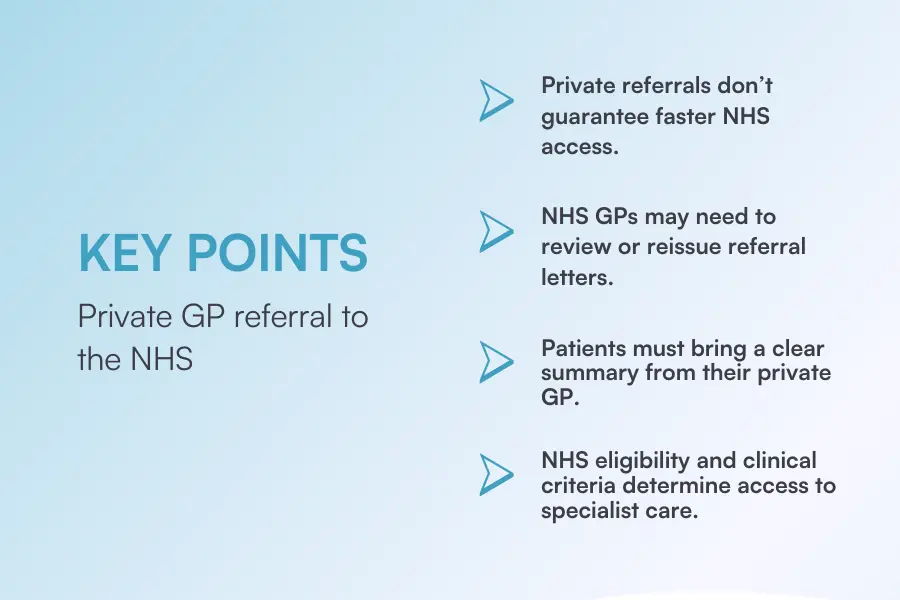
Where a routine case does go through the NHS GP, some act on the letter as written. Others prefer to reassess the patient and issue their own referral, which is a clinical judgment they are entitled to make. A practice that explains both outcomes upfront avoids the disappointed phone call.
Either way, NHS eligibility and clinical criteria still apply. NHS specialists review whether the case meets the requirements for publicly funded treatment, whoever recommended the referral.
A referral handoff holds together when the practice owns four steps, and the fourth one is confirming that the referral arrived.
Capture the clinical detail at the point of care. Writing the letter at the end of the day, from memory, is where examination findings and test dates get lost. A structured general practice intake form gathers medication, allergies, and past history before the consultation, so the letter starts half-written.
Write the letter inside the patient record. A letter saved to a desktop folder cannot be found by whoever picks up the follow-up call three weeks later.
Send it by the route the Trust accepts, with a date attached. Copy the patient’s NHS GP, and tell the patient roughly when to expect contact from the NHS.
Close the loop. Two weeks after the handover, someone checks whether the Trust received the referral, and the patient hears the answer either way.
Give that fourth step a named owner. Without one, the letter goes out, the patient assumes it is moving, and nobody learns otherwise until they call back weeks later.
Running outside NHS systems means no queue moves a referral on the practice’s behalf. That trade-off sits alongside the other benefits of private practice worth weighing before expanding.
Referral letters carry patient data, so GDPR and record-keeping standards govern how they are stored and sent. A CQC inspection checklist is a practical way to test whether that documentation holds up under scrutiny.
Referral tracking works best as a status on each referral. A practice that can filter for referrals sent but not yet confirmed can work through that list in a few minutes each week.
That capability decides more than the feature count when a practice is comparing software for GP practices. A system that stores letters but cannot report on their status leaves the same job on a spreadsheet.
Letter templates do the other half of the work. A template that already asks for test dates and the requested specialty stops an incomplete letter leaving the building.
Five beliefs cause most of the friction around private GP referrals, and each one comes down to who controls access to NHS care.
A private GP can only refer through your NHS GP. Private providers can refer to NHS services directly when the patient is eligible. The NHS GP route is common for routine cases because some Trusts and ICBs still ask for it, and because private GPs cannot use e-RS.
A private referral speeds up NHS access. NHS waiting times follow medical need and local capacity. A referral that started privately joins the same queue at the same point, carrying better clinical detail but no priority.
Private care means leaving your NHS GP. Patients stay registered with their NHS practice while using private services. The NHS GP continues to manage the overall record and can coordinate with private providers.
GP practices are part of the NHS. Most NHS GP practices are independent businesses holding an NHS contract, rather than NHS-owned organizations. They deliver NHS services and use NHS systems such as e-RS. That contract gives them e-RS access, which a private practice does not have.
The NHS cannot refer a patient into private care. NHS commissioners do send patients to independent providers under NHS contracts, at no cost to the patient. A privately funded referral to a hospital the patient chooses is a separate arrangement altogether.
Private practices usually handle the clinical side of a referral well. They assess the patient, write the letter, and explain what happens next.
Referrals stall later, once nobody is tracking them. Without a list of referrals sent and their current status, a practice cannot tell which letters reached the Trust or the NHS GP. Unconfirmed letters sit unanswered in an inbox.
In Pabau, the referral letter, the clinical notes behind it, and the follow-up task sit on the same patient record. Pabau’s letter templates send and store formal letters to GPs, specialists, and partners, so the practice holds a dated record of what went out.
Because the letter lives on the patient record rather than in a shared drive, the confirmation call starts from the record instead of a search. Every Pabau subscription includes the full platform, so letter templates, patient records, and reporting sit together rather than across three tools.

Pabau stores the referral letter, the clinical notes behind it, and the follow-up against the same patient record. Your team can see what was sent and when, instead of rebuilding the trail from an inbox.

A private GP can refer to NHS specialists directly, and the referral is a handoff that fails where ownership changes. Send the letter by the route the Trust accepts, write it so nobody has to reassess, and decide who confirms it arrived.
Tracking is the part worth fixing first. The practice that tracks its referrals is the one whose patients stop calling to ask what happened.
Want to see how Pabau keeps referral letters, patient records, and follow-up in one place? Book a demo and we will walk through the handoff with your practice.

Choosing a system for a private practice? Best EHR for private practice compares the options on cost, setup time, and how fast a new hire gets productive.
Running primary care across disconnected tools? Primary care software covers what records, scheduling, and reporting look like inside one system.
Got a CQC inspection coming? CQC inspection checklist sets out the evidence to have ready and the notice period you can expect.
Need a structured intake before the consultation? General practice intake template captures history, medication, and allergies before the patient sits down.
Weighing up going private? Benefits of private practice looks at the clinical and commercial trade-offs of working outside the NHS.
Only if the information is sent to your NHS GP. Private practices and NHS primary care share no record system. A private consultation reaches your NHS file when you or the private GP send a letter, so ask for a copy at the appointment.
Yes. A private GP can send an urgent suspected cancer referral directly to the NHS Trust. NHS England guidance says these referrals should not be rejected for arriving outside e-RS, for patient safety. Send it the same day and copy the patient’s NHS GP.
Usually not. Most private specialists will see a self-referred patient. Some ask for a GP letter, and most insurers require one before authorizing treatment. A private referral also hands the specialist the history and test results they would otherwise repeat.
Most are independent businesses holding an NHS contract, rather than NHS-owned organizations. They deliver NHS services, are paid by the NHS, and use NHS systems such as the e-Referral Service. A private GP practice holds no such contract, so it has no e-RS access, though it can still refer to NHS services directly.
Yes. NHS commissioners send patients to independent providers under NHS contracts, and the patient pays nothing for that care. An NHS referral to a private hospital the patient chooses and funds themselves is a separate arrangement, outside NHS funding.
Yes, if they judge that a referral is not clinically indicated or that NHS criteria are not met. They should explain the reason and what would change their view. You can ask for a second opinion within the practice, or go privately at your own cost.
Yes, and that is a different pathway from the one this article covers. A patient moving from private to NHS care joins the NHS waiting list from the NHS referral date. Time already waited privately does not count, and NHS and private care for the same condition must stay separate.