Journal prompts for mental health
Journal prompts for mental health are guided questions that help people process ...

1
Last Updated: Oct 13, 2026

A private therapy practice needs an active state license, a registered LLC or PLLC, and malpractice insurance before the first client.
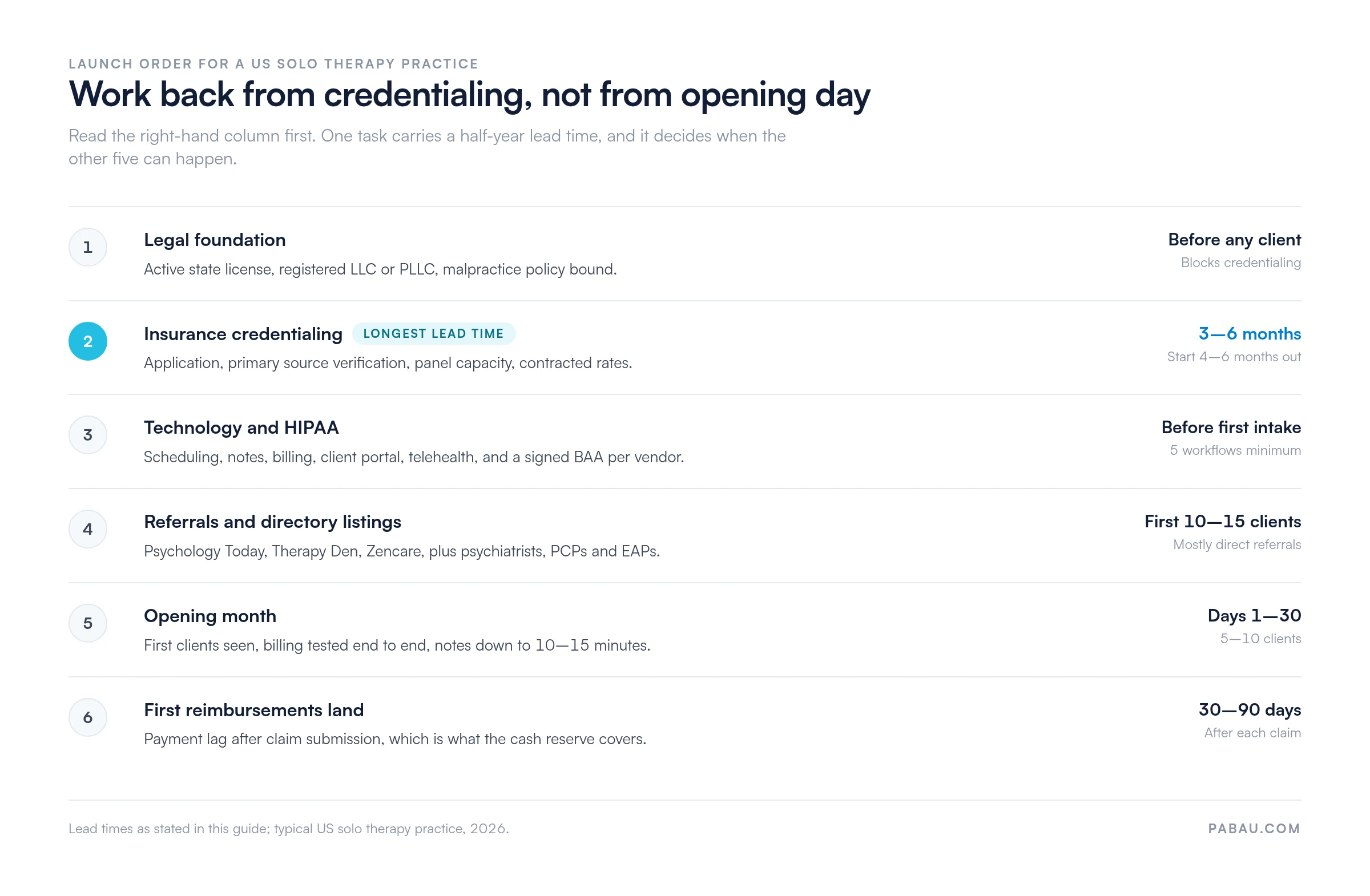
Insurance credentialing takes 3-6 months, so start it 4-6 months before your intended opening date.
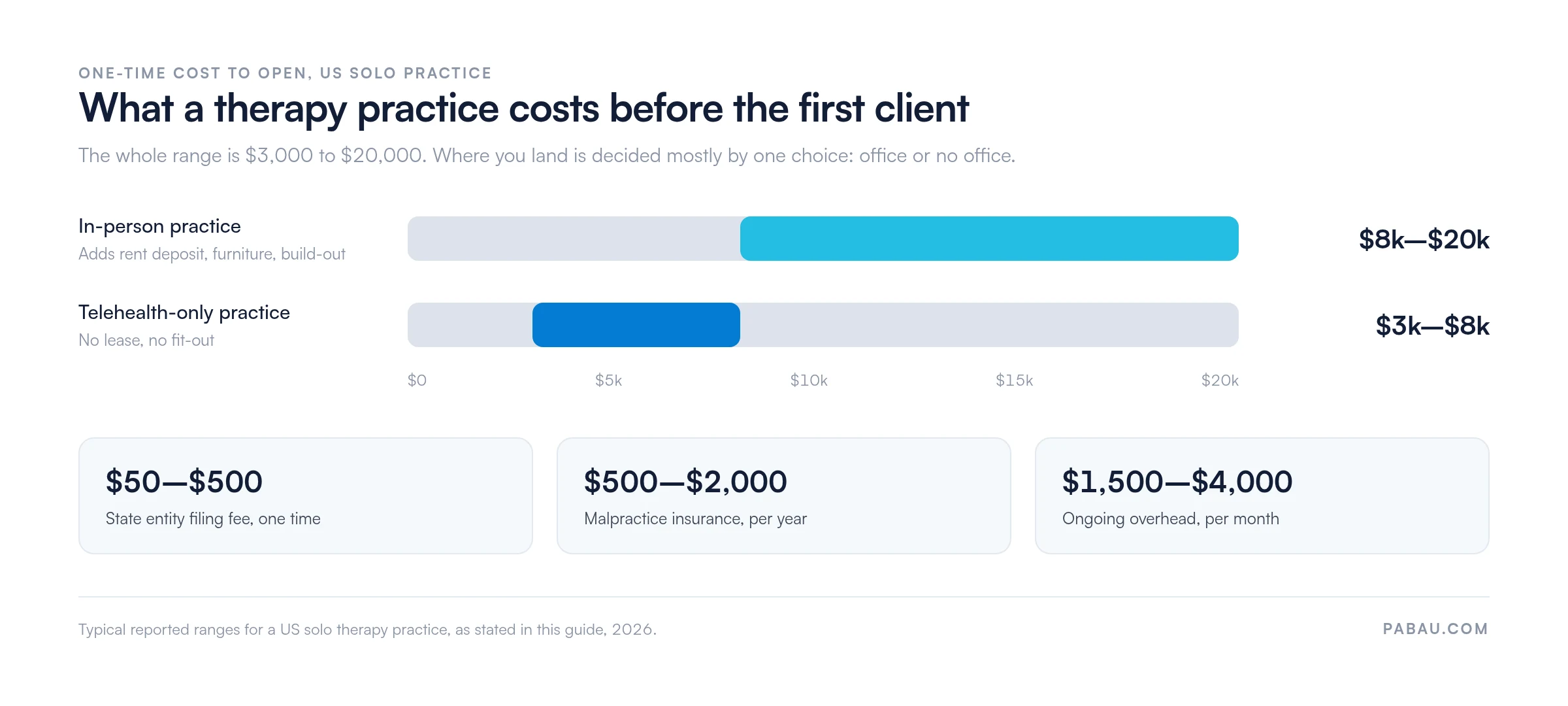
Startup costs run $3,000 to $20,000. A telehealth-only launch sits at the low end and an in-person practice at the high end.
Work back from credentialing rather than from opening day, because it is the only launch task with a half-year lead time.
Practice management software like Pabau covers scheduling, intake forms, notes, billing, and telehealth in one place, so a solo launch needs no second vendor.
Clinical training prepares you to treat clients. It does not prepare you to register a business entity, get credentialed with payers, set your fees, or pick an EHR. Those workstreams decide whether a practice opens on schedule or three months late.
The American Counseling Association notes that many clinicians launch a private practice while still employed elsewhere. They build a caseload gradually before making the full transition, which lowers the financial risk of the first year.
This guide is written for licensed mental health professionals: LCSWs, LPCs, LMFTs, licensed psychologists, and PMHNPs. It covers each workstream in the order you will meet it, from legal setup through technology and marketing.
One rule shapes the whole plan. Credentialing carries the longest lead time, so schedule every other task around it.
Before you schedule your first client, three legal requirements must be in place. You need an active license in your state, a registered business entity, and professional liability insurance. Skipping any one of them exposes you to regulatory action and personal financial liability.
Most new private practitioners choose between a sole proprietorship, an LLC, and a PLLC. A sole proprietorship requires no state filing and is the simplest option, but it gives you no liability protection. An LLC separates personal assets from business liabilities, which is why most solo practitioners pick it.
Not every state lets a licensed therapist form a standard LLC. Some require a PLLC, a professional limited liability company built for licensed professions. Check with your state licensing board and a local attorney before you file.
| Structure | Liability protection | State filing required | Best for |
|---|---|---|---|
| Sole proprietorship | None | No | Testing the waters part-time |
| LLC | Yes, personal assets protected | Yes | Solo practitioners in most states |
| PLLC | Yes, and required for licensed professionals in some states | Yes | States that restrict LLC formation for therapists |
Your license must be active and in good standing in the state where you practice. For telehealth, that usually means holding a license in every state where your clients sit during sessions. Interstate compacts are slowly expanding portability, but they do not yet cover every license type.
Malpractice insurance is not optional. Occurrence-based policies protect you for incidents inside the policy period however late the claim arrives, and they cost more than claims-made policies. Professional associations like the National Association of Social Workers (NASW) offer member-rate policies that cut the premium for new practitioners.
A therapy practice is a business, and treating it as anything else is the most common reason new practices fail inside two years. Your plan does not need to run 40 pages. It does need to answer four financial questions before you open.
One decision does most of the work inside that range, and it is whether you take a lease.
The IRS self-employment tax guidance is worth reading before you finalize the model. Quarterly estimated tax payments come out of the same cash flow, and new practitioners routinely forget to reserve for them.
Track startup costs from day one in a dedicated business account, separate from personal finances. This simplifies tax preparation, protects your liability shield, and gives you accurate data on your break-even timeline. Open a business checking account before you spend your first dollar on the practice.
Credentialing with insurance panels is the longest lead-time task in a practice launch. It typically takes 3-6 months depending on the payer and the state, and practitioners report longer waits in some regions. Start it late and it becomes the reason your opening slips.
That single lead time is why the launch order below runs the way it does.
Each insurance company asks you to submit an application covering your license, education, malpractice coverage, and clinical training. The payer then verifies your credentials through primary source verification.
It also checks whether it has capacity on the panel, since some panels are closed to new providers. Once you are approved, you sign a participation agreement that sets your contracted reimbursement rates.
Medicare credentialing runs through CMS’s PECOS system. LCSWs and psychologists have been eligible Medicare providers for years. Two more license types joined them on January 1, 2024.
LMFTs (Marriage and Family Therapists) and LPCs (Mental Health Counselors) can now enroll and bill Medicare independently, per CMS’s two new 2024 provider categories.
Both categories are reimbursed at 75% of the psychologist rate for the same CPT codes. Eligibility and enrollment requirements differ by license type, and they do not match commercial payer rules. Review the CMS guidance for your license before you apply.
Many new therapists credential with three to five major payers to build volume quickly, then move higher-income clients to private pay over time. Others start entirely private pay and use sliding-scale fees to stay accessible. Both routes work.
Your local market usually decides. Areas with lower median incomes generally need insurance acceptance to sustain a caseload, while urban markets often support private-pay-only practices. Whichever route you take, track submission status, denial rates, and reimbursement lag from the very first claim.
Solo practitioners running a practice on spreadsheets, email, and a separate video platform typically spend 8-12 hours a week on admin. Integrated software handles the same work in one or two. Technology decisions made at launch are also hard to reverse.
Your platform needs to handle five workflows from day one: scheduling, clinical documentation, billing and superbills, client communication, and HIPAA-compliant file storage. Practices that add telehealth, intake forms, and automated reminders at launch see lower no-show rates and faster client onboarding.
You may prefer a shortlist to a checklist. Our roundup of the best psychology practice software compares the platforms therapists evaluate most often.
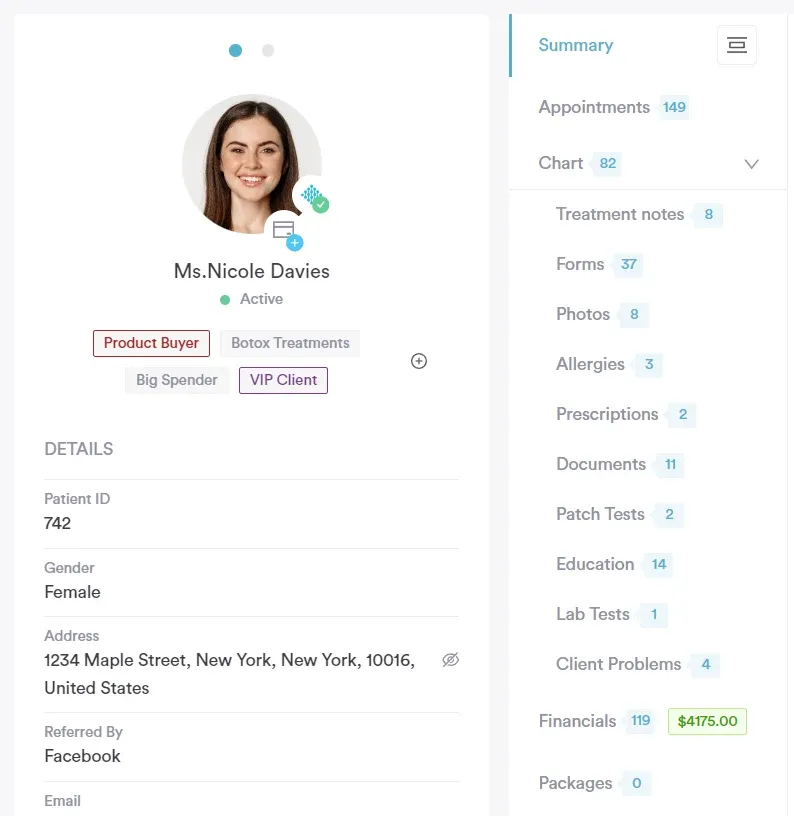
Consolidating those five workflows into one system removes the integration work and the pile of vendor agreements that come with a multi-tool stack. That is the argument for software built for therapists rather than a general-purpose booking tool with add-ons bolted on.
HIPAA compliance is not optional for a US mental health practice. Every tool that touches protected health information, known as PHI, needs a signed business associate agreement (BAA) from the vendor.
That covers your EHR, your email, your video platform, and even your scheduling tool. A missing BAA is a violation on its own, even when no data breach ever occurs.

For solo practitioners, four areas carry most of the risk. Unsecured messaging comes first, so never use personal Gmail or SMS for clinical communication. Then come unencrypted file storage, a telehealth platform with no BAA, and intake forms collected through an unencrypted web form.
The HHS HIPAA guidance for healthcare professionals is the authoritative reference for your obligations as a covered entity.
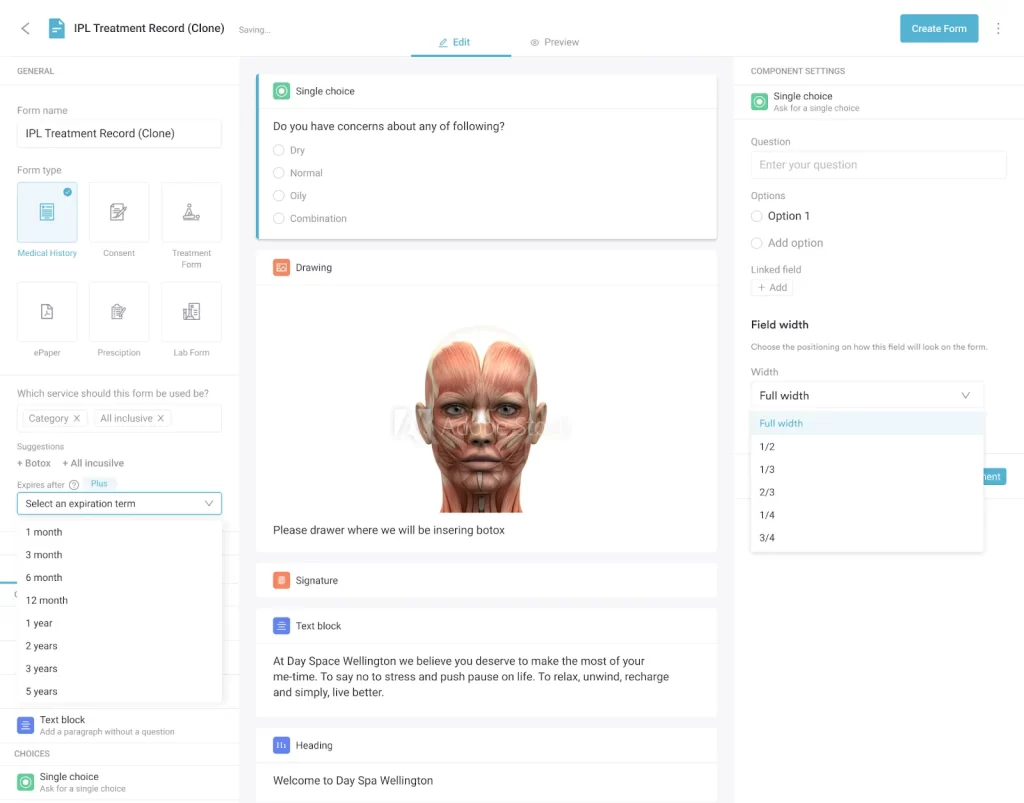
Your intake workflow sets the first impression and the quality of your documentation from session one. Practices that send intake paperwork digitally before the first appointment start with consent forms, histories, and insurance details already on file. That saves 15-20 minutes of setup per new client. Practices that offer group sessions need a separate group therapy informed consent covering confidentiality limits and group rules.
A complete intake packet for a mental health practice usually holds five documents:
Digital forms that write straight into the client record remove the transcription step, and the paper storage that goes with it.
If you work from an ACT model, a baseline values measure belongs in the same packet. The Valued Living Questionnaire scores 10 life domains twice, once for importance and once for how consistently the past week matched it.
In your first 30 days, focus on three jobs. Reach your first five to ten clients, test your billing workflow end to end, and get session notes down to 10-15 minutes. Marketing, referral networks, and specialty positioning can be built out over the following 90 days.
New practitioners overestimate how fast organic marketing produces clients, and underestimate how far one strong referral source goes. Your first 10-15 clients will almost certainly come from direct referrals, directory listings, or former colleagues rather than from social media or Google.
Once that network is tapped out, a full caseload needs a repeatable system. There are proven ways to attract more therapy clients through directory listings, local search, and referral partnerships.
Session-ready material makes a new specialty easier to deliver. A bank of therapy activities for ADHD, for instance, gives a focused practice something concrete to work from in week one.
A practice website with a clear specialty statement, your credentials, and a booking link turns directory traffic into appointments. Without one, a client who finds your listing has no obvious next step.
Reach out to three psychiatrists in your area within your first month of opening. Offer a brief 15-minute call to introduce your specialization and the client populations you work best with. Psychiatrists consistently need trusted therapists for medication-plus-therapy referrals, and they will send clients your way once they know your clinical approach.
Private practice removes the structure employment provides: set hours, administrative support, and peer contact. Without a deliberate design, the admin load of a solo practice stacks on top of clinical work and drives burnout faster than agency employment does.
A full-time solo practice means 20-25 billable sessions a week, not 40. The remaining hours go to documentation, billing follow-up, marketing, professional development, and business administration. Practitioners who push past 35 clinical hours find the documentation backlog alone becomes unmanageable.
Build the limits in from the start. Cap your clinical hours, block documentation time in the schedule, and automate reminders, recalls, and billing follow-up rather than doing them by hand. Retrofitting that structure once you are already overwhelmed is far harder.
A new practice usually ends up with four or five tools. That means a scheduler, a note-taking app, a billing service, a video platform, and a form builder. Each one needs its own business associate agreement, its own subscription, and its own export step whenever data has to move.
Practice management software like Pabau replaces that stack. Scheduling with online booking, structured clinical notes, claims and superbills, and a client portal all sit on the same client record. Video consultations run from it too, so an intake form completed on Monday is already in the chart on Thursday.
Every subscription includes every feature, so a solo therapist gets the same billing and reporting tools as a group practice. You sign one agreement, log in once, and stop moving data between systems to make the notes match the invoices.

Pabau brings scheduling, digital intake forms, clinical notes, billing, and telehealth onto one client record. Book a demo to see it set up the way a solo therapy practice runs.

The hard part of starting a private therapy practice is not clinical. It is running legal setup, credentialing, HIPAA, billing, and client acquisition in parallel. Most people do that across a three to six month window while still working a day job.
So pick your opening date, count back six months, and file the credentialing applications first. Every other task on the list can move. That one cannot, and it decides whether you open with paying clients or an empty calendar.
Choose your software before the first client rather than after the first hundred, because migrating records is far more painful than importing none. Book a demo to see how Pabau handles scheduling, notes, billing, and telehealth for a solo therapy practice.

Need a documentation framework before your first session? SOAP notes for social work shows how to write effective clinical notes that improve documentation.
Worried about burning out in your first year solo? Therapist burnout: signs, causes and prevention covers the risk factors specific to solo practitioners.
Building your intake packet from scratch? The psychotherapy intake form template gives you the fields a first session needs.
Opening in California? How to start a private practice as an LCSW in California covers the state-level licensing and business steps.
Comparing platforms before you commit? Best therapy practice management software compares the systems solo and group practices run on.
Register your business entity, an LLC or PLLC, through your state’s Secretary of State office. Filing fees range from $50 to $500 depending on the state. Your financial plan needs startup cost projections, a break-even caseload based on your session fee, and a 90-day cash flow forecast. Build the forecast around an insurance reimbursement lag of 30-90 days after claim submission.
You need an active, unrestricted state license for your credential type: LCSW, LPC, LMFT, licensed psychologist, or PMHNP. Most licensure paths require a master’s degree or higher plus supervised clinical hours, though psychologists typically need a doctoral degree. For telehealth across state lines, check whether both states take part in an interstate licensure compact before you see out-of-state clients.
Submit a credentialing application to each payer’s provider relations department, or use a credentialing service to manage several applications at once. You will need your license, NPI number, malpractice certificate, educational history, and clinical training documentation. Start 4-6 months before your intended opening date. Some panels are closed to new providers, so have a private-pay rate ready while credentialing is pending.
Budget $3,000 to $20,000, depending on your setup. A telehealth-only practice typically costs $3,000-$8,000 to launch, covering licensing fees, malpractice insurance, EHR software, and directory listings. An in-person practice adds rent deposits, furniture, and build-out costs, which brings the total to $8,000-$20,000. Ongoing monthly overhead for a solo practice generally runs $1,500-$4,000.
List on two or three therapist directories, such as Psychology Today, Therapy Den, and Zencare. Contact psychiatrists, primary care physicians, and EAPs in your area within your first month. Niche specialization speeds up caseload growth in competitive markets. A simple website with online booking converts directory referrals better than a listing alone. Most new practitioners reach 15-20 weekly clients within 6-12 months.