The psychology practice software you choose decides how fast claims get paid and how long notes take. It also decides whether you can show a patient is improving. For most US solo psychologists, SimplePractice is the best pick. TherapyNotes suits groups that live on insurance claims.
Practices that pair psychology with wellness or physical therapy get more from all-in-one practice management software like Pabau. Valant and AdvancedMD fit psychiatry-heavy and enterprise groups, while TheraNest and CarePatron win on price.
Switching later means moving every chart mid-caseload, so the first choice matters. Below, we compare seven platforms on pricing, claims and telehealth. We also run one extra test: can the software show a patient’s intake and week-12 PHQ-9 scores side by side?
Key takeaways
1. SimplePractice — best fit for solo psychologists who run telehealth and want a fast setup.
2. TherapyNotes — strongest insurance billing, with trend-line outcome measures, for claim-heavy groups.
3. TheraNest — lowest published paid plan here, at $29 per therapist per month with unlimited patients.
4. CarePatron — free plan with an AI scribe for solo clinicians who want to test AI notes first.
5. Valant — behavioral health platform built around psychiatry, prescribing and measurement-based care.
6. Pabau — all-in-one system for practices that combine psychology with wellness or other specialties.
7. AdvancedMD — enterprise billing and revenue cycle depth for large groups with dedicated billing staff.
Found our content helpful?
How psychology practice software splits by billing and size
Billing model and practice size sort these seven platforms faster than any feature list, so the order below follows practice type, not overall score. Scan the “Best for” column first. The last column then shows whether each vendor documents a before-and-after view for validated scales.
Name
Best for
Standout feature
Starting price
Outcome-score tracking
Capterra rating
SimplePractice
Solo and small group practices that run telehealth
Telehealth on every plan, used by 250,000+ practitioners
$49/mo
Yes, scores graphed against baseline
4.5/5 (2,611)
TherapyNotes
Groups filing high volumes of insurance claims
Claim tracking plus psychology-specific note templates
$69/mo
Yes, trend-line graph per measure
4.7/5 (900+)
TheraNest
Budget-conscious solo and small practices
Unlimited patients on every plan, with claims built in
$29/mo per therapist
Assessments supported, trend view not documented
4.4/5 (1,029)
CarePatron
Clinicians who want AI notes at low cost
AI scribe and telehealth on the free plan
Free (Plus $31/mo per user)
Auto-scored PHQ-9 and GAD-7 forms, trend view not documented
4.4/5 (514)
Valant
Psychiatry and behavioral health groups
ePrescribing plus intake and assessment automation
No published pricing
Yes, scored scales reviewed over time
4.2/5 (339)
Pabau
Multi-specialty practices adding psychology to wellness or allied health
One record for booking, notes, payments and marketing
From $62/mo
Yes, scores plotted across visits
4.7/5 (651)
AdvancedMD
Large groups with dedicated billing staff
Enterprise revenue cycle management and eligibility checks
No published pricing
Yes, scores trended in Flowsheets
3.6/5 (400+)
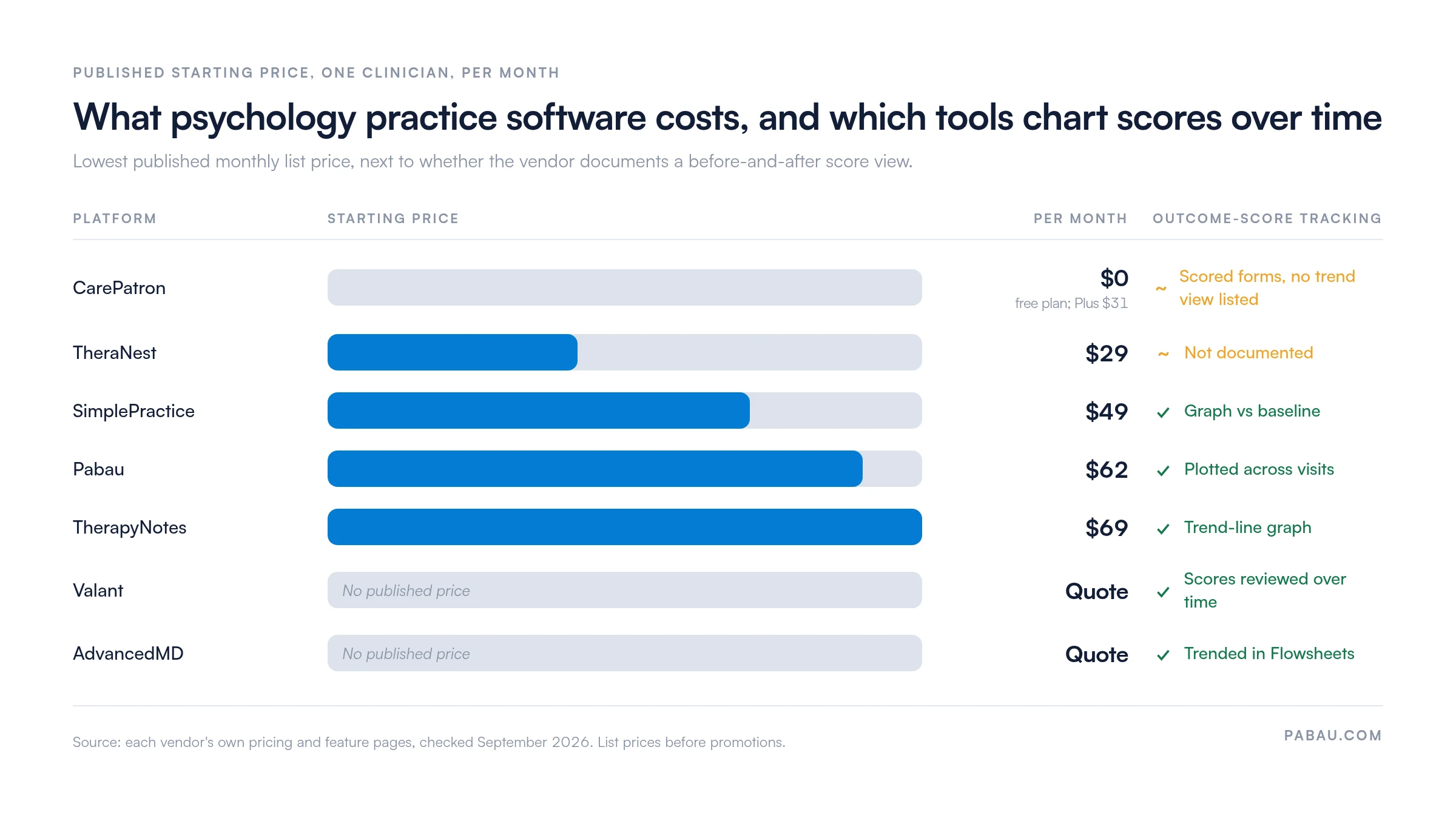
Price and outcome tracking do not move together. The chart below shows the cheapest plans are the ones that document the least about charting scores over time.
Five of the seven platforms document a before-and-after score view, and the two cheapest do not. Prices and features come from each vendor’s own site, checked September 2026.
SimplePractice: Best for solo psychologists who work by video
Rating4.5/5★★★★★Top pick
The bottom line
The quickest way for a solo psychologist to run sessions, notes and billing from one login.
SimplePractice is our top pick because a solo psychologist can run sessions, notes and billing from one login within days. It’s a practice management and EHR platform for solo and small group mental health practices. The company reports more than 250,000 practitioners, so it’s usually first on a new practice’s shortlist.
Telehealth is included on all three solo plans, with no limits on session length. Clinicians launch video sessions from the calendar, and patients join through the client portal without installing separate software.
SimplePractice’s measurement-based care tools send the PHQ-9 or GAD-7 to patients online on a schedule. Each completed measure is scored automatically, and repeat scores appear on a graph showing change since baseline.
Insurance billing sits inside the platform, but claims are not free. SimplePractice’s support pages say claim fees start at $0.39 per submitted claim on every plan from October 1, 2026.
SimplePractice includes telehealth on every plan
Built-in telehealth: HIPAA-compliant video sessions on every plan, launched from the appointment calendar
Measurement-based care: Auto-scored PHQ-9 and GAD-7 with a progress graph in the patient file
Mental health templates: Progress note and treatment plan formats for CBT, DBT and psychodynamic work
Client portal: Online booking, intake forms and card payments before the first session
AI add-ons: Note Taker drafts progress notes from a recorded session or dictation
Where SimplePractice shines
Telehealth without a second subscription: Video, notes and billing share one login and one bill
Ease of use: Clinicians moving off paper usually get running without formal training
Score tracking out of the box: Repeat PHQ-9 and GAD-7 results chart automatically
Where SimplePractice falls short
Add-on creep: AI notes, ePrescribing and the Care Aide suite are each billed on top of the plan
Larger groups: Practices with six or more practitioners move to custom pricing and a sales call
Reviewers rate SimplePractice 4.5 out of 5
SimplePractice holds a 4.5 out of 5 rating on Capterra from roughly 2,611 reviews. Reviewers praise the interface and built-in telehealth. The most common complaint is price increases after plan restructuring.
Who SimplePractice is best for
Solo psychologists and small groups running 25 to 75 sessions a week, much of it by video
Private-pay or mixed-billing practices that want card payments and occasional claims in one place
New practices that need to be seeing patients within days, not weeks
Pricing
Plan
Price
Users
Key inclusions
Starter
$49/mo
1 clinician
Scheduling, notes, client portal, telehealth
Essential
$79/mo
1 clinician
Starter features plus expanded billing and practice tools
Plus
$99/mo
1 clinician
Group appointments, group telehealth, premium phone support
Plus (group)
$99/mo + $74 per extra practitioner
2 to 5 practitioners
Plus features for each practitioner
Custom
Contact sales
6+ practitioners
Personalized onboarding and custom pricing
Prices are SimplePractice’s standard monthly rates before its introductory discount. AI Note Taker costs $35 a month and ePrescribe $49 a month on top.
TherapyNotes: The strongest pick for insurance-heavy groups
Rating4.7/5★★★★★
The bottom line
The most complete insurance billing workflow here for behavioral health groups that live on claims.
Who it’s for
Group practices filing claims every week
Practices with Medicare, Medicaid and commercial payers
If SimplePractice wins on ease, TherapyNotes wins on the claim. It’s behavioral health EHR and practice management software built around insurance billing. The platform suits psychology groups that bill Medicare, Medicaid and commercial payers every week, and psychiatric practices use it too.
Note templates follow the CPT codes psychologists bill most. That means 90832, 90834 and 90837 for psychotherapy, plus psychological and neuropsychological testing codes 96130-96139. Claims move from submission to payment inside the billing module, with denials flagged for follow-up.
TherapyNotes’ outcome measures include the PHQ-9 and GAD-7, scored automatically as soon as a patient submits them through the portal. A trend-line graph in the Insights tab plots every score over any date range you pick, with severity color-coding.
Group features include multi-clinician calendars, supervision workflows for trainees and custom fee schedules for managed care contracts. Reports split revenue by provider, service type and payer.
TherapyNotes centers on claims and outcome measures
Claims management: Electronic claim filing with status tracking and denial flagging
Psychology-specific templates: Notes built around psychotherapy and testing codes
Outcome measures: Auto-scored PHQ-9, GAD-7 and other scales with timeline charts
Supervision documentation: Sign-off workflows for licensed supervisors and trainees
Patient portal: Online forms, measure requests and document sharing
Where TherapyNotes shines
Billing depth: Claim status, denials and payer reports sit in one workflow for behavioral health billers
Measurement-based care: Score trends are visible without an export
Group economics: Unlimited non-clinical users, so billers and front desk staff add no cost
Where TherapyNotes falls short
Learning curve: The billing tools take longer to learn than lighter platforms like SimplePractice
Optional extras: Electronic claims, reminders, ePrescribe and the TherapyFuel AI tools are priced separately
TherapyNotes earns one of the top review scores
TherapyNotes holds a 4.7 out of 5 rating on Capterra from roughly 900 reviews, one of the highest in behavioral health. Reviewers praise the billing automation and templates. Some note a steeper learning curve than simpler tools.
Who TherapyNotes is best for
Group psychology practices filing 200 or more insurance claims a month
Training practices that need supervision documentation and co-signature
Practices that want outcome measures and billing in the same system
Pricing
Plan
Price
Users
Key inclusions
Solo
$69/mo
1 clinician
Scheduling, notes, billing, patient portal
Group
$79/mo + $50 per extra clinician
2+ clinicians
Solo features plus unlimited non-clinical users
TherapyNotes set these rates in its December 2025 pricing update. Electronic claims, reminders, ePrescribe and TherapyFuel stay separately priced.
TheraNest: The lowest paid price, with claims included
Rating4.4/5★★★★★
The bottom line
The lowest published paid price here, with claim submission included and no cap on patients.
TheraNest is the budget answer to TherapyNotes, with claims included from $29 a month. It’s mental health practice management software from Ensora Health, priced per therapist with unlimited patients on every plan. Solo practitioners and small groups get the basics done well for less.
TheraNest automates invoice creation, claim submission and ERA posting once you set rules for each payer. Exceptions land in one queue, so billing time goes on the claims that need a decision.
A dynamic form builder handles intake forms, progress notes and case documentation. Telehealth, payments and the Ensai AI session assistant are sold as add-ons, so the $29 entry price rises once you add them.
TheraNest bundles billing automation with unlimited patients
Per-therapist pricing: Three plans at $29, $59 and $89, all with unlimited patients
Automated billing: Invoices, claim submission and ERA posting driven by payer rules
Dynamic form builder: Custom intake forms, progress notes and treatment plans
Client portal: Patients complete forms and view documents before sessions
Where TheraNest shines
Cost predictability: No per-patient fees, so a growing caseload does not raise the bill
Simple interface: Minimal learning curve for clinicians new to practice software
Where TheraNest falls short
Add-on pricing: Telehealth, payments and AI tools each add to the monthly cost
Outcome tracking: Ensora does not document a before-and-after score chart, so test it in a demo
Users rate TheraNest well for simplicity
TheraNest holds a 4.4 out of 5 rating on Capterra from 1,029 reviews. Users like the straightforward interface and unlimited patients. The most common feedback is limited advanced reporting.
Who TheraNest is best for
Solo practitioners who want the lowest paid entry price with claims included
Small groups coordinating interns and supervisors on one calendar
Clinicians moving from paper to digital records for the first time
Pricing
Plan
Price
Users
Key inclusions
Entry plan
$29/mo per therapist
Per therapist
Unlimited patients, scheduling, notes, billing
Mid plan
$59/mo per therapist
Per therapist
Unlimited patients, more practice tools
Top plan
$89/mo per therapist
Per therapist
Unlimited patients, full TheraNest feature set
Ensora Health publishes the three TheraNest price points but not a full feature split. Ask for the plan comparison before you commit.
CarePatron: A free plan for testing AI session notes
Rating4.4/5★★★★★
The bottom line
A free plan with an AI scribe and telehealth, so you can test AI notes before you pay.
Where TheraNest competes on price, CarePatron competes on AI, and its entry plan is free. It’s practice management software built around AI documentation. The AI scribe turns a recorded session into structured progress notes, treatment plans and summaries that the clinician reviews and edits.
That makes CarePatron one of the cheapest ways to trial therapist note-taking software. The free plan includes the AI scribe, telehealth and a client portal. Paid plans add storage, group scheduling and electronic claim filing from $0.25 per claim.
CarePatron offers PHQ-9 and GAD-7 templates that score automatically and can be sent through the client portal. CarePatron does not document a chart comparing those scores across visits, so check that view in a demo.
CarePatron leads with its AI scribe
AI scribe: Session audio becomes a draft note, plan or summary for clinician review
Assessment templates: Auto-scored PHQ-9 and GAD-7 forms shared via the portal
Telehealth: Video sessions included on every plan, free plan too
Payments: Online payments and card processing, with claims on paid plans
Where CarePatron shines
Documentation speed: AI-drafted notes cut the writing time after each session
Low cost of entry: The free plan is enough to run a small caseload
Where CarePatron falls short
Billing depth: Claims are pay-per-claim and lighter than TherapyNotes or AdvancedMD
Outcome reporting: Scores are captured, but CarePatron does not document a trend chart
Reviewers value CarePatron’s free tier
CarePatron holds a 4.4 out of 5 rating on Capterra from roughly 860 reviews. Reviewers highlight the free tier and the AI documentation. Some mention limits in insurance billing and reporting.
Who CarePatron is best for
Solo practitioners who want AI notes to cut documentation time
Cash-pay practices without complex insurance billing
Clinicians who want to test a platform on a live caseload before paying
Pricing
Plan
Price
Users
Key inclusions
Free
$0/mo
Per user
Unlimited patients, telehealth, AI scribe, 1GB storage
Plus
$31/mo per user
Per user
Unlimited storage, group scheduling and telehealth, claims from $0.25 each
Advanced
$39/mo per user
Per user
Plus features, role controls, unlimited AI and tasks
CarePatron lists these as monthly list prices, often with a time-limited discount on top. Annual billing saves 20%.
Valant: Built for groups that prescribe and measure
Rating4.2/5★★★★★
The bottom line
Built for behavioral health groups that prescribe, bill insurance and practice measurement-based care.
Who it’s for
Psychiatry practices and PMHNPs
Groups combining therapy and medication management
Valant is the pick when medication management sits alongside therapy. It’s behavioral health EHR and psychiatric practice management software for psychiatry, psychology, therapy and counseling groups. One system covers ePrescribing, PDMP checks, treatment planning, telehealth, billing and utilization review.
Valant’s intake and assessment automation sends rating scales like the PHQ-9, GAD-7 and Columbia scale before an appointment. The system scores the responses and files them in the patient record, where clinicians review scores over time.
That workflow suits practices that start every patient on a standardized intake. Many begin with a structured psychiatric evaluation template and then build the same fields into their EHR forms.
Valant pairs assessments with prescribing
Assessment automation: Rating scales sent, scored and filed before each visit
Medication management: ePrescribing, PDMP checks and medication history for psychiatric care
Treatment planning: Behavioral health templates aligned with authorization requirements
Billing: Electronic claims plus utilization review for authorizations
AI Notes Assist: AI help with clinical documentation
Where Valant shines
Behavioral health focus: Workflows are built for mental health rather than adapted from general medicine
Measurement-based care: Scored scales arrive before the session starts
Psychiatric support: Prescribing tools serve practices that combine therapy and medication
Where Valant falls short
Opaque pricing: You need a sales call to get any figure
Interface design: Reviews are mixed on navigation compared with newer platforms
Valant’s reviews praise workflows over design
Valant holds a 4.2 out of 5 rating on Capterra from 339 reviews. Reviewers praise the behavioral health workflows and outcome tools. Criticism centers on interface design and navigation.
Who Valant is best for
Practices combining psychology and psychiatry under one roof
Clinicians who want validated rating scales scored before every appointment
Groups that need prescribing, claims and authorizations in one system
Pricing
Custom plan
Clinical, billing and prescribing modules, quoted per practice
Contact sales / no published pricing
Valant does not publish prices on its website. Expect a quote based on practice size and the modules you choose.
Pabau: One record when psychology sits beside other services
Rating4.7/5★★★★★Best for multi-specialty practices
The bottom line
One record for psychology, wellness and allied health, with scored questionnaires plotted across visits.
Setup runs through structured onboarding, not self-serve
Claims run through Claim.MD, lighter-touch than claim-first tools like TherapyNotes
Valant widens into psychiatry, while Pabau widens into other specialties. It’s psychology practice management software for practices that treat mental health alongside other services. Booking, clinical records, payments and marketing run in one system, so a patient who sees a psychologist and a physical therapist has one file.
Pabau’s measurement tracking tools score the PHQ-9, GAD-7 or your own scale the moment a patient submits it. Pabau stores the score against the patient record and plots every result across visits.
Pabau’s Client records keep intake forms, session notes and scored questionnaires in one patient file, so a psychologist reviews progress without opening a second system.
Documentation runs through Pabau Scribe, our AI scribe, which turns the consultation into a structured note in the same record. Custom digital forms cover psychology intake, consent and treatment-specific questionnaires.
Payments run through Stripe and Pabau Pay, our card terminals, with automated invoicing and memberships. Practices selling therapy packages or wellness memberships set them up in the same system that books the sessions.
For sessions billed to insurance, Pabau connects to Claim.MD in the US. Your team can submit claims electronically, run real-time eligibility checks and track claim status from the same record.
Pabau’s point of sale takes payment for a private-pay therapy session at checkout, so self-pay balances do not pile up for month-end chasing.
Telehealth sessions start from the calendar, and automated SMS and email reminders cut no-shows between sessions. The Client Portal lets patients rebook, complete forms and pay without calling the front desk.
Pabau’s telehealth runs remote therapy sessions from the calendar, so the video visit, the note and the invoice land in one patient record.
For multi-location groups, Pabau’s Enterprise plan covers multiple sites with shared scheduling and cross-location reporting. Our psychology practice software page shows how that setup works for group practices.
Pabau keeps every specialty in one patient record
Measurement tracking: Scored questionnaires plotted across visits in the patient record
Pabau Scribe: AI-drafted clinical notes filed straight into the record
Multi-specialty scheduling: One calendar for psychology, physical therapy, wellness and aesthetics
Digital forms: Intake, consent and assessment forms with conditional logic
Telehealth: Video consultations launched from the appointment calendar
Role-based access: Permissions that limit who can open clinical notes
Marketing and recalls: Automated reminders and re-engagement campaigns between sessions
Where Pabau shines
Cross-specialty records: Psychology, physical therapy and wellness notes share one patient view
No feature gating: Every subscription includes the full platform, from one user to fifty
Multi-location scale: Enterprise covers multiple sites with centralized reporting
Where Pabau falls short
Setup time: Multi-specialty workflows take longer to configure than a psychology-only tool
Mental health templates: Pabau is built for many specialties, so psychology templates are configured during onboarding
Claims depth: Insurance billing runs through Claim.MD, lighter than claim-first tools like TherapyNotes
Users rate Pabau 4.7 out of 5
Pabau holds a 4.7 out of 5 rating on Capterra from 651 reviews. Users praise the breadth of features across specialties. The most common feedback is an initial learning curve because the platform does so much.
Who Pabau is best for
Multi-specialty wellness centers adding psychology to physical therapy, functional medicine or aesthetics
Group practices running psychologists across several locations
Practices selling memberships or packages that bundle therapy with other services
Practices that want outcome-score tracking in the same record as booking and billing
Pricing
Plan
Price
Users
Key inclusions
Starter
From $62/mo
1 user, up to 100 patients
Full platform
Solo
[TODO: add Solo price]
1 user, unlimited patients
Full platform
Team, Medium, Group
Quoted by user count
2 to 15 users
Full platform
Enterprise
Custom quote
16+ users, multiple locations
Full platform plus multi-site setup
Every Pabau plan includes every feature, and annual billing saves up to 20%. The Starter plan caps at 100 patients. Solo and every plan above it remove that cap, matching the unlimited-patient plans TheraNest and CarePatron advertise. You can see the full breakdown on Pabau’s pricing page.
AdvancedMD: Billing depth for large groups with billers
Rating3.6/5★★★★★
The bottom line
Enterprise billing depth for large groups that employ billers and handle heavy claim volume.
Who it’s for
Large psychology and psychiatry groups
Multi-specialty organizations with a mental health arm
AdvancedMD sits at the enterprise end of the list. It’s medical practice management and EHR software for large groups and multi-specialty organizations. Its strength is revenue cycle management, from eligibility checks to claim scrubbing, denial tracking and appeals.
AdvancedMD sells itself on revenue cycle depth, which is why it suits groups that already employ billers.
For psychology groups, AdvancedMD supports scored PHQ-9 and GAD-7 assessments captured in clinical notes. Scores can be trended over time in Flowsheets, and a Blueprint integration adds measurement-based care between sessions.
Practices billing brief standardized assessments can use CPT code 96127 alongside psychological and neuropsychological testing codes 96130-96139. AdvancedMD also offers e-prescribing for psychiatric medication management and custom fee schedules for managed care contracts.
AdvancedMD focuses on catching denials early
Coding support: CPT and ICD-10 suggestions based on clinical documentation
Insurance verification: Eligibility checks before scheduled appointments
Claim scrubbing: Pre-submission checks that catch likely denial triggers
Behavioral health assessments: Scored scales in notes, trended in Flowsheets
Patient portal: Online scheduling, forms and bill payment
Where AdvancedMD shines
Revenue cycle depth: Complex claim scenarios and payer rules are handled in-house
Scalability: Built for many providers and locations on one system
Where AdvancedMD falls short
Solo practice fit: Features and pricing are sized for larger organizations
Mental health setup: A general medical focus means configuring templates for psychology
AdvancedMD reviews split on complexity
AdvancedMD holds a 3.6 out of 5 rating on Capterra from roughly 400 reviews. Users praise the billing features. Criticism covers the learning curve, interface complexity and cost.
Who AdvancedMD is best for
Large psychology groups filing 500 or more insurance claims a month
Multi-specialty organizations running psychology inside broader medical operations
Practices with dedicated billing staff who will use the revenue cycle tools daily
Pricing
Custom plan
Practice management, EHR and billing modules, quoted per practice
Contact sales / no published pricing
AdvancedMD does not publish prices on its website. Quotes depend on provider count and the modules you add.
Choose psychology practice software by answering three questions
Choose psychology practice software by matching it to how you get paid, how many clinicians you run, and whether you track outcome scores.
The best therapy software for a solo, private-pay psychologist is rarely the best for a 12-clinician group billing Medicaid. Settle those three questions first, then shortlist two or three platforms to demo.
Solo practices need speed, while groups need permissions
The right psychologist practice software for a solo practice is one you can set up in a week. Groups need permissions and shared reporting instead.
Psychology private practice software for one clinician should cover booking, notes, telehealth and payments without extra modules. SimplePractice, TheraNest and CarePatron all fit here, and the choice mostly comes down to billing model and budget.
Practice software for psychologists in a group needs multi-clinician calendars, supervision workflows and reports split by provider. TherapyNotes, Valant and AdvancedMD lead on claims, while Pabau leads when the group mixes psychology with other specialties.
Multi-location groups add one more test. They need centralized scheduling, consolidated financial reports and permissions that respect state licensing when psychologists see patients in more than one state.
Outcome-score tracking shows whether treatment is working
Outcome-score tracking means software scores a PHQ-9 or GAD-7 at intake, repeats it on schedule, and shows both scores together in the patient record.
Any software for psychology practice work can store a filled-in questionnaire as a PDF. The difference is whether it turns answers into a number you can compare across visits without retyping a score.
A PHQ-9 given only at intake can’t show change. The automated repeat is what makes measurement-based care stick.
Here is the workflow to look for in a demo:
Baseline at intake: The PHQ-9 (scored 0 to 27) or GAD-7 (scored 0 to 21) goes out with the intake packet.
Scheduled repeats: The system resends the same scale every four sessions or every month, with no staff action.
Automatic scoring: Scores calculate on submission and file against the patient, not in a shared folder.
Side-by-side view: Intake and latest scores appear on one chart inside the record, ready for treatment plan review.
Billing link: Each scored instrument can be documented for CPT code 96127, the brief emotional and behavioral assessment code.
Kroenke and colleagues, who developed the PHQ-9, describe a five-point change as clinically meaningful. A chart that shows a 17 falling to 9 makes that conversation with the patient, or with a payer reviewing authorization, much faster.
To test a vendor, ask them to open one demo patient with three PHQ-9 entries on a single screen. SimplePractice, TherapyNotes, Valant, Pabau and AdvancedMD document this view, while CarePatron and TheraNest do not.
Score every platform against these five criteria
Billing model: Practices collecting most revenue from insurance need direct claim submission (TherapyNotes, AdvancedMD, Valant). Private-pay and mixed-billing practices, including multi-specialty ones, do well with SimplePractice or Pabau, which also files US claims through Claim.MD.
Practice size: Solo practitioners benefit from simple setups (SimplePractice, TheraNest, CarePatron). Multi-location groups need centralized scheduling and cross-site reporting (Pabau, AdvancedMD).
Specialty mix: Psychology-only practices fit specialty tools (TherapyNotes, SimplePractice). Practices adding physical therapy, functional medicine or wellness need one shared record (Pabau).
Telehealth share: Practices running half or more of sessions remotely should favor built-in video over a third-party link.
Pricing structure: Per-therapist plans suit steady caseloads (TheraNest). Add-on and per-claim fees raise the monthly bill, so total them before comparing.
For an insurance-heavy practice, a claim passes through five steps inside the software. Each one can stall it, so it helps to know the route.
Eligibility check: The front desk confirms coverage and copay before the first session, ideally with an automated check.
Charge capture: The signed note carries the CPT code, such as 90837, and a matching ICD-10 diagnosis code.
Claim scrubbing: The software looks for missing details, such as a telehealth place-of-service code or provider NPI.
Submission: The claim goes out electronically, usually through a clearinghouse, and comes back accepted or rejected.
Payment posting: The payer’s electronic remittance advice, or ERA, posts the payment or explains the denial.
Most stalls start in the first three steps. A note signed without a diagnosis code bounces back from the clearinghouse. A skipped prior authorization check can surface as a denial weeks later. So ask each vendor which steps it automates, and which it leaves to your biller.
Check these points before you sign a contract
A sales demo shows a platform at its best, so bring your own tests. Work through this list with each vendor on your shortlist:
Run one week of your own scheduling, notes and billing during the evaluation window or onboarding period.
Price the full stack, including telehealth, AI notes, ePrescribing and per-claim fees.
Ask who works denials: your staff, a vendor billing service, or no one.
Ask how notes and patient data leave the system if you switch, and in what format.
Check that intake forms and scored scales file against the patient record, not a shared folder.
A common buying mistake is comparing entry prices alone. A $29 plan with three add-ons can end up costing more than a $69 plan that includes them.
How Pabau makes repeat outcome scores automatic
Measurement-based care tends to break down at the repeat questionnaire. In practices we onboard, the PHQ-9 often goes out once and never again, because rescoring it by hand takes time between sessions.
Pabau schedules the repeat instead. The same questionnaire goes out every week, every two weeks or every month, and each response is scored on submission.
By the treatment plan review, the intake score and the latest score already sit on one chart in the patient record. You can then show a patient their progress in the session itself, on one screen.
Track outcome scores in the patient record
Pabau scores PHQ-9 and GAD-7 questionnaires on submission and charts every result across visits, next to booking, notes and payments. See the workflow for your practice in a demo.
Start with how you get paid. Insurance-heavy groups should shortlist TherapyNotes, Valant or AdvancedMD. Solo psychologists running telehealth should start with SimplePractice.
Then ask every vendor to show one patient’s intake and latest PHQ-9 on a single screen. That one request separates platforms that support measurement-based care from those that only store forms.
Budget picks like TheraNest and CarePatron cost less upfront, but add-ons and per-claim fees narrow the difference fast. And if your practice mixes psychology with wellness or physical therapy, a psychology-only tool will start to pinch as you grow.
Curious how that looks in a mixed practice? Book a demo to see Pabau chart outcome scores next to notes and payments in one patient record.
How do psychology practice platforms handle insurance billing?
They either submit claims electronically or produce superbills that patients file themselves. TherapyNotes, Valant, AdvancedMD, TheraNest, SimplePractice, CarePatron and Pabau file claims directly, often for a per-claim fee. Direct filing gets you paid faster, but someone still has to work the denials.
What’s the difference between practice management software and an EHR?
A practice management system runs the business side, including scheduling, billing, claims and reports. An EHR, or EMR, holds the clinical record of notes, diagnoses and assessments. Most psychology platforms bundle both, so test the clinical side as hard as the billing.
How does HIPAA compliance work in psychology practice software?
The vendor signs a Business Associate Agreement, encrypts records, logs access and limits who sees what. Your practice still owns compliance, including staff training. HIPAA gives psychotherapy notes extra protection, so keep them separate from the main record.
Is there a ChatGPT for psychology?
Yes, AI scribes such as CarePatron’s scribe, Pabau Scribe and SimplePractice’s Note Taker draft session notes from a recording or dictation. A clinician still reviews every note. General chatbots like ChatGPT do not replace therapy or clinical judgment.
Do solo psychologists need practice management software?
Not on day one, but it pays off quickly. Once reminders, intake forms, notes and card payments pile up, one system cuts the double entry. A free plan, such as CarePatron’s, lets you start without a monthly bill.