Fertility clinic marketing: Strategies that attract & convert patients
Fertility clinic marketing is how a fertility practice attracts, educates, and c...

Last Updated: Oct 14, 2026

How to get more patients starts with visibility: Google Business Profile, local SEO, and medical directories put your practice in front of patients who are actively searching.
Online booking reduces friction – practices with 24/7 scheduling typically see 30-40% of appointments booked outside office hours.
Reviews are the fastest trust signal: A consistent stream of genuine patient reviews directly impacts how many new patients choose your practice over a competitor.
Paid ads and specialty-specific tactics close the gaps organic visibility leaves – dental, chiropractic, physical therapy, and med spa practices each need a different channel mix to acquire patients.
Practice management software like Pabau automates the operational side of patient acquisition – workflows, online booking, and review requests – so your team can focus on care.
Most practices that struggle to grow aren’t failing because of poor clinical care. They’re invisible online, hard to book, and slow to follow up. Fixing those three problems is how to get more patients without doubling your marketing budget.
This guide covers the patient acquisition strategies that practice owners across aesthetics, primary care, physical therapy, and specialty practices use to consistently book more patients. We cover digital visibility, booking experience, reviews, referrals, paid ads, and automation – the levers that move the needle, plus how the mix shifts depending on your specialty.
When a potential patient searches “dermatologist near me” or “physical therapist [city],” your Google Business Profile is the first thing they see. An incomplete or unverified profile hands those patients directly to a competitor who bothered to fill theirs in.
Optimizing your profile costs nothing and takes under an hour. The payoff is immediate local visibility for patients who are already looking for exactly what you offer.
One often-missed step: Your listed categories. Most practices choose one. Google allows multiple. A skin care practice could list Dermatologist, Skin Care Clinic, and Medical Spa, each capturing different search queries from different patient groups. For more on converting website visitors into booked appointments, the principles extend directly from search profile to booking page.
The single biggest operational blocker to getting more patients is a phone-only booking process. Patients searching at 9pm on a Sunday will book the practice that lets them schedule immediately. They will not call back during business hours.
Pabau’s online booking software lets patients self-schedule around the clock, choose their preferred practitioner, and complete intake forms before they arrive. For practice managers, the benefit is fewer admin calls and a pre-filled record waiting before the appointment starts.
Three things make online booking convert well:
The connection to improving patient engagement is direct: A frictionless first booking experience sets the tone for every interaction that follows.
Patients read reviews before they book. Full stop. A practice with 4 reviews and a 4.8 rating loses to a practice with 80 reviews and a 4.3 rating almost every time, because volume signals trustworthiness at a glance.
According to a SERMO physician survey, 42% of doctors identified word-of-mouth referrals as the most important channel for new patient acquisition. Online reviews are the digital equivalent of that word-of-mouth.
One practitioner community discussion noted that a Google Business Profile with at least a 4.2 rating across 20 or more reviews correlates with a meaningful drop in cost per new patient, though results vary by market and specialty.
The problem most practices have is inconsistency. They ask for reviews when they remember to, which means they get sporadic results.
Pabau’s automated review requests send a follow-up message to patients after their appointment, asking them to share their experience on Google or another platform of your choice. The request goes out at the right time in the patient journey, without anyone on your team having to remember to send it.
Two rules to stay compliant with FTC guidelines: never offer an incentive for a positive review, and never discourage patients from leaving negative feedback. Soliciting honest reviews is fine. Filtering them is not.
Pair this with a system for capturing patient feedback internally so you can address issues before they become public reviews, and you have a reputation loop that compounds over time.

Online booking, automated review requests, recall campaigns, and patient records in one platform. Built for practices that want to grow without growing their admin workload.

Google Business Profile is the tip of the local SEO iceberg. The algorithm also weighs your website’s authority, your citations across directories, and the consistency of your NAP (Name, address, phone number) across every listing.
For practices wanting to know how to get more patients from organic search without paying for ads, local SEO delivers the most durable return. It compounds: every citation built, every blog post published, and every review earned adds to your ranking strength. Local search is one channel of several, and a wider view of healthcare lead generation helps you decide where the next hour goes.
Word-of-mouth is the highest-converting channel for most practices – a referred patient arrives pre-sold on your practice. The challenge is that most practices leave referrals entirely to chance. Patients who had a great experience don’t refer because nobody asked them to.
A structured referral program changes that. It doesn’t need to be complicated. A post-appointment message that says “Know someone who’d benefit from [treatment]? Here’s a link to book” – sent automatically at the right moment – works better than a paper card handed over at checkout.
Practices that want to grow a medical practice sustainably combine referral programs with retention tactics: the patients most likely to refer are those who’ve returned for a second or third visit, not first-timers. Retention and acquisition are the same flywheel.
Run a quarterly referral audit. Pull your new patient data and tag how each patient heard about you. If referrals account for less than 20% of new patients, your referral program needs a systematic follow-up sequence, not just a verbal ask at checkout.
Automating patient communication is where practices find the fastest wins on the acquisition and retention crossover. Recall campaigns alone – automated messages to patients due for a follow-up, annual checkup, or repeat treatment – can refill a schedule that has been quietly going cold for months.
The practice automations that drive revenue growth fall into two categories: pre-appointment (confirmation, reminders, intake forms) and post-appointment (follow-up care instructions, review requests, recall invitations). Both categories improve the patient experience and reduce no-shows, which are the two levers that move new patient numbers most predictably.
Pabau’s automated patient workflows and email and SMS campaigns handle both. A new patient gets a confirmation immediately after booking, a reminder 48 hours before, and a post-visit message asking for feedback. An existing patient who hasn’t been seen in six months gets a personalized recall. All of this runs without your front desk having to manually trigger anything. Those campaigns are part of Pabau’s broader practice marketing toolset, which also covers gift cards, memberships, and loyalty programs.
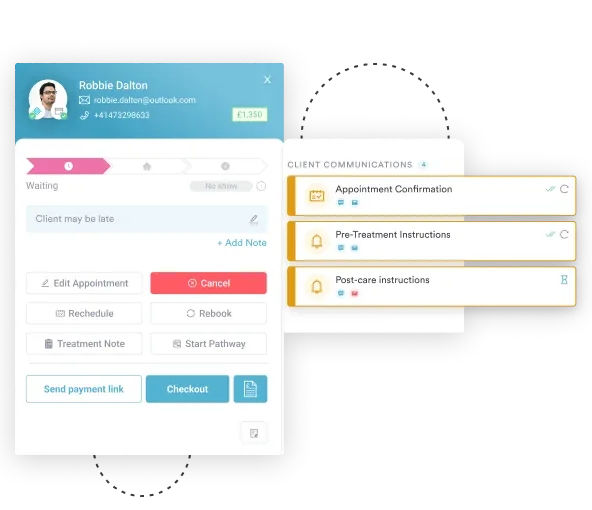
| Automation type | When it fires | Patient acquisition impact |
|---|---|---|
| Booking confirmation | Immediately after scheduling | Reduces no-shows, builds trust |
| Appointment reminder | 24-48 hours before visit | Lowers no-show rate, frees appointment slots for new patients |
| Post-visit review request | 24 hours after appointment | Compounds review volume, drives organic discovery |
| Recall campaign | 90-180 days after last visit | Reactivates lapsed patients, boosts utilization |
| Intake form pre-send | Before first appointment | Reduces check-in friction, improves first impression |
Organic channels compound over months. Paid ads work immediately, which makes them the fastest way to acquire patients while your Google Business Profile and local SEO are still building authority.
Google Ads let you bid on the exact treatment or service someone is searching for in your area, so the person searching “botox near me” or “physical therapist for shoulder pain” sees your practice at the top of the results instead of buried on page two.
Facebook and Instagram ads work differently – they target by location, age, and interest rather than search intent. That suits practices where the deciding factor is seeing the provider’s actual work, which is why aesthetics, dermatology, and cosmetic dentistry practices tend to get the most out of them.
Three tactics do most of the work for new patient acquisition through paid channels:
Set a fixed monthly budget before you start, and track cost per booked appointment rather than cost per click. A cheap click that never converts costs more than an expensive one that books.
Social media doesn’t directly fill an appointment book. What it does is maintain visibility with people who aren’t ready to book yet – and convert them when they are. For aesthetic and dermatology practices and wellness-focused specialties, Instagram and TikTok function as a second website where potential patients assess your work before ever visiting the real one.
The content that performs best is educational and specific: Not “we offer Botox” but “here’s what to expect at your first Botox consultation and how to prepare.” That level of specificity helps patients self-qualify and shortens the path between inquiry and decision. For broader practice marketing strategies, educational content builds authority across every channel you use.
Content marketing through a practice blog compounds differently from social media. A documented approach to healthcare content marketing keeps those posts aimed at the questions patients actually type. Blog posts that answer specific patient questions (“how long does recovery take after X”) can rank in Google search for years, continuously generating new patient inquiries at zero marginal cost per visitor.
Not every patient starts their search on Google. Many go directly to Healthgrades, Zocdoc, or insurance company provider directories when they need a new practitioner. If your profile doesn’t exist there, you simply don’t exist to that segment of patients.
Each directory has its own ranking logic, but consistent principles apply: complete profiles with photos rank higher, profiles with recent reviews rank higher, and profiles that enable online booking generate more conversions than those that require a phone call. The investment of an hour per directory pays off in consistent, passive referrals.
Priority directories vary by specialty and geography, but for most US-based practices the core list is: Google Business Profile, Healthgrades, Zocdoc, WebMD doctor finder, Bing Places, and relevant specialty directories (AAD for dermatologists, ADA for dentists, APTA for physical therapists). Each one is another entry point for patients who are actively looking for a practice like yours.
Audit your directory listings every six months. Practice names change, phone numbers update, and outdated information on a high-authority directory actively hurts your local search ranking. Set a calendar reminder and check your top five directories in one sitting.
The strategies above apply across specialties, but the weighting changes depending on what you treat and how patients search for it.
Whatever the specialty, the same operational backbone applies: whoever books first, follows up fastest, and asks for a review every time will out-grow a competitor running the identical marketing playbook.
Knowing how to get more patients is a systems problem, not a marketing budget problem. The practices that grow consistently are the ones that make it easy to find them, easy to book, and easy to recommend – and they use automation to keep those systems running without adding to their admin workload.
Pabau brings online booking, automated recall campaigns, review requests, and patient communication into one platform built for practices. If you want to see how those tools work together to fill your schedule, book a demo and we’ll show you the setup that fits your practice.

Want a deeper look at marketing tactics for your specialty? Marketing for clinics covers channel selection and campaign planning for healthcare practices of all sizes.
Want a plan you can finish this quarter? Healthcare marketing plan template gives you a fillable plan covering goals, personas, channels, budget, and KPIs.
Want your records to double as marketing assets? Healthcare content marketing guide covers the formats, compliance rules, and ROI behind the strategy.
Optimizing your Google Business Profile and enabling 24/7 online booking are the two fastest levers – both can be actioned in a single day and start generating results immediately. Pairing those with automated review requests compounds the impact over the following weeks as your rating and review volume build.
The right number varies considerably by specialty, practice size, and local market – a solo primary care practice has different capacity constraints from a multi-practitioner aesthetics practice. Most growing practices target a new patient rate that fills 15-30% of available appointment capacity each month, adjusting the target as retention improves and existing patient utilization rises.
Reviews function as digital word-of-mouth and directly influence whether a patient chooses your practice over a competitor. Volume matters as much as rating – a consistent stream of recent reviews signals an active, trustworthy practice. Automated post-appointment review requests are the most reliable way to build volume without adding to your team’s workload.
Local SEO, directory listings, patient referral programs, and organic social media content are the four highest-return channels that require time rather than significant spend. A well-maintained Google Business Profile, consistent Healthgrades and Zocdoc listings, and a structured referral follow-up can generate steady new patient flow at minimal ongoing cost.
The most effective approach combines visibility (Google Business Profile, SEO, directories), friction reduction (online booking, fast response times), trust signals (reviews, educational content), and systematic follow-up (recall campaigns, referral requests). No single tactic works in isolation – practices that grow consistently use several complementary channels together.
The strongest results come from combining organic visibility with paid ads rather than relying on either alone: a complete Google Business Profile and local SEO build a durable base, while targeted Google and social ads fill bookings while that base is still growing. Layering in automated reviews and referral follow-up compounds both.
Med spas convert best on visual proof, so before-and-after content on Instagram alongside a Google Business Profile stocked with real photos typically outperforms directory listings alone. Pairing that visibility with 24/7 online booking and automated review requests turns interest into booked appointments instead of missed inquiries.