CRM for chiropractors: how to manage patients, bookings and marketing
A CRM for chiropractors is a patient relationship management system built around...

Last Updated: Oct 13, 2026

Healthcare reputation management covers monitoring, responding to, and generating reviews across Google, Healthgrades, and other platforms patients use to choose providers.
Practices that respond to every review – including negative ones – build more trust than those that only collect 5-star ratings.
HIPAA-compliant responses never confirm a patient relationship; always acknowledge the feedback generically and invite offline resolution.
Pabau’s automated review requests send post-appointment follow-ups that bring verified patient feedback to Google and other platforms without manual effort.
Seventy-seven percent of patients use online reviews as their first step when selecting a new healthcare provider, according to a Software Advice patient review survey. For clinic owners and practice managers, that figure has a direct operational consequence: your star rating on Google is now a patient acquisition channel, not a vanity metric. Poor reputation management in healthcare means losing new patients before they ever call your front desk.
This guide covers what healthcare reputation management involves, why it matters for practices of every size, and the specific workflows that turn patient feedback into a growth asset. We also look at how clinic software can automate the repetitive parts so your team focuses on patient care, not chasing reviews.
Healthcare reputation management is the ongoing process of monitoring how your practice appears across review platforms, directory listings, and search results, then taking deliberate steps to shape that perception. It covers four core activities: generating new reviews from patients, monitoring existing feedback, responding to reviews in a way that builds trust, and correcting inaccurate information in directory listings.
Most practices focus almost entirely on the first activity and neglect the other three. That imbalance creates blind spots. A clinic with 50 Google reviews and no responses looks less attentive than a competitor with 30 reviews and a thoughtful reply on every one.
The scope has also expanded. As Zocdoc’s 2026 guide notes, online reputation management now includes monitoring AI-generated search summaries that pull from your reviews and directory data. When a patient asks ChatGPT or Google’s AI Overview “best dermatologist near me,” the answer draws on your review volume, rating, and how recently you’ve received feedback. This is an emerging area, and the specific ranking mechanisms are still evolving.
For aesthetic clinics and wellness practices specifically, reputation carries extra weight. Patients choosing between two injectors or two skin clinics are making a discretionary decision about their appearance. They read more reviews, read them more carefully, and are more sensitive to how providers respond to criticism. Understanding your patient acquisition strategies means treating reputation as part of the funnel, not a separate marketing task. Pairing that trust with targeted targeted promotions turns strong reviews into booked appointments.
A weak reputation doesn’t just slow new patient growth. It actively directs patients to competitors. When two practices appear in the same local search and one has 4.8 stars with 200 reviews while the other has 3.9 stars with 40 reviews, most patients click the first result without reading a single individual review.
There are three compounding effects worth understanding:
Medical reputation management starts with knowing which platforms your patients actually read, and that varies by specialty and geography. Google Business Profile dominates for most clinic types in the US and UK. Healthgrades carries significant weight for medical practices. For aesthetic clinics, RealSelf is a meaningful channel for cosmetic-adjacent searches. Zocdoc is important for appointment-driven practices in the US. Measuring patient satisfaction across these platforms requires a consistent monitoring process, not ad-hoc checking.
The single most effective thing a clinic can do to improve its online reputation is simply ask. Most satisfied patients don’t leave reviews without a prompt. They intend to, then don’t. Practices that automate the ask see significantly higher review volumes than those relying on patients to act spontaneously.
The optimal window for a review request is 1-3 hours after the appointment ends. Patient sentiment is highest immediately after a positive experience. Requests sent the next day or later show lower conversion. An SMS sent while the patient is still feeling the benefit of the treatment, but not in the middle of it, hits the right moment.
Manual review requests don’t scale. A front-desk team managing check-ins, phone calls, and rebooking cannot consistently send individual follow-up messages. Post-appointment SMS campaigns built into practice management software handle this automatically: the appointment completes, the system triggers a message with a direct link to your Google review page, and the patient receives it without any staff intervention.
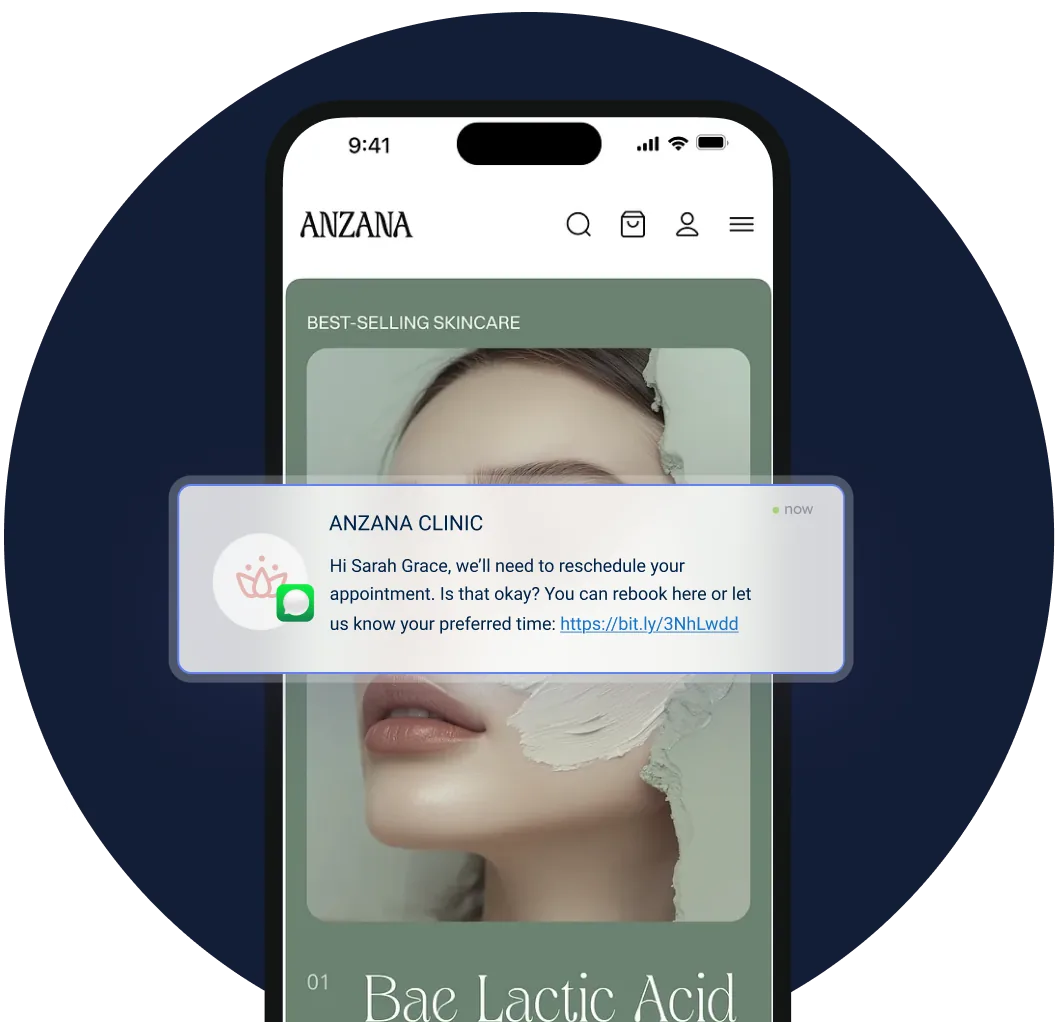
The FTC’s guidelines on review solicitation apply here. Clinics must not offer incentives (discounts, free services, gifts) in exchange for reviews. Requests should ask for honest feedback, not specifically positive feedback. This is both an ethical requirement and a platform rule: Google and Yelp both prohibit incentivized reviews.
Review volume on a single platform creates a single point of failure. Practices should distribute requests across Google, Healthgrades, and one specialty-relevant platform. Rotating the destination link in automated messages builds a balanced profile. Surveys and reputation management are closely linked: internal patient satisfaction surveys can identify happy patients before routing them to public review platforms.
Filter your review requests by appointment type. Patients who had complex consultations or clinical procedures may not be ready to leave a public review immediately. Set up separate automation sequences for aesthetic treatments (prompt sooner) and medical appointments (allow more time and consider a satisfaction survey first).
Response rate matters as much as review volume. Google’s documentation confirms that responding to reviews signals engagement to the algorithm. More practically, a practice that responds to every review, positive and negative, demonstrates to prospective patients that the team is present and accountable.
Keep positive responses short and personal. Thank the reviewer by first name when they’ve used it. Avoid copying and pasting the same template for every review; Google’s systems detect repetitive responses and reduce their weight. Reference something specific from the review: if a patient mentioned a practitioner by name, thank them for the kind words about that person. This is part of improving patient engagement more broadly; the review response is a micro-interaction that shapes how existing patients feel about the practice.
Negative review responses in healthcare carry a legal risk that doesn’t exist in other industries. HIPAA prohibits disclosing protected health information (PHI) in public responses, even in defense of a complaint. Confirming that someone is a patient, referencing treatment details, or disputing a clinical claim in a public reply all constitute potential HIPAA violations.
The framework for compliant responses is straightforward:
The HHS HIPAA Privacy Rule governs what can be disclosed. Clinics should consult with a compliance officer or legal counsel when developing their response templates, particularly for practices that see a high volume of medically sensitive cases. For further context on your obligations, see HIPAA compliance for clinic software.
Here’s a compliant template structure for negative reviews:
| Response element | Example language |
|---|---|
| Opening acknowledgement | “Thank you for taking the time to share your experience.” |
| Express concern | “We’re sorry to hear your visit didn’t meet your expectations.” |
| Invite offline resolution | “We’d welcome the opportunity to discuss this further. Please contact us directly at [phone/email].” |
| Close without confirming PHI | “Our team is committed to providing the best possible care to everyone who visits us.” |

Pabau sends post-appointment review requests automatically, so your team never has to chase patients for feedback. See how it works for your clinic.

Effective clinic reputation management starts with knowing about a review the day it appears, not weeks later. Most practices only find out about a negative review when a patient mentions it in person or a team member stumbles across it. By that point, the review has already been visible to prospective patients for days or weeks. A monitoring system closes that lag.
The minimum viable monitoring stack for a small to mid-sized clinic:
For practices managing multiple locations, manual monitoring doesn’t scale. Review management software centralizes feedback from all platforms into a single dashboard. This side of healthcare review management becomes a practical necessity, not a nice-to-have, once a practice operates across three or more sites. Spa reputation management features in clinic software typically include unified inbox functionality, automated response queues, and platform-level sentiment analysis.
Standalone reputation management tools add another subscription and another login to a clinic’s workflow. The more effective approach is integrating review generation directly into the software that already manages appointments, patient records, and follow-up communications. Integrating review generation with built-in marketing tools keeps campaigns, loyalty programs, and reviews inside one workflow.
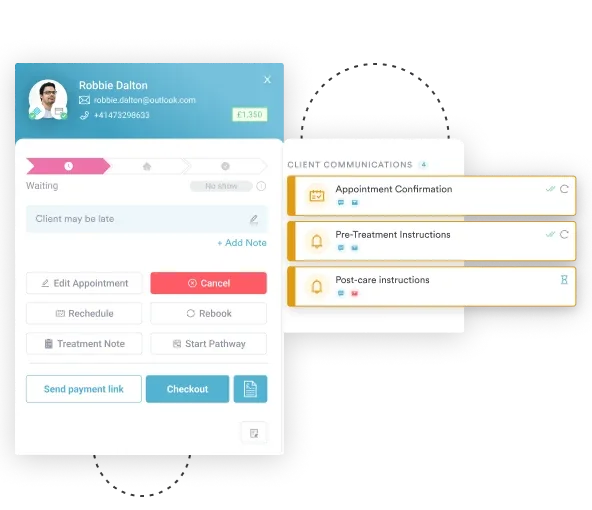
Pabau’s automated review requests connect to your appointment workflow. When an appointment is marked as completed, the system can automatically send a review request to the patient via SMS or email. The request goes out at the right time, to the right patient, with a direct link to your preferred review platform. No manual steps from your team.
Beyond review generation, Pabau’s automated follow-up workflows support the broader patient communication cycle. Pre-treatment consent forms, post-treatment care instructions, and satisfaction check-ins all feed into the same workflow engine. A patient who receives consistent, well-timed communication throughout their journey is more likely to leave a detailed, positive review because the experience itself feels organized and professional.
The connection between operational quality and online reputation is direct. As Relias notes in their reputation management guidance, reputation management is a reflection of your culture and operations, not just a marketing activity. Clinics that run tight workflows generate better reviews because the patient experience is genuinely better.
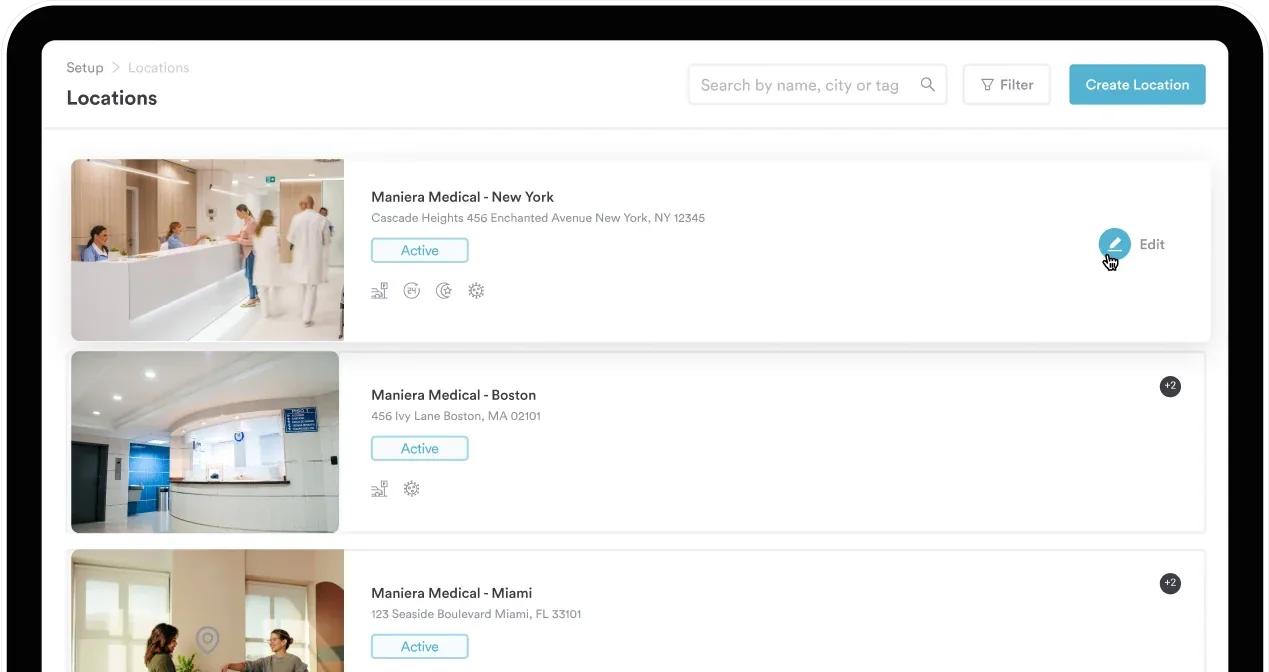
For multi-location practices, Pabau provides centralised visibility across all sites. Practice managers can see review performance by location, identify which sites are underperforming, and apply workflow changes at the location level without disrupting the whole network. This is important for group practices and franchise models where brand consistency matters as much as individual clinic performance. Exploring how to capture patient feedback systematically is the first step toward building a reproducible reputation model across locations. Online booking software puts availability in front of the patient and writes the appointment straight into the calendar.
Run a quarterly audit of your review response rate, not just your star rating. If you have a 4.6-star average but a 20% response rate, you’re leaving trust-building opportunities on the table. Set a target of responding to 100% of reviews within 48 hours and build that into your front-desk or practice manager’s weekly task list.
Each clinic location needs its own Google Business Profile. A single profile for a multi-site practice dilutes location-specific SEO and makes it harder for patients in each area to find the right clinic. More importantly, patient experiences vary by location. A cluster of negative reviews at one site should not drag down the rating of your best-performing location.
The operational challenge is maintaining consistent response quality across sites when different team members handle review responses. Three practices that scale well:
For practices using medical spa software with multi-location capabilities, the reporting layer makes it possible to benchmark review volume and rating across sites month-over-month. This turns reputation data into an operational metric, not just a marketing concern. You can identify whether a dip in ratings correlates with a specific practitioner schedule, a seasonal staffing change, or a shift in treatment mix, and address the root cause directly.
For practices specifically in the aesthetic and wellness space, this operational view matters. Spa reputation management features that integrate with scheduling data let you correlate review sentiment with specific treatment types or appointment slots, giving you data that standalone reputation tools can’t provide.
Behavioral health practices face a review problem the rest of healthcare doesn’t. Patients in therapy, psychiatry, or addiction treatment rarely leave public reviews, because posting one means publicly identifying themselves as a patient. A satisfied dermatology patient will happily write about their results. A psychotherapy patient usually won’t. That leaves mental health clinics with thin, slow-moving review profiles that don’t reflect the quality of care being delivered.
The fix is to shift weight away from public star counts and toward feedback patients can give privately. Route every long-term or discharged patient to an internal satisfaction survey first. Those results never need to be public to be useful: they surface the practitioners and moments patients value, and they give you compliant language to feature as testimonials once a patient has given written consent.
For psychotherapy clinics and psychiatry groups running these steps in practice management software like Pabau, the satisfaction survey, the consent record, and the follow-up message all sit on one patient timeline. That is what lets a behavioral health practice build a trustworthy reputation without ever pressuring a patient to identify themselves online.
Patients choose providers based on what they find online before they ever contact your clinic. Healthcare reputation management is no longer a reactive task for when something goes wrong. It’s an ongoing operational process: generating consistent reviews, monitoring platforms systematically, responding to every piece of feedback in a compliant and professional way, and using the data to improve the patient experience at its source.
Pabau’s automated review and follow-up workflows make the repetitive parts of this process run without manual intervention. From post-appointment review requests to multi-location visibility, the platform connects reputation management to the operational data that explains it. If you’re ready to build a review workflow that runs itself, growing your medical practice starts with the systems behind it. Book a demo to see how it works in your clinic’s setup.

Need the complete picture on practice reputation? Medical practice reputation management guide covers how review platforms now shape provider discovery.
Building a plan around doctor reviews? Online reputation management for doctors shows how to collect, monitor, and respond to patient feedback.
Healthcare reputation management is the ongoing process of monitoring, generating, and responding to patient reviews across Google, Healthgrades, Zocdoc, and other platforms where patients research providers. It also includes maintaining accurate directory listings and, increasingly, tracking how your practice appears in AI-generated search summaries.
Never confirm that the reviewer is a patient, reference any treatment details, or dispute clinical claims in a public response. Acknowledge the feedback, express concern, and invite the reviewer to contact the practice directly to resolve the issue. Consult your compliance officer when developing response templates for medically sensitive cases.
Google Business Profile is the most important platform for most clinic types. Healthgrades carries significant weight for medical practices. Zocdoc is widely used for appointment-driven practices in the US. RealSelf is relevant for cosmetic and aesthetic specialties. Facebook reviews and Yelp contribute secondary signals for local search.
Send automated review requests via SMS 1-3 hours after appointments complete, linking directly to your Google Business Profile review page. Automated post-appointment messaging through practice management software generates consistent review volume without requiring manual effort from your team. Never offer incentives in exchange for reviews, as this violates both FTC guidelines and Google’s review policies.
Practices with higher review volumes and more recent feedback rank higher in Google’s local results, increasing visibility before a patient even visits your website. Review content also influences conversion: patients who read specific, detailed reviews about practitioners and treatment experiences convert at higher rates than those arriving through generic search results.
It automates review requests, monitors your ratings across Google, Healthgrades, and other platforms, and pulls responses into one dashboard. Built into practice management software, review generation runs from the same system that handles appointments and records, so a request triggers automatically after each completed visit rather than depending on staff to remember.
Mental health and behavioral health patients rarely post public reviews, since a review identifies them as a patient. These practices lean on private satisfaction surveys, specialty directories like Psychology Today, and stricter HIPAA-safe public replies than the typical medical reputation management approach a dental or dermatology clinic would use.