Professional development record
A professional development record is a structured log of a healthcare practition...

8
Last Updated: Oct 8, 2026

CQC requirements apply to every provider of regulated health and social care activities in England.
The 13 fundamental standards sit in Regulations 9 to 20A, and care must never fall below them.
Registration comes before your first patient, and carrying on a regulated activity unregistered is a criminal offence.
Inspectors score you on five key questions, using the evidence you can produce on the day.
Consent records, training logs, and governance minutes are the files a private practice should keep ready.
CQC requirements are the legal standards every registered health and social care provider in England must meet, and prove. Proving it is the harder half. The standards sit in the Health and Social Care Act 2008, and there are 13 of them.
An inspector will not take your word for it, so your consent forms, training records, and governance minutes carry the argument. Keep those current and inspection becomes a formality rather than a scramble.
This guide covers registration, the 13 standards, the five key questions, ratings, enforcement, and what to have ready in 2026.
CQC requirements are the obligations that every provider of regulated health and social care activities in England has to meet.
They come from the Health and Social Care Act 2008 and the Health and Social Care Act 2008 (Regulated Activities) Regulations 2014. Those regulations set out 13 fundamental standards.
These are not aspirational targets. The 13 standards are the floor below which care must never fall. Breach one and the CQC has grounds for enforcement, up to cancelling your registration.
Two structures run alongside each other, and they are easy to confuse. The 13 fundamental standards are the law. The five key questions, covering safe, effective, caring, responsive, and well-led, are how inspectors judge you against it.
Any organization or individual carrying on a regulated activity in England must register with the CQC first.
Regulated activities include treatment of disease, disorder or injury, diagnostic and screening procedures, and surgical procedures. Schedule 1 of the 2014 Regulations holds the full list.
Registered providers include NHS trusts, independent hospitals, GP practices, care homes, dental practices, ambulance services, and private practices offering regulated treatments.
The route to getting CQC registered runs through an application, a statement of purpose, a nominated individual declaration, and your policies.
Most registered providers also need a registered manager in post. That is the named person who runs the regulated activity day to day, and who must pass the fit and proper persons test.
One exemption exists. An individual sole provider who personally manages the service day to day does not need a separate registered manager. That comes from regulation 5 of the CQC (Registration) Regulations 2009.
The pathway is the same whatever the clinical setting. A physical therapy practice and a cosmetic surgery clinic complete the same application. Only the regulated activity you name changes.
Applications stall on detail rather than on principle. Check these before you send it:
Keep the statement of purpose and the policies in step. If one names an activity the other ignores, expect follow-up questions and a slower decision.
The CQC fundamental standards are defined in Regulations 9 through 20A of the Regulated Activities Regulations 2014. Every registered provider must meet all 13. Here is what each one requires in practice.
Three of those standards carry the most weight in a private practice, and each one has a document behind it:
Every service is assessed against five key questions. Is it safe, effective, caring, responsive, and well-led? The standards are the law, and these questions are the lens.
Under each key question sits a set of quality statements. They are written as “we statements” that describe what good care looks like, and each one points back to the regulations behind it. So a judgment about being well-led traces to Regulation 17, not to an inspector’s mood.
The CQC then gathers evidence in six categories: people’s experience of care, feedback from staff and leaders, feedback from partners, observation, processes, and outcomes.
Which categories carry the most weight varies by the type of service. For a small private practice, patient feedback and your own processes usually do the heavy lifting.
A weak score in safe or well-led weighs heavily on the overall rating. Those two questions cover risk and leadership, so a problem there tends to show up in the other three as well.
Published guidance leans heavily on care homes and NHS trusts, which leaves independent providers reading around their own situation. Private practices carry the same legal obligations. The regulated activity changes, the regulations do not.
Three questions come up more than any others.
If you carry on an activity listed in Schedule 1, yes. Surgical procedures, treatment of disease, disorder or injury, and diagnostic or screening procedures all sit on that list. Cosmetic surgery, private GP services, and prescription-only treatments given under a registered prescriber generally fall inside it.
Sometimes. Treatments outside the regulated activities list, delivered without prescription medicines, may not need registration. One prescribing consultation on site can change that answer, so check the list rather than assume the exemption.
Not directly. It assesses whether you have systems that keep staff trained, supervised, and competent for the treatments they deliver. Governance documentation is where independent providers most often lose marks, because the work happened and the record did not.
Check Schedule 1 of the Regulated Activities Regulations 2014 before you assume your practice does or doesn’t need to register. It lists every regulated activity. Registration depends on what you do, not on what you call the service.
There is no fixed CQC list of mandatory training subjects. Regulation 18 requires staff with the right skills, qualifications, competence, and experience for the care they deliver. What that means in practice depends on your service type and the roles in it.
Skills for Care’s statutory and mandatory training guidance is the reference point most care providers work from. Inspectors expect to see training in the areas it covers, even though it is guidance rather than a statutory list. The subjects that come up most often are:
Records decide this section. Training that happened but was never logged is not evidence, however good the session was. Keep signed records, certificates, and renewal dates together, and give one person the job of chasing what expires next quarter.
Inspections are announced or unannounced. Routine assessments usually come with notice, while a visit prompted by a concern or a complaint may not. The team can include specialist clinical advisors and inspectors with a background in your type of service.
On the day, the team observes care, talks to staff and patients, and reads records. Expect them to ask for a specific document and then follow the thread through it.
A consent form leads to the treatment note, and the treatment note leads to the training file of whoever delivered the treatment.
Inspection is only one part of the Care Quality Commission’s role. It also monitors providers between visits, using the notifications you send, feedback it receives, and the information you submit.
Afterwards you get a draft report to check for factual accuracy. You can challenge facts, not judgments, so keep your correction letter narrow and evidenced.
Once published, the rating goes on the CQC website and must be displayed at your practice and on your own site.
Each of the five key questions gets its own rating, and so does the service overall. There are four to choose from.
Most compliant providers running steady systems land on Good. Outstanding asks for something extra, and the evidence for it has to exist before the inspector arrives.
The CQC’s powers run from a written warning to criminal prosecution. In rough order of severity, they are a warning notice, a fixed penalty notice, conditions on registration, suspension, then cancellation.
Which one it uses depends on the risk to people, and on whether earlier action worked.
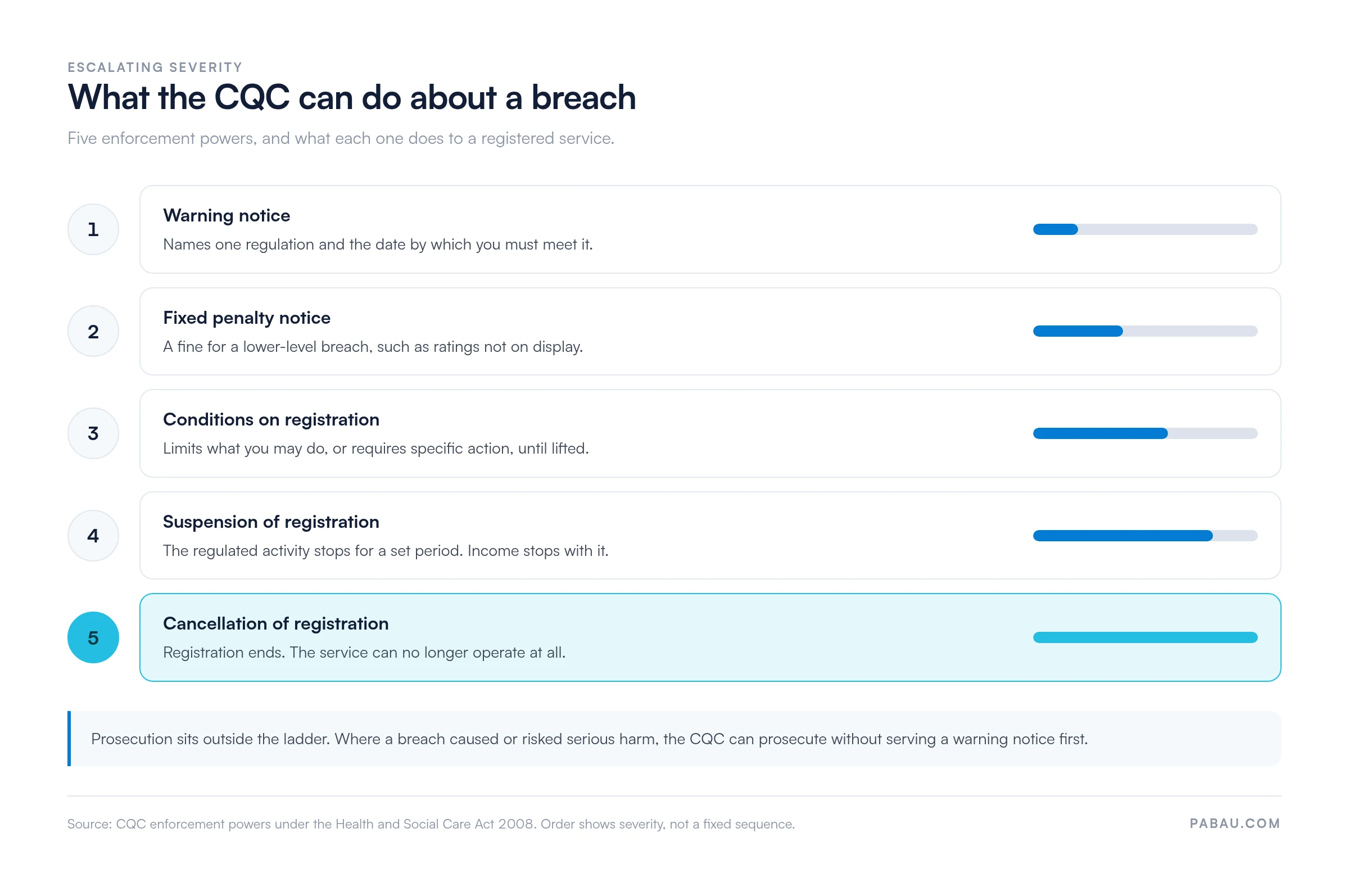
Providers placed in special measures get closer monitoring and a fixed period to improve. Miss that window and cancellation usually follows. Enforcement decisions are published too, so they follow the practice’s name around for years.
Preparation is not a sprint before the inspector arrives. It is a set of habits that leave a trail behind them. Work through this list once a quarter instead of once a year.
All three are record-keeping problems rather than care problems. They are also the cheapest findings to prevent.
Ask a private practice for last April’s consent form and the answer is usually “give me an afternoon”. The record exists. It is split across a filing cabinet, a shared drive, and a practitioner’s phone, which is what makes inspections feel like an event.
Practice management software like Pabau keeps that evidence attached to the patient instead. Our compliance management software captures consent digitally, timestamps it, and files it against the patient record alongside the treatment note and the before-and-after photos. Custom forms cover the rest of the paper trail, from medical questionnaires to incident logs.
The benefit is narrow and useful. When an inspector asks for a document, you search for a patient rather than a cabinet. The record itself shows whether the form was ever signed. Data protection duties overlap heavily with this, and the UK GDPR compliance checklist covers the same records from the other direction.
No system makes a practice compliant, and none can promise you a rating. What changes is how long it takes to prove what you already do well.

Pabau files digital consent, treatment notes, and photos against the patient record, each one timestamped. The evidence an inspector asks for takes seconds to find.

CQC requirements reward habit over heroics. Document consent the same way every time. Log training the week it happens. Write down what changed after an incident. Do those three and you will pass inspections you never really prepared for.
So pick the weakest of those three and fix it this month. Registration duties and the 13 standards are fixed, and you cannot negotiate them. How quickly you can prove them is the part you control.
Book a demo to see how Pabau keeps consent, treatment notes, and patient records inspection-ready for private practices in England.

Ready to start your application? How to get CQC registered walks through the form, the statement of purpose, and the registered manager requirements for independent providers.
New to the regulator? The Care Quality Commission’s role explains what the CQC does between inspections, and how it monitors registered providers.
Need a consent form to audit against? Consent for medical treatment template gives you the fields a Regulation 11 record should carry, ready to adapt.
Want to test your own records first? How to run a medical chart audit sets out a sampling method you can use before an inspector picks the files.
Handling patient data as well as care quality? UK GDPR compliance checklist covers retention, access requests, and the records that both regimes expect you to keep.
The nominated individual represents an organization to the CQC and supervises how the regulated activity is carried on. The registered manager runs the service day to day and is registered in their own right. An organization needs both roles filled. An individual sole provider who personally manages the service does not have to appoint a separate manager.
Certain events, in writing, without waiting for an inspection. The CQC (Registration) Regulations 2009 set the list. It covers deaths, serious injuries, allegations of abuse, police involvement, and events that stop the service running safely. Failing to notify is itself a breach, so make one named person responsible for sending them.
No. Registration belongs to the provider, not to the business. The buyer registers, or applies to add the location to an existing registration, while the seller applies to remove it. Plan the overlap early, because the new provider cannot carry on the regulated activity until its own registration is in place.
The standards are the law, and quality statements describe what good practice looks like under each key question. Each statement points back to the regulations behind it. Evidence is gathered in six categories, weighted differently by service type, so patient feedback, staff feedback, and your own processes all count.