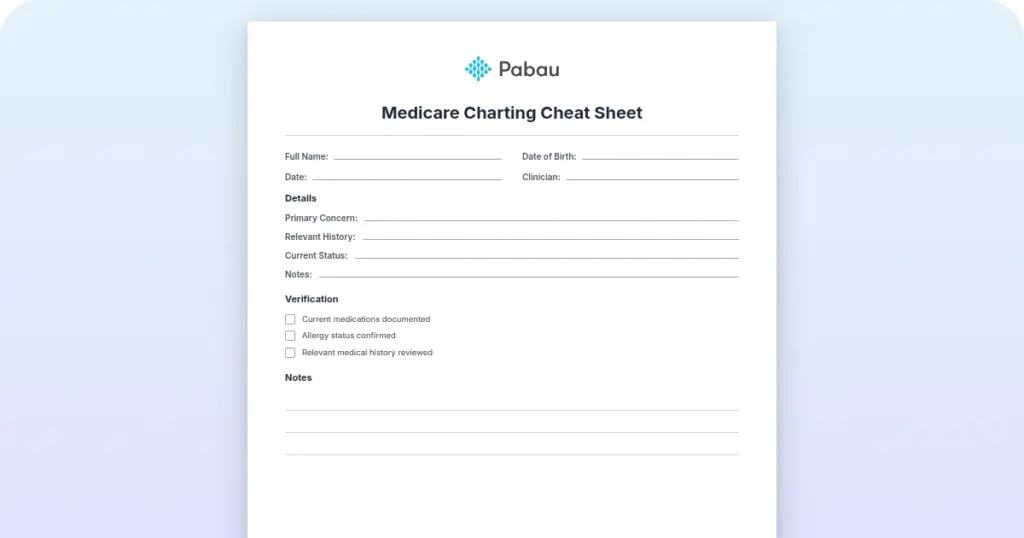
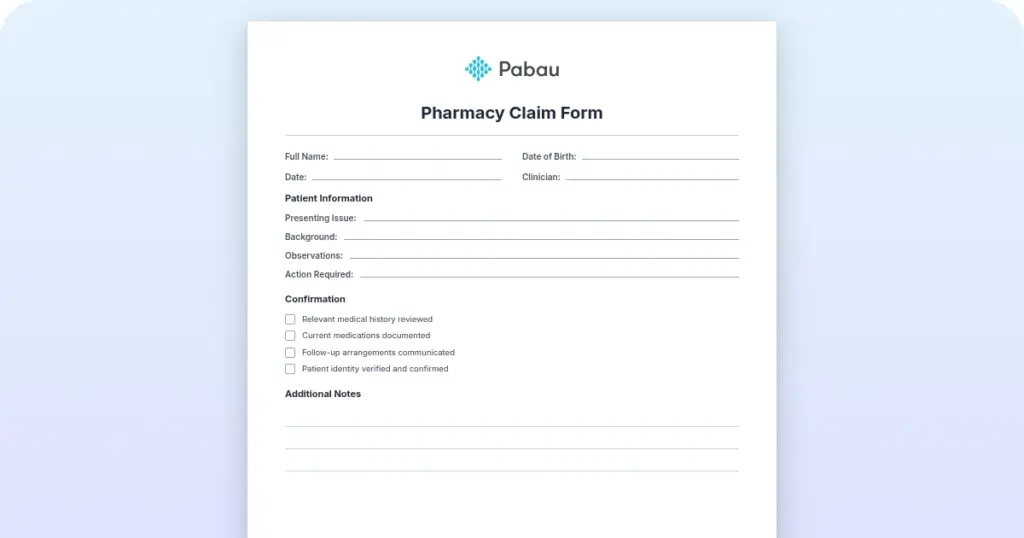
Medicare charting cheat sheet
A Medicare charting cheat sheet is a one-page reference that lists what Medicare...

10
Last Updated: Oct 21, 2026
Healthcare policy management software helps a healthcare organization write, approve, distribute and version its policies, then prove which staff have read them. For an independent practice, the choice is usually between a dedicated policy platform and the compliance tools already inside its practice management system.
Dedicated platforms such as PowerDMS and HealthStream Policy Manager win when accreditation surveys or multi-site governance demand formal policy lifecycle evidence. When consent, clinical records and staff protocols drive most of your compliance work, one system usually serves you better. Pabau, the all-in-one practice management platform we build, covers that ground in a single subscription.
If your practice is a HIPAA covered entity, 45 CFR Part 164 requires written policies and procedures that the relevant staff can access. That rule sends many practices shopping for this software, and either approach can meet it.

Healthcare policy management software covers policy authoring, version control, staff acknowledgment tracking and audit-ready reporting.
Dedicated platforms such as PowerDMS, HealthStream Policy Manager and ComplyAssistant are built for health systems with complex multi-site governance needs.
Pabau embeds consent, audit logging and protocol storage in clinical workflows, which suits practices that want one system and have no compliance department.
Total cost of ownership favors Pabau for practices that already need scheduling, billing and documentation tools, because dedicated policy software adds a second subscription.
Healthcare policy management software is a system that centralizes how clinical and operational policies are created, approved, distributed and tracked over their lifecycle. It handles the governance records that regulators, accreditation bodies and risk managers ask about.
Those records answer four questions. Who wrote the policy? When was it last reviewed? Which staff have read and signed it? What did earlier versions say?
The category splits into two segments. Dedicated platforms are purpose-built for policy governance, and their feature set runs deep:
Practice management platforms take the opposite approach. They place policy-adjacent tools inside the clinical workflow, including consent form management, staff protocol storage, audit logging and documentation standards. Staff meet these tools during daily operations, so there is no separate compliance product to log into.
Both approaches can satisfy HIPAA’s written-policy requirement. The deciding factor is which one fits how your practice runs, without adding cost or a second system you don’t need.
A consistent framework makes the comparison fairer. These are the features that matter most for practice-level policy governance, drawn from the criteria accreditation reviewers and compliance officers use to judge readiness.
Policy and procedure management covers how your practice creates, stores and updates clinical and operational documents. The minimum is a central repository with version history. Stronger tools add approval workflows, mandatory review cycles and the ability to roll back to an earlier version.
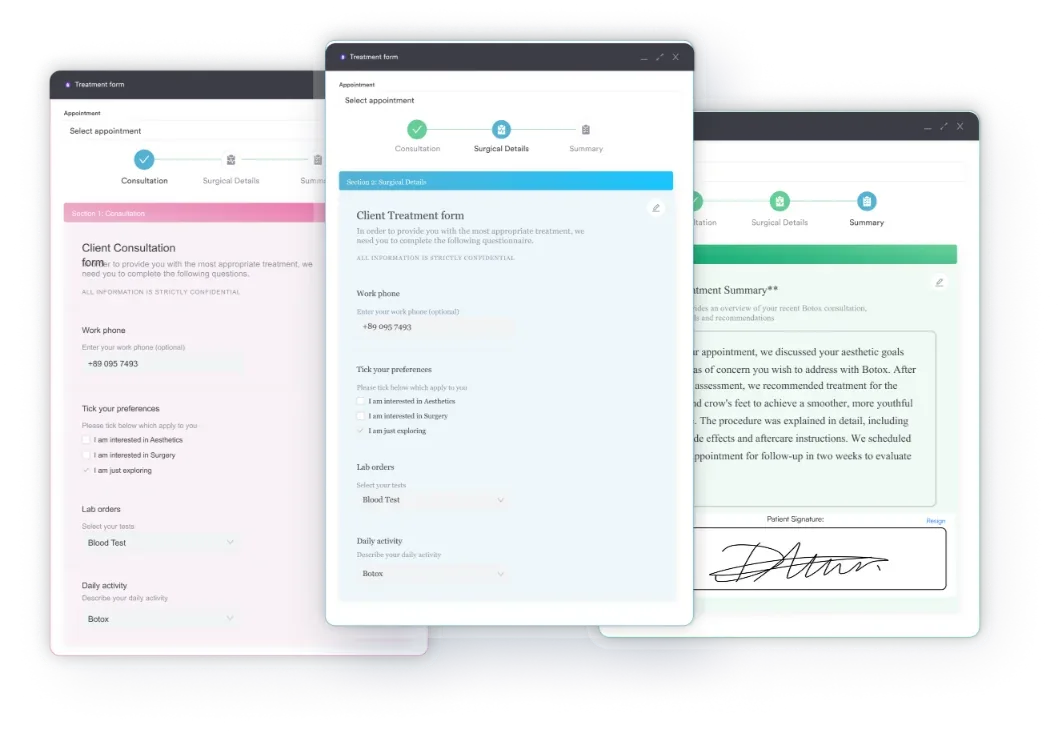
In Pabau, digital consent forms and clinical templates are built inside the forms library. Previous versions of a form can be restored as a new copy, which covers the document control most practices need. Pabau is less suited to formal policy authoring with structured approval chains and regulatory content libraries.
PowerDMS and HealthStream Policy Manager provide structured authoring environments, full revision history, periodic review reminders and rollback. For a health system managing hundreds of policies across departments, that depth earns its cost.
Staff acknowledgment tracking answers a standard auditor question. Which staff members have read and signed the current version of each policy, and when? Dedicated policy platforms treat this as a core feature, while practice management systems treat it as a secondary one.
Pabau’s staff management workflows store onboarding documents and staff protocols alongside each team member’s record. You won’t get per-policy dashboards showing which staff are outstanding. Staff records do sit in the same platform as the clinical record, though.
ComplyAssistant builds acknowledgment into its compliance workflow. When a new policy version is published, staff get reminders, sign digitally and show up on dashboards by department and role. Multi-site health systems facing Joint Commission surveys need that level of reporting.
HIPAA also expects workforce training to be documented, which our guide to HIPAA training for employees walks through.
Audit readiness means your documents can answer a regulator on demand. Who accessed which record? When was a policy last reviewed? Can you show two years of acknowledgment history?
Pabau keeps an audit trail on patient records, form submissions and clinical notes. That record usually covers clinical audits, such as US state board reviews or CQC inspections in England. Accreditation surveys from the Joint Commission or NCQA also look for policy lifecycle documents, which Pabau doesn’t produce as formal reports.
Dedicated platforms produce policy-by-policy acknowledgment rates, overdue review flags and exportable audit packages for specific submissions. For organizations in an active accreditation cycle, those reports save weeks of manual preparation.
A med spa is subject to HIPAA only if it qualifies as a covered entity, for example because it bills health plans electronically. Once it does, the HIPAA rules apply whether its services are aesthetic or clinical. Platforms differ in how they help you meet that obligation.
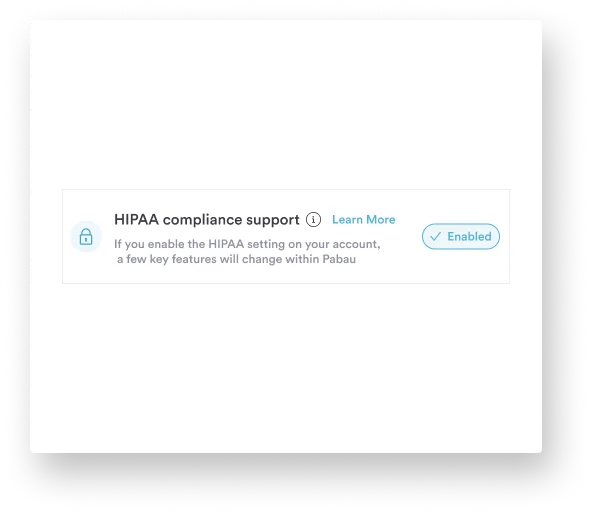
Pabau builds HIPAA-relevant safeguards into the platform, including encrypted data storage, access-controlled patient records, consent capture and audit logging. You write your own HIPAA policies, and Pabau helps your team follow them day to day. A HIPAA compliance policy template gives you a starting draft to adapt.
ComplyAssistant is built around HIPAA compliance frameworks. It offers HIPAA policy templates, risk assessment tools, breach notification workflows and staff training aligned to specific rule requirements.
Under HHS guidance on the HIPAA Security Rule, covered entities must implement written policies and procedures. Dedicated compliance tools hand you those policies ready-made. Pabau gives you the operational setup to follow them.
Run a quarterly document review even if your software doesn’t prompt you. List every clinical protocol, consent form and staff policy, then flag anything nobody has reviewed in 12 months. In Pabau, start from the forms library.
The table below compares Pabau with dedicated healthcare policy management software on the core buying criteria. The dedicated column reflects the combined capability of PowerDMS, HealthStream Policy Manager and ComplyAssistant.
Dedicated healthcare policy management software is sold as a standalone subscription. You pay for it on top of the clinical system your practice already uses. For a 10-practitioner practice, that means two vendors, two subscription fees and two systems to maintain.
Pabau’s pricing bundles compliance features into the practice management subscription. Every plan includes consent form management, digital documentation, audit logging and staff management tools. There is no compliance add-on license and no second platform to integrate.
| Plan / Tier | Price | Details |
|---|---|---|
| Starter | From $65/month | Per practitioner; billed monthly |
| Team / Group | Scales by location and user count | Volume-based pricing |
| Enterprise | Custom pricing | Contact sales for a quote |
PowerDMS, HealthStream Policy Manager and ComplyAssistant publish no pricing on their websites and quote on request. Whatever the quote, it sits on top of your clinical, scheduling and billing software.
For a practice already paying for practice management software, the cost calculation is simple. Dedicated policy software adds a second subscription, while Pabau covers consent, audit logging and protocol storage in one subscription.
Implementation is where the two approaches diverge most for smaller practices. A dedicated policy platform means migrating your policy library, configuring approval workflows, assigning acknowledgments and training your team on a second interface.
A 50-bed hospital with a compliance department and an IT team can absorb that project. For a 6-practitioner aesthetic practice without IT support, it can delay go-live by weeks.
Pabau is designed for clinical teams without compliance departments or IT staff. Onboarding is structured in stages. The onboarding team migrates your existing data first, then Customer Success configures forms, communications and booking rules around your workflows.
A dedicated Client Coordinator and the Pabau Portal, our onboarding guide, support your team through each stage. Consent, audit logging and protocol storage are part of the core product, with no separate compliance module to configure.
Integration cost is easy to overlook when comparing healthcare policy management software. Dedicated policy platforms sit alongside your clinical system, so linking acknowledgments to staff records and clinical workflows needs an integration. That integration becomes a maintenance job of its own.
When a staff member acknowledges a policy update in a dedicated platform, the record stays in that platform’s database. Your scheduling and billing system knows nothing about it. Compliance evidence and clinical records stay apart unless you build and maintain a connection between them.
Pabau’s automated clinical workflows run inside one platform, so there is no connection to build. A consent form completed during booking flows straight into the patient record. Staff protocols sit in the same system as the appointments and notes they govern.
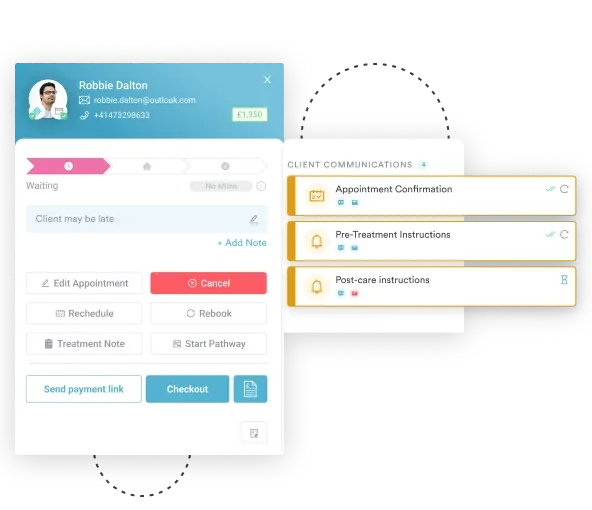
This matters most during an audit. A CQC inspector or a HIPAA auditor may ask for the full record of a patient interaction. Pabau shows the notes, consent forms, treatment records and practitioner attribution in one place. With two systems, you pull evidence from both and reconcile it by hand.
Before evaluating any healthcare policy management software, map your audit risk. List the three events most likely to trigger a review, such as a patient complaint, a data access request or an accreditation visit. Then check whether the software can produce the evidence for each in under 10 minutes.
Independent practices and enterprise health systems rarely shop for the same product, because their audiences barely overlap. The question below sorts most organizations into one segment or the other.
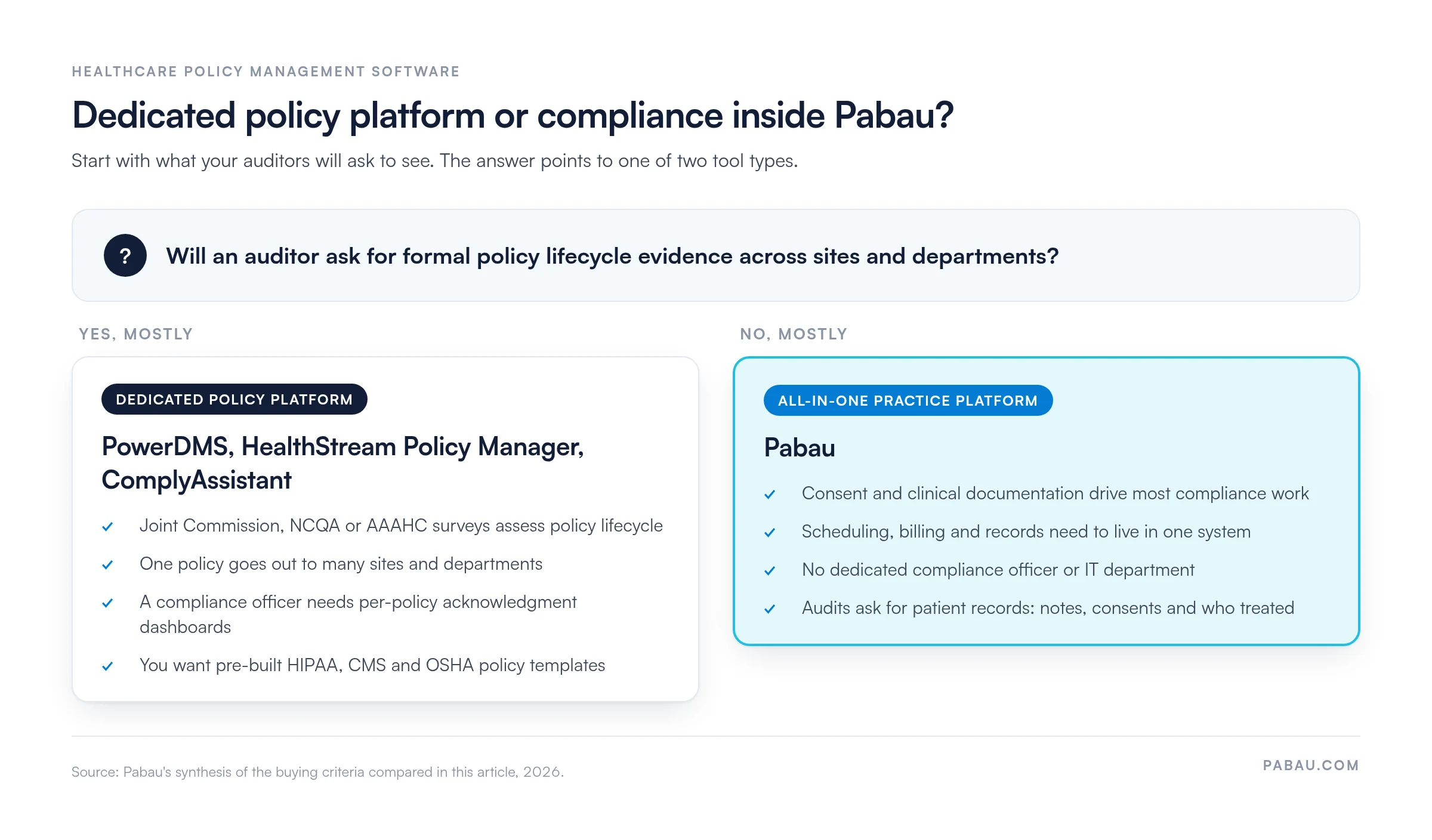
Pabau fits practices that want compliance embedded in daily work rather than run as a separate governance function. As a rule of thumb, these practice profiles are the strongest fit:
Any HIPAA compliance software you choose has to support your obligations in daily operations. Pabau does that through consent management, audit logging and documentation workflows.
Dedicated healthcare policy management software earns its extra cost when governance needs go beyond what a practice platform’s built-in compliance tools handle. That usually means one of these organizations:
If that describes you, PowerDMS, HealthStream Policy Manager or ComplyAssistant offer much more depth in formal policy governance. The Joint Commission’s accreditation standards expect current, reviewed and accessible policies, and these platforms are built to evidence exactly that. They solve a specialized governance problem and don’t replace practice management software.
Most independent practices keep policies in shared folders, consent on paper or in a separate forms tool, and staff sign-offs in email threads. When an auditor asks for evidence, someone pieces it together from all three.
Pabau’s compliance management software keeps that evidence in the platform your team already uses for appointments and notes. It covers consent form creation and capture, pre- and post-care document delivery, staff protocol storage and audit trails on patient records.
Because the consent form sits on the treatment record it belongs to, you can answer an auditor from one screen. There is no integration to maintain, and your compliance evidence lives with your clinical records.

Book a walkthrough to see how Pabau handles consent forms, audit trails, staff protocols and documentation workflows inside one connected platform.

Start by listing what your auditors ask to see. If the requests are about patient records, consent and who treated whom, a second policy platform adds cost without adding evidence.
If accreditation surveys or multi-site governance demand policy lifecycle reports, budget for a dedicated platform and accept the integration work it brings. Plan that move before a survey date forces it.
For most independent practices, keeping compliance inside the clinical workflow means fewer systems, fewer reconciliations and a faster answer when an inspector calls. Book a demo to see how Pabau keeps your consent, audit and protocol records audit-ready in one place.

Need to understand HIPAA obligations for your practice? HIPAA compliance for medical offices covers the key requirements every practice manager should know.
Writing your own HIPAA policies? HIPAA compliance policy template gives you a structured draft to adapt to your practice.
Need a privacy policy patients can read? HIPAA privacy policy template sets out how your practice uses and protects patient information.
Planning staff compliance training? HIPAA training for employees explains what to cover and how to document it.
Wondering what a compliance failure costs? HIPAA violation penalties breaks down the penalty tiers and how they are applied.
Healthcare policy management software is a system that centralizes how clinical and operational policies are created, distributed, version-controlled and acknowledged by staff. It shows that policies meet regulatory requirements, that staff have read them and that the records are audit-ready. Dedicated platforms focus only on this governance job. All-in-one platforms like Pabau embed policy-adjacent compliance tools within the wider practice workflow.
HIPAA requires covered entities to maintain written policies and procedures under 45 CFR Part 164. Dedicated policy software helps with pre-built HIPAA policy templates, staff acknowledgment tracking and audit-ready reports. Pabau supports HIPAA in daily operations through consent management, encrypted data handling and audit logging. With Pabau, practices write their own HIPAA policies rather than using a built-in library.
Pabau is an all-in-one practice management platform that embeds compliance features in clinical workflows. Dedicated policy management tools are standalone systems built only for policy governance, with deeper authoring, version control and per-staff acknowledgment tracking. As a rule of thumb, Pabau suits practices that want one system and have no compliance department. Dedicated tools suit larger health systems with multi-site governance needs and dedicated compliance staff.
For most small practices, a dedicated healthcare policy management platform adds cost and complexity without a matching benefit. A practice management platform with consent management, audit logging and document storage usually covers a small practice’s compliance needs. Practices approaching accreditation surveys or operating across many sites may find a dedicated tool worthwhile. Most small practices don’t need that level of governance infrastructure.